
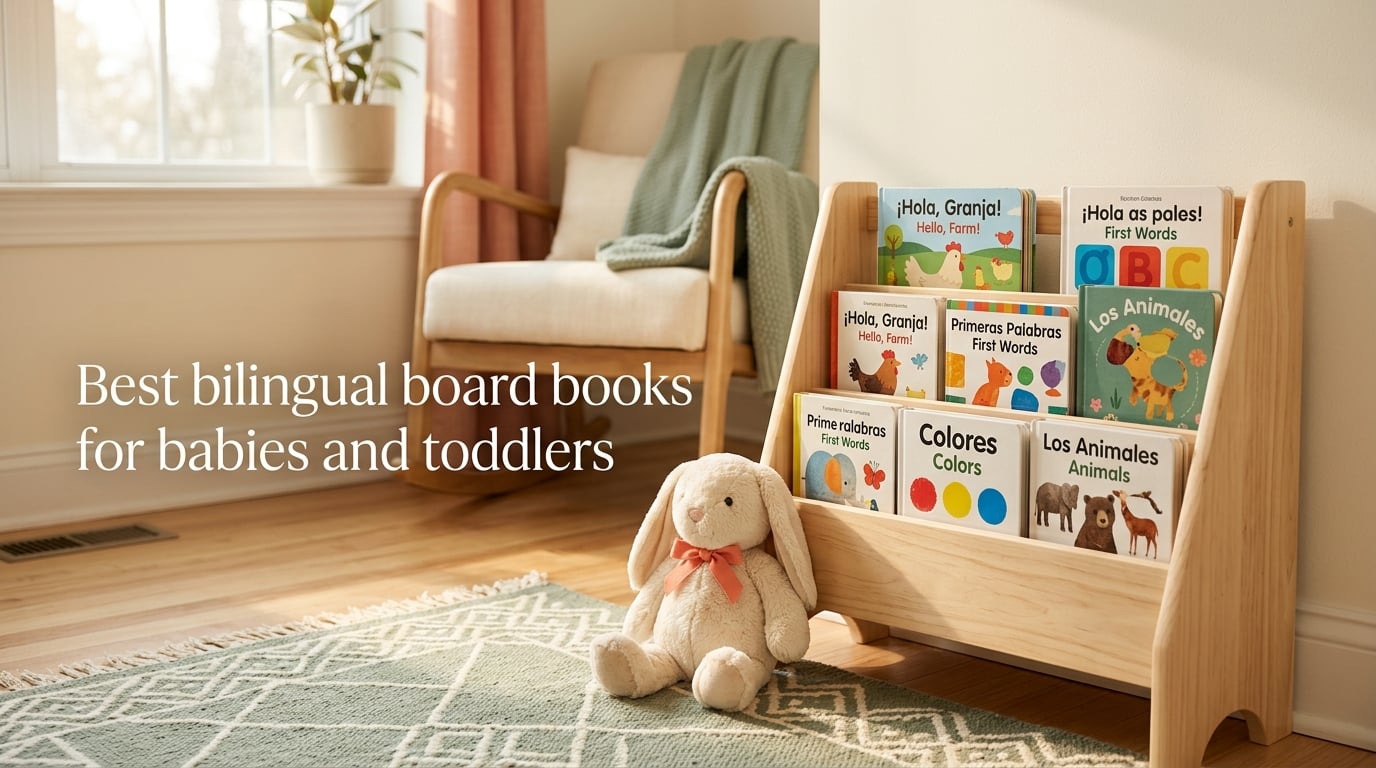
A bilingual board book is a sturdy, baby-safe book printed in two languages (most often English and Spanish) so a parent can read to a child in either or both languages, supporting early exposure to a second language through everyday reading aloud. After my daughter was born, I went down a long rabbit hole looking for the best bilingual board books for babies and toddlers, talking to bilingual parenting communities on Reddit and leaning on recommendations from librarians and early-childhood educators.
This guide pulls together what I learned. It covers why bilingual books matter for early development, what to look for in a quality board book, age-segmented picks from birth through age three, reading tips that actually work, and answers to the questions parents ask most. If you are raising a bilingual baby, supporting a heritage language at home, shopping for a baby shower, or building a dual-language library for a classroom, you will find something useful here.
Table of Contents
Why bilingual board books matter for early development
Reading aloud in two languages from infancy builds vocabulary, strengthens the caregiver-child bond, and supports cognitive skills that last a lifetime. Research on bilingual language exposure consistently shows benefits in working memory, attention control, and problem-solving, without delaying speech milestones in either language.
A widely cited body of work, summarized by researchers at the University of Washington and reviewed across the National Institutes of Health literature, finds that bilingual children do not confuse their two languages. Instead, they learn to switch between them, a skill that strengthens executive function. Parents in the r/multilingualparenting community report noticing it firsthand: their babies recognize rhymes in both languages by 12 months and begin pointing to objects while naming them in either tongue shortly after.
For heritage-speaker households, bilingual books do something extra: they make the home language visible on the page. A child who hears Spanish at home but rarely sees it in print learns that their family’s language belongs in books, on library shelves, and in school. Books celebrating Latino culture, including titles featuring Selena, El Chavo, Celia Cruz, and other beloved figures, give bilingual children mirrors of themselves that English-only shelves rarely provide.
Beyond language, the read-aloud ritual itself matters. Sitting together with a board book, pointing at pictures, repeating favorite lines, these moments build attachment and early literacy at the same time. A bilingual board book simply lets that ritual happen in two languages instead of one.
How to choose a quality bilingual board book
A great bilingual board book is more than two translations glued together. The best titles feel intentional, where the languages work together, not against each other. Here is what to look for when you are choosing books for a baby or toddler.
Build quality and baby safety. Pages should be thick and rounded at the corners so a teething baby can mouth them without harm. Look for non-toxic inks, padded covers, and reinforced spines. For newborns through about 18 months, the Indestructibles format, which is a thin, wipeable, rip-resistant book, is the safest bet. Traditional board books work well from about 6 months onward, when babies can sit up and turn pages.
Language balance and translation quality. There are two common formats. Some books place English on one page and Spanish on the facing page, which lets a parent switch languages naturally. Others alternate languages page by page. Both work. What matters more is the quality of the Spanish itself. A common frustration voiced by heritage speakers on Reddit is that many “bilingual” books feel like English classics awkwardly translated into Spanish, where the rhythm and idioms feel off.
Authenticity of origin. This is where publisher reputation matters. Canticos, Lil’ Libros, and Barefoot Books publish titles rooted in Spanish-language tradition or written by Latino authors. Titles from major educational publishers such as DK or Kaplan Early Learning often translate English classics, which can be a perfectly fine choice for English-speaking families learning Spanish, but less ideal for heritage households looking for books that feel like home.
Age-appropriate design. Newborns see best at high contrast, so bold black-and-white patterns and simple shapes work well in the first months. From 6 to 12 months, babies love faces, peek-a-boo, and repetition. Toddlers engage with lift-the-flap surprises, puppet books, and stories that name emotions, colors, and family members.
Format options to know. A traditional board book is the workhorse of any baby library. Indestructibles are rip-proof and washable, ideal for car seats and strollers. Lift-the-flap books add surprise and motor-skill practice. Puppet books and touch-and-feel titles add sensory engagement. Mixing formats keeps a young child’s attention better than stocking up on a single style.
Best bilingual board books for babies 0 to 12 months
For the youngest readers, the goal is simple: bold visuals, simple words, repetition, and pages that can take a beating. These titles are favorites among bilingual parents, speech-language pathologists, and early-childhood educators.
Indestructibles: Spanish and English editions
Workman’s Indestructibles series is the most baby-proof format on the market. The pages are soft, paper-thin, and rip-proof, and you can wipe them clean. Spanish-English editions cover nursery rhymes, baby animals, foods, and everyday words. They are ideal for car seats, diaper bags, and the chewing stage.
Canticos Little Chickies / Los Pollitos
Canticos publishes bilingual board books based on classic nursery rhymes from the Spanish-speaking world. Little Chickies, Little Mice, and the rest of the series pair singable Spanish verses with English translations and rich, color-saturated illustrations. Parents often buy one Canticos title at a time and end up collecting the whole set.
Lil’ Libros board books
Lil’ Libros titles introduce cultural icons and concepts in Spanish-English pairs. From Frida Kahlo to Loteria to ABCs of Latin America, each book is small enough for tiny hands, with simple text on each page and illustrations that celebrate Latino heritage. They are gift-shop staples for baby showers and first birthdays.
High-contrast bilingual titles
Babies in the first three months see best at high contrast. A handful of bilingual board books, often labeled “high-contrast” or “newborn,” pair bold black-and-white patterns with a single word in English and Spanish on each spread. These are gentle on tired eyes and build early visual tracking.
Peek-a-boo and lift-the-flap baby picks
By 8 to 12 months, babies love surprises. Spanish-English peek-a-boo board books and lift-the-flap titles turn reading into a guessing game. Look for sturdy flaps that survive grabbing, simple vocabulary, and animal or family themes that match what your baby sees every day.
Best bilingual board books for toddlers 1 to 3 years
Toddlers are ready for longer stories, more vocabulary, and interactive elements. They also begin to point, name, and repeat, which makes this the sweet spot for language growth. These picks cover bedtime, classics, counting, and cultural representation.
Bedtime-themed bilingual picks
A bilingual bedtime book anchors a soothing nighttime routine. Goodnight Moon translated into Spanish (Buenas Noches, Luna) is a familiar favorite, but families also love original Spanish bedtime stories that introduce lullaby rhymes and family warmth. Look for soft illustrations, repeating refrains, and quiet pacing.
Classics translated to Spanish
The Very Hungry Caterpillar / La Oruga Muy Hambrienta, Brown Bear, Brown Bear / Oso Pardo, Oso Pardo, and similar Eric Carle classics all have Spanish-English board book editions. These are reliable, giftable, and useful for parents learning Spanish alongside their child.
Canticos and Lil’ Libros for toddlers
As toddlers grow, both Canticos and Lil’ Libros expand into richer narratives, longer vocabulary, and culture-forward titles. Canticos Loteria and Lil’ Libros Juanita y sus Amigos are toddler favorites that pair everyday play with bilingual labels.
Hispanic heritage and Latino culture titles
Toddlers benefit from seeing their culture reflected on the page. Titles featuring Selena, Celia Cruz, Frida Kahlo, and other beloved figures introduce pride, music, and history alongside language. Bilingual books by Latino authors and illustrators, such as Yuyi Morales, Juana Martinez-Neal, and Matt de la Peña, belong on every bilingual shelf.
Lift-the-flap and interactive toddler books
Lift-the-flap bilingual books about feelings, animals, opposites, and counting keep toddler hands busy while their ears absorb new words. Look for thick flaps, strong picture-text match, and themes your toddler already loves (trucks, food, baby animals, family).
First words, counting, and alphabet
Bilingual alphabet, counting, and first-word books are practical buys for toddler libraries. They double as conversation starters: parents can name each picture in both languages, point, and repeat. Choose titles with clear illustrations and one concept per page.
Beyond Spanish: French, Mandarin, Arabic, and more
Spanish-English titles dominate the bilingual market, but excellent board books exist for French, Mandarin, Arabic, and Haitian Creole households. If you are raising a multilingual child or learning a non-Spanish second language, look for publishers like Barefoot Books, Star Bright Books, and Blue Dot Kids Press, which publish in several language pairs.
How to read bilingual board books with your baby
Picking the right book is only half the job. How you read it matters even more. These seven tips come from speech-language pathologists, bilingual parenting educators, and parents who have done it themselves.
- Start early. You can begin reading aloud from birth, or even during the last trimester of pregnancy. Babies recognize familiar voices and rhythms before they understand words.
- Slow down and point. Pause on each picture and name what you see in both languages. Pointing builds vocabulary and attention at the same time.
- Pick one language per session or alternate days. Both approaches work. Some families read in Spanish at bathtime and English at bedtime. Others switch daily. Choose what feels natural to you.
- Repeat favorite books. Repetition is how babies learn. Reading the same three books 50 times each is more valuable than reading 50 different books once.
- Don’t worry about mixing languages. Research shows code-switching between two languages does not confuse babies. It teaches them that one concept can carry two names.
- Build a routine. Same chair, same time, same books. Predictable reading rituals help children associate books with safety and attention.
- Follow your child’s cues. If your baby looks away or fusses, pause. If they grab the book or vocalize, lean in. Reading is a conversation, not a lecture.
If you are a parent learning Spanish yourself, give yourself permission to mispronounce words. Your baby learns language from hearing it, not from perfection. Reading aloud in imperfect Spanish still counts, and counts a lot.
Frequently Asked Questions
What are the best books for bilingual babies?
The best bilingual board books for babies combine sturdy, baby-safe construction with high-quality Spanish-English text. Top picks for the first year include Workman’s Indestructibles series in Spanish-English, Canticos nursery-rhyme titles such as Little Chickies, and Lil’ Libros cultural board books. Look for bold visuals, repetition, and translations that feel natural in both languages.
Does being bilingual affect language development?
Research consistently shows that bilingual exposure from infancy supports stronger working memory, attention control, and problem-solving without delaying speech milestones in either language. Bilingual children learn to switch between their two languages, a skill that strengthens executive function. Bilingual books are an effective way to deliver that early exposure during everyday read-aloud routines.
When should I start reading bilingual books to my baby?
You can start from birth, or even during the last trimester of pregnancy. Newborns recognize familiar voices and rhythms before they understand words, so daily reading aloud builds early attachment and listening skills. The earlier you start, the more repetition your baby absorbs before toddlerhood, when language growth accelerates.
Are bilingual books better than monolingual?
Bilingual books are not strictly better than monolingual, but they offer a unique advantage: they expose a child to two languages at once during the same bonding routine. For heritage-speaker households, second-language-learning families, and bilingual classrooms, bilingual books are an efficient way to build vocabulary in both languages without doubling read-aloud time.
How do I choose bilingual books for my toddler?
For toddlers aged 1 to 3, prioritize sturdy board book construction, age-appropriate themes such as bedtime, counting, family, and feelings, and translations that read naturally in both languages. Lift-the-flap and interactive formats engage toddler attention. Choose titles from publishers with authentic Spanish-language roots (Canticos, Lil’ Libros, Barefoot Books) if cultural authenticity matters to your family.
What is the most effective way to teach a child two languages?
The most effective approach is consistent, everyday exposure in both languages, especially through caregiver interaction and read-aloud. Read bilingual board books daily, name objects in both languages during routines, and pair each language with a specific context (Spanish at bathtime, English at bedtime, for example). Repetition, patience, and follow-through matter more than any single book or method.
Final thoughts on building your bilingual bookshelf
The best bilingual board books for babies and toddlers are the ones you read over and over. A small shelf of three to five well-loved titles beats a giant library you never open. Choose sturdy books, prioritize translation quality, and make read-aloud part of your daily rhythm.
If you are just starting out, pick one Indestructibles title, one Canticos nursery-rhyme board book, and one cultural favorite such as a Lil’ Libros or Barefoot Books title. Read them daily for a month, and watch what happens. When you are ready to expand, look beyond Spanish into French, Mandarin, Arabic, or whichever second language fits your family. Drop your favorites in the comments so other parents can find them too.