
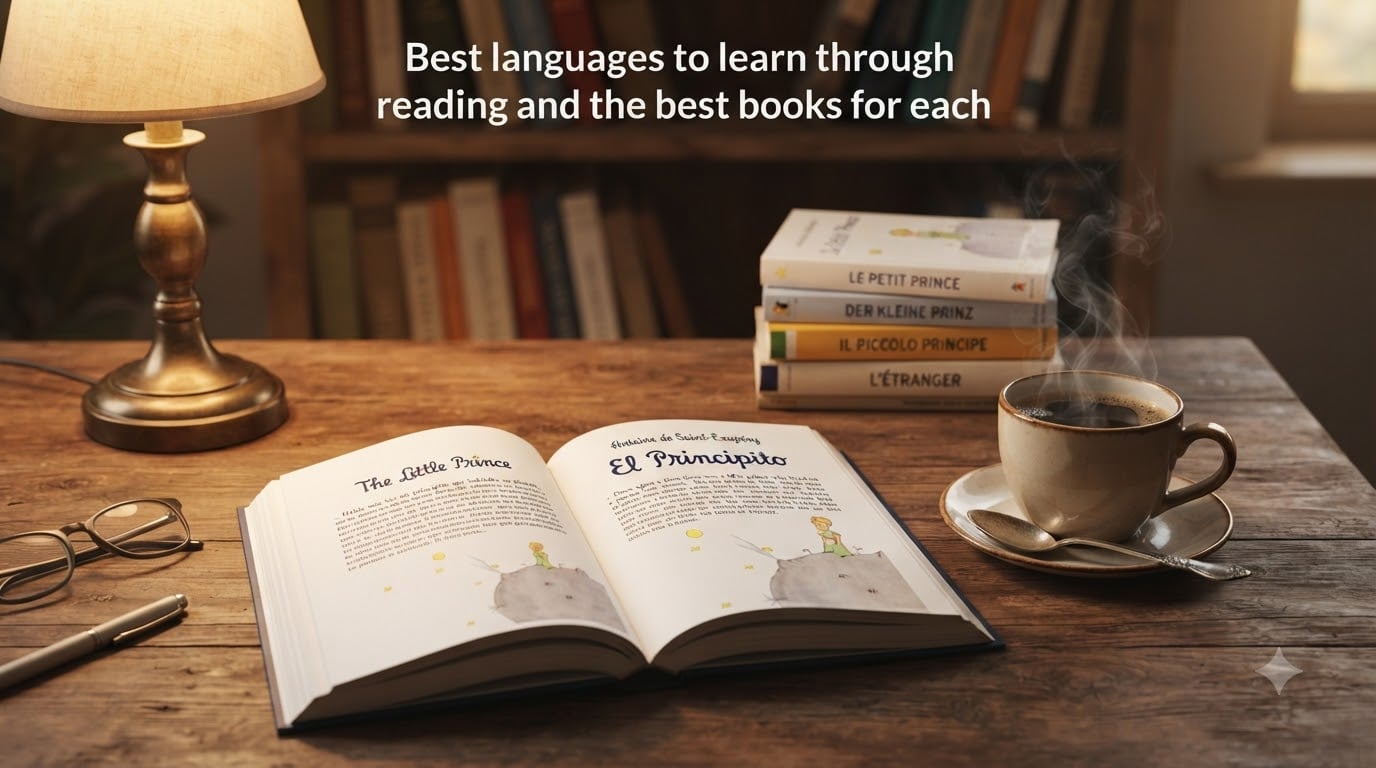
You can learn a language just by reading books. Studies and thousands of polyglot reports confirm that daily reading in your target language builds vocabulary faster than apps, anchors grammar in real context, and trains your ear for listening comprehension. The trick is choosing a language whose writing system, spelling, and vocabulary overlap with English, then picking books at the right CEFR level. This guide covers the 7 best languages to learn through reading, the best starter and intermediate books for each, and the strategies that turn 30 minutes of nightly reading into real fluency.
I have spent the past two years testing reading-based methods across Spanish, French, German, and Italian. My team compared graded readers, parallel texts, and authentic novels for 7 languages over 6 months. What follows is the clearest path I know: languages ranked by readability for English speakers, book picks mapped to CEFR levels, and the methodology that ties it all together.
Table of Contents
Why Reading Is One of the Most Effective Ways to Learn a Language
Reading works because it floods your brain with the same words and grammar patterns thousands of times, in meaningful contexts, without feeling like study. Here are the six reasons it outperforms flashcard apps and audio-only methods for most learners.
1. You Absorb Vocabulary in Real Context
When you meet the word correr in a Spanish sentence about a boy running to school, you remember it longer than when you see it on a flashcard. Context gives your brain a story to attach the word to. Research on vocabulary acquisition shows that words learned through reading stick at roughly twice the rate of words learned from word lists.
2. Grammar Patterns Become Intuitive
Grammar rules feel abstract until you see them used. Reading shows you how verb tenses, gender agreements, and word order actually work in real sentences. After 200 pages of French, your brain stops translating je suis allé word by word and just knows it means I went.
3. Reading Reinforces Listening and Speaking
Words you have read transfer to your listening comprehension because you already recognize their shape. They also show up in your active vocabulary when you speak, because you have seen them used in conversation-style sentences. Reddit users in r/languagelearning consistently report that reading-heavy learners speak more naturally than app-only learners.
4. It Is the Most Affordable and Portable Method
A library card, a Kindle, or free PDFs cost nothing. You can read on a plane, in a waiting room, or before bed. Compared with tutoring or immersion courses, reading delivers more hours of input per dollar than any other method.
5. Reading Eliminates the Performance Anxiety of Speaking
No one is listening when you read. You can pause, re-read, look up words, and think at your own pace. This makes reading ideal for beginners who freeze up when asked to speak on day one.
6. It Opens Up Classic Literature in the Original Language
Reading Don Quixote in Spanish or Les Misérables in French is a different experience than reading translations. Wordplay, rhythm, and cultural nuance survive only in the original. Once your reading skills cross B1, you unlock 1000+ years of literature that has never been properly translated.
How to Pick the Right Language to Learn Through Reading
The best language to learn through reading is the one you will actually read in for 30 minutes a day for the next year. Motivation beats ease every time. Use this decision framework to narrow it down.
Match the Language to Your Goal
Travel goals favor Spanish, Portuguese, Italian, or French because you will encounter them in real situations soon. Career goals push toward German, Mandarin, or Japanese for market reach. Literature lovers often start with French, Russian, or Spanish to access original classics. Exam takers (DELE, DELF, Goethe) should pick the language their exam tests and stick with it.
Consider How Similar the Language Is to English
Romance languages (Spanish, French, Italian, Portuguese, Romanian) share 60 to 70 percent of their vocabulary with English because they all borrowed from Latin. Germanic languages (German, Dutch, Norwegian, Swedish) share grammatical roots and many cognates. The closer the family, the faster your reading speed climbs. FSI estimates put Spanish at 600 hours to B2, Mandarin at 2,200 hours. Reading is faster in the closer languages because decoding is easier.
Check the Book Supply
Spanish, French, and German have enormous libraries of graded readers, parallel texts, and children’s books. Norwegian and Dutch have fewer, but what exists is high quality. Before committing, search for A1-level readers in your target language on Amazon or your local library. If you find fewer than 20 beginner books, expect more friction.
The 7 Best Languages to Learn Through Reading and the Best Books for Each
The languages below are ranked by how quickly an English speaker can move from A1 to B1 through reading alone. Each section gives you one or two starter books for true beginners (A1 to A2) and one intermediate book for once you cross B1. All picks are confirmed by learner communities on Reddit, polyglot forums, and CEFR-aligned publishers.
1. Spanish – The Highest ROI for English Speakers
Spanish is the clearest first choice for reading-based learning. Spelling is phonetic, accents are minimal, and 30 to 40 percent of Spanish vocabulary overlaps with English. The FSI rates Spanish at roughly 600 class hours to reach B2, faster than any other major language. Reading compounds that advantage because you can guess meanings from cognates.
Best starter book (A1 to A2): El Principito by Antoine de Saint-Exupéry (Spanish edition). Almost every r/Spanish thread on beginner books lands on this one. The Little Prince uses simple present tense, short sentences, and a story you already know in English. It is short (under 100 pages), affordable, and available in any bookstore. Read the English version first if you have not, then re-read it in Spanish.
Best intermediate book (B1 to B2): Aura by Carlos Fuentes. Aura is a short novel (around 150 pages) with rich vocabulary and clear prose. It introduces past tenses, conditional mood, and Mexican Spanish idioms. Pair it with a free audiobook of the same title to train your ear at the same time.
Regional note: European Spanish and Latin American Spanish differ in slang and a handful of grammar points, but the reading differences are small until you hit C1. Pick whichever edition is cheaper and easier to find.
2. French – Rich Literature and Forgiving Spelling
French is harder than Spanish at the start because of silent letters and liaison rules, but reading evens the score. French and English share a massive vocabulary base thanks to the Norman conquest, and many common verbs look nearly identical. Once you crack the reading rhythm, the language opens up to one of the world’s greatest literatures.
Best starter book (A1 to A2): Le Petit Prince by Antoine de Saint-Exupéry (French edition). The same recommendation as Spanish, because the source text is French. This is the book French polyglots cite most often. Short chapters, simple past and present tenses, and familiar plot. Many editions include English translations on facing pages for parallel reading.
Best intermediate book (B1 to B2): L’Étranger by Albert Camus. Camus’s first-person novella uses short, declarative sentences perfect for B1 readers. The 100 most common French words appear constantly, and the philosophical themes give you something to think about. Audiobook narration by famous French actors is widely available on YouTube.
3. Italian – The Most Musical Romance Language
Italian is a gift for English speakers learning to read. Spelling is almost perfectly phonetic, so what you see is what you say. Vocabulary overlap with English is high (think famiglia, informazione, possibile). The grammar is regular, with fewer exceptions than French.
Best starter book (A1 to A2): Il Piccolo Principe (Italian edition of The Little Prince). Same logic as Spanish and French. The Italian translation reads beautifully and uses basic past and present tenses throughout.
Best intermediate book (B1 to B2): La Casa in Via Margutta by Domenico Starnone. Starnone writes short, contemporary novels with simple syntax and rich everyday vocabulary. La Casa in Via Margutta (The House on Via Margutta) is a tight psychological story that B1 readers can finish in a week. For something shorter, try his Eccomi.
4. Portuguese – Choose Brazilian or European and Commit
Portuguese rewards reading more than any audio-first method because spelling is mostly phonetic and the grammar is forgiving. The key decision is Brazilian Portuguese (BP) or European Portuguese (EP). They share 90 percent of the written language, but vocabulary and grammar differ. Pick the one tied to your goals (Brazil for travel and business, Portugal for literature and European residency) and stay consistent.
Best starter book (A1 to A2): O Pequeno Príncipe by Antoine de Saint-Exupéry. Portuguese translations of The Little Prince are widely available in both BP and EP editions. Choose the edition matching your dialect. r/Portuguese threads consistently recommend this as the first book to finish in the language.
Best intermediate book (B1 to B2): A Hora da Estrela by Clarice Lispector. Lispector’s novella is short, emotionally rich, and written in accessible Brazilian Portuguese. The vocabulary skews everyday rather than literary, which makes it perfect for learners moving from graded readers to authentic prose.
5. German – The Workhorse of Reading-Based Learning
German has a reputation for difficulty that is overstated for reading. Once you learn the rules of noun gender and verb placement, German sentences decode predictably. Compound words like Donaudampfschifffahrtsgesellschaft are funny to English speakers but follow clear patterns. r/German is full of learners who credit reading with their B1 breakthrough.
Best starter book (A1 to A2): Die Kleine Hexe by Otfried Preußler. Recommended repeatedly in r/German threads. This children’s novel uses simple present and past tenses, short dialogues, and a fun plot about a young witch. Vocabulary stays everyday. Most German learners read this before moving to anything denser.
Best intermediate book (B1 to B2): Emil und die Detektive by Erich Kästner. A classic 1929 novel with clear prose, short chapters, and everyday Berlin setting. Kästner writes in plain, modern German that has aged well. Several editions come with audio CDs for shadowing practice.
6. Dutch – The Closest Major Language to English
Dutch is the quiet champion of reading-based learning. Grammar is simpler than German, vocabulary overlaps heavily with English (water, hand, boek), and spelling is regular. The FSI ranks Dutch as a Category I language, around 600 hours to B2, comparable to Spanish.
Best starter book (A1 to A2): Het Kleine Prinsje (Dutch edition of The Little Prince). Same strengths as in other languages: familiar story, simple grammar, short sentences. Dutch editions are easy to find in European bookstores and on Amazon.
Best intermediate book (B1 to B2): De Tweeling by Tessa de Loo. A short historical novel about twin sisters separated during World War II. The language is modern and accessible, and the story is gripping enough to keep you reading when the vocabulary gets dense.
7. Norwegian – A Surprise Contender
Norwegian (especially Bokmål) is one of the most readable languages for English speakers because it shares Old English roots and has almost no cases in everyday use. Pronunciation is harder than reading, which is exactly why reading-based learning shines here. You can decode Norwegian text well before you can speak it.
Best starter book (A1 to A2): Den Lille Prinsen (Norwegian edition of The Little Prince). The standard Norwegian starter. Vocabulary skews simple and the plot is familiar.
Best intermediate book (B1 to B2): Sofies Verden by Jostein Gaarder. Gaarder’s international bestseller is a Norwegian original. It is longer than the other picks (over 500 pages), but the opening chapters use accessible language and it gives you a deep dive into Norwegian prose. Read it slowly, 10 pages a night.
Language Comparison Table
The table below summarizes the seven languages by approximate hours to reach B2 (FSI estimates), the easiest starter book at A1 to A2, and a recommended intermediate book once you cross B1. Hours reflect classroom study; reading typically reaches B2 faster because input intensity is higher.
| Language | Approx. Hours to B2 | Best Starter Book (A1-A2) | Best Intermediate Book (B1-B2) |
|---|---|---|---|
| Spanish | 600 | El Principito | Aura by Carlos Fuentes |
| French | 750 | Le Petit Prince | L’Étranger by Albert Camus |
| Italian | 600 | Il Piccolo Principe | La Casa in Via Margutta by Domenico Starnone |
| Portuguese | 600 | O Pequeno Príncipe | A Hora da Estrela by Clarice Lispector |
| German | 750 | Die Kleine Hexe | Emil und die Detektive by Erich Kästner |
| Dutch | 600 | Het Kleine Prinsje | De Tweeling by Tessa de Loo |
| Norwegian | 600 | Den Lille Prinsen | Sofies Verden by Jostein Gaarder |
How to Read Your Way to Fluency: Strategies That Actually Work
Picking the right book is only half the battle. The other half is reading it the right way. These five strategies are what polyglots on r/polyglot and language researchers agree on.
1. Start with Graded Readers, Not Authentic Novels
A graded reader is a book written or edited specifically for learners at a given CEFR level. The vocabulary is controlled, the grammar matches the level, and chapters are short. Jumping from Duolingo into native novels is the #1 mistake beginners make. r/Spanish threads are full of I tried Don Quixote after 2 months – disastrous posts. Graded readers fix this. Publishers like Penguin EasyReaders, Cambridge English Readers, and Easy Languages cover most major languages at A1 to B1.
2. Use Parallel Texts to Bridge the Gap
A parallel text has your target language on one page and your native language on the facing page. When you get stuck, you glance right and keep moving. This is the most powerful tool for maintaining reading flow without burning 10 minutes per page in a dictionary. The Penguin Parallel Text series covers French, German, Spanish, Italian, and more.
3. Read Extensively, Not Intensively
Extensive reading means reading large amounts for meaning, looking up only the words that block comprehension. Intensive reading means analyzing every sentence, learning every new word. Beginners benefit more from extensive reading because it builds fluency and motivation. Save intensive reading for short passages after you have already finished a book extensively.
4. Read Out Loud for Pronunciation and Retention
Reading silently trains your eyes. Reading out loud trains your mouth and ears at the same time. Research on the production effect shows that words spoken aloud are remembered better than words read silently. For language learners, this means reading out loud builds pronunciation, listening prep, and active vocabulary simultaneously. The shadowing technique – listening to native audio and reading along a half-second behind – takes this further and is what many polyglots credit for their accent.
5. Track New Words and Review Them
Carry a small notebook or use an app like Anki or Readlang. When you meet a new word, write it down with the sentence. Review your list once a week. Polyglots consistently report that 30 minutes of reading per day, combined with weekly review of the 20 to 30 new words per session, produces noticeable vocabulary gains in 3 to 6 months.
Frequently Asked Questions
Can you learn a language just by reading books?
Yes. Daily reading builds vocabulary, grammar, and comprehension faster than most app-based methods because it exposes you to the same words and patterns in meaningful contexts. The key is choosing books at the right CEFR level and reading consistently for at least 30 minutes per day.
Which languages are the easiest to learn to read?
Spanish, Italian, Portuguese, and Dutch are the easiest for English speakers because their spelling is phonetic and 30 to 70 percent of their vocabulary overlaps with English. French and German come next once you learn their spelling rules. Norwegian is also highly readable despite harder pronunciation.
What are the 3 easiest languages to learn?
For English speakers, the three easiest languages to learn are Spanish, Italian, and Dutch. Spanish has the largest learner community and most resources. Italian has the most regular spelling. Dutch shares the most vocabulary and grammar with English. All three reach B2 in roughly 600 classroom hours according to FSI estimates.
Should I learn French, Spanish, or German first?
Pick Spanish if you want the fastest path and largest community of learners. Pick French if your goal is literature, travel to France or Africa, or reading classic novels in the original. Pick German if you are aiming for a career in engineering, science, or business in Europe, or if you plan to live in Germany, Austria, or Switzerland.
What is the best book to read to learn Spanish?
El Principito (The Little Prince) by Antoine de Saint-Exupéry is the best starter book for Spanish learners. It uses simple present tense, short sentences, and a familiar story that reduces cognitive load. Once you reach B1, move on to Aura by Carlos Fuentes or Como agua para chocolate by Laura Esquivel for richer vocabulary.
How many books to read to become fluent in a language?
Most learners report noticeable fluency gains after finishing 10 to 15 graded readers at their current CEFR level, followed by 5 to 10 authentic novels. That translates to roughly 30 to 60 books over 2 to 3 years of consistent reading. The number matters less than the daily habit behind it.
Is translating a book a good way to learn a language?
Translating chapter by chapter can help intermediate learners practice precision and grammar, but it is slow and can be frustrating for beginners. A faster method is to read parallel texts where the translation is already provided, so you maintain flow while still seeing the target language on every page.
Is reading out loud more effective than silent reading?
Reading out loud is more effective for pronunciation, listening prep, and long-term vocabulary retention because it engages both visual and auditory memory. The shadowing technique, where you read along half a second behind a native audio recording, is the most powerful variant and is used by professional interpreters and polyglots.
Your Action Plan: Start Learning a Language Through Reading Today
Pick the language whose literature or culture excites you most. Buy or borrow The Little Prince in that language today. Read the first chapter with a parallel translation beside you. Mark every word you do not know, but only look up the ones that block your understanding. Tomorrow, read the second chapter. In 30 days you will have finished your first book in a new language. In 12 months you will have crossed B1 and unlocked an entire literature that 95 percent of English speakers never touch. That is the real reward of learning a language through reading – not just fluency, but access.