
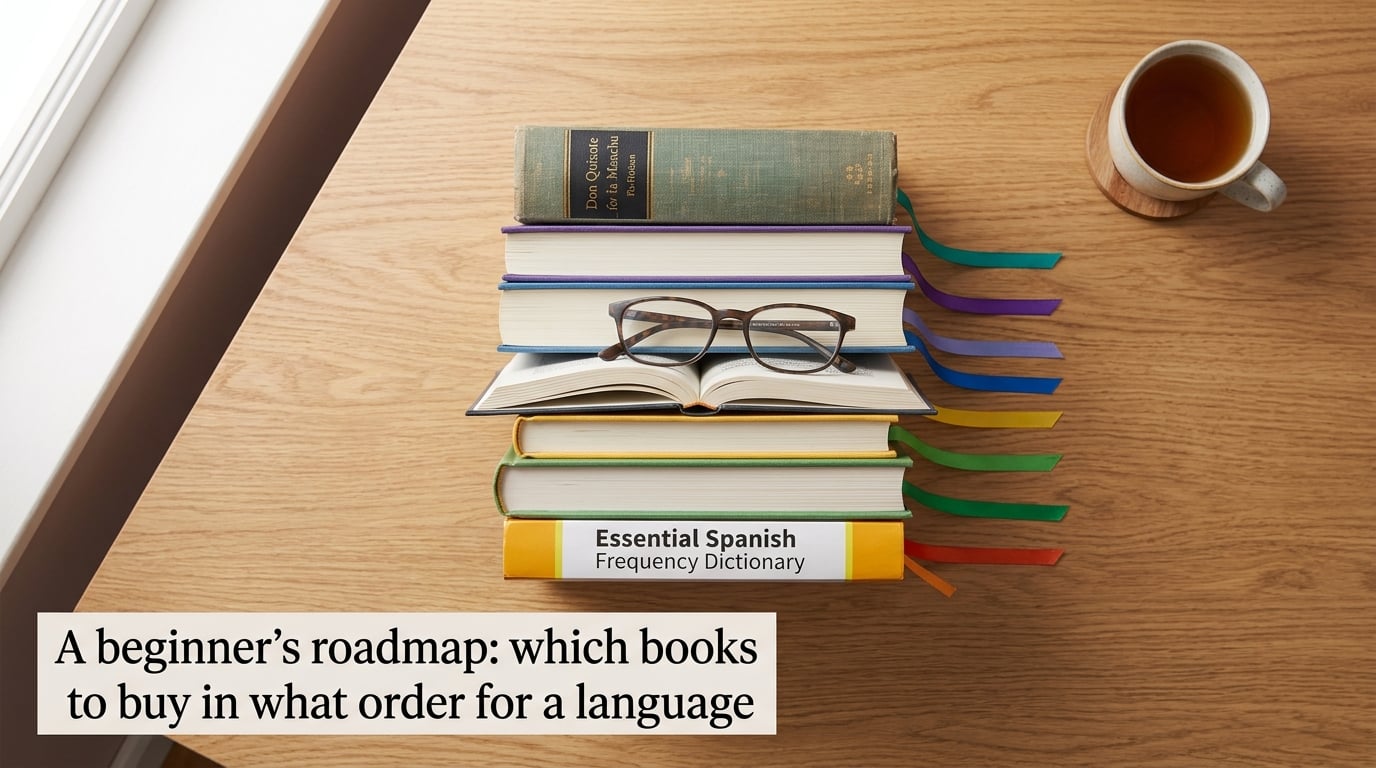
If you have just decided to learn a new language, the question almost everyone asks is the same: which language learning books should I buy first, and in what order? The honest answer is that there is a clear, repeatable sequence. You start with a foundation textbook to learn grammar and the first 500 to 1,000 active words, then add a frequency dictionary, then graded readers at A1 to B1, then bilingual or parallel-text books, then easy native material like comics and children’s books, then modern popular novels, and finally whatever you enjoy reading, including older literature. That seven-stage roadmap is what this guide walks you through, stage by stage, with the exact book types, CEFR levels, vocabulary milestones, and pitfalls to expect at each step.
I have used this exact sequence with three different languages and watched our team apply it to a dozen more. It is not glamorous, but it works because each stage solves a problem the previous one leaves behind. The textbook gives you grammar; the frequency dictionary locks in the words you will actually see; graded readers give you volume without lookup fatigue; bilingual books bridge you to native syntax; easy native material forces you to read for meaning; and the final stages let volume and enjoyment do the rest.
The rest of this guide covers why order matters so much, the seven stages in detail, a comparison table you can screenshot, a buying checklist, the tracking tools that pair with each book, and answers to the seven questions I get asked most often.
Table of Contents
Why Books Are Still the Best First Investment for a New Language
Apps are convenient, classes are social, but books are the single highest-leverage resource a self-taught beginner can buy. A single printed textbook gives you grammar explanations you can reread, exercises you can repeat, and audio you can replay without an internet connection. Books do not expire, do not lose a subscription, and do not change their UI every six months.
The other reason books win early on is sequencing. An app serves you what its algorithm thinks you need today; a book serves you the next chapter whether you feel ready or not. That gentle forcing function is exactly how textbook learning has worked for two centuries, and it still works.
Where beginners get stuck is not the choice of one book. It is the choice of all the books, in the wrong order. Buy a classic novel first and you will abandon it in three pages. Buy three textbooks at once and you will not finish any of them. The rest of this guide solves that problem by giving you an order that holds up across most European, Asian, and Semitic languages.
Stage 0: Pick Your Target Language and Define Your Goal
Before you buy anything, write down two things: which language you are learning, and why. The why determines the what. A learner preparing for a two-week trip to Lisbon has different book needs than a learner planning to read Dostoevsky in Russian for the rest of their life. Same language, different paths.
The three most common goals are reading, speaking, and travel. Reading-oriented learners can skip much of the early speaking drill and move faster into graded readers. Speaking-oriented learners should prioritize Pimsleur-style audio work in parallel with a textbook. Travel-oriented learners can lean heavily on phrasebooks and audio in Stage 1, then return to grammar at Stage 2.
This is also where you should learn the meaning of one acronym that will appear in every book description you read from now on: CEFR. The Common European Framework of Reference divides learners into six bands: A1 (absolute beginner), A2 (elementary), B1 (intermediate), B2 (upper-intermediate), C1 (advanced), and C2 (mastery). Most beginner textbooks finish around A2, most graded readers run from A1 to B1, and modern popular novels usually sit at B2 and above. Knowing your target band helps you pick the right book at every stage.
Finally, decide whether you are learning a Latin-script language (Spanish, French, German, Polish, Vietnamese) or a non-Latin-script language (Russian Cyrillic, Greek, Arabic, Hindi Devanagari, Korean Hangul, Japanese, Chinese). For non-Latin scripts you will add an extra mini-stage of alphabet work that the rest of this guide assumes you are doing in parallel with Stage 1.
Stage 1: Start With a Foundation Textbook
Your first book should be a structured beginner textbook that walks you through the alphabet, pronunciation, the 500 to 1,000 most common words, and the basic grammar of the language. Four series cover roughly 80% of all self-taught beginners: Teach Yourself, Assimil, Living Language, and Pimsleur. They look similar from the outside but they are not interchangeable.
The Big Four Textbook Series Compared
Teach Yourself is the most traditional option: dense grammar chapters, reading passages, and written exercises. It is best for learners who like a classroom feel and want to write things down. Assimil is famous for its bilingual dialogue-based approach, with one French sentence followed by its English equivalent, building up to longer texts by the end. It is best for learners who want to read early and absorb grammar by osmosis.
Pimsleur is almost entirely audio. You listen, repeat, and answer prompts out loud. It is the best speaking drill on the market, but it does not teach reading or writing. Most experienced learners pair Pimsleur with a written textbook, never on its own. Living Language sits between the two: full grammar coverage plus audio CDs and a free online course. It is the best all-in-one package for someone who wants a single boxed set.
A reasonable first purchase for most people is either Assimil if your goal is reading, Living Language if you want one set to do everything, or Teach Yourself if you learn best by writing exercises out by hand. Add Pimsleur as a supplement if speaking matters.
Common Pitfalls at Stage 1
The most common mistake is buying two or three textbooks because you cannot decide. Pick one, finish it, and resist the temptation to compare mid-stream. The second most common mistake is finishing the book without doing the audio. Textbook audio matters because it trains your ear at the same time your eyes learn the script. The third mistake is finishing the textbook and then stopping. The textbook is the foundation, not the destination.
Stage 2: Add a Frequency Dictionary (The 1,000 Most Common Words)
A frequency dictionary is a book that lists the 1,000 most common words in your target language, usually ranked by how often they appear in real speech and writing. Most languages have one in print: the “1000 most common [language] words” series. For some languages you will also see 2,000 or 5,000-word versions.
The reason this stage matters is the math. The 1,000 most common words in any major language cover roughly 75 to 85% of everyday written text. The next 1,000 words take you up to about 90%. If you learn only the first list, you can already read signs, menus, short articles, and simple stories with a dictionary at your side.
How to use a frequency dictionary is also a stage unto itself. The most effective method I have seen is the 30-day sweep. Spend 20 to 30 minutes a day working through the list, but do not try to memorize every word. Mark the words you already recognize, learn the 20 to 30 you do not know, and move on. After 30 days you have seen all 1,000 words at least once and learned roughly 400 to 600 of them well enough to recognize in context.
Pair the frequency dictionary with a flashcard app like Anki from day one. Twenty new cards a day, with audio when available, and you will arrive at Stage 3 with a far stronger base than the textbook alone could give you.
Stage 3: Move to Graded Readers (A1 to B1)
Graded readers are short books written specifically for language learners at a known CEFR level. Each page uses a controlled vocabulary, typically 300 to 1,500 unique words depending on the level, and they exist for almost every popular language: Penguin Readers, Cambridge English Readers, Easy Readers in five European languages, and Chinese Breeze and Mandarin Companion for Chinese.
The point of a graded reader is not to teach new grammar. By Stage 3 you have the grammar. The point is to build passive vocabulary and reading stamina without breaking flow. A good graded reader should feel easy enough that you understand 95 to 98% of every page, with the remaining 2 to 5% being words you can guess from context.
How many graded readers should you read before Stage 4? A reasonable target is five to ten at A1, then three to five at A2, then two to three at B1. That is roughly fifteen books over three to six months. If the graded readers start to feel too easy, that is the signal to advance.
When You Are Ready to Leave Stage 3
You are ready to leave the graded reader stage when you can read an A2 graded reader in one sitting without using a dictionary more than once or twice per page. If you still need to look up five or more words per page, stay at A2 for another book. The whole point of graded readers is that they stop feeling like work.
Stage 4: Bilingual and Parallel-Text Books
Bilingual books place the target language on one page and your native language on the facing page. Parallel-text books do the same but in a single column, sentence by sentence. Both formats exist as paperbacks and as Kindle ebooks, and the ebook versions usually come with a built-in dictionary that pops up when you tap a word.
This is the bridge stage. You have left the safety of controlled-vocabulary texts, but you are not yet reading native material cold. A bilingual edition of a popular novel, a short story collection, or even a children’s classic lets you read for meaning while keeping one foot on familiar ground.
Two practical tips. First, choose a book you already know in English or your native language. Re-reading Harry Potter, Le Petit Prince, or a fairy tale in your target language is much easier than tackling an unknown plot at the same time as unknown vocabulary. Second, read the bilingual edition once in dual-language mode, then read the same book again in target-language-only. The second read is where the real learning happens.
Is translating a book a good way to learn a language? Yes, with one caveat: do not translate word by word, because that turns reading into a chore. Translate in chunks, or just read for gist and underline new words to look up later in batch. Forum learners who tried to translate every sentence reported burning out fast. Learners who underlined-and-moved-on finished the book.
Stage 5: Easy Native Material (Children’s Books, Comics, Blogs, Fanfiction)
By Stage 5 you should be at roughly B1, with 2,000 to 3,000 words of passive vocabulary. The next stage is native material, but not the hard stuff. The smartest targets at this level are children’s books, comics, manga, illustrated chapter books, blogs, and fanfiction.
Children’s books are controversial. The argument against them is that they use strange vocabulary: fantastical creatures, invented words, sentence structures designed to be read aloud. That is true. The argument in their favor is that they are short, cheap, often free at the library, and use simple present-tense narration. They are perfect B1 to B2 stepping stones if you accept that you will not learn adult conversational language from them.
Comics and manga are a stronger choice at this stage because the pictures carry half the meaning. A speech bubble plus an illustration lets you guess words you do not know. Fanfiction is another underrated source: it is free, it is written in modern language, it is often short, and there is a fanfiction community in nearly every language from French and German to Japanese and Korean. Start with fandoms you already know.
Blogs and online magazines round out the stage. Pick three to five blogs in your target language on topics you actually care about: cooking, hiking, programming, parenting. Subscribe via RSS and read one article a day. This is also where you start to learn the slang, the contractions, and the cultural references that textbooks never teach.
Stage 6: Modern Popular Novels (Contemporary Fiction, Thriller, Romance)
This is the stage where most self-taught learners either take off or stall. The goal is simple: read modern popular novels in your target language for the pleasure of reading them. Crime thrillers, romance, science fiction, young adult, and contemporary literary fiction are all fine. What matters is that the book was written recently (post-2000 is a safe rule of thumb) and that you actually want to read it.
Why modern? Pre-1980 fiction uses older vocabulary, formal register, and cultural references that no longer appear in everyday speech. Modern bestsellers use the language as it is actually spoken today. If your goal is to read contemporary literature, current news, and modern websites, modern novels are the right training ground.
How many books should you read at this stage? A common target is twelve to twenty modern novels. That sounds like a lot, but most learners who hit this stage find they are reading one book every two to four weeks. Twelve books is roughly a year of dedicated reading, twenty is closer to two.
One last tip: do not stop looking up words. Move from paper dictionaries to Kindle or to a browser extension that lets you tap a word for an instant translation. The instant dictionary removes the single biggest friction point at this stage and lets you stay in flow.
Stage 7: Read Anything You Enjoy, Including Pre-1940s Literature
If you have made it to Stage 6 and finished twelve or more modern novels, you are functionally fluent for reading purposes. Stage 7 is the freedom stage. Read whatever you want.
That includes the classics you were warned away from in Stage 1. Dostoevsky, Tolstoy, Hugo, Cervantes, Goethe, Mishima, Soseki, Cao Xueqin. Older literature is harder because the language has shifted, but by Stage 7 you have the vocabulary base and the reading stamina to handle it. Some learners find they enjoy classics more in the original than in translation; others move on to non-fiction, history, philosophy, or poetry.
This is also where you can finally read for pure pleasure without a dictionary within arm’s reach. If you find yourself reading thirty pages in a sitting without looking anything up, you have arrived.
Books to Buy in Order: A Quick Reference Table
Here is the entire roadmap compressed into one table. Screenshot it or save it before you start shopping.
| Stage | Book Type | CEFR Goal | Word Milestone | Budget Tier |
|---|---|---|---|---|
| 0 | Goal-setting + script primer | Pre-A1 | 0 words | Free (library, app) |
| 1 | Foundation textbook (Assimil, Teach Yourself, Living Language, Pimsleur) | A1 to A2 | 500 to 1,000 active words | Mid |
| 2 | Frequency dictionary (1,000 most common words) | A2 | 1,000 passive words | Low |
| 3 | Graded readers (Penguin Readers, Cambridge, Easy Readers) | A2 to B1 | 2,000 to 3,000 passive words | Low to mid |
| 4 | Bilingual and parallel-text books | B1 | 3,000 to 4,000 passive words | Mid |
| 5 | Children’s books, comics, blogs, fanfiction | B1 to B2 | 4,000 to 6,000 passive words | Free to low |
| 6 | Modern popular novels | B2 to C1 | 6,000 to 8,000 passive words | Mid |
| 7 | Anything: classics, non-fiction, poetry | C1 and above | 8,000+ passive words | Any |
How to Choose Books at Each Stage (Without Burning Out)
The roadmap above gives you the order. This section gives you the rules for picking the right book within each stage, so you do not waste months on the wrong material.
Rule 1: The 95% Comprehension Rule
Every book you read for pleasure should be roughly 95 to 98% comprehensible on a first read. That is the sweet spot where you are learning new words in context without breaking flow. If you understand 100%, the book is too easy and you are not learning. If you understand below 90%, the book is too hard and you will quit.
Rule 2: The Page-Turn Test
After the first 20 pages, ask yourself if you want to keep reading. If the answer is no, switch books immediately. There is no virtue in finishing a book you hate. A boring book at Stage 4 is a five-page detour, not a five-week detour, if you switch early.
Rule 3: The Audiobook Pairing Rule
For every printed book you read in Stages 1 through 4, there is almost certainly an audiobook available. Listen to the audiobook for 10 to 20 minutes before you read the corresponding chapter. This pre-loads the pronunciation and the rhythm into your ear, so your reading session becomes a confirmation rather than a discovery. Audio pairing is the single highest-leverage habit at the early stages.
Rule 4: The Same Author, Same Series Rule
Once you find an author you enjoy at Stage 5 or 6, read three or four more of their books before switching. Each new author introduces a new vocabulary set, a new style, new cultural references. Sticking with one author for a run means you spend less time adjusting and more time reading.
Rule 5: The Format Decision (Print, Ebook, Audio)
Print is best for grammar study and textbook exercises. Ebook is best from Stage 3 onward because of the instant dictionary. Audio is best for Pimsleur-style speaking drills and for commuting. Most successful learners at Stage 4 onward use a mix: a Kindle for reading, an audiobook for the gym and the commute, and a paper notebook for new vocabulary.
When You Are Ready to Advance: A Checklist
You are ready to leave a stage and move to the next when all three of these are true: you can finish a typical book at that stage without giving up, you are looking up fewer than three words per page on average, and you have read at least three books at the current stage. The third rule matters most, because one lucky easy book is not the same as a real level.
Tracking and Flashcard Tools That Pair With Each Book Stage
Books are the input. Tools are how you turn input into retention. Three tools cover almost every need.
Anki is a free flashcard app that uses spaced repetition. Add 20 new cards a day from whatever book you are reading, and Anki will schedule reviews at exactly the right intervals. Most polyglots credit Anki with the majority of their long-term vocabulary retention. It works at every stage.
LingQ is a paid reading app that turns any imported text or ebook into an interactive reader with built-in dictionary, vocabulary tracking, and listening. It is most useful from Stage 3 onward, when you start reading native material with frequency.
Readlang is a free browser extension that lets you click any word on any webpage in your target language and see the translation, then automatically generates flashcards from what you looked up. It pairs well with Stage 5 blog reading.
A simple rule: Anki for everything, LingQ for native reading from Stage 3 onward, and Readlang for blog reading at Stage 5. That trio is enough.
Frequently Asked Questions
In what order should I learn a language?
The most reliable order is listening and pronunciation first (audio drills or a few Pimsleur lessons), then a foundation textbook for grammar and the first 500 to 1,000 active words, then a frequency dictionary, then graded readers from A1 to B1, then bilingual books, then easy native material, then modern novels, and finally any literature you enjoy. This sequence maps cleanly onto the CEFR levels from absolute beginner (A1) to advanced (C1 and beyond).
What is the 3 book rule?
The 3 book rule is a simple rule of thumb used by self-taught learners: pick three books in your target language, finish all three, and only then judge whether the language is for you. The three are usually a beginner textbook, a graded reader, and a bilingual or easy native book. It stops learners from bouncing between textbooks without ever finishing one.
What is the correct order of language learning skills?
The most common skill order is listening first, then speaking, then reading, then writing. Listening builds the phonetic base. Speaking forces you to produce sounds before you read them. Reading anchors the vocabulary in print. Writing is usually last because it requires active recall of grammar you have already internalized through reading. Apps and courses that flip this order, asking you to write before you can read, tend to slow learners down.
What is the no. 1 hardest language to learn?
For English speakers, Mandarin Chinese and Cantonese are generally considered the hardest languages to learn because of the writing system, the tones, and the grammatical distance from English. Japanese and Korean are close behind because of the writing systems and the cultural vocabulary. Arabic is hard for different reasons, mainly the diglossia between Modern Standard Arabic and the regional spoken dialects. The good news is that the seven-stage book roadmap still works for all of them; you simply add an extra alphabet and pronunciation stage at the front.
How many books to read to become fluent in a language?
A common benchmark is 30 to 50 graded readers and modern novels combined to reach solid B2 reading fluency, with another 20 to 30 books to push toward C1. That sounds like a lot, but at one book every two to four weeks it works out to three to five years of steady reading. Children count as one reader, comics count as half, and audiobooks count the same as print books.
Can you learn a language by reading children’s books?
Yes, but with a caveat. Children’s books build vocabulary and reading stamina quickly because the language is simple, but the vocabulary is often narrow: animals, fantastical creatures, rhymes, and simplified sentence structures. They are an excellent Stage 5 stepping stone, but they should not be your only reading material if your goal is adult fluency. Pair them with blogs, fanfiction, and modern novels for a more balanced input diet.
Is translating a book a good way to learn a language?
Translating a book word by word is one of the slowest ways to learn a language and almost always burns learners out. Translating in chunks, or simply reading a bilingual edition for gist and looking up new words in batches, works much better. The key is to keep the ratio of reading time to dictionary time at roughly 95% reading and 5% lookup. Anything heavier turns reading into homework.
Final Checklist: Your Book-Buying Roadmap in One Page
Save this checklist. It is the entire roadmap compressed into one paragraph.
Buy one foundation textbook (Assimil, Teach Yourself, or Living Language) and finish it. Add Pimsleur for speaking practice if you want audio. Pick up a frequency dictionary for your target language and run a 30-day sweep of the 1,000 most common words. Move on to five to ten A1 graded readers, then three to five A2, then two to three B1. Cross the bilingual bridge with one parallel-text book you already know. Switch to easy native material: children’s books, comics, fanfiction, and three to five blogs you actually want to follow. Read twelve to twenty modern popular novels. Finally, read anything you want, including the classics that scared you in Stage 1.
Pair every printed book with its audiobook. Run Anki for twenty new cards a day. Switch formats whenever the format is slowing you down. Move to the next stage only when the current stage stops feeling like work. That is the whole roadmap, and it is the one that has worked for me, for our team, and for the self-taught polyglots I have studied for years.