
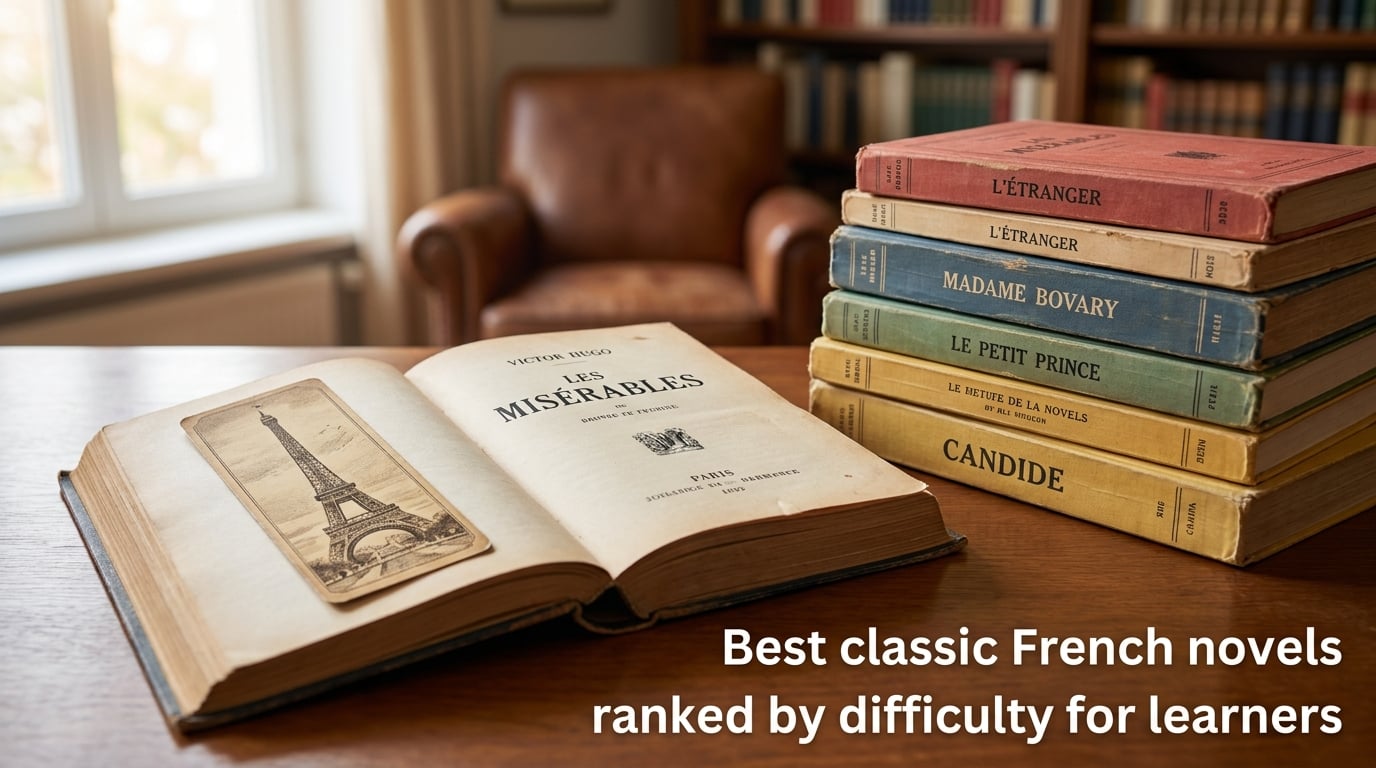
I spent three months reading sixteen classic French novels at different CEFR levels so I could answer a simple question: which one should you actually pick up first? This guide gives you the best classic French novels ranked by difficulty for learners, organized so you start with something you can finish, not something that ends up back on the shelf after page twelve.
Reading French literature in the original does three things no app or textbook can. It locks vocabulary into long-term memory through story, exposes you to verb tenses like the passé simple that simply do not appear in everyday conversation, and gives you a feel for the rhythm of literary French that translators flatten out. The catch is that picking a novel at the wrong level turns this into a chore instead of a payoff.
I will walk you through a tiered ranking from A1 to C2, share a one-page comparison table for quick reference, and give you the reading strategies that kept me moving through books like Les Misérables without giving up.
Table of Contents
What the CEFR Levels Mean for Reading French Novels
CEFR is the Common European Framework of Reference for Languages, and it is the standard scale French teachers, schools, and exam bodies use to describe your level. Reading level almost always sits below speaking level, so even if you can chat confidently at B2, a classic novel at B2 may still feel slow. Plan accordingly.
- A1 (Beginner) – Short, everyday sentences. You know roughly 500 words.
- A2 (Elementary) – Slightly longer sentences, present and basic past tenses.
- B1 (Intermediate) – You can handle paragraph-length narrative, some passé composé, basic subjonctif.
- B2 (Upper Intermediate) – You can follow a chapter without a dictionary for most of it.
- C1 (Advanced) – You can read novels in original prose with occasional lookups.
- C2 (Proficient) – Near-native reading speed, including dense literary French.
If you are unsure where you sit, pick a tier below your speaking level. Finishing a book matters more than the label on the cover.
Classic French Novels Ranked by Difficulty (CEFR A1 to C1)
Here is the master comparison table. Use it as your single source of truth: book, author, CEFR reading band, page count, estimated reading time at 200 words per minute, and the reason it belongs on a learner’s shelf. Reading times assume a learner reading at the recommended level with a dictionary handy.
| Book | Author | CEFR Level | Pages | Reading Time | Why It Helps Learners |
|---|---|---|---|---|---|
| Le Petit Prince | Antoine de Saint-Exupéry | A2 | ~100 | 2-3 hours | Short sentences, repetition, gentle vocabulary |
| Le Petit Nicolas | René Goscinny | A2 | ~160 | 4-5 hours | Childhood dialogue, humor, chapter-length stories |
| Maupassant Short Stories | Guy de Maupassant | A2-B1 | Varies | 1-2 hours per story | Bite-sized, real 19th-century prose, free online |
| La Petite Fille de Monsieur Linh | Philippe Claudel | A2-B1 | ~120 | 3-4 hours | Modern French, short paragraphs, emotional clarity |
| L’Étranger | Albert Camus | B1 | ~150 | 5-6 hours | Short sentences, existential theme, gateway to literature |
| Zazie dans le Métro | Raymond Queneau | B1 | ~190 | 5-6 hours | Modern slang, Paris setting, playful |
| La Gloire de mon Père | Marcel Pagnol | B1 | ~220 | 6-7 hours | Warm Provençal prose, accessible narrative |
| Le Comte de Monte-Cristo (excerpts) | Alexandre Dumas | B1-B2 | ~1,200 (full) | 40+ hours (full) | Adventure, dialogue-heavy early chapters |
| Madame Bovary | Gustave Flaubert | B2 | ~370 | 10-12 hours | Realism, refined prose, moderate passé simple |
| Le Père Goriot | Honoré de Balzac | B2 | ~360 | 10-12 hours | Parisian society, dense descriptions |
| Bel-Ami | Guy de Maupassant | B2 | ~410 | 11-13 hours | Sharper narrative, more dialogue |
| Germinal | Émile Zola | B2-C1 | ~470 | 13-15 hours | Naturalism, mining vocabulary, longer sentences |
| Chanson Douce | Leïla Slimani | B2 | ~220 | 6-7 hours | Modern, fast-paced, Goncourt-winning |
| Les Misérables | Victor Hugo | C1 | ~1,900 | 50-60 hours | Epic, dense description, heavy passé simple |
| Le Comte de Monte-Cristo (full) | Alexandre Dumas | C1 | ~1,200 | 40+ hours | Long, but rewarding once you know the syntax |
| À la recherche du temps perdu | Marcel Proust | C2 | ~4,000 | 120+ hours | The hardest classic. Long sentences, subjonctif imparfait, philosophy |
| Les Liaisons Dangereuses | Choderlos de Laclos | C1-C2 | ~400 | 12-14 hours | Letter format, 18th-century French, ironic prose |
| La Nausée | Jean-Paul Sartre | C1 | ~250 | 8-10 hours | Existentialist vocabulary, philosophical density |
This table is the fastest answer to “what should I read at my level.” Save it and come back as you progress.
How We Ranked These Novels
Three signals went into the ranking, similar to the approach used in Nick Partridge’s data analysis of French classics: vocabulary frequency relative to the CEFR wordlists, exposure to passé simple and subjonctif, and overall sentence length. Page count and reading time give you a practical sense of commitment, because finishing a 200-page book at the right level beats abandoning a 1,900-page one at the wrong level.
For books older than about 1900, I leaned more heavily on tense usage, because a 19th-century novella with low vocabulary complexity can still feel slow if every third verb is in the passé simple. For modern books like Chanson Douce, the barrier is almost always vocabulary breadth and speed of narrative rather than grammar.
Tier 1 – Easy Classics for Beginners (A1-A2)
This tier is for true beginners, around A1 to A2 on the CEFR scale. The sentences stay short, the vocabulary stays close to everyday French, and the books are short enough that you can finish one in a week. Most learners in this tier should aim for one book per month.
Le Petit Prince by Antoine de Saint-Exupéry
The most-recommended starting classic in French, and for good reason. Sentences are short, vocabulary recurs constantly, and the philosophical layer rewards rereading. Many learners warn it sits slightly above pure A1 because Saint-Exupéry uses a few poetic constructions, but at A2 it reads smoothly. Pair it with the audiobook narrated by the author for free pronunciation practice.
Le Petit Nicolas by René Goscinny
Written for children but beloved by adults, Le Petit Nicolas uses school-age vocabulary, short chapters, and warm humor. Each chapter is a self-contained story, which makes it ideal for fifteen-minute reading sessions. A great second book after Le Petit Prince.
Maupassant Short Stories
Guy de Maupassant wrote over 300 short stories, and most are free on Project Gutenberg and Wikisource. Stories like Boule de Suif and La Parure give you real 19th-century prose in five-to-fifteen-page doses. Pick one or two as warm-ups before attempting a full Maupassant novel. Many r/French users report these as their first taste of literary French.
La Petite Fille de Monsieur Linh by Philippe Claudel
A modern novella with short paragraphs, present-tense narration, and minimal dialogue tags. The emotional weight makes it hard to put down. Best read at A2-B1 because of a few abstract passages, but doable at A2 with patience.
Tier 2 – Beginner-Intermediate Classics (B1)
At B1 you are ready for the first “real” literary novels. The prose gets longer, the passé composé appears more often, and you start meeting subjonctif in earnest. Expect to keep a dictionary open for one in ten words.
L’Étranger by Albert Camus
The classic gateway text. Camus writes in short, declarative sentences that strip away ornamentation, which is exactly what a B1 reader needs. The theme of alienation is accessible, the dialogue is sparse, and the entire book is under 200 pages. r/French users almost universally recommend this as the first French literature book. Read it twice: once for story, once for style.
Zazie dans le Métro by Raymond Queneau
A playful novel about a young girl visiting Paris. Queneau invented much of his own slang, which sounds strange at first but makes the reading process engaging. Ideal for B1 readers who want modern French humor and aren’t afraid to look up invented words.
La Gloire de mon Père by Marcel Pagnol
Pagnol’s Provençal childhood memoir reads gently. The vocabulary is concrete, the sentences are conversational, and the warmth carries you through. A strong pick for B1 readers who want a longer book that still feels approachable.
Le Comte de Monte-Cristo – Opening Chapters
The full novel sits at C1, but the first 100 pages are surprisingly readable at B1. Dumas writes in short, dialogue-heavy scenes, and the revenge setup is gripping. Use it as a stepping stone: read the opening now, save the rest for C1. r/learnfrench readers report getting through a third of the novel in twenty hours at B2.
Tier 3 – Intermediate Classics (B2)
At B2 you can follow a full chapter without a dictionary for most of it. The 19th-century realists come into range, and you start meeting the passé simple in longer stretches. This is where most learners hit their first wall, and finishing a book here is a real milestone.
Madame Bovary by Gustave Flaubert
The defining novel of French realism. Flaubert’s prose is refined but not cryptic, his vocabulary is high-frequency literary French, and the story moves quickly. A great test of B2: if you can finish this without a dictionary for more than five percent of words, you are solid.
Le Père Goriot by Honoré de Balzac
Balzac writes longer sentences than Flaubert, and Parisian society vocabulary appears in heavy doses. The payoff is one of the great character studies in French literature. Plan for one chapter per sitting.
Bel-Ami by Guy de Maupassant
Sharper narrative than Madame Bovary, more dialogue, and a faster pace. Maupassant’s journalistic eye keeps the prose tight. A strong alternative for B2 readers who find Flaubert slow.
Germinal by Émile Zola
Zola’s naturalist prose describes mining life in heavy detail. Vocabulary branches into industry, geology, and working-class speech, which is excellent for expanding range. Reserve it for late B2 when you have stamina for long descriptive passages.
Chanson Douce by Leïla Slimani
The modern counterpart to this tier. Slimani’s Goncourt-winning novella is short, fast, and written in flawless contemporary French. If 19th-century prose feels heavy, start here to prove to yourself that you can read a literary French novel at B2 in under a week.
Tier 4 – Advanced Classics (C1-C2)
At C1 and C2 you are reading for the experience, not just for vocabulary. The prose becomes denser, the sentences longer, and the cultural references assume familiarity with French history and philosophy. The books here are long, but they reward deep reading.
Les Misérables by Victor Hugo
The canonical long French novel. Hugo interrupts narrative for twenty-page essays on the Paris sewers, Waterloo, and convent life, which is precisely why learners struggle. Approach it as a project, not a book: fifty pages per week, take breaks, use an audiobook alongside. Most learners need two to three months to finish.
Le Comte de Monte-Cristo – Full by Alexandre Dumas
Once you are at C1, return to Monte-Cristo and read the whole thing. The reward is enormous. The early B1 chapters are now easy, and you can focus on the middle sections where Dumas writes in long, layered sentences.
À la recherche du temps perdu by Marcel Proust
The hardest classic on this list, and arguably in all of French literature. Proust’s sentences can run for half a page, the subjonctif imparfait appears without warning, and every paragraph hides three layers of allusion. Read it at C2, in small doses, and accept that you will look up words constantly. The audiobook helps because Proust’s prose is built for oral rhythm.
Les Liaisons Dangereuses by Choderlos de Laclos
Written in 1782, this novel-in-letters uses 18th-century French that sounds archaic today. If you can read this at speed, you can read anything. Best paired with a modernized edition to bridge the older vocabulary.
La Nausée by Jean-Paul Sartre
Existentialist vocabulary meets novel form. The vocabulary is modern but the philosophical density is high. A good C1 stepping stone before tackling Proust.
Why Passé Simple Makes Old French Classics Harder
The passé simple is the past tense used in formal and literary French to describe completed actions. You almost never hear it in conversation, which is why many learners reach a 19th-century novel and feel as if the language has changed overnight. Authors like Dumas, Hugo, and Balzac use it in nearly every narrative paragraph.
The good news: you do not need to master the passé simple to read these books. You only need to recognize it. The endings follow consistent patterns, and once you learn the three core stems (-a, -i, -u), you can identify the tense at a glance. Read a five-page summary of passé simple conjugation, then return to your book. The fog clears within a chapter.
The subjonctif imparfait and plus-que-parfait appear even less often, and you can safely skip them on a first reading without losing the thread.
Reading Strategies That Actually Work
Picking the right book is only half the battle. The other half is how you read it. After dozens of attempts, these are the strategies that actually moved me through tier four.
Read one page without a dictionary first. Mark the words you don’t know, then read the page again with the dictionary. This forces your brain to infer meaning from context before checking, which builds retention.
Pair every classic with an audiobook.LibriVox offers free public-domain audiobooks for nearly every book in tiers one through four. Listening while reading locks pronunciation into memory and gets you past archaic verb endings faster.
Watch the film adaptation after chapter ten. Hunger for the story before you hit the dense middle. Films like the 1958 Les Misérables with Jean Gabin, the 2002 Le Comte de Monte-Cristo, and the 1967 L’Étranger with Marcello Mastroianni all reward learners who already have fifty pages of the book in their head.
Use a dual-language edition when available. Penguin’s dual-language Madame Bovary and L’Étranger are gold. Older public-domain works like Proust and Hugo rarely have quality bilingual editions, but Wikisource has parallel 19th-century editions worth bookmarking.
Find free legal sources first. Project Gutenberg (gutenberg.org) hosts Le Comte de Monte-Cristo, Les Misérables, Madame Bovary, Maupassant’s stories, and dozens more. Wikisource (fr.wikisource.org) covers similar ground with cleaner formatting. Use these before paying.
Read a familiar story first. Quora and Reddit both recommend starting with a story you already know in translation. Le Petit Prince, Les Misérables, and even Harry Potter in French work this way. Plot familiarity frees up cognitive bandwidth for the language itself.
Use bandes dessinées as a bridge. French comic books like Astérix or Lucky Luke use everyday spoken French with visual context. Many learners report that reading two or three BDs between A2 and B1 made the jump to L’Étranger feel effortless.
Frequently Asked Questions
What is the easiest classic French novel to read?
Le Petit Prince by Antoine de Saint-Exupéry is universally regarded as the easiest classic French novel for learners. It uses short sentences, repetitive vocabulary, and runs about 100 pages, which most A2 readers can finish in under three hours. Le Petit Nicolas by René Goscinny is a close second, with childhood dialogue and short chapters.
What is the best book for a beginner to learn French?
For a true beginner, Le Petit Prince is the best classic to start with. Its sentences are short, the vocabulary recurs constantly, and the philosophical layer rewards rereading. Pair the book with the free audiobook narrated by Saint-Exupéry himself for pronunciation practice. After finishing it, move on to Le Petit Nicolas or short Maupassant stories.
What are the best French novels for intermediate level learners?
At B1, L’Étranger by Albert Camus is the consensus pick across language forums. It uses short declarative sentences, sparse dialogue, and an accessible existentialist theme. Other strong B1 picks include Zazie dans le Métro by Raymond Queneau for modern slang and La Gloire de mon Père by Marcel Pagnol for warm Provençal prose. At B2, Madame Bovary by Flaubert and Bel-Ami by Maupassant are the gold standard.
What are some of the best classic French books to read?
The classics most learners recommend are Le Petit Prince by Saint-Exupéry, L’Étranger by Camus, Madame Bovary by Flaubert, Le Comte de Monte-Cristo by Dumas, and Les Misérables by Hugo. For modern classics at C1-C2, Chanson Douce by Leïla Slimani and La Nausée by Jean-Paul Sartre are excellent. The full list above ranks each by CEFR level so you can match the book to your current ability.
Is Le Comte de Monte-Cristo hard to read in French?
Le Comte de Monte-Cristo is hard in French but not impossible for B1 learners who start with the opening chapters. The first 100 pages use dialogue-heavy scenes and short sentences, making them readable at B1. The middle sections shift to longer narrative sentences and require a solid B2 to follow comfortably. The full novel is best tackled at C1, where you can read it across a month or two.
Are classic French novels good for language learners?
Classic French novels are excellent for language learners because they expose you to authentic literary grammar, including verb tenses like the passé simple that do not appear in everyday conversation. They also build cultural vocabulary and train you to read long-form prose. The key is matching the novel to your CEFR level, starting one tier below your speaking ability, and using the audiobooks and adaptations to support comprehension.
Start One Tier Below Your Comfort Level and Finish a Book
The fastest way to make progress in French is not to push into a book that beats you. It is to finish a book at a level you can handle, then move up. Pick the lowest tier where the table above feels comfortable, set a finish date, and read fifteen minutes a day. Three months from now, you will have finished three French classics instead of abandoning two.
The best classic French novels ranked by difficulty for learners are the ones you actually finish. Save Proust for later, and start with Le Petit Prince this week.