
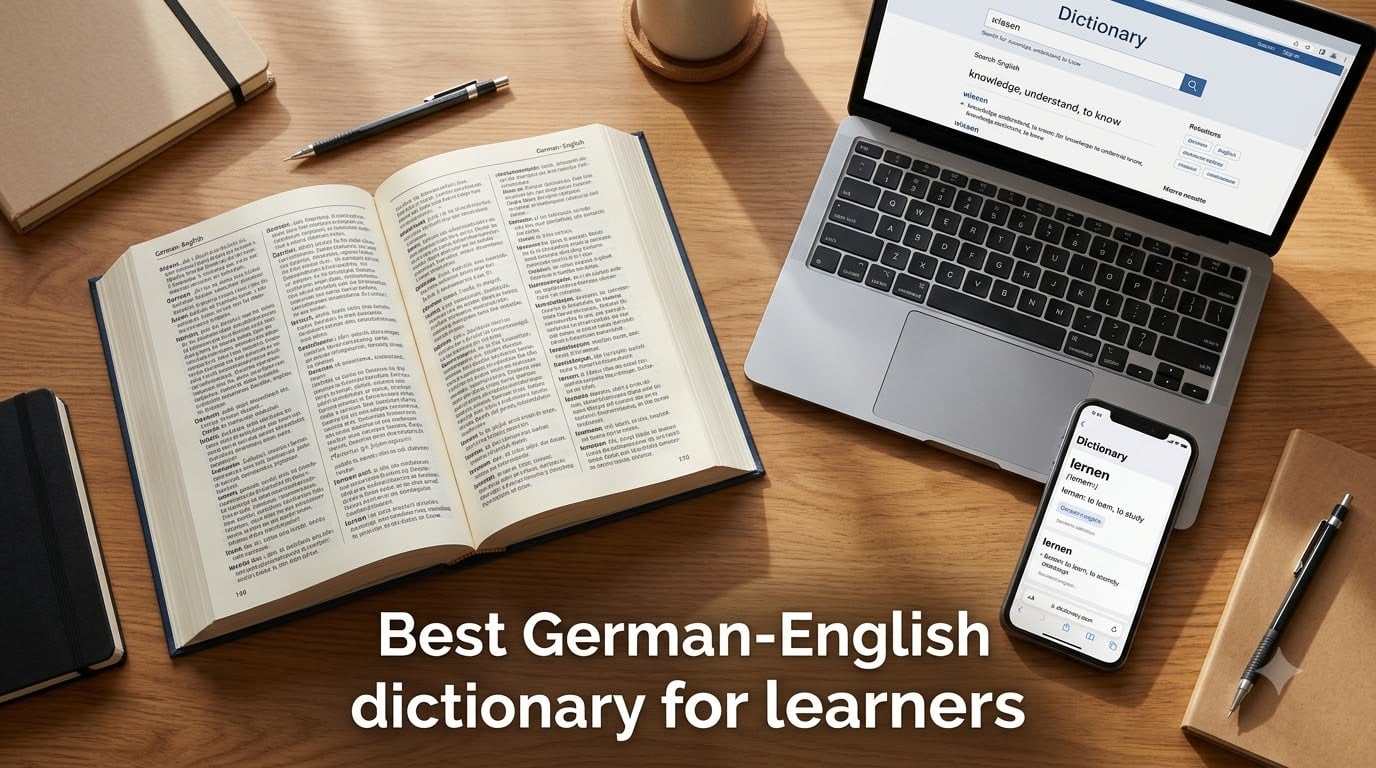
Finding the best German-English dictionary for learners can feel overwhelming when you are early in your German journey. I have tested around a dozen free and paid tools across beginner, intermediate, and exam-prep contexts, and the right pick depends on your level, your study style, and whether you need offline access. This guide breaks down online dictionaries, mobile apps, and print editions so you can build a small, reliable setup instead of bouncing between half-working tools.
A learner dictionary is not just a translation lookup. The best ones give you example sentences, noun gender, verb conjugation, and audio so you actually understand how a word behaves in real German. Over the next few minutes I will walk you through the strongest options across formats, then show you how to combine two or three of them for the smoothest study workflow in 2026.
Table of Contents
Quick Picks: Top 5 German-English Dictionaries at a Glance
If you only have 30 seconds, here are the five tools I would lean on most this year:
- Linguee — best for seeing words in real translated sentences, ideal for B1 and up.
- Dict.cc — fastest online lookup with strong idiom coverage and a community-driven feel.
- LEO — deepest grammatical info and a lively forum for nuanced translation questions.
- Collins German Dictionary (Complete & Unabridged, print) — best overall print reference for serious learners.
- Langenscheidt Standard Dictionary German — trusted print companion for travel and exam settings.
Each of these does one thing well. Below, I will explain what makes each shine and where to use it inside a typical study week.
Best Online German-English Dictionaries You Can Use Free Today
Online German-English dictionaries are the workhorses of daily study because they are free, fast, and updated by real users. The four services below cover nearly every lookup a learner needs, and I have ranked them by what they do best.
Dict.cc — Fastest Lookup and the Widest Idiom Coverage
Dict.cc is the dictionary I open most often when reading an article or watching a German show. It is community-driven, which means users submit and vote on translations, so idioms like Daumen drücken or Ich verstehe nur Bahnhof show up with context you will not find in older print editions. Speed is the other headline feature: results appear as you type, and the keyboard shortcuts make it feel like an extension of your browser.
The free version is ad-supported and covers over 1 million entries. You can also download the full database for a small fee and use it offline in the official apps. On r/German, learners consistently call Dict.cc the “Wikipedia of German dictionaries” because new slang and tech terms appear within weeks. For A1-B2 work, this is the single most useful free site to bookmark.
LEO (dict.leo.org) — Deep Grammar Notes and a Real Forum
LEO is where I go when a translation looks plausible but I want to see the grammar. Each entry typically shows noun gender, plural forms, verb conjugation tables, and example phrases pulled from the LEO forum. The forum itself is searchable, so you can read how native speakers actually use a phrase in emails, travel, or work contexts.
LEO is run by a German publisher, which gives it a slightly more conservative voice than Dict.cc. That is a plus for B1 and above learners who want authoritative grammar alongside translation. The trade-off is the interface looks dated, but the data behind it is excellent.
Linguee — See Your Word in Real Translated Sentences
Linguee changed how I study because it pulls millions of bilingual sentence pairs from professional sources: EU documents, company websites, patents, and translated books. You type a German word and instantly see how it has been translated in context. For learners working at B1 and above, this is gold for picking the right register.
For example, searching Fingerspitzengefühl on Linguee shows you how professional translators have rendered it into English across dozens of real contexts. Linguee is owned by the same team behind DeepL, so the integration between the two is tight. Linguee is a context tool first and a dictionary second, so I pair it with Dict.cc or LEO for the basic lookup.
Collins, Pons, and Reverso — Three Solid Support Players
The Collins online dictionary pairs well with the Collins print editions, so you can preview an entry before you buy the book. Pons offers a clean interface and German-publisher heritage, useful when you want a European perspective on usage. Reverso Context is similar to Linguee but lighter and more phrase-focused, which makes it nice for idioms and email phrasing.
You will not go wrong adding any of these as a third tab in your lookup workflow. Most serious learners I have talked to run two or three in parallel rather than trying to find a single perfect site.
Best German-English Dictionary Apps for iOS and Android
Mobile apps matter when you are commuting, traveling, or sitting in a language class without a laptop. The best German-English dictionary apps share four traits: real offline support, decent text-to-speech, an SRS-style vocabulary trainer, and a battery profile that does not drain your phone in an afternoon.
Dict.cc App — Best for Offline and Speed
The official Dict.cc app is my top app pick because you can download the full German-English database once and look up words without a connection. Audio quality is solid, you can hear noun gender read aloud, and the built-in vocabulary trainer uses spaced repetition so new words stick. For A1-B1 learners especially, this app alone can replace a paper dictionary.
LEO App and Linguee App — Best for Reference Lookups
The LEO app mirrors the website with grammar tables and forum excerpts, which is helpful when you want conjugation details on the go. The Linguee app is lighter and focuses on sentence context, great when you spot a phrase in a book and want to see how it is used elsewhere. Both are free with optional paid tiers.
What About Google Translate and DeepL?
Google Translate and DeepL are not dictionaries in the strict sense, but learners use them that way. DeepL tends to be the most accurate for full sentences, while Google Translate is unbeatable for instant camera translation of menus and signs. Use them as a complement, not a replacement, because neither shows you grammar tables or reliable noun gender the way a dedicated dictionary does.
Best Print and Paper German-English Dictionaries for Learners
Print dictionaries still earn their place on the shelf, especially for travel, exams that ban phones, and serious reading sessions where you want to flip pages and see related words nearby. The five editions below are the ones serious learners reach for in 2026.
Collins German Dictionary Complete and Unabridged
This is the heavyweight print pick for upper-intermediate and advanced learners. Coverage is broad, example sentences are well chosen, and the cultural notes on usage help you avoid textbook German. It is also the most frequently recommended print edition on r/German threads asking about book purchases.
Langenscheidt Standard Dictionary German
Langenscheidt is a German publisher with deep roots, and the Standard Dictionary German is a balanced, mid-sized reference suitable for B1-B2 learners. It pairs nicely with a free online dictionary because it gives you a curated, edited set of examples in a format that is faster to browse than any app.
Oxford Learner’s German Dictionary
The Oxford Learner’s edition targets A1-B2 learners specifically, with clear typography and example phrases chosen for school and exam use. If you are studying for Goethe or TestDaF, this is one of the easier print dictionaries to navigate.
Cassell’s German and English Dictionary
Cassell’s has a long history with German-English work and is known for solid coverage of idioms and classical usage. It is a good second print dictionary to keep beside a newer Collins or Langenscheidt.
Merriam-Webster’s German-English Dictionary
Merriam-Webster’s compact German-English dictionary is the lightweight option. It is small enough to carry in a backpack and works well as a travel companion when you do not want to rely on phone data.
Which German Dictionary Matches Your CEFR Level?
Your CEFR level is the fastest way to narrow down which dictionary to trust. I have grouped the recommendations below by stage, because the dictionary that helps an A1 learner will frustrate a C1 student and vice versa.
A1-A2 Beginners
At A1-A2 you want short example sentences, audio, and clear noun gender indicators. Dict.cc online plus the Dict.cc app is the simplest setup. Pair it with a beginner-friendly print dictionary such as the Oxford Learner’s German Dictionary for reading exercises. Avoid German-German dictionaries like DWDS or Duden at this stage, because they will slow you down.
B1-B2 Intermediate Learners
At B1-B2, you want grammar detail and context. LEO becomes very useful here, and Linguee helps you see how a phrase is actually used in writing. The Collins Complete and Unabridged is a strong print companion when you start tackling longer German texts.
C1-C2 Advanced Learners
Advanced learners benefit from German-German dictionaries like DWDS and Duden alongside bilingual tools. DWDS gives you deep corpus examples, and Duden is the authority on spelling, grammar, and word formation. Pair these with Linguee for translated context and you have a very strong setup.
Exam Prep: Goethe, TestDaF, and DSH
For Goethe certificate prep, TestDaF, and DSH, lean on a serious print dictionary like Collins Complete and Unabridged or Langenscheidt Standard. Many exam centers do not allow phones, so offline familiarity with a paper dictionary is a real advantage. Supplement with LEO for grammar review the week before the exam.
How to Choose the Right German-English Dictionary for You
Choosing the right dictionary comes down to four questions: how do you study, where do you study, what level are you at, and do you need offline access. Use the framework below to pick a starter setup, then refine as your German improves.
Free vs Paid: When Does Paid Make Sense?
Free online dictionaries cover roughly 90% of learner needs. The case for paying is narrow: you want offline databases for travel, you want an ad-free app, or you want a curated print edition for serious study. Start free, and only pay once you hit a specific gap.
Online vs App vs Print
Online dictionaries are best for desktop reading and writing. Apps win for travel and quick lookups on the go. Print dictionaries win for exam conditions and focused reading sessions. Most learners end up using all three, which is why I recommend a layered setup rather than a single tool.
Compound Words: A German-Specific Dictionary Test
German compounds like Kraftfahrzeughaftpflichtversicherung break simple translators because the words are not stored as a single entry. The dictionaries that handle compounds best either break the word for you (Dict.cc and LEO do this well) or carry large compound databases (Collins Complete and Unabridged). If you study German seriously, this is the feature to test first.
Audio Quality and Example Sentences
Audio pronunciation matters because German vowels and umlauts are easy to misread. Look for tools with native-speaker recordings rather than robotic text-to-speech. Example sentences matter because the right German word depends on context, and a single translation rarely tells the full story.
Combining Two or Three Dictionaries
The fastest way to get reliable answers is to cross-check. I run Linguee for context, Dict.cc or LEO for grammar and base meaning, and a print Collins for deeper reading. This sounds like overkill, but it saves time in the long run because you stop second-guessing translations.
Tackling Compound Words: A German-Specific Dictionary Challenge
Compounds are the single most common reason a learner gives up on a dictionary. When you type a long German word and the dictionary returns nothing, you need a tool that breaks the word into parts. Dict.cc and LEO do this automatically: type the full compound and the site offers to look up each segment. Collins Complete and Unabridged also handles compounds well in print form.
When all else fails, split the compound yourself. Read from right to left and identify the head noun first, then the modifiers. For Kraftfahrzeughaftpflichtversicherung, the head is Versicherung, the modifier Haftpflicht, then Kraftfahrzeug. A dictionary that supports compound splitting turns this kind of word from a roadblock into a learning moment.
German-English Dictionary Comparison at a Glance
The table below summarizes the strengths of each major dictionary so you can pick your starter setup in one glance.
| Dictionary | Format | Best For | CEFR Level |
|---|---|---|---|
| Linguee | Online | Context in real sentences | B1-C2 |
| Dict.cc | Online + app | Speed, idioms, community | A1-C1 |
| LEO | Online + app | Grammar depth, forum | B1-C2 |
| Collins German Dictionary Complete & Unabridged | Serious study and reading | B2-C2 | |
| Langenscheidt Standard Dictionary German | Travel and exam prep | B1-C1 | |
| Oxford Learner’s German Dictionary | School and beginner-friendly | A1-B2 | |
| DWDS | Online | Corpus examples and German-German | C1-C2 |
| Duden | Online + print | Spelling and grammar authority | B2-C2 |
Frequently Asked Questions
What is the best dictionary for learning German?
For most learners, the best dictionary for learning German is a layered setup: Linguee for context, Dict.cc for fast lookups and idioms, and a serious print dictionary like Collins German Dictionary Complete and Unabridged for reading sessions. Beginners get the most mileage from Dict.cc online plus the official Dict.cc app.
Which is better, dict.cc or LEO?
Dict.cc is faster and stronger on idioms and slang, which makes it ideal for beginners and intermediate learners. LEO has deeper grammar notes, verb conjugation tables, and an active forum, which makes it ideal for intermediate and advanced learners. Most serious learners keep both bookmarked.
What is the best German to English dictionary app?
The official Dict.cc app is the strongest German to English dictionary app for most learners because of its offline database, audio, and built-in vocabulary trainer. The LEO app is a close second for grammar detail, and the Linguee app is best when you need to see a phrase in context.
Is Linguee a reliable translator?
Linguee is a reliable translator for context and short phrases because it pulls real bilingual sentence pairs from professional sources. It is less reliable as a standalone full-text translator. Pair Linguee with DeepL for full sentences and with Dict.cc or LEO for grammar and base meaning.
Is there a Collins German to English dictionary available?
Yes. The Collins German Dictionary line includes the compact Essential Edition for beginners, the Complete and Unabridged edition for serious learners, and an online version on the Collins website. The Complete and Unabridged edition is the most recommended print pick on learner forums.
What is the best free German dictionary?
The best free German dictionary for most learners is Dict.cc, which combines a fast online lookup, a strong offline app, audio, and a community-driven database of over one million entries. LEO and Linguee are excellent free complements, especially at intermediate level and above.
Final Verdict: Picking the Best German-English Dictionary
If I had to pick a single starting point for the best German-English dictionary for learners, I would start with the free Dict.cc app plus Linguee in a browser tab, then add Collins German Dictionary Complete and Unabridged in print once you reach B1. This layered setup covers speed, context, and depth without paying anything up front, which is the fastest way to build a sustainable German study habit in 2026.
Your next step is simple: bookmark Dict.cc and Linguee today, install the Dict.cc app on your phone, and pick one print dictionary from the list above once you reach B1. From there, your dictionary stack will grow with you.