
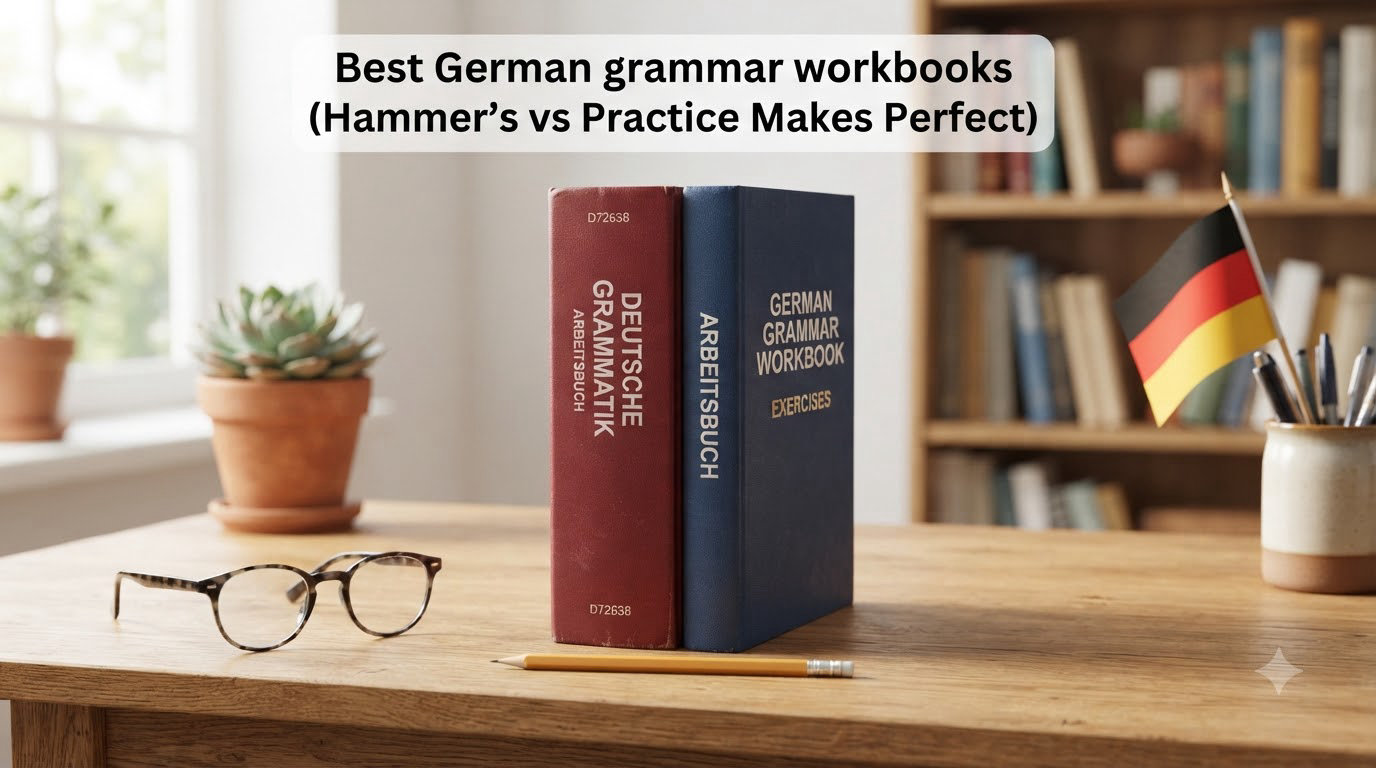
If you’re searching for the best German grammar workbook, you’ve probably narrowed it down to two titles: Hammer’s German Grammar and Usage and Practice Makes Perfect: Complete German Grammar. They are the two most-recommended English-language grammar books for self-study, but they are built for very different jobs.
Hammer’s is a reference grammar — the book you reach for when you need a deep, authoritative explanation of a case, a tense, or a sentence pattern. Practice Makes Perfect (often shortened to PMP) is a workbook — concept on the left page, exercises on the right, with an answer key in the back. Picking the wrong one wastes months. Using both together is the strategy most upvoted by readers of r/German.
This guide is the direct head-to-head comparison I wish I’d had when I started. I’ll break down who each book is for, when to pick one over the other, how to pair them, and which CEFR level (A1, A2, B1, B2, C1) each one actually fits.
Table of Contents
Quick Answer: Which German Grammar Workbook Should You Buy?
Buy Hammer’s German Grammar and Usage if you’re at B1 or above and want the most thorough English-language reference grammar available. Buy Practice Makes Perfect: Complete German Grammar if you’re between A1 and B1 and learn best by working through structured exercises. Buy both if you can: PMP becomes your daily spine, and Hammer’s becomes the lookup you pull off the shelf when PMP’s explanations leave a question unanswered.
That short answer covers roughly 90% of self-study learners. The rest of this guide explains the why, the when, and the how — including how to avoid the single biggest mistake learners make with Hammer’s (reading it cover-to-cover and burning out by chapter four).
What Is Hammer’s German Grammar and Usage?
Hammer’s German Grammar and Usage is the leading English-language reference grammar of modern German, currently in its 6th edition (Bloomsbury). It is edited by Martin Durrell, with contributions from a team of Germanists, and it has been in print since 1971. That longevity matters: it means the explanations have been refined across decades by teachers who actually use the book with English-speaking learners.
The book is organized by topic, not by lesson. Each chapter covers a single grammatical area — the cases (Nominativ, Akkusativ, Dativ, Genitiv), adjective declension, verb conjugations, the subjunctive moods (Konjunktiv I and II), word order, prepositions, and so on. Within each chapter, the grammar is explained in dense, paragraph form with examples. There are almost no exercises. There is no answer key. There is no audio.
This is the trade-off. You get the deepest, most accurate English-language explanations of German grammar anywhere. You do not get a structured course, and you do not get practice questions to test what you’ve absorbed. Reviewers on r/German consistently describe Hammer’s the same way: it is the reference grammar, not a textbook.
Who Hammer’s is built for
Hammer’s assumes you already understand what grammar is and how a language works. It does not stop to define basic terms. A first-year beginner opening this book will feel lost within ten pages — a recurring complaint in the r/German self-study threads.
What it does exceptionally well is answer the awkward questions. Why does the verb move to the end in some subordinate clauses and not others? When does “wann” mean “when” and when does it mean “if”? Why are there two past tenses and which one should I actually use? Hammer’s handles these with the kind of careful, layered explanation no workbook can match.
What Is Practice Makes Perfect: Complete German Grammar?
Practice Makes Perfect: Complete German Grammar is a theory-plus-exercises workbook written by Ed Swick, currently in its Premium 3rd Edition (McGraw-Hill). It is built around a lesson format: each unit opens with a short explanation of one grammar concept, shows a few examples, then gives you 20–40 exercises to practice it, with an answer key at the back of the book.
The format is the exact opposite of Hammer’s. PMP is linear — you work from unit 1 forward. The explanations are short, in plain English, and pitched at a learner who is encountering the concept for the first time. The exercises are the point of the book. Without them, you’d just have a short textbook.
The Premium 3rd Edition added online audio and digital exercises on top of the print workbook, which is why most buyers now specifically look for the Premium edition rather than the older 2nd edition.
Who PMP is built for
PMP is built for self-study learners between A1 and B1. If you’re starting from zero or rebuilding grammar after a few years away, the lesson-by-lesson format is the easiest path. You always know what to do next: read two pages, do the exercises, check the answers, move on.
The trade-off is depth. Once you’re at B1 and start asking the harder questions (when to use Konjunktiv II versus the simple past, how relative clauses interact with case, why some adjectives take weak endings and others strong), PMP’s explanations stop being enough. That’s when most learners discover they need Hammer’s.
Hammer’s vs Practice Makes Perfect: Direct Head-to-Head
The fastest way to choose between these two is to compare them across the six categories that actually matter for a self-study learner: format, level, exercises, depth of explanations, ease of use, and price.
Format
Hammer’s is a reference book. You open it to look something up. PMP is a workbook. You open it to work through the next lesson. If you want to study for 30 minutes a day with no decisions about what to do, PMP wins. If you want a book you can keep on your desk for the next five years and dip into forever, Hammer’s wins.
Level
Hammer’s covers everything from A1 to C1 and beyond, but its explanations are written for B1+ readers. PMP covers A1 to lower B1 in genuine depth; beyond that the explanations get thin. Reviewers on r/German and the Amazon listings agree: PMP is a beginner-and-intermediate book, Hammer’s is a serious-student book.
Exercises
Hammer’s has almost none. PMP is exercises. This is the single biggest practical difference. If you learn by doing, PMP gives you hundreds of practice items per unit. If you learn by reading, Hammer’s gives you the most thorough grammar reading you’ll find.
Depth of explanations
Hammer’s wins decisively here. Ed Swick’s explanations are clear and friendly; Durrell’s are dense and precise. When you need to understand why something works in German, Hammer’s is the book you trust.
Ease of use
PMP is easier. The lessons are short, the layout is uncluttered, the answer key is in the back. Hammer’s is dense, full of abbreviations, and assumes you can parse long paragraphs of grammatical prose. Beginners consistently give up on Hammer’s within the first 50 pages.
Price
PMP is roughly a third of the price of Hammer’s. That’s a real consideration for a self-learner buying on a budget — but it’s also the reason most learners end up owning both eventually.
Side-by-side comparison
The table below summarizes the head-to-head at a glance.
| Category | Hammer’s (6th ed.) | Practice Makes Perfect (Premium 3rd ed.) |
|---|---|---|
| Format | Reference grammar | Workbook with answer key |
| Best level | B1 to C1+ | A1 to lower B1 |
| Exercises | Very few | Hundreds per unit |
| Depth of explanations | Deepest in print | Clear but surface-level |
| Ease of use | Dense; reference style | Beginner-friendly |
| Approximate price | Higher | About a third of Hammer’s |
| Best for | Intermediate–advanced learners, university, test prep | Beginners, self-study from zero, structured learners |
| Weakness | No exercises; overwhelming for beginners | Stops short at B1; explanations get thin |
CEFR Level Guide: Which Book for A1, A2, B1, B2, and Beyond?
The CEFR (Common European Framework of Reference) gives us a clean way to map each book to the level you’re actually at.
A1 and A2: Start with PMP
At the absolute beginner level, you need a structured lesson path and lots of low-stakes practice. PMP gives you both. Hammer’s is not useful at A1 because you don’t yet have the grammatical vocabulary to follow the explanations. Save Hammer’s for later.
B1: Transition zone
At B1 you can start reading Hammer’s chapters profitably. The typical pattern learners describe on r/German is finishing a PMP unit, then opening Hammer’s to read the corresponding chapter for the deeper explanation. By the end of B1 you’ve used PMP as the spine and Hammer’s as the lookup.
B2 and beyond: Hammer’s becomes primary
Once you’re at B2, Hammer’s becomes your main grammar reference. PMP’s lessons no longer cover the cases and constructions you need. You read Hammer’s chapters for understanding, then find exercises elsewhere (Durrell’s companion Practising German Grammar, the German Grammar Drills book, or any online exercise bank).
C1 and C2: Hammer’s plus a usage dictionary
At C1/C2 you mostly need Hammer’s plus a good German usage dictionary for the fine points of register and idiom. PMP is no longer relevant for grammar study at this level.
How to Use Hammer’s Without Getting Overwhelmed
The single most common complaint about Hammer’s among self-study learners is overwhelm. Beginners try to read it cover-to-cover, get stuck around chapter three or four, and shelve it. That is the wrong way to use a reference grammar. Here is the right way.
Step 1: Pick one topic you actually need right now — for example, the dative case, or the simple past tense, or word order in subordinate clauses. Don’t try to learn all of German grammar at once.
Step 2: Read the relevant Hammer’s chapter slowly, twice. The first pass is for orientation. The second pass is where the explanations actually land.
Step 3: Keep a running notes file. Write out the one or two things from the chapter you didn’t already know. Don’t try to copy the chapter — just capture what’s new.
Step 4: Immediately find exercises for that topic from another source — PMP, German Grammar Drills, or an online exercise bank — and do them. Without exercises, what you read in Hammer’s fades within a week.
Step 5: Come back to Hammer’s only when you hit a question your other materials can’t answer. That’s the role it was designed for.
Using Hammer’s and Practice Makes Perfect Together
The single most upvoted recommendation on the r/German subreddit is to use both books together, and the pattern works because they cover each other’s weaknesses so cleanly.
The PMP-spine + Hammer’s-reference system
Work through PMP linearly as your daily study. When you hit a PMP lesson where the explanation leaves a question unanswered, open Hammer’s and read the relevant chapter. The PMP lesson becomes the practice you do; the Hammer’s chapter becomes the understanding you bring to it.
This system works for the entire A1-to-B1 journey. By the time you finish PMP, you’ve also read most of the relevant Hammer’s chapters without ever trying to read the book cover-to-cover.
The Durrell duo: Hammer’s + Practising German Grammar
Some learners prefer a different pairing: Hammer’s plus its companion workbook, Practising German Grammar, also by Durrell. The advantage is that the explanations and the exercises come from the same author, so the vocabulary and example patterns match. The disadvantage is that you give up PMP’s friendly beginner pacing.
If you’re starting from zero, the PMP spine is easier. If you’re restarting after a gap and can already read intermediate grammar, the Durrell duo feels tighter.
The Ed Swick duo: PMP + German Grammar Drills
Ed Swick also wrote a second workbook, German Grammar Drills. The Ed Swick duo (PMP + Drills) is the obvious pairing if you want to stay within one author’s voice across both theory and exercises. Reviews on Amazon and Goodreads consistently rate this duo well for A1-B1 self-study.
Who Should Buy Hammer’s (and Who Shouldn’t)
You should buy Hammer’s if you are at B1 or above, you learn best by reading precise explanations, you are preparing for an exam (Goethe, TestDaF, DSH) where the finer points of case and tense matter, or you are a university student taking German linguistics or translation courses.
You should not buy Hammer’s if you are starting from absolute zero and want a linear course to follow, if you learn best by doing exercises rather than reading explanations, or if you want a single book that combines theory and practice. For all three of those cases, PMP is the better first purchase.
Who Should Buy Practice Makes Perfect (and Who Shouldn’t)
You should buy Practice Makes Perfect if you are between A1 and lower B1, you want a structured daily study plan you can work through without deciding what to do next, you learn by doing exercises, or you want a grammar book with an answer key so you can self-check.
You should not buy PMP if you are above B1 and need depth on the trickier parts of German, if you already own a similar self-study workbook you like, or if you learn best by reading long explanations and don’t need the exercises. For those learners, Hammer’s is the better fit.
Frequently Asked Questions
Is Hammer’s German Grammar and Usage a good book?
Yes. Hammer’s German Grammar and Usage is the leading English-language reference grammar of modern German, currently in its 6th edition. It gives the deepest, most precise explanations of cases, verb conjugations, subjunctive mood, and word order available in print. The trade-off is that it has almost no exercises and is dense, so it works best for learners at B1 or above who use it as a reference rather than reading it cover-to-cover.
Is Hammer’s German Grammar good for beginners?
Not as a first book. Beginners consistently report feeling lost in Hammer’s because the explanations assume you already know what grammar is and use technical vocabulary without defining it. If you are at A1 or A2, start with a structured workbook like Practice Makes Perfect first, then introduce Hammer’s once you reach B1 and can follow the explanations.
How do I use Hammer’s German Grammar without getting overwhelmed?
Do not try to read Hammer’s cover-to-cover. Pick one specific topic you need right now, read that chapter slowly twice, write down the one or two things you didn’t already know, then find exercises for that topic elsewhere. Use Hammer’s as a lookup when your other materials can’t answer a question. That is the role the book was designed for.
Should I use Hammer’s and Practice Makes Perfect together?
Yes — using both together is the most upvoted recommendation on r/German. The combination covers each book’s weaknesses: PMP gives you the structured lessons and exercises for A1-B1, and Hammer’s gives you the deeper explanations PMP lacks. Work through PMP linearly, and open Hammer’s whenever a PMP explanation leaves a question unanswered.
Which edition of Hammer’s and Practice Makes Perfect should I buy?
For Hammer’s, buy the current 6th edition from Bloomsbury — earlier editions are missing updates to several chapters. For Practice Makes Perfect, buy the Premium 3rd Edition by Ed Swick, which adds online audio and digital exercises. Older 2nd editions are missing the audio component and have less polished layouts.
Can Practice Makes Perfect get me to B1 or B2 German?
PMP can take you comfortably to a strong A2 and into early B1 with consistent study. Beyond that, its explanations get thin for the harder cases and tenses, and most learners need a deeper reference like Hammer’s plus a separate exercise source to progress through B1 and into B2.
Verdict: One Book, the Other, or Both?
For the best German grammar workbook choice in 2026, the short version is this: pick PMP if you’re starting out, pick Hammer’s once you’re past the early stages, and pick both if you can afford to. The Reddit community’s most consistent advice is that no single book covers German grammar in full for an English-speaking self-learner — and the Hammer’s-plus-PMP pairing is the closest thing to a complete system you can buy off the shelf.
Whatever you choose, commit to it. Both books work, but only if you actually work through them.