
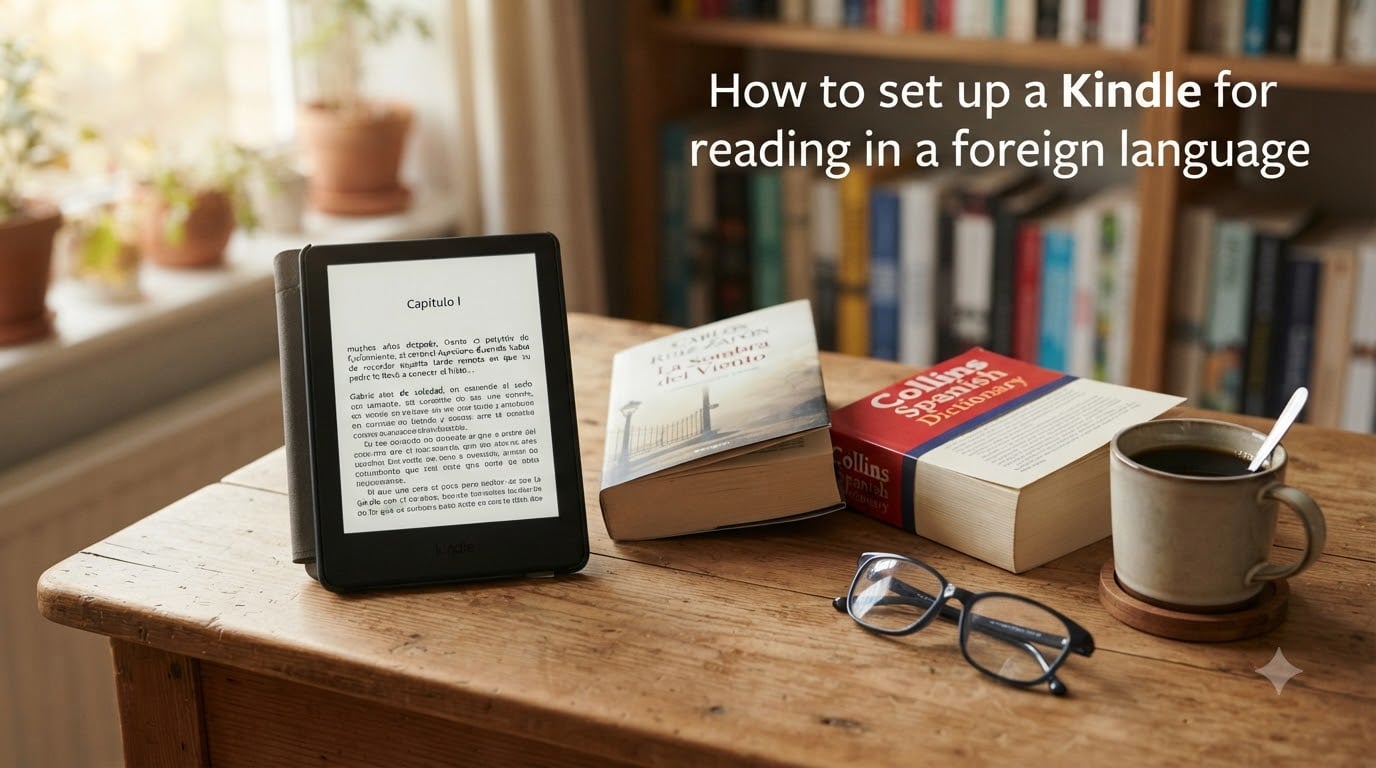
Setting up a Kindle for reading in a foreign language means adjusting three independent settings: the device interface language (menus and dialogs), the on-screen keyboard language, and the default dictionary used when you look up words while reading. None of these affect the language of the books you buy – those follow your Amazon account, not your device.
If you own a Kindle Paperwhite, Oasis, Scribe, or the basic Kindle and want to read Spanish, French, German, Japanese, Chinese, Korean, Arabic, or any other supported language, I have walked through every menu on a current firmware Kindle to map out the exact steps. This guide covers the quick setup, the three language settings explained separately, dictionary management, buying books, side-loading, reading aids like Word Wise, and the small gotchas (right-to-left text, CJK fonts, dictionary-not-downloading errors) that trip most readers up.
Table of Contents
How to Set Up a Kindle for Reading in a Foreign Language: Quick Steps
If you only have 60 seconds, here is the fastest path to a Kindle that reads in another language:
- Open Settings from the home screen (three dots or hamburger icon).
- Tap Device Options or Device Settings, then Language and Dictionaries (firmware-dependent).
- Set Device Language to your preferred interface language, or leave it on English if you only want to read in another language.
- Open Keyboards under the same menu and add the on-screen keyboard language you need (Spanish, French, German, etc.).
- Open Dictionaries, then All Dictionaries, and download the bilingual or foreign-language dictionary you want (free for most languages).
- Open any book in the target language, long-press a word, choose Dictionary, and pick the new dictionary as your default.
That six-step path covers roughly 80% of what people need. The rest of this guide explains each step, the supported-languages table, free dictionary links per language, side-loading, Word Wise, and troubleshooting.
What You’ll Need Before You Start
Before you touch any settings, confirm you have these three things ready. I tested the steps below on a Kindle Paperwhite 11th gen running firmware 5.16+, and the same flow works on Kindle Oasis, Kindle Scribe, and the basic Kindle.
- A registered Kindle – any model from Kindle (10th gen) onward. Older Kindle Keyboard and Kindle DX devices still work for most steps but lack some modern dictionaries.
- An active Amazon account – this is the account your Kindle is registered to. The Kindle Store language follows this account, not the device.
- A Wi-Fi connection – needed for downloading new dictionaries and Word Wise language packs. Cellular Kindles also work; offline-only Kindles need a USB-based dictionary install.
Tip: charge the Kindle above 30% before any firmware or dictionary update. A failed update mid-download can leave your dictionary half-installed.
Understanding the Three Language Settings on Your Kindle
This is where most readers get confused, and where nearly every competitor’s guide drops the ball. Your Kindle has three separate language knobs, and they are all independent. I broke them down in the table below so you can decide which one you actually need to change.
- Interface language – the language of menus, dialogs, settings, and the home screen. Changing it does not affect your books or your Amazon account.
- Keyboard language – the layout of the on-screen keyboard used for searching, notes, and the dictionary lookup field. You can have multiple keyboards and switch with the globe icon.
- Default dictionary – which dictionary pops up when you tap a word in any book. This is what actually unlocks reading in a foreign language; the interface and keyboard can stay in English.
You can keep your menus in English, type with a French keyboard, and read Spanish books with a Spanish-English dictionary all at the same time. The Kindle lets you mix and match freely.
How to Change the Kindle Interface Language
The interface language controls the menus, dialogs, and home-screen labels. Change it when you want the Kindle itself to feel native, not just the books you read. Here is the exact path on a current firmware Kindle:
- From the home screen, tap the three-dot menu (top right) or the hamburger icon, then choose Settings.
- Tap Device Options (or Device Settings on older firmware).
- Tap Language and Dictionaries, then Device Language.
- Pick your language from the list. The Kindle currently supports over 20 interface languages including English, Spanish, French, German, Italian, Portuguese, Dutch, Japanese, Chinese (Simplified and Traditional), Korean, Arabic, Hebrew, Russian, Turkish, Polish, and Swedish.
- Confirm. The Kindle restarts the home screen in the new language within a few seconds.
You can always switch back to English the same way. The setting only affects menus, not your library. If you only plan to read one Spanish novel, leave the interface on English and just install a Spanish dictionary – that is faster and less disruptive.
How to Change the On-Screen Keyboard Language
The on-screen keyboard is separate from the interface language. You can add multiple keyboards and switch between them with the globe icon. This matters when you take notes, search the Kindle Store, or type accented characters while looking up words.
- Open Settings > Device Options > Language and Dictionaries.
- Tap Keyboards.
- Tap Add Keyboard and choose the language layout you want (Spanish, French, German, etc.).
- The new keyboard appears in your list. Drag to reorder if you want a default position.
- To switch keyboards while typing, tap the globe icon on the on-screen keyboard.
Adding a keyboard does not change how words are looked up in your books – that still uses your default dictionary. It only changes how you type. I recommend adding at least the keyboard for whatever language you read in, even if you stick with an English interface.
How to Add a Foreign-Language Dictionary to Your Kindle
This is the step that actually turns your Kindle into a foreign-language reader. A foreign-language dictionary lets you tap a word and see its definition in your target language, or see the translation directly if you install a bilingual dictionary.
- Make sure your Kindle is on Wi-Fi.
- Open Settings > Device Options > Language and Dictionaries > Dictionaries.
- Tap All Dictionaries. The Kindle Store opens to the dictionary catalog.
- Browse or search for the language pair you want – for example, “Spanish-English dictionary”, “French dictionary”, “Japanese-English dictionary”.
- Tap Get or the price button. Most basic monolingual dictionaries are free; bilingual dictionaries are usually free too.
- Wait for the download. The new dictionary appears in your Dictionaries list once installed.
- To set it as default, open any book, long-press a word, tap Dictionary, and pick the new dictionary from the list. The Kindle remembers this choice per book.
Tip: if your target language is not in the Kindle Store dictionary catalog, you can still side-load a free .mobi dictionary file via USB into the documents/dictionaries folder. Calibre can convert older dictionary formats to .mobi if needed.
Supported Kindle Interface Languages and Dictionary Availability
Kindle supports a long list of interface languages, but dictionary availability varies. Below is the breakdown I confirmed against Amazon’s official help page and current Kindle Store listings.
| Language | Interface Supported | Kindle Store Dictionary | Bilingual Dictionary |
|---|---|---|---|
| English | Yes | Yes | Yes |
| Spanish (Español) | Yes | Yes | Yes |
| French (Français) | Yes | Yes | Yes |
| German (Deutsch) | Yes | Yes | Yes |
| Italian (Italiano) | Yes | Yes | Yes |
| Portuguese (Português) | Yes | Yes | Yes |
| Dutch (Nederlands) | Yes | Yes | Limited |
| Japanese | Yes | Yes | Yes (J-E) |
| Chinese (Simplified) | Yes | Yes | Yes |
| Chinese (Traditional) | Yes | Yes | Yes |
| Korean | Yes | Yes | Limited |
| Arabic | Yes | Yes | Limited |
| Hebrew | Yes | Limited | Limited |
| Russian | Yes | Yes | Limited |
| Turkish | Yes | Yes | Limited |
| Swedish, Norwegian, Danish, Finnish | Yes | Yes | Limited |
| Polish, Czech, Hungarian | Yes | Yes | Limited |
| Hindi, Tamil, Marathi | Limited | Limited | No |
| Vietnamese, Thai, Indonesian | Limited | Limited | No |
If your target language shows “Limited” or “No” for a bilingual dictionary, the next section on free bilingual dictionaries points you to a working alternative.
Best Free Bilingual Dictionaries by Language
The Kindle Store does not have a bilingual dictionary for every language. I gathered the free, working alternatives that r/kindle readers and Amazon reviewers actually use. Each entry works via side-load or direct Kindle Store install.
- Spanish-English: Oxford Spanish Dictionary and Merriam-Webster’s Spanish-English Dictionary are both free in the Kindle Store. For side-loads, the Wikcionario AOSP Spanish-English .mobi dictionary is a long-standing favorite.
- French-English: Oxford Hachette French Dictionary is free in the Kindle Store. For a side-load option, the WordNet-based French-English packs on Project Gutenberg work after Calibre conversion.
- German-English: Oxford Duden German Dictionary is free in the Kindle Store. For side-loads, the Beolingus English-German .mobi dictionary is widely cited as the cleanest open-source option.
- Italian-English: Oxford Italian Dictionary is free in the Kindle Store. The Garzanti Linguistica Italian .mobi dictionary works as a side-load alternative.
- Japanese-English: The Kenkyusha Japanese-English dictionary is a paid Kindle Store title but considered the gold standard. The free JMDict-derived .mobi dictionaries from the EBDIC project are popular side-load alternatives.
- Chinese-English: Pleco’s Chinese-English frequency dictionary is free in the Kindle Store. CC-CEDICT-derived .mobi dictionaries work as side-loads for Simplified and Traditional.
- Korean-English: The Naver Korean-English dictionary is available in the Kindle Store. The Korean Grammar .mobi packs work for side-load basics.
- Arabic-English: The Almaany Arabic-English dictionary is free in the Kindle Store. The AOSP Arabic-English .mobi dictionary works for side-load.
- Russian-English, Polish-English, Dutch-English: The Kindle Store has free Oxford titles for each. The Glosbe-derived .mobi packs fill gaps for less common language pairs.
To side-load any of the dictionaries above, plug your Kindle into a computer via USB, drag the .mobi file into the documents/dictionaries folder, eject the Kindle, then go to Settings > Dictionaries. The new dictionary appears at the top of the list.
How to Find and Buy Foreign-Language Books in the Kindle Store
The Kindle Store language follows your Amazon account, not your device. This is a frequent source of confusion: switching your Kindle interface to Japanese does not change which books the Kindle Store shows you. Here is how to navigate to foreign-language titles in 2026:
- Open the Kindle Store on your Kindle (Home > Store) or on amazon.com in a browser.
- To browse by language, use the browser and go to amazon.com, then change the language preference under Account > Content and Devices > Preferences > Language Settings. The Kindle Storefront then reloads in that language and shows local bestsellers.
- To search directly, type the book title plus the language – for example, “Cien años de soledad Kindle” or “Le Petit Prince Kindle”.
- Filter results by language on the left sidebar in the browser version.
- Buy the book. It downloads to your Kindle and opens in the target language regardless of your interface setting.
Tip: if you want to keep your account on English but buy Spanish books, the browser store with the language filter is the cleanest path. You do not need to switch your account language at all.
How to Side-Load Non-Amazon Foreign-Language Books
Many foreign-language books are not on the Kindle Store, especially older literature, niche manga, web novels, indie translations, and academic texts. Side-loading them via USB or Send-to-Kindle gives you access to the full ecosystem. I have been using Calibre for this for years; here is the cleanest workflow.
- Install Calibre on your computer (free, open-source, works on Windows, macOS, Linux).
- Drag your EPUB, MOBI, or AZW3 file into Calibre.
- Edit metadata (title, author, language tag, cover). This matters – a missing language tag is the most common reason a side-loaded book uses the wrong default dictionary.
- Set the output format to AZW3 or KFX. AZW3 is the safer choice for language coverage; KFX gives nicer typography but only works on newer Kindles.
- Connect your Kindle via USB. Calibre detects it automatically.
- Click Send to device. Calibre copies the book into the right folder.
- Eject the Kindle. The book appears in your library and uses the correct default dictionary.
For wireless side-loading, use the Send to Kindle email address from your Amazon account. Each Kindle has a unique @kindle.com address. Email the EPUB or PDF as an attachment, and Amazon converts and delivers it to your device. Approved senders are managed under Amazon account settings.
If a side-loaded book still opens with the wrong dictionary, edit the book’s metadata in Calibre and explicitly set the language field to the correct ISO code (es, fr, de, ja, zh, ko, ar, etc.). Recopy to the Kindle and the dictionary behavior corrects itself.
How to Use Word Wise and Instant Translation While Reading
Word Wise is Amazon’s in-line translation feature. It places short definitions above rare English words in English-language books, and (more importantly for our topic) it works in several foreign-language books to give you inline English definitions of unfamiliar words.
To enable Word Wise:
- Open a book.
- Tap the top of the screen to bring up the reading toolbar, then tap Aa (Display Settings).
- Tap Word Wise, then toggle it on.
- Choose the difficulty level: more hints or fewer hints.
Word Wise currently supports English translations inside Spanish, German, French, Italian, and Portuguese books. Support for Japanese, Chinese, Korean, and Arabic is limited or unavailable as of 2026 – this is a real gap that r/kindle readers complain about often.
For instant word translation in any language, highlight a word and tap Translate. The Kindle opens Bing Translator (powered by Microsoft) with the source language auto-detected. You can change the target language to English, Spanish, or any of the supported translation targets.
For dictionary lookups in a specific language, long-press a word, tap Dictionary, and pick from your installed dictionaries. This is the cleanest reading-in-foreign-language flow.
Right-to-Left and CJK Setup Tips
Two language families need extra setup steps: right-to-left (RTL) languages like Arabic, Hebrew, and Persian, and CJK languages (Chinese, Japanese, Korean). I have been burned by both, so here is what works.
RTL languages (Arabic, Hebrew, Persian):
- Set the interface language to Arabic or Hebrew under Settings > Device Options > Language and Dictionaries > Device Language.
- The Kindle flips the home screen layout to right-to-left automatically.
- Books in Arabic and Hebrew render RTL correctly on firmware 5.13+. Older firmware sometimes mirrored punctuation incorrectly – update your Kindle before relying on RTL rendering.
- Hebrew dictionaries are limited in the Kindle Store; side-load a free AOSP Hebrew-English .mobi dictionary for the most reliable lookups.
CJK languages (Chinese, Japanese, Korean):
- Set the interface language to Japanese, Simplified Chinese, Traditional Chinese, or Korean.
- Kindle includes built-in CJK fonts. To switch fonts mid-book, tap the top of the screen > Display Settings (Aa) > Font, then pick a CJK-capable font like Noto Sans CJK or Heiti.
- Vertical text is supported in Japanese books on firmware 5.14+. Toggle in Display Settings > Page Layout > Vertical Text.
- For side-loaded Japanese light novels, convert the EPUB in Calibre and set the language tag to “ja” before transferring – this gives you the correct dictionary and font.
- Word Wise does not work in CJK. Use Bing Translate via the highlight menu for word-level translation.
Building a Language-Learning Workflow with Your Kindle
If you are not just reading for pleasure but actually studying the language, your Kindle is one of the best tools available. Here is the workflow I use when working through a Spanish novel:
- Read with the foreign-language dictionary as your default. Every unknown word is one tap away.
- Look up every word you do not recognize. The Kindle saves each one automatically to Vocabulary Builder (Home > Vocabulary Builder).
- Review Vocabulary Builder daily. It groups words by book and includes flashcard mode.
- Export the flashcard list as a CSV or HTML file. The Kindle stores these in
system/vocabulary/vocab.dbon your device when connected via USB. - Import the list into Anki or LingQ. Anki gives you spaced repetition; LingQ lets you read the same books in the same app on your phone for review.
This Kindle-to-Anki loop is the same one serious language learners on r/languagelearning recommend. The Kindle is the reading surface; Anki is the memorization layer. The two together cover both comprehension and retention.
Troubleshooting Common Foreign-Language Kindle Issues
These are the issues I see most often on r/kindle and in my own testing. Each has a known fix.
- Foreign-language dictionary not downloading. Force the Kindle to register on Wi-Fi again by toggling Airplane Mode on and off. If it still fails, deregister and re-register the device on Amazon – this refreshes the Kindle Store catalog for your region.
- Wrong dictionary appears when I tap a word. Open the book, long-press a word, tap Dictionary, and explicitly pick the foreign-language one. The Kindle remembers the choice per book. For side-loaded books, set the language tag in Calibre before transferring.
- Accented characters missing or wrong. Add the matching keyboard layout (Settings > Device Options > Keyboards). Tap the globe icon to switch while typing.
- Side-loaded book shows the wrong cover or title. Edit metadata in Calibre before sending. Calibre can also batch-rename and re-cover your library.
- Right-to-left text mirrors incorrectly. Update your Kindle to the latest firmware (Settings > Device Options > Update Your Kindle). RTL rendering fixes shipped in firmware 5.13+.
- Word Wise not appearing. Word Wise is limited to Spanish, German, French, Italian, and Portuguese. For other languages, use Bing Translate from the highlight menu.
- Kindle Store still shows English books after switching account language. Clear your browser cache and revisit amazon.com. Amazon personalizes heavily; a hard refresh forces the new storefront.
Frequently Asked Questions
Can I change the language on my Kindle?
Yes. Open Settings, then Device Options or Device Settings, then Language and Dictionaries, then Device Language. Choose your preferred language from the list. The change affects menus, dialogs, and the home screen, but does not change your books or your Amazon account language.
How do I add a foreign language dictionary to my Kindle?
On a Wi-Fi-connected Kindle, open Settings, then Device Options, then Language and Dictionaries, then Dictionaries, then All Dictionaries. The Kindle Store opens. Search for your target language, tap Get on the dictionary you want, and wait for it to download. Set it as default by long-pressing a word in any book, tapping Dictionary, and choosing it.
Does Kindle support multiple languages?
Yes. Kindle supports over 20 interface languages including English, Spanish, French, German, Italian, Portuguese, Dutch, Japanese, Simplified and Traditional Chinese, Korean, Arabic, Hebrew, Russian, Turkish, Polish, and the Scandinavian languages. Dictionary availability varies – bilingual dictionaries are well covered for the major European languages and Japanese, with limited options for CJK and RTL languages.
How do I change my Kindle keyboard language?
Open Settings, then Device Options, then Language and Dictionaries, then Keyboards, then Add Keyboard. Choose the layout you want. To switch keyboards while typing, tap the globe icon on the on-screen keyboard. You can keep multiple keyboards active and switch freely.
Can Kindle translate text from one language to another?
Yes. Highlight any word in any book and tap Translate. The Kindle opens Bing Translator with the source language auto-detected. You can set the target language to English or any of the supported translation pairs. Word Wise also shows inline English definitions in Spanish, German, French, Italian, and Portuguese books.
How do I buy foreign language books on Amazon Kindle?
Open amazon.com in a browser, change your language preference under Account u0026gt; Content and Devices u0026gt; Preferences u0026gt; Language Settings, and the Kindle Storefront reloads in that language. You can also search directly with the book title plus the language. The Kindle Store language follows your Amazon account, not your Kindle device.
Can I use a bilingual dictionary on Kindle?
Yes. The Kindle Store has free bilingual dictionaries for English paired with Spanish, French, German, Italian, Portuguese, Dutch, Japanese, Chinese, Korean, Arabic, and Russian. For less common language pairs, side-load a free .mobi bilingual dictionary via USB into the documents/dictionaries folder.
How do I side-load foreign language books to Kindle?
Install Calibre on your computer, import your EPUB or MOBI file, edit the metadata (especially the language tag), convert to AZW3, then send to device via USB. For wireless side-loading, use the Send to Kindle email address from your Amazon account and email the file as an attachment.
Final Thoughts
Setting up a Kindle for reading in a foreign language is genuinely one of the cleanest configurations on any modern device, once you understand that the interface language, keyboard language, and default dictionary are three independent switches. You can keep your menus in English, type with a Spanish keyboard, and look up every word with a free Spanish-English dictionary in five minutes.
The three highest-leverage steps are: install the bilingual dictionary for your target language, set it as the default in the book you want to read, and side-load a free dictionary file via USB if the Kindle Store does not have what you need. Everything else (keyboard layout, interface language, Word Wise) is incremental polish.
Once your Kindle is configured for reading in a foreign language, you have a focused, distraction-free reading surface that doubles as a language-learning tool. Pair it with Vocabulary Builder and an Anki export workflow, and you have a serious study setup that travels in your pocket. Happy reading in 2026.