
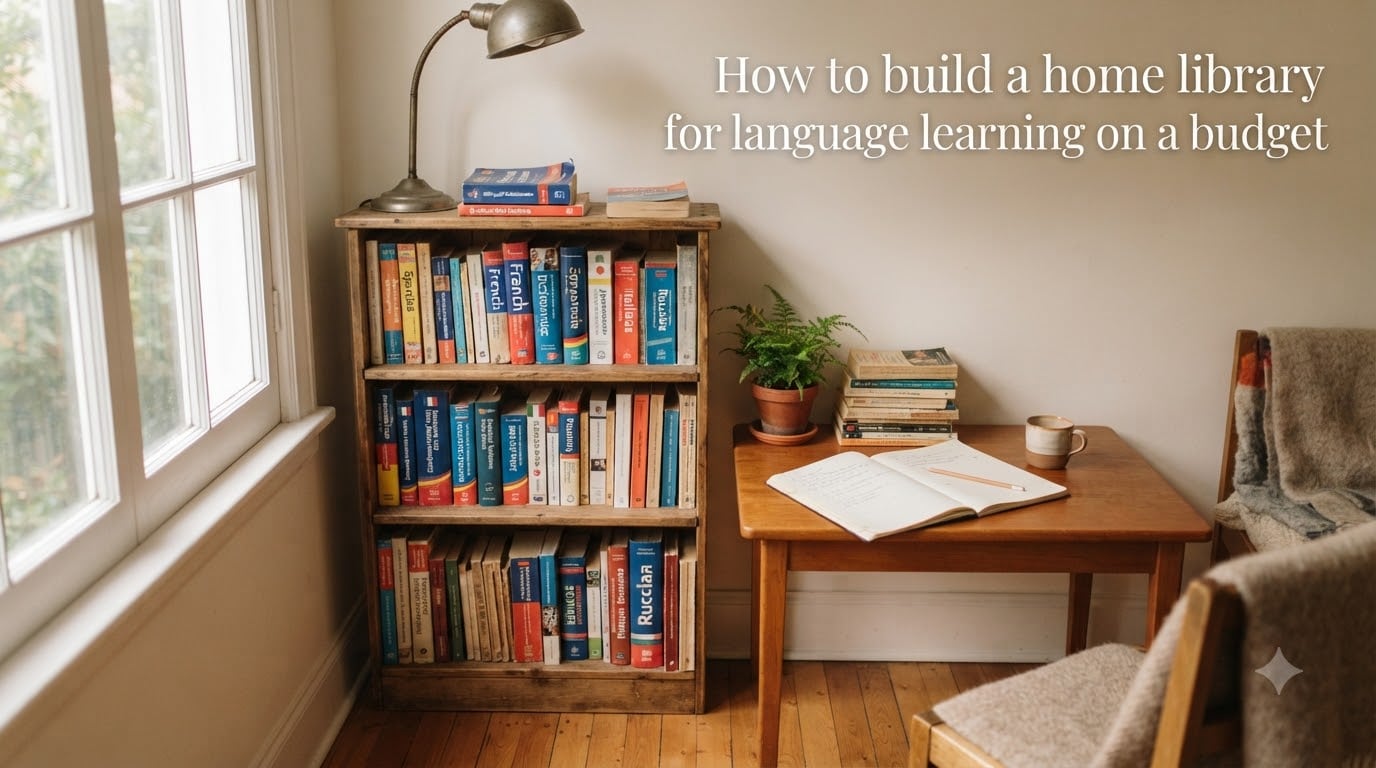
A language learning home library is a personal collection of textbooks, dictionaries, grammar references, graded readers, and audio resources curated around one or more target languages, built intentionally to support self-study. You can build a useful starter library for as little as $25 using used books and free digital resources.
After a few months of putting together my own collection, I realized the biggest unlock was not the apps on my phone. It was the shelf of well-chosen books I kept coming back to. Apps are great for spaced repetition, but they rarely give you the structured, distraction-free depth that a real book does. A focused home library for language learning, even a tiny one, becomes the spine of your study routine.
The good news: you do not need a big budget. In this guide, I will walk you through five practical steps for building a personal language library that fits your goals, plus a tiered budget plan starting at just $25. Whether you are learning Spanish, German, Japanese, or anything in between, the same framework applies.
Table of Contents
Step 1: Define Your Language Goal and Current Level
Before buying a single book, get clear on two things: which language you are actually studying, and where you realistically are right now. Without this, you will end up with a pile of mismatched materials.
The CEFR framework (A1 to C2) is the easiest way to anchor your level. A1 is absolute beginner, B1 is conversational, B2 is upper intermediate, and C1 is advanced. Most self-study bookshelves are organized around these tiers, so knowing your CEFR level lets you skip whole categories that are not relevant yet.
Ask yourself three questions:
- Do I want to learn one language deeply, or sample several?
- Am I preparing for travel, an exam, heritage maintenance, or pure curiosity?
- How much time can I honestly give this each week, for the next 6 months?
Your answers decide whether you need a single-language deep-dive shelf or a multi-language sampler shelf. A single-language learner benefits from buying across categories. A polyglot-in-training is better off buying one solid starter per language and rotating.
Do not skip this step. Most people over-buy because they never defined the goal. A focused $25 shelf for one language beats a scattered $200 shelf for three.
Step 2: The Essential Book Categories Every Language Library Needs
A complete budget language library needs five to seven core categories. Here is the table I use when planning any new language shelf.
| Category | Purpose | Ideal Level | Free Alternative |
|---|---|---|---|
| Starter Textbook | Structured lessons with explanations and exercises | A1 to B1 | Open Library loans, Wikibooks |
| Bilingual Dictionary | Look up words quickly while reading | All levels | Wiktionary, Google Translate (offline file) |
| Grammar Reference | Look up rules when confused | All levels | Public library, free PDF downloads |
| Graded Readers | Reading practice at the right difficulty | A1 to B2 | LingQ mini-stories, BBC Languages archive |
| Audio Companion or Audiobook | Listening practice on the go | All levels | LibriVox, free language podcasts |
| Meta-Learning Book | Strategies for how to learn languages | Any learner | Library borrow of Fluent Forever |
You do not need every category on day one. Start with a starter textbook, a bilingual dictionary, and one graded reader. Add the others as your budget and commitment grow.
Why Meta-Learning Books Belong on Your Shelf
Meta-learning books teach you the science and strategy behind language acquisition. Titles like Fluent Forever by Gabriel Wyner or How to Learn Any Language by Barry Farber changed how I study more than any textbook. They are also widely available at libraries, so you can read them for free before deciding whether to buy.
Step 3: Where to Find Free or Cheap Language Books
This is where the budget language library gets built. Most of the sources below will get you the books in your Step 2 list at a steep discount, or free.
Free Sources
- Your public library – The single best resource. Most public libraries have a foreign language section and offer free interlibrary loans for harder-to-find titles.
- Open Library (openlibrary.org) – Borrow digital scans of thousands of language textbooks and readers. Free with an account.
- Project Gutenberg (gutenberg.org) – Public domain bilingual books, especially strong for French, German, Spanish, and Italian classics.
- Wikibooks – Free textbook-style language lessons, surprisingly decent for review.
- LibriVox (librivox.org) – Free public-domain audiobooks in dozens of languages. Perfect audio companions.
- BBC Languages archive – Though no longer updated, the lesson PDFs and audio are still downloadable.
- LingQ mini-stories – Free tier offers beginner reading and listening practice.
- Language-specific free PDFs – Many government cultural institutes (Goethe, Alliance Francaise, Cervantes) post free learning materials.
Cheap Sources (Under $10 Per Book)
- ThriftBooks (thriftbooks.com) – Used paperbacks from a few dollars, with free shipping over a small threshold. My default starting point.
- AbeBooks (abebooks.com) – The single best source for older and out-of-print language textbooks. Search the foreign language section.
- LibraryThing (librarything.com) – A cataloging site that also surfaces used copies and rare finds.
- Thrift stores and used bookstores – Always browse the foreign language shelf. You will occasionally find $1 treasures.
- Library book sales – Annual clearance sales often sell retired copies for one to three dollars.
- LibraryThing Local and neighborhood Little Free Libraries
- Facebook Marketplace and Buy Nothing groups – Language learners offloading old textbooks.
- University surplus sales – When language departments upgrade editions, they sell the old ones cheap.
Stack two or three sources. For example, pair a free Open Library loan of a grammar reference with a $5 ThriftBooks graded reader, and you have already built a working shelf for under $10.
Step 4: Borrow vs Buy — A Decision Framework
Not every language book belongs on your shelf. Some you want to own forever; others you need exactly once. Here is the simple framework I use.
- Buy reference books you will return to again and again: your main grammar reference, frequency dictionary, and a bilingual dictionary. These earn their shelf.
- Borrow textbooks you will work through once. Public library and Open Library loans cover this perfectly.
- Buy readers only when you love them. Most graded readers are consumable. Borrow first, buy only the ones you want to reread or annotate.
- Always borrow meta-learning books first. They are easy to find at libraries, and you do not want a shelf of self-help books you read once.
Following this rule keeps your shelf lean and your wallet intact.
Step 5: Tiered Budget Plan for Your Starter Library
Below is the framework I use for new learners. Pick the tier that matches your commitment level. You can always upgrade later.
| Budget Tier | What to Buy | Where to Source Each | Best For |
|---|---|---|---|
| $25 Starter | 1 used starter textbook, 1 used bilingual dictionary, library borrow of a grammar reference | ThriftBooks, AbeBooks, free library apps | Beginners testing commitment |
| $50 Intermediate | Add 1 graded reader set, 1 audio companion, plus a meta-learning book from the library | ThriftBooks for readers, LibriVox for audio, library borrow for meta book | Learners past the 3-month mark |
| $100 Advanced | Add a full graded reader series (5 to 8 books), a frequency dictionary, and a second reference grammar | AbeBooks for series deals, Open Library for the rest | Serious self-study at B1 and beyond |
How many books do you need to learn a language? In my experience, three to five well-chosen books are enough for a beginner shelf, with another five to eight added as you move into intermediate reading. Beyond that, variety matters more than volume.
Start at $25. If you are still studying after 90 days, level up to $50. If you cross six months, go for the $100 shelf. This graduated spending matches the way real commitment builds.
Common Mistakes to Avoid When Building Your Library
After watching dozens of learners (and making most of these errors myself), here are the pitfalls I see most often.
- Buying multiple new textbooks upfront. Most learners regret this within a month. Start with one used textbook, prove your commitment, then buy more.
- Choosing the wrong CEFR level. A B1 grammar book will crush a beginner. Match every book to your current level, not your goal level.
- Picking outdated editions. Some grammar books go through major revisions. For living languages, editions older than 10 to 15 years may use deprecated terminology.
- Skipping audio entirely. A library without listening material leaves a major skill underdeveloped. Pair every textbook with at least one free audio source.
- Buying a single-language paper dictionary. Free dictionary apps now exceed paper dictionaries for most languages. Save your shelf space.
- Buying for languages you have not started yet. That beautiful Italian grammar book does not help if you are still on Spanish basics.
Avoid these and your shelf will stay useful instead of becoming a guilt collection.
How to Organize and Catalog Your Language Library
A small, well-organized shelf beats a large chaotic one. Here is the system that has worked for me across four languages.
- One shelf or box per language. Label the spine. Even a sticky note saves real time.
- Sub-sort by category. Within each language, group textbooks, readers, dictionaries, and audio together.
- Keep a digital catalog. LibraryThing is free for up to 200 books and tracks your collection, notes, and which books you have actually finished.
- Store a small notebook per language with your active study notes, vocabulary, and progress markers. The notebook is part of the library.
For multi-language hobbyists, color-coded stickers on the spine make browsing faster. The goal is to make picking up the right book feel as easy as opening an app.
Are used books good for learning a language? Yes, with one caveat: confirm the edition is not more than 15 years old for grammar references, and that any included audio is still accessible through the publisher’s site.
Frequently Asked Questions
How do I start a home library for language learning?
Pick one target language and your current CEFR level (A1 to C2), then collect five core book categories: a starter textbook, a bilingual dictionary, a grammar reference, a graded reader, and one audio companion. Source most of them free from your public library and Open Library, and spend on used copies only for the books you will return to again and again.
What are the best books for learning a new language on a budget?
The best budget buys are used starter textbooks from ThriftBooks or AbeBooks, library-borrowed grammar references, free graded readers from Open Library, and free audiobooks from LibriVox. For meta-learning, borrow Fluent Forever or How to Learn Any Language from your public library before deciding whether to own them.
Where can I find free or cheap language learning books?
Free sources include your public library (with interlibrary loan), Open Library, Project Gutenberg, Wikibooks, LibriVox, and the BBC Languages archive. Cheap sources include ThriftBooks, AbeBooks, LibraryThing, thrift stores, library book sales, and university surplus sales. Stacking two or three sources lets you build a working shelf for under $25.
Are used books good for learning a language?
Yes, as long as the edition is not outdated for grammar references (avoid anything older than 10 to 15 years for living languages) and any bundled audio is still accessible through the publisher. Used paperbacks are usually fine for readers and dictionaries, which rarely go out of date.
What is the cheapest way to learn a language?
Combine a free app like Duolingo or Anki for daily drills with a free library-borrowed textbook and one used graded reader. Add a free LibriVox audiobook for listening practice. This stack costs almost nothing and covers reading, listening, vocabulary, and structured lessons.
Is it cheaper to learn a language with books or apps?
Apps are cheaper up front, since most free tiers cover the basics. Books become cheaper over the long term because you keep using the same shelf for years. The best budget plan combines both: free apps for daily practice plus a small used-book shelf for depth and structure.
Conclusion
Building a home library for language learning on a budget is not about owning everything. It is about choosing the right five to ten books for your current level and committing to actually use them. Start with a $25 starter shelf, sourced from your public library and one or two used-book sites, and grow it only after you have stuck with the language for 90 days.
Pick your target language today, set your CEFR level, and pull three titles from the Step 2 table. That is the whole start of your budget language library. Everything else is decoration.