
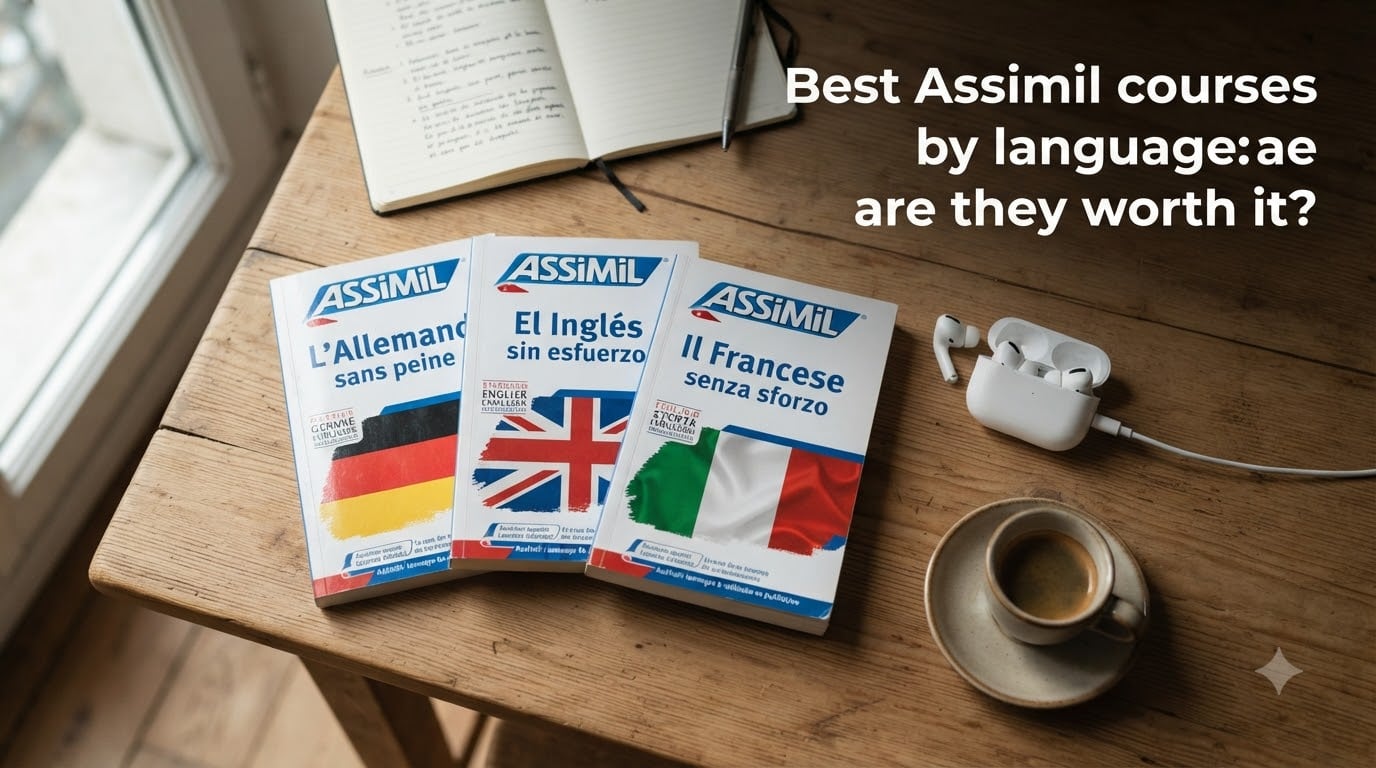
Looking for the best Assimil courses by language, and wondering whether the method is actually worth your time? I have worked through Assimil Italian with Ease and studied how the series performs across French, German, Japanese, Korean, and several others, and the short answer is yes, for the right learner Assimil is one of the best self-study language systems ever made. This guide ranks the best Assimil languages for English speakers, breaks down the passive-then-active method, gives an honest CEFR level estimate, and flags the discontinued titles plus the widely hated Assimil app so you can buy the right thing.
Table of Contents
What Is Assimil?
Assimil is a French language-course publisher founded in 1929 by Alphonse Cherel, best known for its dialogue-based Sans Peine series, translated for English speakers as With Ease. The flagship course for each language is a paperback book of roughly 71 lessons paired with native-speaker audio, and after 96 years the formula has barely changed. Once you finish a With Ease course you can ladder into the Perfectionnement series, which is the publisher’s intermediate-to-advanced line aimed at pushing learners from B1 up toward C1.
Two things make Assimil unusual. First, the entire method is built around realistic dialogues that you read while listening, then later translate from memory. Second, every lesson includes cultural notes and grammar footnotes that other audio courses tend to skip. NPR once called the books “The Magic Books” for that reason, and serious polyglots from Benny Lewis to the Mezzofanti Guild have used them as a backbone for years.
Where the name “Sans Peine” comes from
“Sans Peine” means “without effort” in French, and the marketing line is that you learn a language the way a child picks up their first language, intuitively. The honest version, which I will get to below, is that you still need discipline, but the structure takes a lot of the planning off your plate.
How the Assimil Method Actually Works
The Assimil method works in two phases, and understanding them is the difference between finishing a course and giving up halfway through lesson 30.
The passive phase (lessons 1 to about 50)
In the passive phase you read each new dialogue in your target language while listening to the native-speaker audio, then check the translation underneath. You repeat the dialogue out loud once or twice and move on. There is no drilling, no flashcards, and no grammar memorization in this phase. The theory is that by exposure alone your brain starts to feel the rhythm and structure of the language. Most lessons take around 45 to 60 minutes the first time you do them, and closer to 30 on review days.
The active phase (lessons 51 to 71)
Once you cross roughly lesson 50, you flip the process. You now cover the English translation, listen to the audio, and try to translate the dialogue back into your target language without peeking. This is where real retention kicks in. Reviewers on r/languagelearning who logged 100+ days on Assimil Italian with Ease report that the active phase is where the language actually started sticking.
Review cadence and lesson structure
Every six lessons you hit a review section that revisits the vocabulary and grammar from the previous block. A standard With Ease course contains about 71 lessons, so a full pass takes roughly 2.5 to 3 months at one lesson per day. Each lesson includes cultural notes and grammar footnotes in the back of the book, which most learners say are the most underrated part of the series.
Best Assimil Languages for English Speakers
No top-ranking article I could find ranks the best Assimil courses by language, so I built this list from the publisher’s catalogue, the strength of each English edition’s audio, and what long-term Assimil learners on Reddit actually recommend. Seven languages stand out.
French With Ease. This is the original Sans Peine course and the best-supported title in the English lineup. Audio quality is excellent and the cultural notes are the deepest, since the publisher is French.
Spanish With Ease. The second-strongest title. Native-speaker audio from Spain, clear cultural notes on regional usage, and a large pool of long-term learners who report hitting A2-B1 after one full pass.
Italian With Ease. Italian has more 100-day Assimil logs on Reddit than any other language, partly because the grammar is forgiving and the audio recordings feel warm and clear.
German With Ease. Solid audio and good cultural notes. German learners on r/German often pair this with an Anki deck to handle noun cases.
Japanese With Ease. This is the one Benny Lewis used in his well-known Assimil Korean review structure, and it works, but you need to learn hiragana and katakana first. The course includes romanization in the early lessons.
Korean With Ease. Similar approach to the Japanese edition, with romanized text in early lessons and a clean transition to Hangul-only by lesson 20. False-beginner learners report good retention.
Brazilian Portuguese With Ease. Useful for anyone targeting Brazilian rather than European Portuguese. Audio is recorded with Brazilian speakers and the cultural notes cover regional slang.
Honourable mentions
Chinese, Russian, and Arabic all exist in the English catalogue but require learning a new writing system before you start. If you already know the alphabet for those languages, the courses are well-produced. If you do not, pair them with a writing-system primer like Tofugu’s “Learn Hiragana” or the free Arabic alphabet apps before lesson 1.
What CEFR Level Does Assimil Get You To?
The honest answer is A2 to B1 after one full pass through a With Ease course, with a chance of hitting B2 if you do the active phase seriously and pair the book with conversation practice. The marketing claim on the back of each book is “B2 in a few months,” and the Perfectionnement series claims to push you from B1 toward C1, but real learners on r/languagelearning report more conservative outcomes.
For Italian and French, multiple 100+ day logs put completion-level learners at solid A2 and conversational B1. For Japanese and Korean, the writing system adds friction, so realistic outcomes are A2 reading and listening with A1 speaking after one pass. Treat the B2 claim as a ceiling, not a guarantee.
Honest Pros and Cons of Assimil
What Assimil does well
Cultural notes and grammar footnotes that feel like a one-on-one tutor, not a textbook.
Audio recorded by native speakers in real conversation, not robotic studio reads.
A method that has survived 96 years because it works for motivated self-learners.
No screens required. You can do a lesson on a park bench with a paperback and earbuds.
Where Assimil falls short
Older editions still ship with audio CDs, and most modern laptops no longer have disc drives. The MP3 download or USB key editions solve this, but you have to pick the right bundle.
There is no progress bar, no streak counter, and no in-app accountability. If you skip a week, nothing nudges you back.
Pronunciation feedback is zero. You need a tutor or language partner to know whether you sound right.
Pricing has crept up over the last few years while the English catalogue has shrunk.
Warning: Skip the Assimil App and Buy the Book
This is the single most important callout in this guide. The Assimil app is widely panned compared to the printed book plus audio bundle. Multiple threads on r/languagelearning warn new buyers away from the app, citing clunky navigation, missing review features, and audio that does not match the printed lessons. Buy the book + MP3 download edition instead. You will get the same content, better audio playback, and the cultural notes laid out in a way the app does not replicate.
Languages Assimil Discontinued for English Speakers
Several Assimil courses that used to exist in English have been quietly discontinued, including Dutch, Polish, Vietnamese, and a handful of smaller titles. This is a real pain point on r/languagelearning, where learners complain that the English catalogue is shrinking while the French original catalogue stays complete.
If you wanted one of those discontinued titles, your best substitutes are Pimsleur for the spoken foundation, the Teach Yourself series for grammar, and a tutor on italki for the cultural and pronunciation layer that Assimil used to provide. None of those is a perfect drop-in, but the combination gets you 80 percent of what Assimil would have.
Assimil vs Pimsleur vs Michel Thomas
This is the comparison most PAA boxes ask for, so here it is at a glance.
| Method | Format | Best for | Accountability | CEFR after one course |
|---|---|---|---|---|
| Assimil With Ease | Book + audio, 71 lessons | Motivated self-learners | None, you set your own pace | A2-B1, sometimes B2 |
| Pimsleur | Audio only, 30 lessons per level | Commuters and hands-busy learners | Built-in spaced repetition | A1-A2 per level |
| Michel Thomas | Audio of a tutor and two students | Learners who want a teacher feel | Light, but guided | A1-A2 |
Pick Pimsleur if you want pure audio and built-in review. Pick Michel Thomas if you like the feel of being taught by a patient tutor. Pick Assimil if you can commit to a daily reading-and-listening habit and want the deepest cultural notes on the market.
What to Pair Assimil With to Reach B2
Assimil alone will not get most learners to B2. The pattern that works in practice is to use Assimil as your reading and grammar spine, then add three lightweight layers.
Language exchange. A weekly 30-minute session on Tandem or HelloTalk forces you to produce the phrases Assimil taught you.
Anki. A 10-minute daily deck built from the Assimil lesson vocabulary locks in the words you would otherwise forget.
An italki tutor. A single 30-minute lesson every two weeks catches pronunciation errors Assimil cannot flag.
Target-language media. One TV episode or podcast per week in the language keeps your ear tuned and rewards you for finishing the book.
That combination is what the 100+ day Assimil Italian and French logs on Reddit are built around, and it is how learners reliably close the gap between the B2 claim on the back cover and the A2-B1 outcome in practice.
Frequently Asked Questions
Is the Assimil language course worth it?
Yes, for motivated self-learners who can commit to roughly one lesson per day. After one full pass most learners reach solid A2 to B1, with the cultural notes and grammar footnotes being the standout strength. The book plus audio bundle is what you want, not the app.
How does the Assimil method work?
The Assimil method runs in two phases. In the passive phase (lessons 1 to about 50) you read each dialogue while listening to native-speaker audio, then check the translation. In the active phase (lessons 51 to 71) you cover the translation and try to reproduce the dialogue aloud without help.
How long does it take to finish an Assimil course?
A standard Assimil With Ease course has about 71 lessons and takes roughly 2.5 to 3 months at one lesson per day. Learners who take longer and revisit lessons often report stronger retention than those who rush through.
What level does Assimil get you to?
After one full pass most learners reach A2 to B1 on the CEFR scale, with a realistic shot at B2 if you do the active phase seriously and pair the course with conversation practice. The B2 marketing claim on the back of each book is a ceiling, not a guarantee.
Which is better, Pimsleur or Assimil?
It depends on your style. Pimsleur is pure audio with built-in spaced repetition and is great for commuters. Assimil is a book plus audio system that goes deeper on cultural notes and grammar, and rewards learners who can stick to a daily reading habit. Most serious self-learners I have seen end up using both.
Can you learn a language only with Assimil?
You can get a strong A2-B1 foundation from Assimil alone, but reaching B2 and beyond almost always requires adding conversation practice, a vocabulary system like Anki, and ideally a tutor for pronunciation feedback. Assimil is the spine, not the whole course.
Conclusion
The best Assimil courses by language for English speakers are French With Ease, Spanish With Ease, Italian With Ease, German With Ease, Japanese With Ease, Korean With Ease, and Brazilian Portuguese With Ease, in roughly that order. The method itself is worth it if you are a motivated self-learner, but buy the printed book plus audio bundle, not the app. Start with one lesson per day, plan on 2.5 to 3 months for a full pass, and pair the course with conversation practice if you want to land at B2 instead of A2.