
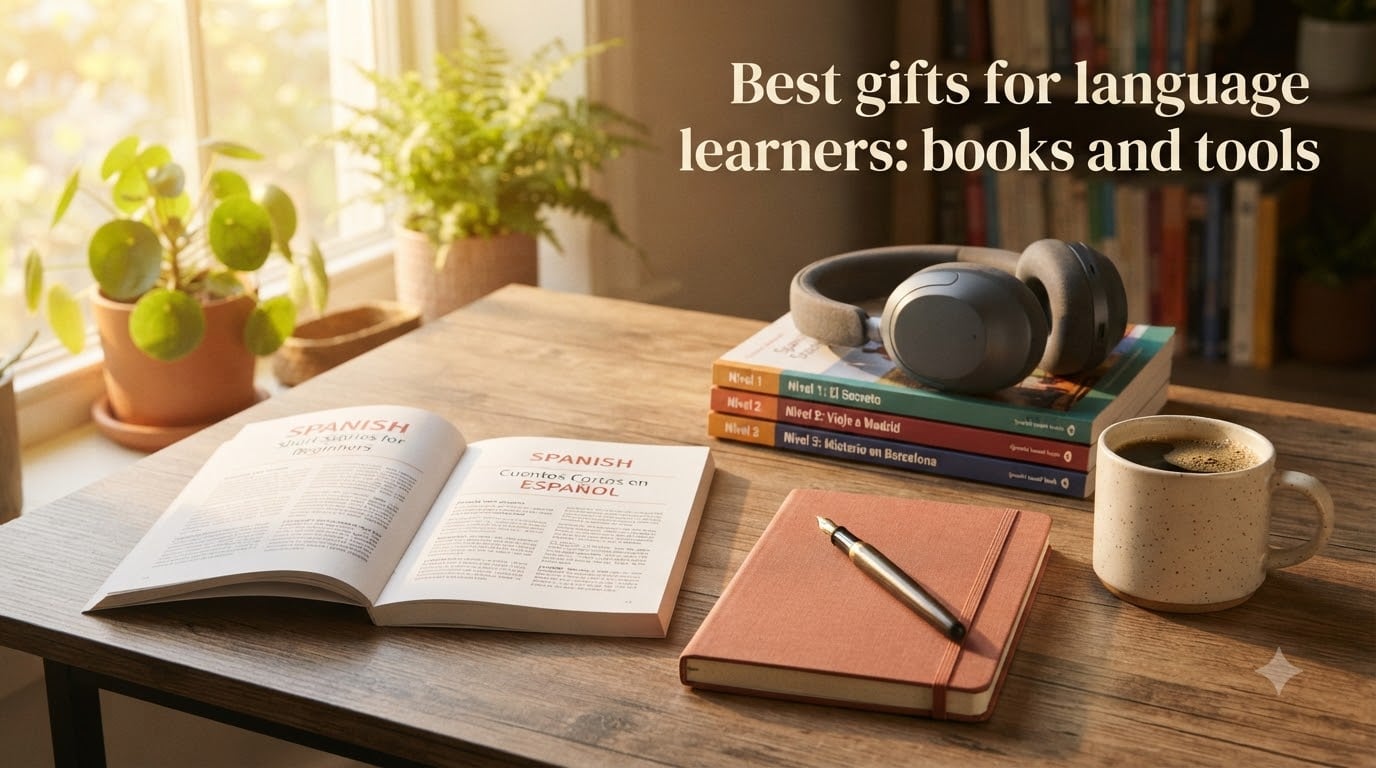
Picking the best gifts for language learners is harder than it sounds. Language study is a long, slow hobby, and the wrong present (a generic phrasebook, an app the recipient already uses) can feel like you didn’t pay attention. The right gift, on the other hand, becomes part of someone’s daily routine for months or years.
I’ve been on both sides of this equation: as someone who has tried to learn Spanish, Japanese, and Italian on my own time, and as the friend who scrambles for birthday and Christmas gifts for fellow language nerds. After comparing dozens of books, tools, and subscriptions over the past year, I’ve grouped my favorites into ten categories that work for beginners, intermediate learners, polyglots, and heritage speakers alike.
This guide covers books, dictionaries, apps, stationery, audio tools, and a few niche picks for non-Latin scripts. I’ll also walk you through how to match a gift to someone’s level, language, and budget, plus answers to the questions readers ask most about gifting language-learning tools.
Table of Contents
Best Gifts for Language Learners at a Glance
Here is a quick-pick list of the gift categories covered in this guide, with a short note on who each one suits:
- Graded reader – short, level-matched books that build reading confidence without overwhelming a beginner.
- Bilingual dictionary – Oxford or Collins titles are the gold standard for serious learners.
- Phrasebook – Lonely Planet and Berlitz guides are great for travelers and beginners.
- Grammar reference book – a solid workbook (English Grammar in Use, Japanese Grammar Guide) for self-studiers.
- Language learning app subscription – Babbel, Duolingo Plus, Rosetta Stone, or Pimsleur unlock months of structured practice.
- Vocabulary notebook or language journal – Leuchtturm1917, Midori, or Moleskine dotted notebooks for daily vocab and reflections.
- Physical flashcards or Anki setup help – tactile cards for tactile learners; an Anki subscription for digital natives.
- Audiobook or audio course – Pimsleur, Audible language titles, or Coffee Break podcasts for auditory learners.
- Script-specific workbook – kana/kanji, Chinese characters, Arabic alphabet, or Korean Hangul workbooks for non-Latin targets.
- Tutor gift card – iTalki, Preply, or italki credits for one-on-one practice with a native speaker.
If a single item feels too small, you can bundle two or three of these into a “language kit” in a small box — a notebook, a phrasebook, and a coffee-shop gift card is a classic combo that always lands well.
Books and Graded Readers Make Core Gifts for Language Learners
Books remain the foundation of language learning, even in an app-first world. A physical book doesn’t need wifi, doesn’t run out of battery, and quietly stays on a desk as a daily reminder. For gift-giving, that tactile quality is part of the appeal.
For a beginner, a graded reader is the safest choice. Graded readers are short stories or simplified novels written in controlled vocabulary, matched to CEFR levels (A1, A2, B1, B2). Penguin Readers, Oxford Bookworms, and Cambridge English Readers cover dozens of languages at every level, and most titles cost less than a paperback novel. They let a beginner read a full book without needing a dictionary for every sentence.
For an intermediate learner, a bilingual book — a novel printed side-by-side in the target language and English — is a step up. Bilingual editions exist for Spanish, French, German, Italian, and Russian classics. Reading one page in Spanish, one in English, builds intuition for sentence structure that flashcards never quite teach.
For an advanced learner or polyglot, give a monolingual dictionary or a frequency dictionary. The 501 most common Spanish words, for example, cover roughly 80% of everyday conversation. A frequency dictionary turns study sessions into targeted work on the highest-value vocabulary.
Grammar workbooks round out the books category. Raymond Murphy’s English Grammar in Use is the standard for English learners; A Japanese Grammar Guide or Grammatik aktiv for German serve the same role for other languages. A grammar book is a longer-term gift than a graded reader, which is why it works well for serious self-studiers.
Best Books for Beginners
A graded reader matched to A1 or A2 level, plus a short grammar primer, is the easiest book gift to get right. Avoid generic “Learn X in 30 days” paperbacks; reviewers on r/languagelearning consistently rate them as low-value.
Best Books for Intermediate Learners
Bilingual novels, short story collections, and monolingual frequency dictionaries hit the sweet spot. Look for editions published by Oxford University Press, Collins, or Penguin.
Bilingual Dictionaries and Phrasebooks Are Practical Tools for Language Learners
A good dictionary is a gift that lasts for years. Unlike an app, a dictionary never breaks, never needs updating, and works in airplane mode. For a serious learner, an Oxford or Collins bilingual dictionary is the gold standard, and most are updated every few years with new vocabulary.
Phrasebooks are the lighter-weight cousin of the dictionary. Lonely Planet, Berlitz, and Rick Steves phrasebooks are well-edited and durable, with sections on food, transport, emergencies, and small talk. A phrasebook is a great gift for a traveler or someone about to take a study-abroad trip.
For a heritage learner — an adult relearning a family language — a children’s bilingual picture book or a phrasebook aimed at adult beginners can be more useful than a thick academic dictionary. The lower reading level removes the frustration that often stops adult re-learners.
How to Choose a Dictionary
Pick a publisher first (Oxford or Collins), then the right edition for the learner’s level. Pocket dictionaries are great for travelers; desk dictionaries are better for serious study. Frequency dictionaries (which list the most common words first) are a smart gift for self-taught learners who want to focus on high-value vocabulary.
Language Learning Apps and Subscriptions Are Flexible Gifts for Beginners and Beyond
App subscriptions are popular gifts for language learners because they deliver months of structured practice for the price of a dinner out. The four big names — Babbel, Duolingo, Rosetta Stone, and Pimsleur — cover most languages and learning styles.
Babbel leans toward practical conversation, with grammar explanations built into each lesson. Duolingo is the gamified, free-tier option; Duolingo Plus removes ads and adds offline mode. Rosetta Stone uses immersive repetition and is a good fit for visual learners. Pimsleur is audio-first and ideal for commuters.
For self-studiers who already use one app, a subscription to a different one can broaden their routine — for example, Pimsleur for listening and Babbel for grammar. Pairing two subscriptions in a small gift box is one of the easiest ways to give “a language” as a gift.
Are Language Learning Apps a Good Gift?
Yes, with one caveat. Apps are a good gift when paired with something physical — a notebook, a phrasebook, or a handwritten note explaining which language and level you’re aiming for. Without that context, a subscription can feel impersonal. Many reviewers note that the most-used subscription gifts come with a short personal note and a specific level in mind.
Stationery and Language Journals Help Active Language Learners Build Vocabulary
Notebooks are the unsung heroes of language learning. A dedicated vocabulary notebook — separate from work or school notes — gives a learner a single place to track new words, example sentences, and review cycles. The act of writing by hand also strengthens recall, which is why language journals have a devoted following on r/polyglot.
Leuchtturm1917, Moleskine, and Midori are the three names that come up most often. Leuchtturm1917 dotted notebooks are a favorite because of the index page and page numbers. Moleskine Cahier journals are lighter and cheaper. Midori MD notebooks are loved for their smooth paper, especially by fountain-pen users.
Beyond notebooks, physical flashcards (small index-card sets in a ring binder) and label makers are popular gifts. A label maker lets a learner label household items in the target language — fridge, mirror, door — turning a kitchen into a passive study space. It is one of the most affordable immersion gifts you can give.
Sustainable Stationery Picks
Recycled-paper notebooks, refillable pen systems, and bamboo pens are a small but growing niche. None of the major gift guides I reviewed cover this angle, so a refillable notebook paired with a refill pack can feel thoughtful and original.
Audiobooks, Podcasts, and Listening Courses Are Gifts for Auditory Language Learners
Listening practice is the hardest part of self-study to get for free. A paid audiobook in the target language, an Audible subscription, or an audio course gives a learner hours of native-speaker input that they would otherwise struggle to find.
Pimsleur audio courses are the long-standing favorite in this category. Each 30-minute lesson drills pronunciation and conversation through spaced repetition. Coffee Break and Notes in Spanish are great podcasts for European languages; Sakanapan and JapanesePod101 serve Japanese learners.
For a learner who already has a few hundred hours of input under their belt, an audiobook in the target language — a children’s classic, a travel memoir, a translated novel — is a meaningful upgrade. Audible credits or a one-time audiobook purchase both work well.
Script-Specific Workbooks Are Niche Gifts for Language Learners Studying Non-Latin Alphabets
If the recipient is studying Japanese, Mandarin, Korean, Arabic, Hebrew, or another non-Latin language, a script-specific workbook is one of the most useful gifts you can give. These workbooks drill stroke order, character recognition, and writing practice — areas that apps cover only superficially.
For Japanese learners, Genki and Remembering the Kanji are the standard textbooks, and dedicated kana and kanji workbooks are widely available. For Mandarin, the HSK standard workbooks cover each level of the official proficiency exam. Korean Hangul workbooks are short and approachable; Arabic alphabet primers help with right-to-left script and calligraphy basics.
This is one of the most underserved gift categories in mainstream guides. A targeted workbook on the alphabet is a gift that almost every non-Latin-script learner appreciates.
How to Choose the Right Gift for a Language Learner
Matching a gift to the learner comes down to three questions: what language, what level, and what budget. Get those three right and the choice is usually obvious.
By level. Beginners do best with graded readers, phrasebooks, and beginner apps. Intermediates benefit from bilingual books, monolingual dictionaries, and more structured apps like Babbel or Pimsleur. Advanced learners and polyglots prefer native media — audiobooks, podcasts, monolingual dictionaries, and tutor gift cards.
By language. For widely taught languages (Spanish, French, German, Italian), mainstream dictionaries and graded readers are easy to find. For less commonly taught languages (Hungarian, Vietnamese, Swahili), look at specialist publishers like Routledge or Hippocrene, which carry phrasebooks and dictionaries for hundreds of languages.
By budget. Under $25 covers a graded reader, a phrasebook, a notebook, or flashcards. The $25 to $75 range covers bilingual dictionaries, premium notebooks, and a single month or two of an app subscription. Above $75, you can bundle multiple items, fund a year of an app subscription, or give tutor credits for several iTalki lessons.
Best Gifts Under $25
A graded reader, a Lonely Planet phrasebook, a Leuchtturm1917 pocket notebook, a pack of physical flashcards, or a one-month app subscription. Each of these lands well for a casual learner or a stocking stuffer.
Best Gifts $25 to $75
A bilingual dictionary, a fountain pen plus a notebook bundle, a three-month subscription to Babbel or Rosetta Stone, or a script-specific workbook for Japanese, Mandarin, or Arabic.
Best Gifts $75 and Above
A 12-month app subscription, a tutor gift card for several iTalki or Preply lessons, a premium monolingual dictionary, or a curated language kit with a notebook, dictionary, phrasebook, and a coffee-shop gift card.
Language-Specific Picks
For a Spanish learner, a Collins Spanish dictionary plus a beginner graded reader covers the basics. For French, the Larousse dictionary is a classic. For Japanese, a kana workbook plus a basic grammar primer is the strongest starter. For German, a Collins German dictionary and a Pimsleur audio course pair well together.
Frequently Asked Questions
What to buy someone who is learning a language?
Practical tools that match the learner’s level work best. Beginners appreciate graded readers, phrasebooks, and beginner apps like Duolingo or Babbel. Intermediates benefit from bilingual books and monolingual dictionaries. Advanced learners and polyglots value native audiobooks, tutor credits, and monolingual reference materials.
What are the best books for language learners?
Graded readers like Penguin Readers and Oxford Bookworms are ideal for beginners. Bilingual novels are perfect for intermediate learners. Monolingual dictionaries and frequency dictionaries suit advanced students and polyglots. Grammar workbooks such as English Grammar in Use round out the books category.
Are language learning apps a good gift?
Yes. App subscriptions from Babbel, Duolingo Plus, Rosetta Stone, or Pimsleur give months of structured practice. They feel more personal when paired with a notebook, a phrasebook, or a handwritten note naming the language and level you had in mind.
What tools help you learn a new language?
A combination of input tools (books, audiobooks, podcasts), active practice (notebooks, flashcards), and structured study (apps, courses) covers most learning styles. The right tool depends on whether the learner is visual, auditory, or kinesthetic, and on their current level.
What is the best bilingual dictionary to buy?
Oxford and Collins bilingual dictionaries are the gold standard for most European languages. For less commonly taught languages, Routledge and Hippocrene publish reliable dictionaries. A pocket-sized edition works for travelers, while a desk edition suits serious self-study.
What is a good gift for a polyglot?
A polyglot usually has their routine dialed in, so novelty is welcome. A tutor gift card for iTalki or Preply, a native-language audiobook, a script-specific workbook for a new alphabet, or a premium fountain pen for journaling all work well.
How do you give a language as a gift?
Bundle a few small items together: a graded reader, a notebook, a phrasebook, and a one-month app subscription. Wrap them in a small box with a handwritten note naming the language and the learner’s level. This combo signals that you paid attention and supports active study.
Wrapping Up Our Gift Guide for Language Learners
The best gifts for language learners are the ones that fit into a real study routine — a graded reader that lives on a desk, an app subscription that runs for three months, or a notebook that turns daily practice into a habit. Match the gift to the learner’s level and target language, and add a personal note that names what you had in mind.
If you can, bundle two or three items into a small language kit. A phrasebook, a notebook, and a one-month app subscription, wrapped together, signals more thought than any single item alone. Whether you are shopping for a beginner or a longtime polyglot, the categories above should give you a solid starting point for the best gifts for language learners this year.