
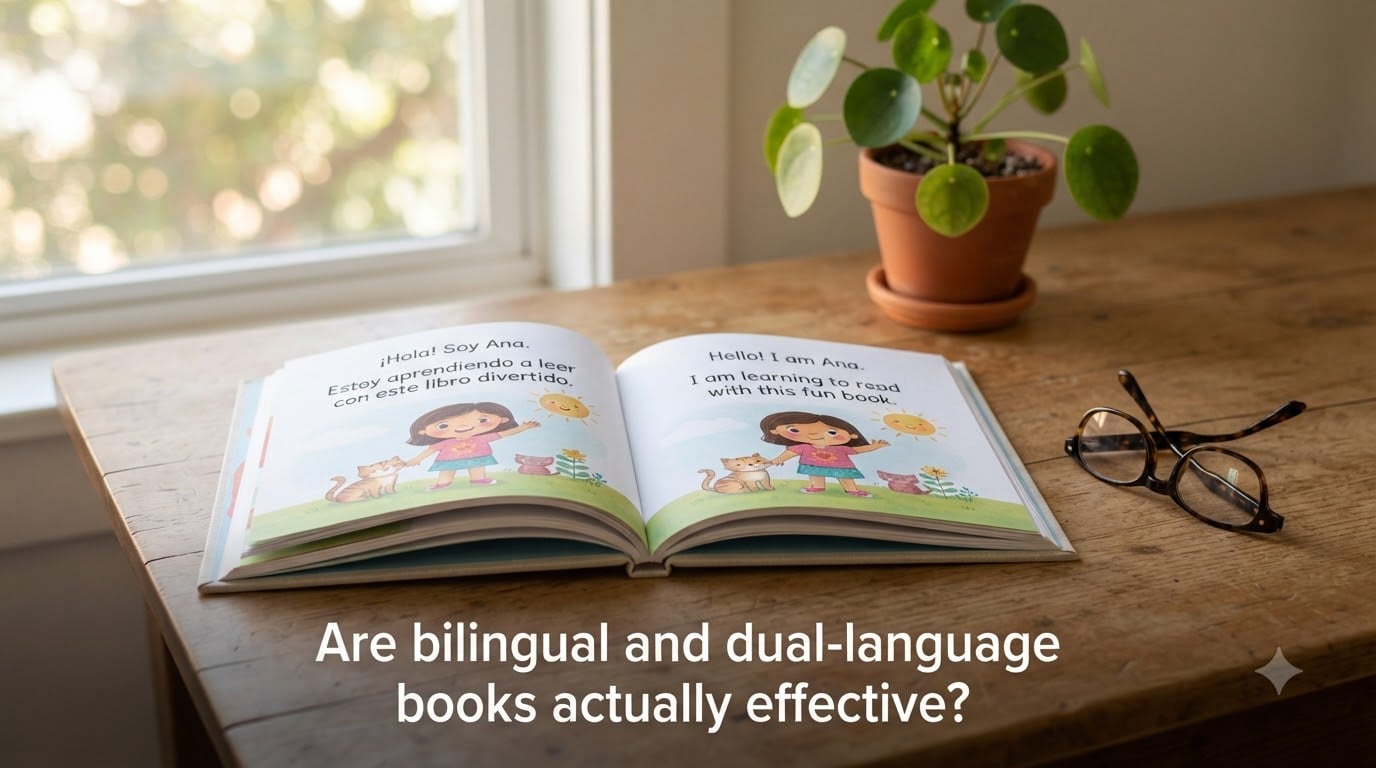
Yes, bilingual and dual-language books are effective for language learning, but only when you use them at the right proficiency level and with the right reading approach. Research from Cummins, the Bell Foundation, and the Education Endowment Foundation shows that bilingual books support vocabulary acquisition, comprehension, and home-language development when they are treated as a learning tool rather than a passive dictionary. The short answer to whether bilingual and dual-language books are actually effective is yes, when matched to the reader and used with intention.
I’ve spent the last several months working through side-by-side Spanish, German, and Japanese texts at different proficiency tiers. Below I share what actually moved the needle on my fluency, what research backs up, and the common mistakes that turn these books into a crutch instead of a catalyst.
Table of Contents
What Is the Difference Between Bilingual and Dual-Language Books?
A bilingual book is any book that presents the same content in two languages, usually side-by-side or on facing pages. A dual-language book is a specific application of bilingual books used in dual-language education programs, where the text carries parity between languages and supports classroom instruction in both.
Outside the classroom, the two terms get used interchangeably. Inside dual-language education, the distinction matters because dual-language books are designed to teach content in two languages with roughly equal time and emphasis, often as part of a two-way immersion program.
| Feature | Bilingual Book | Dual-Language Book |
|---|---|---|
| Format | Two languages, side-by-side or facing pages | Two languages, parity of text, often classroom-tested |
| Typical audience | Adult self-learners, families, casual readers | Dual-language classrooms, ELL/EAL learners, heritage programs |
| Primary goal | Vocabulary and comprehension support | Biliteracy and content learning in both languages |
| Reading direction | Reader chooses which side to read | Curriculum guides when each language is used |
| Examples | Parallel-text novels, Beelinguapp stories | School district dual-language readers, ILA-published texts |
Bell Foundation defines dual-language books as storybooks or non-fiction with matching text in two languages. The matching is what separates them from a random translation; the language work is intentional on both sides.
What Does the Research Say About Bilingual Books?
Decades of research back up the effectiveness of bilingual and dual-language books, with Jim Cummins’s interdependence hypothesis being the most-cited piece of evidence. Cummins argued that literacy skills developed in a learner’s home language transfer to the second language, which means strong dual-language reading support accelerates English literacy rather than slowing it down.
The Bell Foundation, a UK non-profit focused on language education, names dual-language books as one of its “Great Ideas” resources for EAL learners. Their position is that when a child can read a familiar story in their home language, they get to focus cognitive energy on the new English vocabulary instead of decoding the plot.
The Education Endowment Foundation’s 2020 guidance on improving reading comprehension echoes this. Structured reading activities, including paired-language reading, consistently show a positive effect size when teachers discuss the text with students. Reading is not a passive activity in their findings; talk around the text is what cements comprehension.
A 2024 study in the International Literacy Association’s “Reading Teacher” journal, “Biliteracy in Bilingual Programs,” found that because dual-language books print the entire text in two languages nearby on the page, they have great potential to support cross-language connections. The study is paywalled, but the abstract confirms that the side-by-side layout reduces the friction of looking up translations while preserving the integrity of the second-language reading experience.
The mechanism behind all of this is what researchers call metalinguistic awareness. When a reader compares how the same idea is expressed in two languages, they start noticing patterns, grammar, and idioms that they would miss reading monolingual text alone.
The Real Benefits of Bilingual and Dual-Language Books
When you use bilingual and dual-language books with intention, the benefits compound. Below are the four strongest results I and other learners have observed, all backed by the research cited above.
Stronger Vocabulary Acquisition Through Context Confirmation
Reading a word in the target language and instantly seeing its translation in the home language cements the meaning faster than a flashcard. The sentence gives you grammar, register, and collocation in one shot. This is the core mechanism that makes bilingual books effective: real-time translation keeps you inside what linguist Stephen Krashen calls comprehensible input, the narrow band of language you can mostly understand but still learn from.
Better Cross-Language Grammar Awareness
Comparing sentence structures side-by-side trains your brain to notice grammar patterns. After a few chapters of bilingual German, I started catching how English passive voice maps onto German “werden” constructions without consciously trying. That kind of metalinguistic awareness does not show up in monolingual reading.
Identity Affirmation for Heritage and EAL Learners
For children from immigrant or multilingual families, seeing their home language printed at the same size and quality as the dominant language sends a powerful message: this language belongs here. The International Literacy Association describes bilingual books as “a seamless bridge between students’ home languages and English.” That affirmation is a literacy benefit in itself.
Lower Reading Anxiety
Side-by-side translations reduce the fear of missing the plot. New readers stay engaged because the safety net is visible. Engagement is the single biggest predictor of progress in language acquisition, so anything that keeps a learner reading longer pays compounding dividends.
When Bilingual Books Work Best and When They Fall Short
Bilingual books are not a magic shortcut. They are a tool that performs brilliantly in some scenarios and poorly in others. Here is the level-by-level guidance most language learners and teachers eventually arrive at.
Beginner Level (A0 to A2): Use Sparingly
At true beginner levels, bilingual books can actually slow you down. The temptation is to read the home-language side and skim the target-language side, which means you are not training the language at all. Reddit’s r/languagelearning threads on bilingual books surface this complaint over and over: learners treat the format as a dictionary and never push into the unfamiliar text.
At this stage, monolingual graded readers with audio support usually work better.
Intermediate Level (B1 to B2): The Sweet Spot
Once you have a working base of grammar and vocabulary, bilingual and dual-language books become highly effective. You can attempt a full chapter in the target language, fall back on the home-language side for the tricky parts, and absorb new vocabulary in context.
This is the proficiency band where I personally saw the biggest fluency gains. Spanish parallel-text novels at B1 pushed my reading speed up noticeably over six weeks.
Advanced Level (C1 and Above): Use as a Complement
By C1, monolingual reading should be your main diet. Bilingual books still help with rare vocabulary, dialect exposure, and stylistic nuance, but they should not be your primary reading input. At this level, monolingual novels, news, and essays are more efficient.
The Monolingual Immersion Question
A common PAA question is whether monolingual reading is more effective than bilingual reading. The honest answer is that monolingual reading is more efficient per minute once you reach B1, but bilingual reading keeps you reading longer because it lowers the frustration threshold. For most self-learners, that longer reading time wins on total vocabulary gained.
How to Use Bilingual and Dual-Language Books Effectively
Effectiveness depends almost entirely on how you read them. Here is the step-by-step method I use, followed by classroom-tested activities adapted from the Bell Foundation.
For Adult Self-Learners
- Pre-read the home-language side first. Get the plot, characters, and key ideas locked in. This gives you a schema to attach new vocabulary to.
- Read the target-language side at natural pace. Do not stop at every unknown word. Try to maintain flow and use the home-language side only when truly stuck.
- Mark but do not look up every word. Highlight or note unfamiliar words, but only look them up after finishing a chapter. Looking up every word kills reading speed and enjoyment.
- Re-read the target-language side aloud. Pronunciation and rhythm reinforce vocabulary in a way silent reading does not.
- Summarize the chapter in the target language. Even three sentences of summary activates productive vocabulary and exposes what did not stick.
- Spaced repetition for new words. Move the marked words into a flashcard system like Anki for review at 1, 3, and 7 days.
For Classroom Teachers
Bell Foundation’s dual-language book activities include paired reading (one student reads each language), prediction games where learners guess what comes next in both languages, and storytelling retells where students translate parts of the story back into English. The key is structured talk around the text, not silent reading.
Using Digital Bilingual Reader Tools
Apps like Beelinguapp, LingQ, and Anylang apply the same parallel-text concept with audio, spaced repetition, and adjustable difficulty. LingQ in particular is popular with adult learners because it lets you tap any word for instant translation while preserving the original text flow. These tools work well as a complement to physical bilingual books, especially for the audio component that print cannot provide.
Common Mistakes to Avoid With Bilingual Books
Most people who say bilingual and dual-language books “do not work” are making one of these three mistakes.
Using Them as a Dictionary Crutch
If you read the home-language side first and never attempt the target-language side, you are reading a translation, not a bilingual book. Force yourself to attempt the second language before peeking.
Reading Passively Without Engagement
Bilingual books without active follow-up (note-taking, summary writing, speaking practice) give weaker results than even short monolingual reading sessions where you engage deeply with the text. Pair every bilingual reading session with at least one active output task.
Picking Books Above Your Level
If you understand less than 70% of the target-language side, the bilingual book becomes a translation exercise rather than a language-learning tool. Choose books where you can follow the target-language side with only occasional help.
Confusing Format with Method
A bilingual book is a format, not a method. The format only works when paired with active reading strategies: predicting, summarizing, re-reading aloud, and reviewing vocabulary.
Frequently Asked Questions
Are bilingual books effective for language learning?
Yes. Research from Cummins, the Bell Foundation, and the Education Endowment Foundation shows that bilingual books support vocabulary acquisition, comprehension, and home-language development when used at the right proficiency level (B1 and above) and with active reading strategies. They are most effective as a complement to monolingual input, not a replacement for it.
What is the difference between bilingual and dual-language books?
A bilingual book presents the same content in two languages, usually side-by-side or on facing pages. A dual-language book is a specific application used in dual-language education programs, where the text carries parity between languages and supports classroom instruction in both. Outside the classroom, the terms are often used interchangeably.
Are bilingual books good for kids?
Yes, especially for English Language Learners (ELL/EAL) and heritage-language learners. The International Literacy Association describes bilingual books as a seamless bridge between home languages and English. Benefits include stronger vocabulary acquisition, metalinguistic awareness, home-language affirmation, and lower reading anxiety.
Are bilingual books better than monolingual books?
Neither is universally better. Monolingual reading is more efficient per minute once you reach B1, but bilingual reading keeps you reading longer because it lowers the frustration threshold. For most learners, that longer total reading time wins on vocabulary gained. At beginner levels, monolingual graded readers usually outperform bilingual texts.
What does the research say about bilingual books?
Jim Cummins’s interdependence hypothesis (1984, 1991) showed that literacy skills developed in a home language transfer to a second language. The Bell Foundation names dual-language books a Great Idea for EAL learners. The Education Endowment Foundation positions structured paired-language reading as a high-impact literacy strategy. All three bodies of work support the effectiveness of bilingual and dual-language books when used with intention.
How do you use dual-language books effectively?
Read the home-language side first to lock in the plot. Then read the target-language side at natural pace, looking up words only after finishing a chapter. Summarize the chapter in the target language, then move new vocabulary into a spaced-repetition system like Anki. Pair every bilingual reading session with one active output task, such as re-reading aloud or writing a summary.
The Verdict on Bilingual and Dual-Language Books
So, are bilingual and dual-language books actually effective? Yes, when you match them to the right proficiency level and use them with active reading strategies rather than passive lookup. The format is one of the most efficient bridges between what you already know and what you are trying to learn, and decades of research back that up. Pick a book at your level, follow the six-step method above, and you will see the difference within a few chapters.