
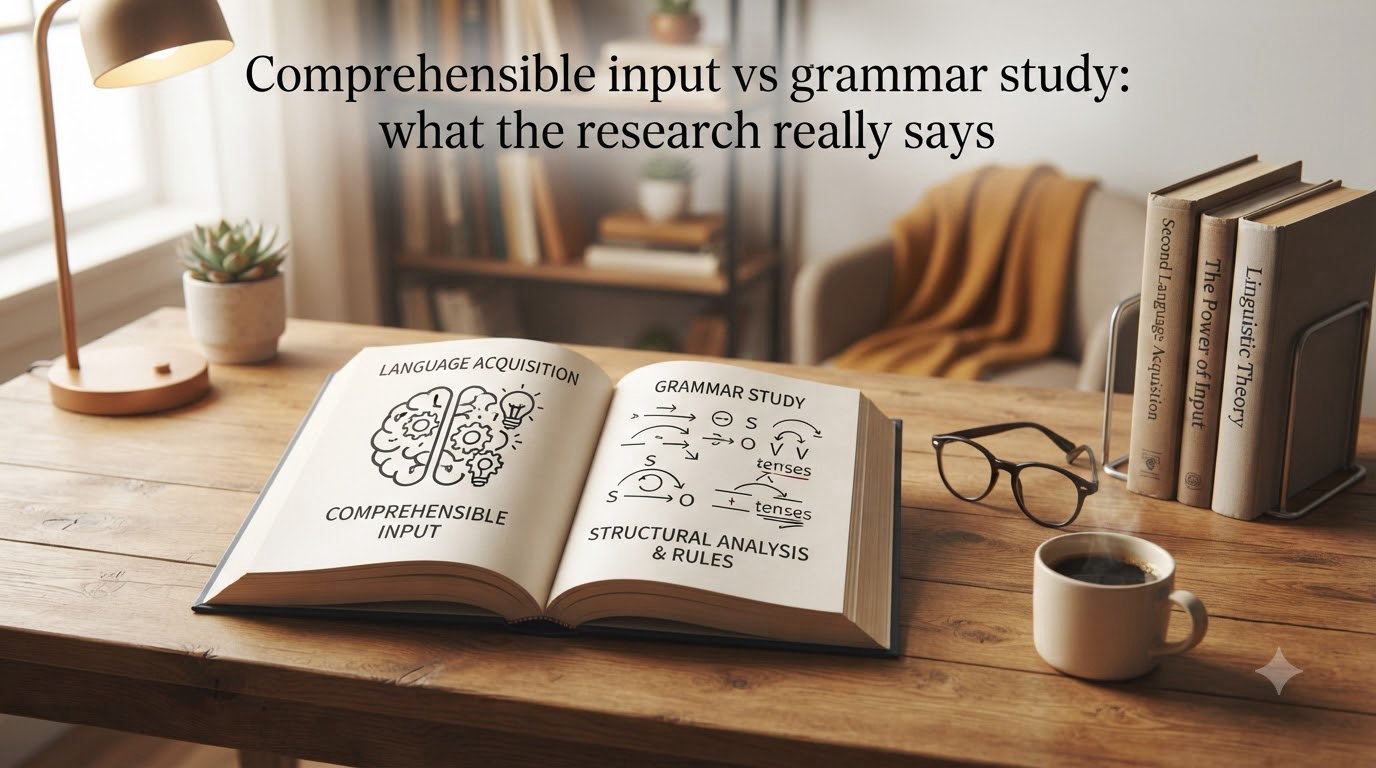
Comprehensible input vs grammar study is one of the most-debated questions in language learning, and the research does not give a clean winner. Decades of second language acquisition (SLA) studies point to comprehensible input (CI) as the primary driver of how we acquire language, while explicit grammar instruction has measurable but narrower benefits. In this guide I’ll walk you through what each side actually claims, where the evidence is strong, where it breaks down, and how adult learners can combine both approaches without falling into the trap of either pure immersion or pure grammar drills.
I have spent several months reading the original Krashen papers, the Norris and Ortega meta-analysis, and a stack of more recent neuroscience work to put together a synthesis that does not pick a team. The goal here is honest: what does the research really say, and what does it mean for you on a Tuesday evening when you have 30 minutes to study?
Table of Contents
What is comprehensible input (CI) and the i+1 hypothesis
Comprehensible input is language you can mostly understand, even when it contains a few structures slightly beyond your current level. Stephen Krashen called that stretch i+1: the input you receive should sit one small step above where you already are (your “i”) so your brain has something new to acquire but nothing so far out of reach that you cannot follow the meaning.
The i+1 hypothesis is the practical heart of the input hypothesis. If input is too easy (i+0), you already know it and nothing new enters your system. If it is too hard (i+2, i+3, i+10), you cannot extract meaning and very little gets acquired. The “just right” zone is where most of the language learning happens.
Comprehensible input can be delivered in many ways. Free voluntary reading (FVR), extensive reading at an easy level, narrow listening on a familiar topic, graded podcasts, subtitled TV, and conversations with a tutor who adjusts to your level all count. What matters is not the format but whether you understand enough of the message to stay engaged.
Two clarifications matter before we go further. First, Krashen did not say “no grammar ever” – he said grammar is not what builds acquisition; input is. Second, comprehensible input does not require perfect comprehension. A few unknown words per page or per minute are exactly what triggers acquisition.
Krashen’s five hypotheses: the framework behind the input hypothesis
When people say “the input hypothesis,” they usually mean one piece of a five-part theory Krashen developed in the 1970s and 1980s. The whole framework matters when you weigh comprehensible input vs grammar study, because each hypothesis predicts something different about when grammar study helps.
- Input hypothesis – We acquire language when we understand input that contains i+1. Acquisition happens when meaning is clear and structures are just slightly ahead.
- Acquisition-learning hypothesis – “Acquisition” is subconscious, like how children pick up their first language. “Learning” is conscious knowledge of rules. The two are separate systems, and learned rules cannot directly turn into acquired language.
- Monitor hypothesis – Conscious learning acts as an editor (“monitor”) on output. It works best when you have time, focus on form, and know the rule – which is why writing accuracy often improves with grammar study but spontaneous speech does not.
- Natural order hypothesis – Grammatical structures are acquired in a predictable order that does not match textbook order. The morpheme studies (Dulay and Burt, 1973, 1974) showed learners acquire -ing, plurals, and copula before third-person -s and question forms, regardless of teaching order.
- Affective filter hypothesis – Anxiety, low motivation, or embarrassment raises the “filter” and blocks input from being acquired. Comprehensible input plus low stress is the right combination; comprehensible input plus high stress is much less effective.
These five hypotheses are what Krashen is really proposing. The input hypothesis gets the spotlight, but it only works because of the acquisition-learning split, the natural order, and the affective filter. Grammar study survives in the model, but only as a monitor on already-acquired language.
What counts as grammar study in this debate
When SLA researchers talk about grammar study, they usually mean explicit instruction: a teacher explains a rule, a textbook presents conjugation tables, or a learner memorizes patterns deliberately. The research literature distinguishes a few flavors that are easy to confuse.
Focus on forms is the traditional classroom approach: pre-planned lessons on specific structures, practiced out of context. Focus on form (Long, 1991) is reactive – the teacher draws attention to a structure the learner just produced or just heard, often through a recast (“oh, yesterday I went, not goed“). Both are explicit, but focus on form is more integrated into meaning-focused interaction.
Grammar study also includes self-study activities: Anki decks on verb endings, grammar workbooks, YouTube explanations of the subjunctive. None of these, by themselves, generate fluent output in Krashen’s model. They sharpen the monitor – the conscious editor that checks what you are about to say or write.
This matters because the question “comprehensible input vs grammar study” often hides a confusion. People compare input (a delivery mechanism for acquisition) against grammar study (a tool for conscious knowledge), as if they were the same kind of thing. They are not. A fairer comparison is CI vs explicit instruction, with the monitor hypothesis predicting exactly where grammar study is expected to help.
The research case for comprehensible input
The evidence that comprehensible input drives language acquisition is broad and converges from several directions.
Free voluntary reading (FVR) studies show large gains from ungraded, self-selected reading over time. Krashen and his colleagues have published multiple studies reporting that learners who read a lot for pleasure in a second language consistently outscore matched peers on vocabulary, grammar, and writing – even without explicit grammar instruction.
Natural order studies show the morpheme acquisition order is remarkably stable across learners and languages, suggesting an internal acquisition sequence that instruction can sequence but cannot override.
Immersion programs demonstrate that learners who spend sustained time hearing and reading comprehensible input end up fluent on most measures, even when their classroom grammar instruction was minimal. Canadian French immersion students, for example, reach near-native receptive skills after several thousand hours of input.
Long’s (1996) interaction hypothesis adds that input becomes comprehensible through negotiated interaction: when a learner signals confusion, a speaker adjusts. This is why conversation with a patient partner often feels more useful than any textbook.
2020s personalized input studies extend the same logic to digital tools. Adaptive reading apps and AI tutors that tune difficulty to a learner’s level produce measurable gains by repeatedly delivering i+1, which is the practical rephrasing of comprehensible input in software form.
The research case for explicit grammar instruction
The evidence that grammar study helps is also real – it just helps in narrower, more specific ways.
Norris and Ortega (2000) published a landmark meta-analysis of 49 studies and found that explicit instruction produced large, robust advantages over implicit-only conditions, with an average effect size of around 0.9 for grammar. That is not a marginal finding; it is a strong one.
Ellis (1994) and later meta-analyses confirmed that explicit instruction tends to accelerate the acquisition of specific target forms, especially complex ones like the English third-person -s or German case marking. Learners who study a rule often produce it correctly sooner than learners who only hear it in input.
Focus on form studies show that brief, meaning-embedded attention to form (a recast, a prompt to reformulate) helps learners notice gaps in their interlanguage. Schmidt’s noticing hypothesis argues that conscious attention is a precondition for converting input to intake, which is the bridge between hearing something and acquiring it.
Where grammar study helps most: written accuracy, complex structures, advanced proficiency, exam performance, and the early stages of learning a language with unfamiliar morphology. Where it helps least: spontaneous spoken fluency, listening comprehension, and the kind of intuition that lets you “feel” a sentence is right without knowing the rule.
Critiques and counter-evidence on both sides
A fair look at comprehensible input vs grammar study has to include the strongest counterarguments on each side.
Critiques of CI: Lydia White (1987) showed that learners receiving only comprehensible input failed to acquire certain properties of English (like missing do-support) that explicit instruction groups learned reliably. Kevin Gregg (1984) argued that the acquisition-learning distinction is unfalsifiable – if Krashen’s monitor model cannot be proven wrong, it cannot be proven right either. Barry McLaughlin (1978) questioned the whole subconscious-acquisition idea, pointing out that adult learners do appear to build conscious rules and use them.
The 2010s neuroscience work added more nuance. Adult brains retain neuroplasticity but use different mechanisms than child first-language acquisition. Statistical learning, pattern detection, and explicit memory systems all contribute, especially in adults. CI is still the strongest single predictor of long-term proficiency, but it is not the only thing happening in the brain.
Critiques of pure grammar study: Decades of grammar-translation classrooms produced generations of learners who could pass multiple-choice grammar tests but could not order coffee in the target language. Studies on output without input consistently show that conscious rules, on their own, do not generate fluency. Grammar knowledge is real, but it is fragile under time pressure, and it decays without continued input.
The strongest critique of grammar-only study is that it confuses the symptom (errors) with the cause (lack of internalized patterns). Learners who study grammar but rarely encounter input end up with a pile of rules they cannot deploy. Learners who consume lots of input with only light grammar study tend to have messy accuracy and feel strong.
CI vs grammar study: a side-by-side comparison
Here is how the two approaches compare across the dimensions that matter most to learners choosing how to spend their time. The table is a quick reference; the sections above and below explain the nuance.
| Dimension | Comprehensible input (CI) | Grammar study (explicit instruction) |
|---|---|---|
| Mechanism | Subconscious acquisition from meaningful input at i+1 | Conscious rule learning applied as a monitor on output |
| Primary evidence | FVR studies, immersion programs, natural order morpheme data, Long 1996 interaction | Norris & Ortega 2000 meta-analysis, Ellis 1994, focus on form studies |
| Strongest effect on | Vocabulary, listening, reading, intuitive grammar, long-term fluency | Written accuracy, complex structures, exam performance, early-stage accuracy |
| Weakest effect on | Spontaneous monitored output at beginner level | Spontaneous speech, listening comprehension, intuition under time pressure |
| Time to noticeable results | Weeks to months for vocabulary; months to years for fluency | Days to weeks for rule recall; months for production |
| Works best when | Stress is low, input is just challenging enough, volume is high | Learner has time to focus, knows the rule, output is monitored |
| Stops working when | Input is too easy or too hard; affective filter is high | Used without input; treated as the source of fluency |
| Best fit | Immersion, extensive reading, listening-heavy self-study | Writing-heavy study, exam prep, complex morphology |
What 2010s-2020s neuroscience adds to the debate
The old debate – comprehensible input vs grammar study – was largely framed in behavioral and classroom data. Modern neuroscience has added a third layer.
Adult brains are still plastic, but they rely more on explicit memory systems than child brains do. Friederici and colleagues have shown that adult L2 learners activate both procedural (implicit) and declarative (explicit) memory networks when processing a second language, while child L1 acquisition leans heavily on procedural memory. This suggests adults benefit from explicit input more than children do, which is consistent with Norris and Ortega’s meta-analytic findings.
Statistical learning research (Saffran and others) shows that even adults extract patterns from input without intending to, given enough exposure and feedback. This is the modern empirical cousin of Krashen’s input hypothesis – we do acquire implicit regularities from input, even as adults.
AI-adaptive tutors and spaced-repetition tools are essentially building i+1 sequences at scale. They pick the next item based on what you have already acquired, then expose you to slightly harder input. The research on these tools, while still young, is broadly consistent with the CI model: personalized comprehensible input works.
What the research really says about CI vs grammar study
Pulling the threads together, here is the honest synthesis. Comprehensible input is the dominant driver of language acquisition across age groups, languages, and learning contexts. This is the strongest, most replicated finding in SLA. Learners who never get comprehensible input rarely become fluent, no matter how many grammar rules they have memorized.
Explicit grammar instruction has a real but narrower effect. It speeds up the acquisition of specific target forms, sharpens written accuracy, helps adults access procedural knowledge through declarative routes, and supports performance in settings where the monitor matters (writing, exams, professional communication). It does not replace input, and it does not generate fluency on its own.
The two approaches are not opposites. CI is the soil; grammar study is a targeted supplement that helps specific structures take root faster. Krashen’s own writings treat grammar as a monitor – useful under the right conditions and useless under the wrong ones. The conditions for grammar study to help are essentially the monitor conditions: time, focus on form, and prior exposure to the structure in input.
For adult learners especially, the research supports a blended approach: heavy input as the default, with focused grammar work on structures that matter for your immediate goals. The mistake is treating either as the whole answer.
Practical recommendations for self-study and classroom learners
Now to the part most learners actually care about: what to do this week.
For self-study learners: Spend 70 to 80 percent of your time on input. That means extensive reading at a level where you understand most of it, listening to graded podcasts, watching subtitled content, and conversations that are comprehensible. Spend 20 to 30 percent on focused grammar work – and do it after you have already encountered the structure in input. Anki decks on verb conjugations, grammar workbooks on the chapter you just read, or a short video on the subjunctive after a week of hearing it in podcasts all work better than grammar in isolation.
For classroom learners: Use class time for the focus-on-form moments you cannot easily get elsewhere: error correction on your writing, recasts from a teacher, structured practice on complex morphology. Outside class, stack up the input. Read what you enjoyed in your first language, translated. Listen to music in the target language. Watch shows with subtitles you can lean on.
For beginners facing the bootstrap problem: This is the gap Reddit users keep flagging. At A0 and A1 levels, very little input is comprehensible without scaffolding. Use a translation app, a beginner podcast with transcripts, or a tutor who can negotiate meaning. A few weeks of grammar-translation at the start is not a betrayal of the input hypothesis – it is a way to reach the level where input actually does its job.
For adult learners with limited time: Input first, always. Thirty minutes of comprehensible listening is worth more for fluency than thirty minutes of grammar drills. Save grammar study for the specific structures you keep getting wrong in your own writing.
For learners returning to grammar study after pure CI: Many Reddit users report that adding even light grammar work after months of input produces quick wins in accuracy. This matches the monitor hypothesis exactly: once the structure is partially acquired, conscious rules help you deploy it more reliably.
How much grammar is “enough”? Most learners do well with one or two focused grammar sessions per week, lasting 20 to 40 minutes, targeting structures they have already seen in their input. If grammar study is more than a third of your total study time, you are likely over-monitoring and under-acquiring.
Frequently Asked Questions
Is comprehensible input better than grammar study?
Not in a clean way. The research generally supports comprehensible input as the primary driver of language acquisition, while explicit grammar study plays a real but narrower role in sharpening accuracy. The strongest studies (Norris and Ortega, 2000) found explicit instruction has a large average effect on grammar outcomes, but learners still need input to become fluent. The honest answer is that CI does the heavy lifting, and grammar study is a useful supplement.
Does the research support Krashen’s input hypothesis?
It supports the core claim that comprehensible input drives acquisition, especially for vocabulary, listening, and the natural morpheme order. It is weaker on the strict acquisition-learning split, which has been critiqued as hard to test (Gregg 1984). Modern neuroscience shows adult brains use both implicit and explicit systems, which Krashen’s model undersells.
What is the i+1 hypothesis?
i+1 is Stephen Krashen’s shorthand for comprehensible input that is just a step beyond your current level. The u0022iu0022 is what you already know; u0022+1u0022 is the small stretch that gives your brain something new to acquire. If input is too easy (i+0), nothing new enters your system. If it is too hard (i+2 or higher), you cannot extract enough meaning to acquire it.
Is explicit grammar instruction effective?
Yes, with caveats. Norris and Ortega’s 2000 meta-analysis found a large average effect size for explicit instruction on grammar outcomes. Ellis (1994) and many subsequent studies confirm the result. The caveats are that grammar instruction accelerates specific structures, especially in writing; it does not generate fluency on its own, and it works best when learners have already encountered the structure in input.
Does comprehensible input work for adults?
Yes, though the mechanism is partly different from child L1 acquisition. Adult brains retain neuroplasticity and rely on statistical learning, so adults do extract patterns from input. Adults also benefit more from explicit instruction than children do, which is why a blended approach tends to work best for adult learners.
What is the difference between acquisition and learning?
In Krashen’s model, acquisition is subconscious and produces the intuitive feel of the language, the same way children pick up their first language. Learning is conscious knowledge of rules – knowing when to use the subjunctive because you memorized the rule, even if you cannot deploy it in real conversation. Acquisition builds fluency; learning sharpens the monitor that edits output.
Key takeaways on comprehensible input vs grammar study
The honest verdict on comprehensible input vs grammar study is that both work, but they do different jobs. Comprehensible input is the engine of language acquisition; grammar study is the steering wheel that helps you deploy specific structures more accurately once the engine has them.
If you take one thing from this guide, let it be this: stack up comprehensible input as your default, and treat grammar study as a focused supplement on structures you have already met in input. That blend is what the strongest version of the evidence in 2026 points to, and it matches the lived experience of learners who have actually crossed from beginner to intermediate. For more on the wider reading and listening habits that feed comprehensible input, our team has put together guides on extensive reading and podcast strategies that pair naturally with this approach.