
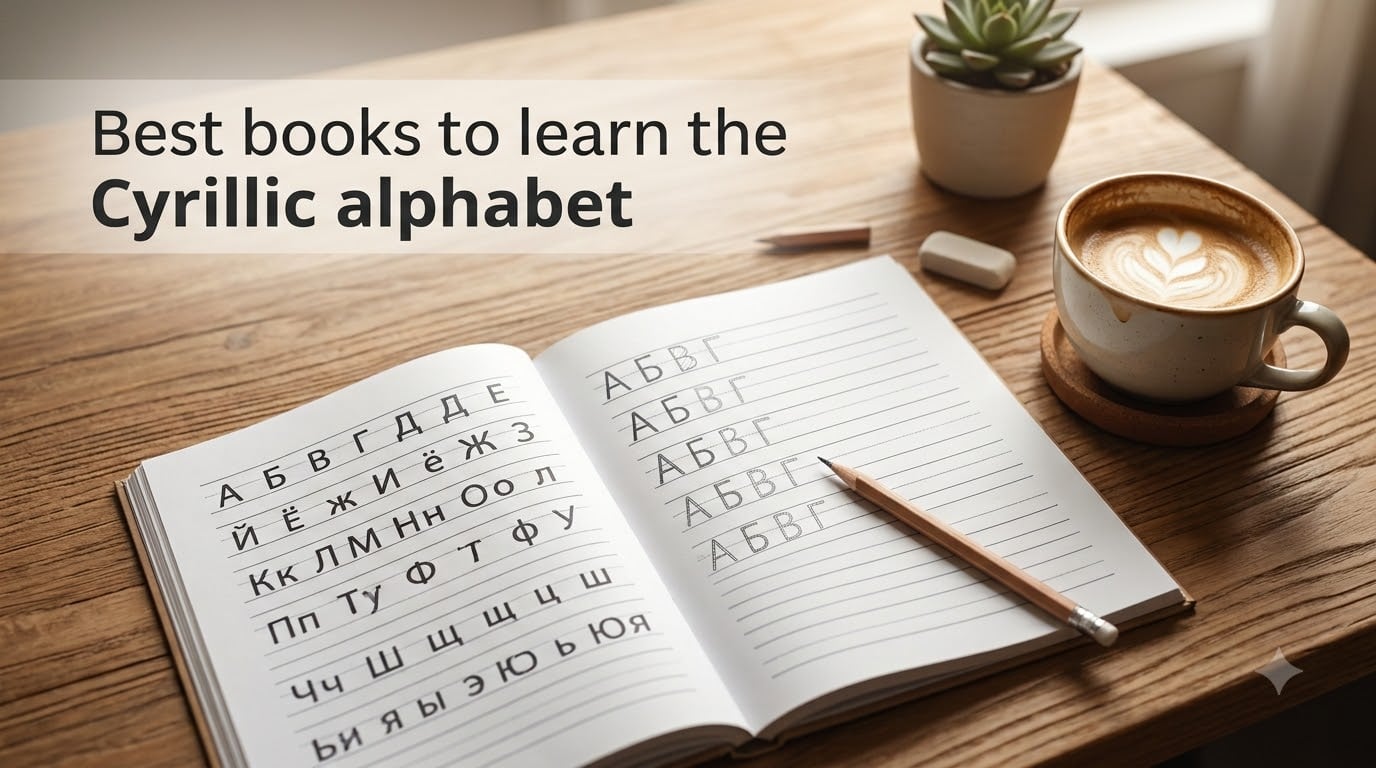
Learning the Cyrillic alphabet is the single biggest unlock for anyone starting Russian, Ukrainian, Bulgarian, or Serbian. Once the 33 letters stop looking like a secret code, every other resource, from apps to menus to novels, suddenly becomes accessible.
I pulled together this guide after comparing more than 20 alphabet-focused books across workbooks, full textbooks, and tracing guides, cross-checking Reddit recommendations from r/russian and r/LearnRussian, and weighing real reader feedback. Below, you’ll find the best books to learn the Cyrillic alphabet, ranked for beginners, plus the look-alike letter traps nobody warns you about and free PDF alternatives if you’re not ready to commit.
Table of Contents
Our Top 5 Picks for the Best Books to Learn the Cyrillic Alphabet
If you only have 60 seconds, start here. These five books cover the alphabet fastest and form the core of most learners’ shelves:
- Russian Alphabet in 33 Moves — best for visual learners who want to read Cyrillic in a weekend, with mnemonic illustrations and downloadable audio.
- Russian Alphabet Made Easy: An All-In-One Workbook — best all-in-one option with tracing, print and cursive, and vocabulary built into every lesson.
- Master the Russian Alphabet: Handwriting Practice Workbook — best for adults who need muscle-memory drills and print-to-cursive progression.
- Learn the Russian Alphabet Workbook — best budget-friendly format with quizzes, flashcards, and answer keys for self-study.
- Complete Russian (Teach Yourself) — best beginner textbook that teaches the alphabet inside a full A1 course, with native-speaker audio.
Each pick below includes what makes it work, where it falls short, and who it suits. I also included free PDF and app alternatives at the end if you want to test the waters before spending anything.
What the Cyrillic Alphabet Is and Why Books Still Help
The Cyrillic alphabet is a writing system of 33 letters used by Russian, plus slightly different letter sets in Ukrainian, Bulgarian, Serbian, Belarusian, and Macedonian. It’s read left to right, mostly phonetically (one letter = one sound), and shares a few letters with the Greek alphabet because Cyrillic was developed by 9th-century missionaries.
You might wonder whether books are even relevant in 2026 when Duolingo and YouTube exist. The honest answer is: apps skip the alphabet fast and assume you already know it. A dedicated alphabet book gives you what apps can’t, which is deliberate handwriting drills, side-by-side print and cursive practice, and a transliteration key you can scribble in. I learned Cyrillic years ago and I still default to a workbook before every trip.
Books also handle the silent traps. Cyrillic has look-alike letters that fool beginners for weeks: a printed Cyrillic А looks identical to Latin A but is pronounced like the “a” in “car”, while Cyrillic В looks like Latin B and sounds like English “v”. A good book calls these out, while apps let you stumble.
What the Cyrillic Alphabet Is and Which Languages Use It
Many learners assume “Cyrillic” and “Russian” mean the same thing. They don’t. The Cyrillic script family includes distinct alphabets, and a Russian-focused book may miss letters or include ones you don’t need.
Here’s how the most common Cyrillic alphabets differ at a glance:
- Russian: 33 letters, including Ё, Ы, Э, which are absent from most other Cyrillic variants.
- Ukrainian: 33 letters, adds І, Ї, Є, Ґ; drops Ё, Ы, Э.
- Bulgarian: 30 letters, drops Ё, Ы, Э, and adds the distinctive Ъ as a separate letter.
- Serbian: 30 letters and unique because Serbian uses both Cyrillic and Latin scripts officially, with 1:1 letter correspondence.
If you’re learning Serbian, pick a book that explicitly says “Serbian Cyrillic.” If you’re learning Russian, almost any Russian alphabet book will transfer most letters to Bulgarian or Ukrainian once you adjust for the few extras.
Best Dedicated Cyrillic Alphabet Workbooks
Dedicated alphabet workbooks do one job: turn the 33 Russian letters into automatic recognition and muscle memory. They’re faster than full textbooks if your goal is “I want to read signs and menus in two weeks.”
Russian Alphabet in 33 Moves
This slim visual guide frames each Cyrillic letter as a small story or shape you can recognize on sight. The “33 moves” are 33 illustrated mnemonics that pair each letter with something memorable. For visual learners, it cuts the time-to-recognition dramatically.
It includes downloadable audio so you can hear native pronunciation alongside the visual cue, and you can finish the entire book in one focused afternoon. It does not cover handwriting drills in depth, so it’s best paired with a separate tracing workbook if cursive matters to you. Reddit users in r/russian consistently recommend it as the first book to grab.
Russian Alphabet Made Easy: An All-In-One Workbook
If you want one workbook that covers tracing, vocabulary, print, cursive, and quizzes, this is the most complete alphabet-only workbook on the market. Each letter gets a full page of practice: trace, write, read sample words, hear pronunciation.
Adults and motivated teens tend to love it because it doesn’t feel like a children’s book. The pacing assumes you want to be conversational, not just literate. The downside is sheer volume: 200+ pages of drills can feel heavy if you only need a quick alphabet pass.
Master the Russian Alphabet: Handwriting Practice Workbook
Where Russian Alphabet Made Easy focuses on recognition, Master the Russian Alphabet focuses on your hand. It includes dotted tracing lines, boxes for size and slant, and print-to-cursive progression so you can actually write the letters, not just recognize them.
If you’re learning for travel, heritage reasons, or journaling in Russian, the handwriting focus is what separates this from competitors. Beginners who only want to type can skip it, but anyone who needs to sign forms or read handwritten notes should put this at the top of the list.
Learn the Russian Alphabet Workbook
This is the budget-friendly entry. You get flashcards, tracing pages, quizzes, and answer keys, with a compact format that fits in a bag. The information density is high but the layout feels slightly less polished than premium options.
For self-study learners who want repetition more than design, this is the best value pick. Reviewers note that the answer key makes it easy to study alone, which is the main complaint about workbooks without keys.
Best Beginner Textbooks That Teach the Cyrillic Alphabet
Full textbooks take longer than workbooks, but they teach the alphabet as part of a structured A1 course, which means grammar, vocabulary, and pronunciation arrive at the right pace. If your goal is real fluency rather than just literacy, a textbook saves you from later backtracking.
Complete Russian (Teach Yourself)
This is the most complete beginner course in book form. It spends its first unit on the alphabet with audio, then builds vocabulary and grammar through themed chapters. Native-speaker audio downloads come with the book, which matters because Russian vowels shift in ways text can’t capture.
It’s the textbook I’d recommend if you only buy one. The downside: it’s dense. Self-study learners who prefer lighter formats may bounce off it.
Beginner’s Russian (Hippocrene)
A gentler alternative to Teach Yourself, with a slow-paced alphabet introduction and cultural notes woven into each chapter. The book is widely recommended for older learners and heritage speakers who want a clear, readable format without overwhelming grammar density.
It teaches the Cyrillic alphabet inside its first ten pages and revisits it through vocabulary, which reinforces letter recognition without conscious drilling. Audio support is weaker than Teach Yourself, so pair it with a free app like Forvo or a YouTube channel for pronunciation.
Russian for Dummies
The Dummies series is rarely the deepest book in any category, but for Cyrillic beginners it’s surprisingly effective. The alphabet chapter is one of the clearest in print, with pronunciation cues written for English speakers and a fun tone that lowers the activation barrier.
It’s a great on-ramp before graduating to Teach Yourself or Penguin. The trade-off: you will outgrow it within a few months.
New Penguin Russian Course
The Penguin course is the traditional recommendation, in print since the 1990s and still considered one of the most thorough beginner courses. The alphabet is taught carefully with phonetic notes and exercises, and the grammar progression is respected by serious learners.
Audio has historically been the weak link: older editions lacked recordings, though newer reprints add companion audio. If you want a classic course with depth and you’re willing to track down audio separately, Penguin delivers.
How to Choose the Right Cyrillic Alphabet Book for Your Goals
Choosing between an alphabet workbook, a beginner textbook, a phrase book, and an app comes down to three questions: how fast do you need recognition, do you need to write by hand, and are you learning one language or several.
Pick a workbook if your main goal is “I want to read signs and street names on a trip next month.” Workbooks compress the alphabet into 30 to 60 focused hours and stay in your muscle memory longer than passive app exposure. Russian Alphabet Made Easy and Master the Russian Alphabet are the strongest all-rounders.
Pick a full textbook if your goal is conversational fluency over six months or longer. Textbooks give you the alphabet as part of grammar and vocabulary, so you don’t learn letters in a vacuum. Complete Russian and New Penguin Russian Course are the two I recommend for serious self-study.
Pick a phrase book alongside a workbook if you’re traveling soon. Phrase books won’t teach you the alphabet, but they reward you for the alphabet work you’re doing. Recognition turns into real-world use faster when you have both.
Pair books with apps, never replace them with apps. Duolingo, Memrise, and Russian Alphabet Mastery all assume some alphabet familiarity. Use them as spaced repetition once a book gives you the foundation.
For most adult learners, the ideal combination in 2026 is one alphabet workbook for handwriting drills plus one beginner textbook for grammar. Kids often do better starting with a visual illustrated book like Russian Alphabet in 33 Moves before moving to a structured course.
Common Mistakes When Self-Teaching the Cyrillic Alphabet
After watching dozens of learners (myself included) stumble on Cyrillic, the same mistakes come up over and over. None of these are covered by most alphabet books, which is why this section exists.
Trusting look-alike letters. Cyrillic А, В, С, Е, К, М, О, Р, Т, and Х all look exactly like Latin letters but make different sounds. А sounds like “car”, В sounds like “van”, С sounds like “s”, and Р sounds like a rolled “r”. Beginners who skim treat these as Latin and read nonsense words. Slow down on these.
Skipping cursive. Russian handwriting (called прописи or propisi) uses connected cursive forms that often look nothing like the print versions. Few printed books cover this well. If you’ll ever read a handwritten note, train cursive from week one, not later.
Forgetting to say the letter aloud as you write it. A learner on r/languagelearning put it simply: “Read the word aloud every time you write it. Focus on it, don’t multitask.” Multitasking through drills is the fastest way to forget half the alphabet in a week.
Drilling without spaced repetition. One full read-through in a single afternoon feels productive but doesn’t stick. Cyrillic needs 3 to 5 spaced exposures over 2 to 3 weeks before letters become automatic. Apps handle this naturally; books require you to schedule revisits.
Picking a generic book for the wrong language. A book titled “Russian Alphabet Workbook” will mostly work for Ukrainian and Bulgarian, but a “Serbian Cyrillic” book is the right choice if Serbian is your target, because Serbian includes unique letters like Ђ, Ј, Љ, Њ, and Ћ.
Best Free and PDF Resources to Learn the Cyrillic Alphabet
You can absolutely learn Cyrillic without buying a book. The free options below pair well with any of the paid picks above, or stand alone if your budget is tight.
- Wikibooks Cyrillic Alphabet: a clean, alphabet-by-alphabet primer with pronunciation and example words. It’s free, open-source, and surprisingly complete.
- Anki Cyrillic decks: pre-made flashcards with spaced repetition baked in. Free on desktop, paid on iOS. Reviewers consistently call Anki the strongest free tool for alphabet retention.
- Memrise Cyrillic courses: gamified spaced repetition that mimics the spaced-repetition mistake beginners make when they cram a book in one sitting.
- Russian Alphabet Mastery (3-hour course): a focused YouTube or app course that walks through all 33 letters with audio in three hours, useful as a companion to a workbook.
- Forvo: a free pronunciation database with native speakers reading each Cyrillic letter and common words aloud.
- LibraryGenesis / Open Library: for older editions of Penguin or Big Silver Book of Russian Verbs in PDF form. Check local libraries first.
The honest take: free resources work best as supplements. The structure, handwriting drills, and answer keys of a paid workbook are hard to replicate for free. If you can spare the cost of a workbook, you’ll save weeks of trial and error.
Cyrillic Across Languages: Russian vs Bulgarian vs Serbian vs Ukrainian
Because the topic “best books to learn the Cyrillic alphabet” gets asked in every Cyrillic-using language, here’s the language-specific guidance most articles skip.
For Russian, any of the workbooks above will work, with Russian Alphabet in 33 Moves and Russian Alphabet Made Easy as the top picks. Russian has the most published alphabet material by far.
For Ukrainian, the book market is thinner, but the alphabet differences from Russian are small (drop Ё, Ы, Э; add І, Є, Ї). A Russian-focused book covers 90% of Ukrainian letters, then you fill the gap with a free Ukrainian alphabet chart online.
For Bulgarian, the alphabet drops three letters and adds a hard sign Ъ. The “Latin and Cyrillic” series and Bulgaria-specific workbooks are the cleanest option. Bulgarian pronunciation is closer to English than Russian, which makes the alphabet easier for English speakers.
For Serbian, pick a book that explicitly teaches Serbian Cyrillic, because Serbian also uses Latin script and learners need to know which letters map to which. Serbian Alphabet Tracing Workbook for Kids and Latin and Cyrillic Serbian Alphabet Book are purpose-built for this.
Across all four languages, the same study habits apply: spaced repetition, handwriting drills, and pairing books with free audio. The letter differences are small enough that one good Cyrillic primer transfers across most of them.
Frequently Asked Questions
What is the best way to learn the Cyrillic alphabet?
The fastest method combines a visual illustrated book for letter shapes, a tracing workbook for handwriting, and a spaced-repetition app for retention. Russian Alphabet in 33 Moves plus a daily 10-minute Anki session covers most letters in two to three weeks.
Is the Cyrillic alphabet hard to learn?
No. Cyrillic is more phonetic than English, meaning each letter almost always makes the same sound. Most adult learners can read simple Cyrillic words within 3 to 5 hours of focused study. The harder part is handwriting cursive and remembering look-alike letters like Cyrillic В (sounds like v) versus Latin B.
How long does it take to learn the Cyrillic alphabet?
Reading recognition: 3 to 5 hours of focused study. Comfortable reading of common words: 8 to 12 hours over 1 to 2 weeks. Full fluency with handwriting, print, and cursive: roughly 30 to 40 hours over 4 to 6 weeks. Daily short sessions beat long weekend cramming.
What are the best books for a beginner learning Russian?
The strongest beginner library is Russian Alphabet in 33 Moves plus Russian Alphabet Made Easy for handwriting, paired with Complete Russian (Teach Yourself) or New Penguin Russian Course for full A1 grammar. This combination gives you alphabet recognition, muscle memory, and structured progression in one stack.
Is Russian worth learning in 2026?
Yes. Russian is one of the most spoken languages in the world, gives access to a vast literary tradition, and remains useful in science, business, and travel. Cyrillic is also a gateway to Ukrainian, Bulgarian, Serbian, and other Slavic languages, so the alphabet investment transfers across multiple languages.
Can you learn Cyrillic in a week?
You can recognize all 33 letters and read simple words in a week with 1 to 2 hours of focused daily practice. Comfortable reading, handwriting, and retention take longer, usually 4 to 6 weeks of spaced repetition. Treat one week as a literacy milestone, not full fluency.
How do you memorize Cyrillic letters?
Use mnemonic illustrations for shape, spaced repetition apps like Anki for retention, and handwriting drills for muscle memory. Say each letter aloud as you write it. Review the trickiest look-alikes (А, В, С, Е, К, М, О, Р, Т, Х) more often than the obvious ones.
Which Cyrillic alphabet is easiest?
Bulgarian Cyrillic is the easiest for English speakers because Bulgarian pronunciation is closer to English than Russian, and the alphabet has fewer letters (30 vs 33). Russian Cyrillic is the most widely taught and has the largest selection of books, which makes Russian the practical best choice for most learners.
Final Recommendation and Next Steps
For most beginners in 2026, the best book to learn the Cyrillic alphabet is Russian Alphabet in 33 Moves for fast visual recognition, paired with Russian Alphabet Made Easy for handwriting drills. If you want a single all-in-one pick, Master the Russian Alphabet covers both reading and writing in one volume.
Once you’ve finished your workbook, graduate to Complete Russian or New Penguin Russian Course for full grammar, and keep Anki or Memrise open daily for spaced repetition. With 30 to 40 focused hours over 4 to 6 weeks, you’ll read Cyrillic fluently and be ready to tackle any Slavic language that uses the script.