
You finished the graded readers. You breezed through the A2 stories and handled the B1 chapters without panic. Now you’re staring at a shelf of real Spanish novels wondering which one won’t crush your confidence in the first chapter. I’ve been there, and so has every serious Spanish learner I know.
This guide gives you seven specific titles that real learners have used as their bridge from graded readers to authentic Spanish novels. More importantly, it gives you the “first 10 pages” test that takes the guesswork out of choosing. By the end, you’ll know exactly what book to open this week, what level it sits at, and how to tell within minutes whether it’s too hard.
If you’ve been asking what the best first real novel to read in Spanish after graded readers actually is, the honest answer is: the one you finish. Let’s find yours.
Table of Contents
What Makes a Book Your First ‘Real’ Spanish Novel
A “real” Spanish novel in this context means an authentic book written for native Spanish speakers, not adapted for learners. The vocabulary hasn’t been simplified. The grammar reflects how people actually speak. The cultural references assume a Spanish-speaking reader.
The leap from graded readers to this kind of text is where most learners stall. They jump straight from a controlled B1 reader to a Gabriel García Márquez novel and hit a wall of unfamiliar words. Then they conclude that “real novels are too hard,” which isn’t true. They just picked the wrong starting point.
The sweet spot for your first real novel is what linguist Stephen Krashen calls comprehensible input: text where you understand roughly 70 to 80 percent of the words without looking them up. At that ratio, your brain acquires new vocabulary naturally, the way it did when you learned your first language. Below 70 percent, you stall. Above 90 percent, you’re not learning anything new.
For most learners, this means aiming for books at the B1 to low B2 level on the CEFR scale. The seven recommendations below cluster right in that range.
The First 10 Pages Test: How to Know If a Book Is Right for You
Before committing to a 200-page novel, run this test. It takes 15 minutes and saves you weeks of frustration.
Step 1: Pick Any Page From the First 10
Open the book randomly to a page in the first ten. This avoids the trap where authors write easy openings to hook readers, then escalate the difficulty in chapter three.
Step 2: Count the Unknown Words
Read one full page and count every word you don’t know or can’t guess from context. On a typical page of 200 words, you want between 40 and 60 unknown words. That puts you right in the 70 to 80 percent comprehensible input zone.
Step 3: Time Yourself
If it takes you more than 4 minutes to read a 200-word page, the book is probably too dense for a first novel. If you finish in under 2 minutes, it’s too easy and won’t push your skills forward.
Step 4: Check Your Gut Reaction
After the test page, ask yourself: do I want to keep reading? If the answer is yes, even with effort, this is your book. Curiosity carries you through unknown vocabulary. Obligation does not.
Red flags that signal a too-difficult book: more than 60 unknown words per page, sentences longer than 25 words on average, or frequent archaic grammar like the Spanish subjunctive in subordinate clauses. These aren’t dealbreakers forever, but they don’t belong in your first novel.
Top 7 First ‘Real’ Spanish Novels After Graded Readers
These seven books come recommended again and again in Spanish learning communities on Reddit and other forums. I’ve grouped them by difficulty so you can pick based on where you actually are, not where you wish you were.
1. El Principito by Antoine de Saint-Exupéry (A2 to B1)
The Little Prince works as a first “real” novel because you already know the story. If you read it as a child in English, the plot provides scaffolding while your brain focuses on the Spanish. The vocabulary stays simple, the sentences stay short, and the chapters are bite-sized.
Learners on r/Spanish consistently praise El Principito as the gentlest possible bridge from graded readers. You can finish the whole book in a weekend and feel like you’ve made a real leap. It counts as your first authentic Spanish novel, even if it’s technically a translation.
2. La Casa en Mango Street by Sandra Cisneros (B1)
Sandra Cisneros writes in short, vignette-style chapters that almost function as micro stories. Each chapter is two to four pages, which makes La Casa en Mango Street perfect for learners who want daily wins. You can read a chapter per sitting and feel constant progress.
The Spanish is accessible but literary. You’ll encounter real Mexican Spanish, idioms you won’t find in textbooks, and emotional themes that resonate with anyone who has felt like an outsider. This book shows up on nearly every “first Spanish novel” list because it works.
3. Manolito Gafotas by Elvira Lindo (B1)
Yes, Manolito Gafotas is technically a children’s book. Adult Spanish learners on Reddit repeatedly say that’s exactly why it works. The voice is conversational, the vocabulary reflects how people actually talk in Madrid, and the humor is sharp enough that you forget you’re reading “below your level.”
If you’re embarrassed about reading children’s literature, get over it. The goal of your first real novel is finishing it with confidence intact. Manolito Gafotas delivers that in roughly 190 pages of pure Madrid slang and family chaos.
4. El Alquimista by Paulo Coelho (B1 to B2)
Paulo Coelho’s The Alchemist is one of the most widely read Spanish-language novels of the last 30 years. The prose is straightforward, the chapters are short, and the story moves fast. A young shepherd travels from Spain to Egypt looking for treasure, and along the way he discovers what he actually needed was already at home.
The vocabulary sits at B1 to B2, which makes it a natural next step after La Casa en Mango Street. You’ll pick up philosophical vocabulary and learn how Latin American Spanish handles dialogue. The book is also widely available in audiobook form, narrated by native speakers.
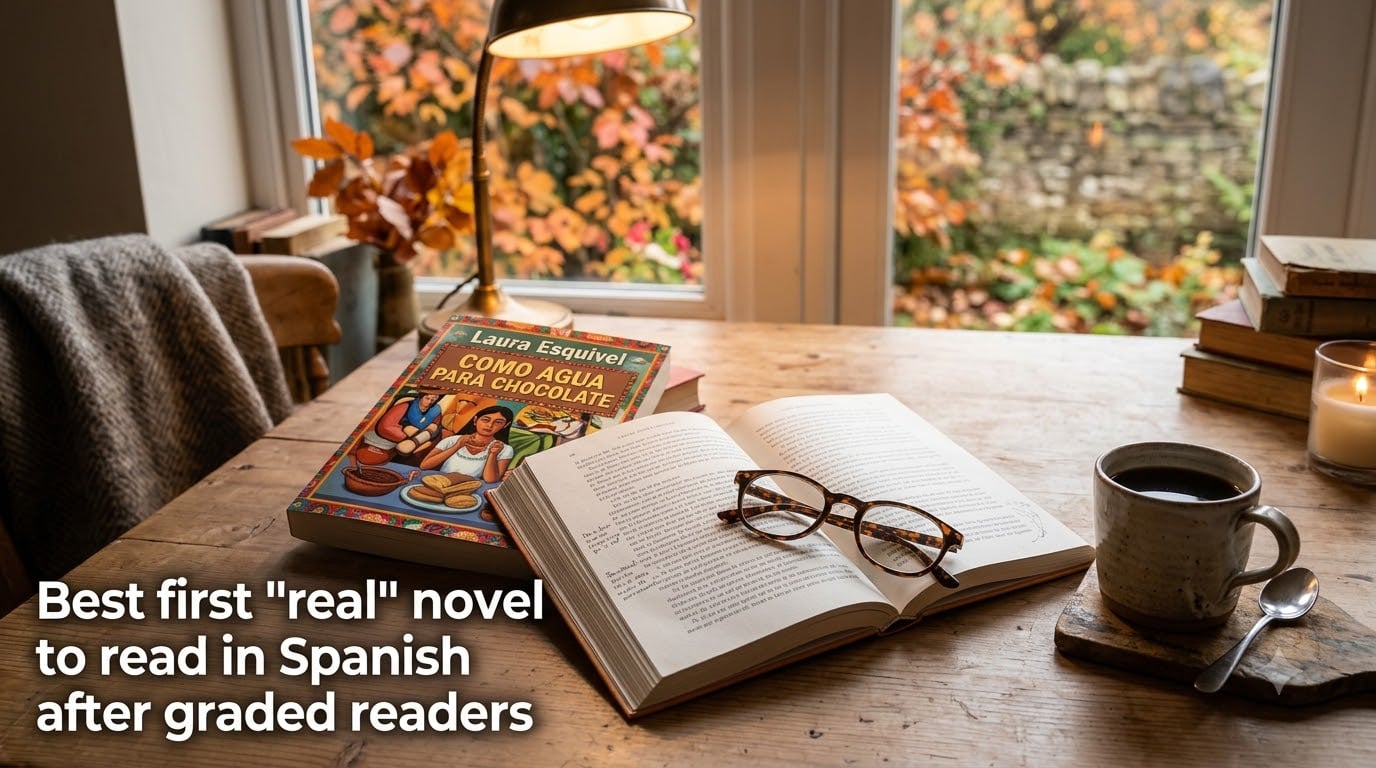
5. Como Agua para Chocolate by Laura Esquivel (B2)
Like Water for Chocolate is set in early 20th century Mexico and blends magical realism with recipes and family drama. The Spanish here is more demanding than the previous picks. Sentences run longer, metaphors stack on metaphors, and you’ll encounter vocabulary tied to cooking, the Mexican Revolution, and rural customs.
I’d place this one as your second or third real novel rather than your very first. But if you’re confident at B1 and want a richer challenge, it rewards the effort beautifully. Bonus: the recipes are actually worth trying once you translate them.
6. El Curioso Incidente del Perro a Mediodanoche by Mark Haddon (B1 to B2)
The Curious Incident of the Dog in the Night-Time, translated to Spanish, makes an unusual but effective first novel. The narrator’s voice is plain, logical, and stripped of idioms, which removes one of the biggest barriers in Spanish fiction. You’ll spend less mental energy decoding slang and more on the story.
This book also introduces you to British English vocabulary translated into Spanish, which is a useful exercise in itself. You’ll see how translators handle cultural terms like “maths,” “chips,” and “lift,” and you start understanding that translation is its own skill.
7. Cuentos de Eva Luna by Isabel Allende (B2)
Isabel Allende’s short story collection sits at the higher end of the B2 range. Each story is self-contained, so if one feels too dense you can skip to the next. The Chilean Spanish is rich, vivid, and full of sensory detail. You’ll learn vocabulary around nature, emotions, and political history.
Save this one for when you’ve already finished one or two easier novels. Short story collections are underrated as language tools because every story gives you a fresh context, which keeps your brain actively engaged instead of coasting on familiar patterns.
Genre-Specific Recommendations for Every Type of Learner
The seven titles above lean toward literary fiction. If that’s not your taste, matching the book to your existing interests matters more than picking the “right” difficulty level. A genre you love will pull you through unknown vocabulary faster than a “perfect level” book you find boring.
For mystery and thriller fans, start with anything by Carmen Mola or with Donna Leon’s Brunetti series translated into Spanish. The dialogue-driven nature of crime fiction gives you everyday speech patterns faster than literary prose.
For romance readers, the “Mil besos tuyos” type of contemporary romance uses simple vocabulary, short chapters, and high emotional stakes. Authors like Alice Kellen and María Martínez write in clear modern Spanish that learners find very approachable.
For short story lovers, the previously mentioned Cuentos de Eva Luna works well. So does “La noche de los tiempos” by Muñoz Molina, though that’s denser. For pure adventure, “Marina” by Carlos Ruiz Zafón is a young adult novel that adult learners enjoy without feeling patronized.
Pair Audiobooks With Print: The Dual-Input Advantage
Reading while listening is the single most powerful technique for moving from graded readers to real novels. It works because your ears catch pronunciation and rhythm while your eyes catch spelling and grammar. Together they create stronger memory traces than either alone.
Here’s the practical workflow I recommend. First, listen to a chapter of the audiobook without reading along, to get the gist. Then read the same chapter in print while listening a second time. Finally, read it once more in silence to lock in the vocabulary.
For audiobooks, Audible has most of these titles in Spanish narration. YouTube also has full audio versions of El Principito and La Casa en Mango Street read by native speakers, often free. The key is matching the audio to the exact edition of the book you’re reading, so chapter numbers line up.
This approach addresses one of the biggest frustrations Spanish learners report on forums: understanding the written word but feeling lost when native speakers talk. The audiobook closes that gap.
Latin American Spanish vs Spain Spanish: Does Your First Novel Matter?
The Spanish of Mexico, Argentina, Spain, and Colombia differs in pronunciation, slang, and even some grammar. Your first novel picks one of these varieties, and that choice shapes what you hear in your head for months afterward.
If your eventual goal is travel, work, or family ties in a specific region, lean toward books from that region. La Casa en Mango Street and Como Agua para Chocolate give you Mexican Spanish. Manolito Gafotas and El Alquimista (in its original) give you Spain Spanish. Cuentos de Eva Luna brings Chilean Spanish.
If you have no specific regional goal, mix early. Read one novel from Spain Spanish, then one from Latin American Spanish, then another. Your brain gets better at handling variation, and you avoid developing a strong accent based on a single author’s quirks.
Both varieties are “real” Spanish. The choice isn’t about correctness but about which flavor you want to absorb first. There’s no wrong answer here.
Frequently Asked Questions
What is the best Spanish novel for beginners?
The best Spanish novel for beginners is El Principito (The Little Prince) because the plot is already familiar from childhood, the vocabulary stays simple, and the chapters are short enough to finish quickly. After that, La Casa en Mango Street by Sandra Cisneros is the natural next step.
What reading level is El principito?
El Principito sits at the A2 to B1 level on the CEFR scale. The sentences are short, the vocabulary is controlled, and the chapters average two to three pages, which makes it the most accessible bridge from graded readers to authentic Spanish fiction.
What are some good Spanish reading books for beginners?
Good Spanish reading books for beginners include El Principito, La Casa en Mango Street, Manolito Gafotas, El Alquimista, Como Agua para Chocolate, and Cuentos de Eva Luna. These titles cluster around the B1 to B2 level and cover both Spain and Latin American Spanish.
Should I read children’s books as an adult Spanish learner?
Yes. Children’s books like Manolito Gafotas use conversational vocabulary, short chapters, and clear plots that work extremely well for adult learners. The goal of your first real novel is to finish it with confidence, and children’s literature delivers that faster than dense literary fiction.
How do I know if a Spanish book is too hard for my level?
Open the book to a random page in the first ten. Count every word you don’t know. If more than 60 out of 200 words are unknown, the book is too hard for your first real novel. Aim for 40 to 60 unknown words per page, which puts you in the 70 to 80 percent comprehensible input zone.
What is the 80/20 rule for Spanish?
The 80/20 rule for Spanish says that roughly 20 percent of the vocabulary covers 80 percent of everyday spoken and written Spanish. Mastering that core 20 percent unlocks most authentic texts, which is why graded readers and beginner novels focus on high-frequency words before rarer terms.
Your Next Step After Graded Readers
The best first real novel to read in Spanish after graded readers isn’t a single title. It’s the one you actually finish. Pick any of the seven books above that sounds interesting, run the first 10 pages test, and commit to 15 minutes a day for the next two weeks.
When you finish it, you’ll have crossed the threshold from controlled reading to authentic reading. That’s the moment most learners realize they can actually read Spanish, not just decode it. Pick your book today and start.