
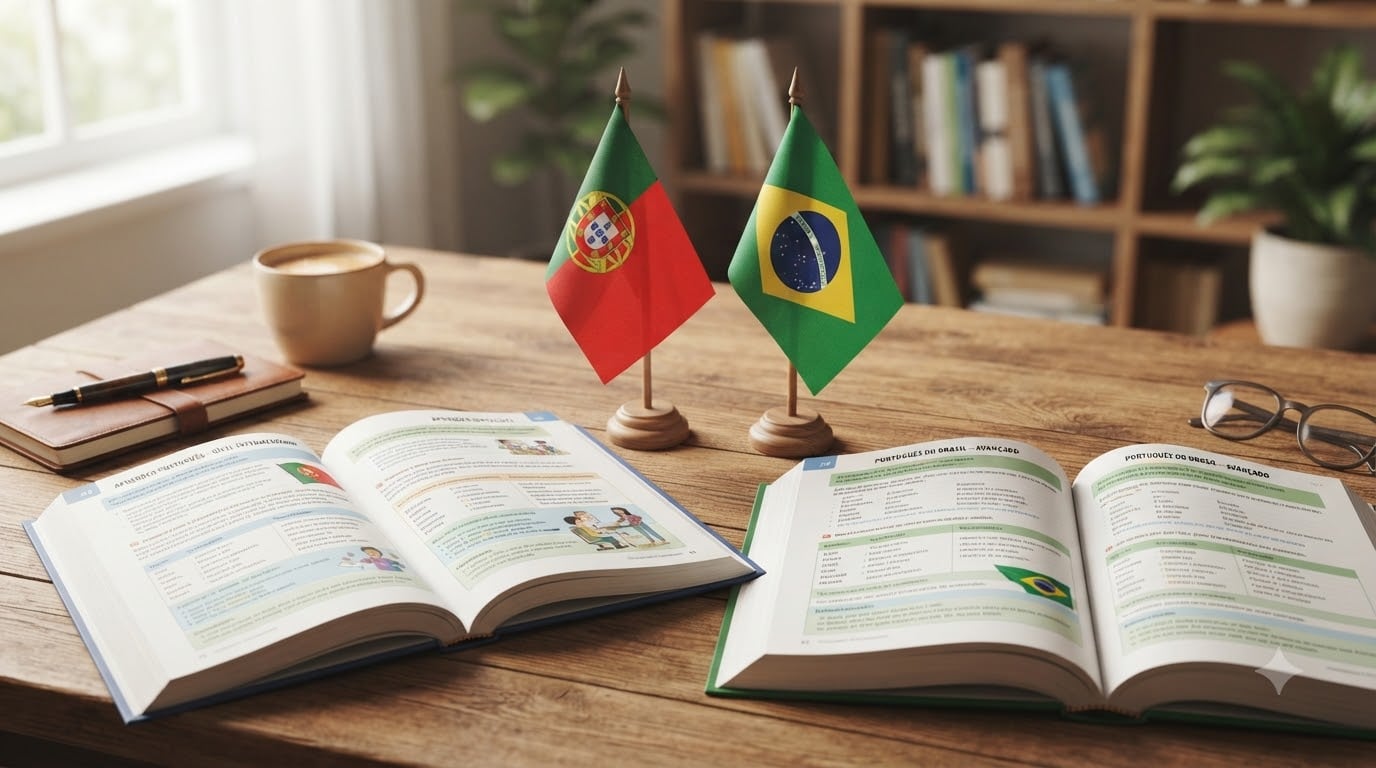
Choosing between Brazilian and European Portuguese is one of the first decisions you’ll face as a Portuguese learner. The two variants share the same root language but differ significantly in pronunciation, grammar, and everyday vocabulary. In this guide, I’ll walk you through the key differences and recommend the best books for each variant so you can start learning with confidence in 2026.
I’ve spent years studying both variants and helping learners pick the right resources. What I’ve found is that the “right” choice depends entirely on your goals—whether you’re planning a trip to Rio, relocating to Lisbon, or connecting with Portuguese-speaking family. Below, I break down everything you need to know.
Table of Contents
Key Differences Between Brazilian and European Portuguese
Brazilian Portuguese and European Portuguese are mutually intelligible, but they diverge in ways that affect how you speak, write, and understand native speakers. Think of the difference as similar to American English versus British English—recognizable, but with real consequences for learners.
Pronunciation Differences
Pronunciation is the most immediately noticeable difference. Brazilian Portuguese has a more open, vowel-heavy sound pattern. Every vowel tends to get pronounced clearly, which makes it feel more musical and approachable to new learners.
European Portuguese, by contrast, uses vowel reduction heavily. Unstressed vowels are often swallowed or reduced to a near-silent schwa sound. This gives European Portuguese a faster, more clipped rhythm that some learners describe as sounding closer to Russian or Polish than to Spanish.
For example, the word “telefone” (telephone) sounds like “teh-leh-FOH-nee” in Brazilian Portuguese but closer to “tl-FOHN” in European Portuguese. The consonant sounds also shift—the “de” and “te” syllables in Brazil often sound like “jee” and “chee,” while in Portugal they stay closer to their written form.
Grammar Differences
The pronoun question is where grammar gets interesting. In Brazil, “você” (you) dominates everyday speech, even in semi-formal situations. In Portugal, “tu” is the standard informal pronoun, and “você” can actually sound rude or overly direct in some contexts.
Verb conjugation follows the pronouns. Brazilian Portuguese speakers conjugate “você” with third-person verb forms (ele/ela), while European Portuguese speakers conjugate “tu” with second-person forms. This means the same sentence uses different verb endings depending on which variant you’re learning.
The gerund is another split. Brazilians say “Eu estou falando” (I am speaking) using the gerund form (-ando/-endo). Portuguese speakers say “Eu estou a falar” using the “a + infinitive” construction. Both are grammatically correct within their respective systems, but mixing them up marks you as using the “wrong” variant.
Vocabulary Differences
Many everyday words differ between the two variants. Brazilians say “ônibus” for bus while the Portuguese say “autocarro.” A train is “trem” in Brazil but “comboio” in Portugal. Mobile phone is “celular” in Brazil and “telemóvel” in Portugal.
Some differences cause amusement or confusion. The word “rapariga” means “girl” in Portugal but is considered vulgar in parts of Brazil. Similarly, “bicha” means “queue/line” in Portugal but is a slur in Brazilian Portuguese. These aren’t just vocabulary differences—they’re potential social landmines if you use the wrong variant in the wrong country.
Brazilian Portuguese has absorbed more loanwords from indigenous Tupi languages, African languages, and modern English. European Portuguese tends to preserve older Portuguese forms and borrows more from French.
Vocabulary Comparison: Brazilian vs European Portuguese
Here are common words that differ between the two variants. Memorizing these helps you understand both versions even if you focus on one.
| English | Brazilian Portuguese | European Portuguese |
|---|---|---|
| Bus | ônibus | autocarro |
| Train | trem | comboio |
| Mobile phone | celular | telemóvel |
| Ice cream | sorvete | gelado |
| Bathroom | banheiro | casa de banho |
| Apartment | apartamento | apartamento / flat |
| Breakfast | café da manhã | pequeno-almoço |
| Pedestrian | pedestre | peão |
| Refrigerator | geladeira | frigorífico |
| Suit | terno | fato |
| Cup | xícara | chávena |
| Train station | estação de trem | estação de comboios |
| Receipt | recibo | recibo / fatura |
| Buttocks | bunda | rabundadeira |
| Girl | menina / garota | rapariga |
Best Books for Learning Brazilian Portuguese
Brazilian Portuguese has the larger market for English-language textbooks, which means more options at every level. Here are the standout resources I recommend.
Complete Brazilian Portuguese is a solid all-in-one course for beginners. It covers grammar systematically with dialogues, vocabulary lists, and audio exercises. The pacing works well for self-study, and the cultural notes add context that pure grammar books miss.
Brazilian Portuguese for Dummies takes a lighter approach. It’s ideal if you want conversational Portuguese for travel rather than academic fluency. The chapters focus on practical situations—ordering food, asking directions, handling emergencies—with pronunciation guides throughout.
Ponto de Encontro deserves special mention here. While it teaches both variants, it’s heavily used in university Brazilian Portuguese courses across North America. The accompanying workbook and audio materials make it a complete package. Many instructors consider it the gold standard for structured classroom learning.
Falar Ler Escrever Português is a Brazilian classic that’s been used in language schools for decades. It moves from beginner to intermediate level with a strong emphasis on practical communication. The dialogues feel natural rather than textbook-stiff.
For intermediate and advanced learners, Gramática Aplicada provides deep grammar coverage organized by CEFR levels. It’s written in Portuguese, which forces you to think in the language rather than constantly translating from English.
Best Books for Learning European Portuguese
European Portuguese has fewer English-language textbook options, which is a real pain point I hear from learners constantly. But the resources that do exist are high quality.
Passaporte para Português is the most widely recommended European Portuguese textbook. It covers levels A1 through B2 with clear grammar explanations, vocabulary lists, and listening exercises. The accompanying audio is recorded by native speakers from Portugal.
Falar pelos Cotovelos focuses on European Portuguese conversation skills. It’s designed for intermediate learners who already have basic grammar knowledge and want to sound more natural in everyday Portuguese situations.
Gramática Aplicada (the European Portuguese version) serves advanced learners studying for CAPLE exams. It covers grammar points from A1 to C2 with exercises and answer keys. Serious learners preparing for formal certification find this indispensable.
Português Outra Vez targets B1-B2 learners who need to solidify their reading, interpretation, and writing skills. It’s particularly useful if you’re preparing for university studies in Portugal or need professional-level Portuguese.
For beginners who want something structured around European Portuguese specifically, the Passaporte para Português series is your best starting point. Pair it with Portuguese podcasts and YouTube channels for listening practice.
Books That Teach Both Brazilian and European Portuguese
If you’re not ready to commit to one variant, or you need to understand both, there’s one book that stands above the rest.
Ponto de Encontro: Portuguese as a World Language is the only major textbook that systematically teaches both Brazilian and European Portuguese side by side. Each grammar topic presents the Brazilian form and the European form, with exercises for both. It’s the textbook used by most American universities for introductory Portuguese courses.
The book comes with an activities manual, audio CDs, and a companion website. It starts from absolute beginner level and progresses to intermediate. The strength is that you learn both variants from day one, so you can understand speakers from either country.
The downside is that Ponto de Encontro is a university textbook, which means it’s structured for classroom use. Self-study is possible but requires more discipline than a book designed specifically for independent learners. Some users also note that the audio quality on older editions is dated.
If you want a more casual introduction to both variants, pairing a Brazilian Portuguese book with supplementary European Portuguese materials can work. Start with one variant as your primary focus, then layer in the other once you reach intermediate level.
How to Choose: Which Portuguese Should You Learn?
The answer depends on your specific situation. Here’s a framework to help you decide.
Learn Brazilian Portuguese if: You’re planning to travel or live in Brazil, you want access to the largest Portuguese-speaking population (over 200 million people), you prefer a more phonetic pronunciation system that’s easier for English speakers, or you’re interested in Brazilian music, film, and culture.
Learn European Portuguese if: You’re moving to Portugal, you want to work in the European Union where Portuguese is an official language, you’re connecting with family roots in Portugal, or you’re interested in African Portuguese-speaking countries like Mozambique, Angola, or Cape Verde (which are closer to European Portuguese).
Consider both if: You’re studying Portuguese academically, you plan to work in international contexts involving multiple Portuguese-speaking countries, or you simply love languages and want comprehensive knowledge.
One practical consideration: Brazilian Portuguese has far more learning resources available in English. If you’re self-studying, you’ll find more apps, YouTube channels, podcasts, and textbooks for Brazilian Portuguese. European Portuguese learners often have to supplement with Portuguese-language resources earlier in their journey.
Don’t overthink this decision. Both variants share 95%+ of their grammar and vocabulary. Learning one gives you a strong foundation in the other. You can always adjust your focus later once you’ve built basic fluency.
Frequently Asked Questions
Is it better to learn European Portuguese or Brazilian Portuguese?
It depends on your goals. Brazilian Portuguese is more widely spoken (200+ million speakers) and has more learning resources available. European Portuguese is better if you’re moving to Portugal or working in EU contexts. Both variants are mutually intelligible, so learning either gives you access to the other.
Is European Portuguese very different from Brazilian Portuguese?
They differ in pronunciation, some grammar structures, and everyday vocabulary, but they’re mutually intelligible. Think of American English versus British English—the differences are real but don’t prevent communication. Pronunciation is the biggest gap, with European Portuguese using more vowel reduction.
What is the best book to learn Portuguese from Portugal?
Passaporte para Português is the most widely recommended European Portuguese textbook. It covers A1-B2 levels with audio from native speakers. For advanced learners, Gramática Aplicada provides comprehensive grammar coverage organized by CEFR levels and is excellent for CAPLE exam preparation.
Can Brazilian Portuguese and European Portuguese understand each other?
Yes, speakers of both variants can understand each other without significant difficulty. The grammar and core vocabulary are essentially the same. Pronunciation differences might require some adjustment, especially for European Portuguese speakers understanding Brazilian Portuguese, but communication flows naturally.
Is it easier to learn Brazilian Portuguese or European Portuguese?
Most learners find Brazilian Portuguese easier to start with because its pronunciation is more phonetic and vowels are clearly articulated. European Portuguese has more vowel reduction, making it harder to distinguish words at first. However, European Portuguese has simpler verb conjugation in some contexts because tu conjugation is more regular.
What are some good Portuguese books for beginners?
For Brazilian Portuguese, Complete Brazilian Portuguese and Ponto de Encontro are excellent starting points. For European Portuguese, Passaporte para Português is the top choice. Ponto de Encontro uniquely teaches both variants side by side, making it ideal if you haven’t decided which to focus on yet.
Conclusion
Understanding Brazilian vs European Portuguese helps you make an informed choice about which variant to learn and which books will serve you best. Both variants share the same foundation, so your decision isn’t permanent—you can always expand into the other dialect once you’ve built fluency in one.
If you’re still torn, I recommend starting with Ponto de Encontro, which covers both variants in a single textbook. Once you’ve worked through the basics, you’ll naturally gravitate toward the variant that matches your goals and interests. The most important step is simply starting—and in 2026, you have more quality Portuguese learning resources available than ever before.