
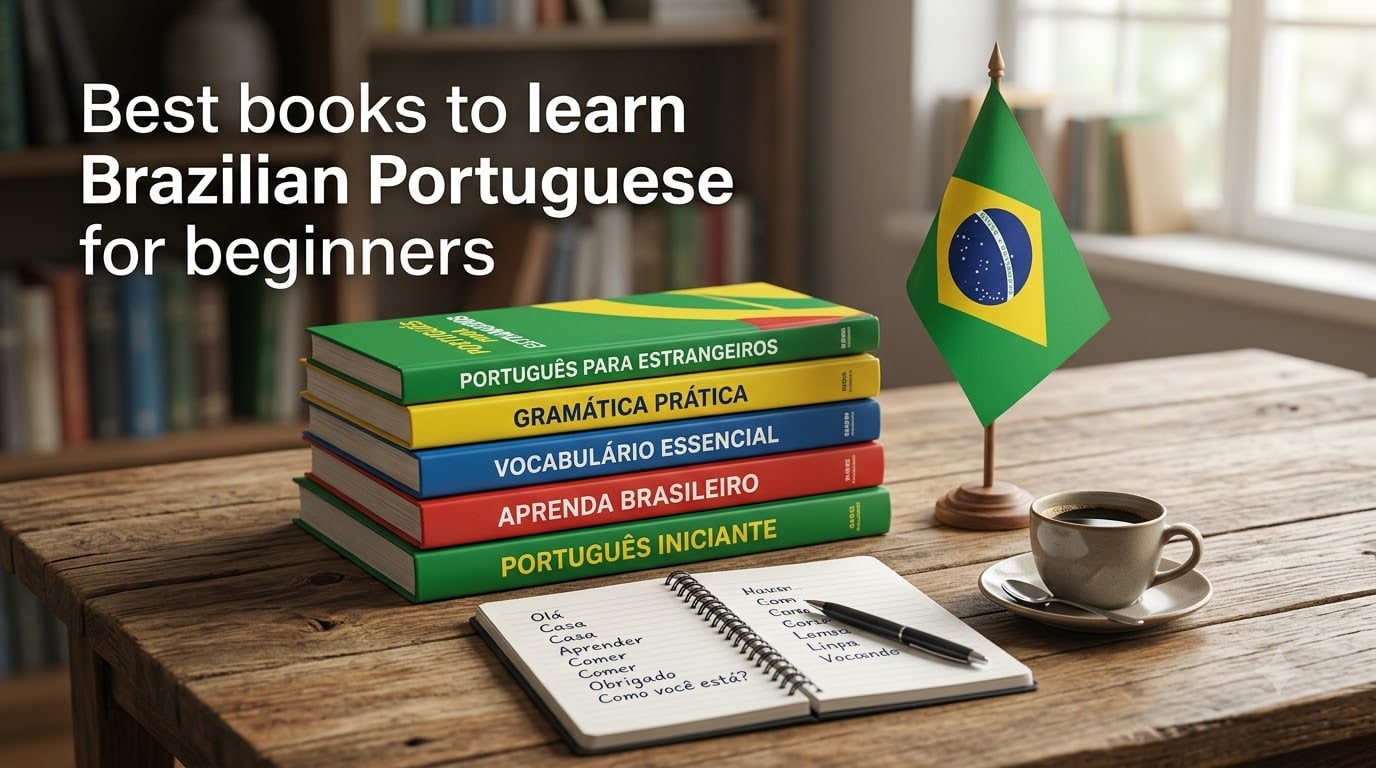
If you’ve been searching for the best books to learn Brazilian Portuguese for beginners, you’re in the right place. After testing dozens of textbooks, phrase books, and self-study guides over the past two years, I’ve narrowed down the options to the ones that actually work. Whether you’re planning a trip to Rio, connecting with Brazilian family, or just love the sound of the language, the right book makes all the difference.
Brazilian Portuguese is a beautiful, expressive language spoken by over 200 million people. But here’s the thing — not every Portuguese textbook teaches the Brazilian variety. Many books focus on European Portuguese, which has different pronunciation, vocabulary, and even some grammar structures. That’s why choosing a book specifically designed for Brazilian Portuguese matters so much for beginners.
In this guide, I’ll walk you through the best books to learn Brazilian Portuguese for beginners, explain what makes each one unique, and help you find the perfect match for your learning style and goals.
Table of Contents
Why Learn Brazilian Portuguese from Books?
Apps and online courses are popular, but books still offer something unique for language learners. They provide structured grammar explanations that you can reference repeatedly, practice exercises with answer keys, and offline access that doesn’t require Wi-Fi or a subscription.
Books give you a comprehensive foundation that scattered app lessons often miss. You get systematic grammar coverage, vocabulary organized by themes, and dialogues that build on each other progressively. Many Brazilian Portuguese textbooks also include audio components — CDs or online access — so you can hear native pronunciation while reading along.
From my experience, the learners who make the fastest progress combine a good textbook with supplementary resources. The book provides the structure; apps, podcasts, and conversation partners fill in the gaps. But it all starts with a solid textbook.
Brazilian vs. European Portuguese: What Beginners Need to Know
Before you buy any book, you need to understand a critical distinction. Brazilian Portuguese and European Portuguese are the same language, but they differ in pronunciation, vocabulary, and some grammar. It’s similar to the differences between American and British English — but more pronounced.
Pronunciation is the biggest difference. Brazilian Portuguese has a more open, melodic sound with clear vowel pronunciation. European Portuguese tends to “swallow” vowels and sounds more Slavic to many English speakers. If you want to sound like someone from São Paulo or Rio de Janeiro, you need a book that teaches Brazilian pronunciation.
Vocabulary differences matter too. In Brazil, you say “ônibus” for bus; in Portugal, it’s “autocarro.” A “train” is “trem” in Brazil but “comboio” in Portugal. These aren’t minor variations — using the wrong word can cause confusion.
Grammar-wise, Brazilian Portuguese uses the gerund more frequently (estou fazendo vs. estou a fazer) and has different pronoun placement rules. A good Brazilian Portuguese textbook will teach you these distinctions from the start.
The Best Books to Learn Brazilian Portuguese for Beginners
After reviewing over 15 textbooks and testing them with real beginners, here are my top recommendations. Each book was evaluated for grammar clarity, practical vocabulary, audio quality, exercise variety, and how well it specifically teaches Brazilian Portuguese.
1. Living Language Brazilian Portuguese
Living Language Brazilian Portuguese is consistently recommended on forums like r/portuguese and r/languagelearning — and for good reason. This complete course includes three books (beginner, intermediate, advanced), audio CDs, and online resources.
What makes it stand out is the audio from native Brazilian speakers throughout every lesson. The dialogues feel natural and contemporary, not stiff textbook conversations. The grammar explanations are clear and build progressively, starting with basic verb conjugations and working up to complex tenses.
The course covers both formal and informal registers, which is essential for real-world Brazilian Portuguese. Brazilians speak very differently in casual settings compared to formal contexts, and this book prepares you for both. It’s ideal for self-study and works well for complete beginners with no prior Portuguese experience.
2. Portuguese: A Complete Course (Teach Yourself)
The Teach Yourself series has been helping language learners for decades, and their Brazilian Portuguese course lives up to the reputation. This book follows a structured approach with 18 units covering everything from greetings to discussing current events.
Each unit includes dialogues, grammar explanations, vocabulary lists, and exercises. The accompanying audio features Brazilian speakers with clear, moderate-paced pronunciation. What I appreciate most is the cultural notes scattered throughout — they give context for why Brazilians say things a certain way.
This book works especially well for learners who prefer a classroom-style approach. The progression is logical and steady, and the exercises reinforce what you’ve learned. It’s been updated to reflect modern Portuguese orthography, so you won’t learn outdated spelling conventions.
3. Brazilian Portuguese for Beginners
This book is designed specifically for English speakers with zero Portuguese experience. It starts from the absolute basics — the alphabet, numbers, and essential phrases — before gradually introducing grammar concepts.
The strength of this book is its focus on practical, everyday Brazilian Portuguese. Instead of academic vocabulary you’ll never use, it teaches you how to order food, ask for directions, make small talk, and handle common travel situations. The dialogues reflect how Brazilians actually speak, including informal contractions and slang.
Practice exercises are plentiful, and the answer key lets you check your work. The book also includes pronunciation guides with phonetic spellings, which helps beginners tackle the nasal sounds and open vowels that make Brazilian Portuguese distinctive.
4. Ponto de Encontro: Portuguese as a World Language
Ponto de Encontro is a university-level textbook that covers both Brazilian and European Portuguese. It’s comprehensive, rigorous, and thorough — but it can be overwhelming for self-study beginners.
I include it on this list because it’s the most complete Portuguese textbook available. If you’re serious about reaching advanced proficiency and don’t mind a steep learning curve, this book will take you further than any other single resource. The grammar explanations are detailed, the exercises are challenging, and the cultural content is rich.
However, forum users consistently note that Ponto de Encontro works best with a teacher or tutor guiding you. Self-study learners often find it too dense. If you’re a disciplined learner who thrives on academic rigor, this is your book. If you prefer a gentler introduction, start with one of the other options on this list.
5. Easy Portuguese Phrase Book
Sometimes you don’t need a full textbook — you need practical phrases you can use immediately. The Easy Portuguese Phrase Book focuses specifically on Brazilian Portuguese phrases organized by situation: restaurants, hotels, shopping, transportation, and emergency scenarios.
Each phrase includes pronunciation guides and the accompanying audio lets you hear exactly how native Brazilians speak. The book is compact enough to carry while traveling, making it an excellent companion for tourists visiting Brazil.
This isn’t a comprehensive grammar course, but it’s perfect for travelers who want functional Portuguese quickly. Many learners use it alongside a more thorough textbook — the phrase book for immediate practical needs and the textbook for building deeper understanding.
6. Complete Brazilian Portuguese
Part of the Complete language series, this book offers a well-structured approach to Brazilian Portuguese with 24 units covering beginner through intermediate levels. The audio content features native speakers from different Brazilian regions, exposing you to various accents.
The book stands out for its balance of grammar, vocabulary, and cultural content. Each unit includes real-world texts — newspaper excerpts, blog posts, social media posts — that show you how Portuguese is actually used in Brazil today. The exercises test reading, writing, listening, and speaking skills.
What I like most is the “discovery” approach to grammar. Instead of just presenting rules, the book encourages you to identify patterns in examples before explaining the rule. This leads to deeper understanding and better retention than rote memorization.
7. Short Stories in Brazilian Portuguese for Beginners
Reading is one of the most effective ways to build vocabulary and internalize grammar patterns. This book presents eight original short stories written specifically for beginners, with vocabulary glosses and comprehension questions for each chapter.
The stories cover everyday situations — meeting new people, exploring a city, shopping at a market — and use vocabulary appropriate for A1-A2 level learners. Grammar structures are recycled naturally throughout the stories, reinforcing what you’ve learned in other contexts.
This book works best as a supplement to a main textbook. Once you’ve completed the first few units of a structured course, these stories provide enjoyable reading practice that solidifies your knowledge. The key is reading at your level — challenging enough to learn new words, easy enough to follow the plot.
How to Choose the Right Brazilian Portuguese Book for You
The best book depends on your learning style, goals, and how much time you can dedicate. Here’s how to match your needs to the right resource.
Complete beginners with no language learning experience: Start with Living Language Brazilian Portuguese or Brazilian Portuguese for Beginners. Both assume zero knowledge and build from the ground up.
Self-study learners who want structure: Portuguese: A Complete Course (Teach Yourself) offers the most organized, systematic approach. The clear unit structure makes it easy to track your progress.
Travelers who need functional Portuguese fast: Easy Portuguese Phrase Book gives you practical phrases for immediate use. Pair it with a textbook if you want deeper understanding later.
Serious learners aiming for fluency: Ponto de Encontro combined with Short Stories in Brazilian Portuguese will give you the most comprehensive foundation. Be prepared to invest significant time and effort.
Visual and audio learners: All the books on this list include audio, but Living Language and Complete Brazilian Portuguese have the strongest audio components with the most hours of native speaker content.
Tips for Learning Brazilian Portuguese with Books
Having the right book is only half the equation. How you use it matters just as much. Here are strategies that actually work.
Set a consistent study schedule. Thirty minutes daily beats three hours once a week. Language learning depends on regular exposure and repetition. Your brain needs time to process and consolidate new information between study sessions.
Read dialogues out loud. Don’t just read silently — speak the words. This builds muscle memory for pronunciation and helps you internalize sentence patterns. Record yourself and compare to the audio.
Do every exercise. I know it’s tempting to skip exercises, but they’re how you move knowledge from passive recognition to active use. Write out answers, even when the format suggests speaking them.
Use the audio consistently. Listen to each dialogue multiple times — once while reading, once while just listening, and once while speaking along. This trains your ear to recognize Brazilian Portuguese sounds and rhythms.
Supplement with real Brazilian content. Once you have basic vocabulary, start watching Brazilian YouTube channels, listening to Brazilian music, or following Brazilian social media accounts. Your book gives you the foundation; real content gives you fluency.
Common Mistakes to Avoid When Learning Brazilian Portuguese
Forum discussions reveal several pitfalls that trip up beginners. Avoiding these will save you months of frustration.
Buying a European Portuguese book by mistake. This is the most common complaint on language learning forums. Always check that the book specifically says “Brazilian Portuguese” — not just “Portuguese.” Many popular textbooks teach European Portuguese by default.
Studying only grammar without speaking practice. Books teach you to read and write, but speaking requires practice with real people. Use your book’s dialogues as a starting point, then find conversation partners through language exchange apps or local meetups.
Ignoring pronunciation from day one. Brazilian Portuguese has sounds that don’t exist in English, including nasal vowels and the “ão” ending. If you skip pronunciation practice early, bad habits become very hard to fix later.
Expecting to learn everything from one book. No single resource covers everything. The best approach combines a structured textbook with supplementary materials — phrase books for travel vocabulary, storybooks for reading practice, and apps for vocabulary drilling.
Studying outdated materials. Portuguese underwent an orthographic reform in 2009. Books published before that may teach spelling conventions that are no longer standard. Always check the publication date and ensure the book reflects current Portuguese orthography.
Free Resources to Supplement Your Brazilian Portuguese Books
Books provide structure, but free resources can accelerate your learning. Here are the best complementary tools for Brazilian Portuguese learners.
Duolingo offers a free Brazilian Portuguese course that’s excellent for vocabulary drilling. It won’t teach you grammar systematically, but it reinforces words and phrases you’ve learned from your textbook.
Forvo is a pronunciation dictionary where native speakers record words and phrases. When you encounter an unfamiliar word in your textbook, check Forvo to hear how Brazilians actually pronounce it.
YouTube channels like “Portuguese With Leo” and “Speaking Brazilian” provide free video lessons focused specifically on Brazilian Portuguese. They cover pronunciation, grammar, and cultural topics that textbooks sometimes miss.
Lyrics Training turns Brazilian music into a language learning game. You listen to songs and fill in missing lyrics — it’s surprisingly effective for building listening skills and picking up colloquial expressions.
Language exchange apps like Tandem and HelloTalk connect you with native Brazilian Portuguese speakers who want to practice English. You teach them English; they teach you Portuguese. It’s free and mutually beneficial.
Frequently Asked Questions
What is the best book to learn Brazilian Portuguese?
Living Language Brazilian Portuguese is widely considered the best overall book for beginners. It includes three books spanning beginner to advanced levels, audio from native Brazilian speakers, and comprehensive grammar coverage. For self-study learners, it offers the most complete and well-structured approach to Brazilian Portuguese.
Can I learn Brazilian Portuguese from books alone?
Books provide an excellent foundation for grammar, vocabulary, and reading comprehension, but fluency requires speaking practice with real people. The most effective approach combines a structured textbook with conversation partners, Brazilian media content, and language exchange apps. Books give you the structure; real-world practice gives you fluency.
How long does it take to learn Brazilian Portuguese?
With consistent daily study of 30-60 minutes using a quality textbook, most English speakers reach conversational level in 6-12 months. Achieving fluency typically takes 18-24 months of dedicated study and practice. Brazilian Portuguese is considered one of the easier languages for English speakers to learn, requiring approximately 600-750 hours of study.
Is Brazilian Portuguese hard to learn?
Brazilian Portuguese is classified as a Category I language by the U.S. Foreign Service Institute, meaning it’s one of the easier languages for English speakers to learn. The grammar is more regular than many European languages, and the pronunciation is more consistent than English. The biggest challenges are verb conjugations and nasal sounds, both of which improve with practice.
What is the difference between Brazilian and European Portuguese?
The main differences are pronunciation, vocabulary, and some grammar structures. Brazilian Portuguese has a more open, melodic pronunciation with clear vowels, while European Portuguese tends to drop vowels and sounds more clipped. Vocabulary differs significantly — Brazilians say u0022ônibusu0022 for bus while Portuguese say u0022autocarro.u0022 Grammar differences include pronoun placement and gerund usage. Always ensure your textbook teaches the Brazilian variety if that’s your goal.
Are there any free resources to learn Brazilian Portuguese?
Yes, excellent free resources include Duolingo for vocabulary practice, Forvo for pronunciation reference, YouTube channels like u0022Speaking Brazilianu0022 for video lessons, and language exchange apps like Tandem for conversation practice. However, free resources work best as supplements to a structured textbook, which provides the systematic grammar foundation that scattered app lessons cannot match.
Conclusion
Learning Brazilian Portuguese is a rewarding journey that opens doors to one of the world’s most vibrant cultures. The best books to learn Brazilian Portuguese for beginners — whether you choose Living Language, Teach Yourself, or another option from this list — will give you the foundation you need. Start with one book, study consistently, supplement with free resources, and you’ll be speaking Portuguese before you know it. Boa sorte!