
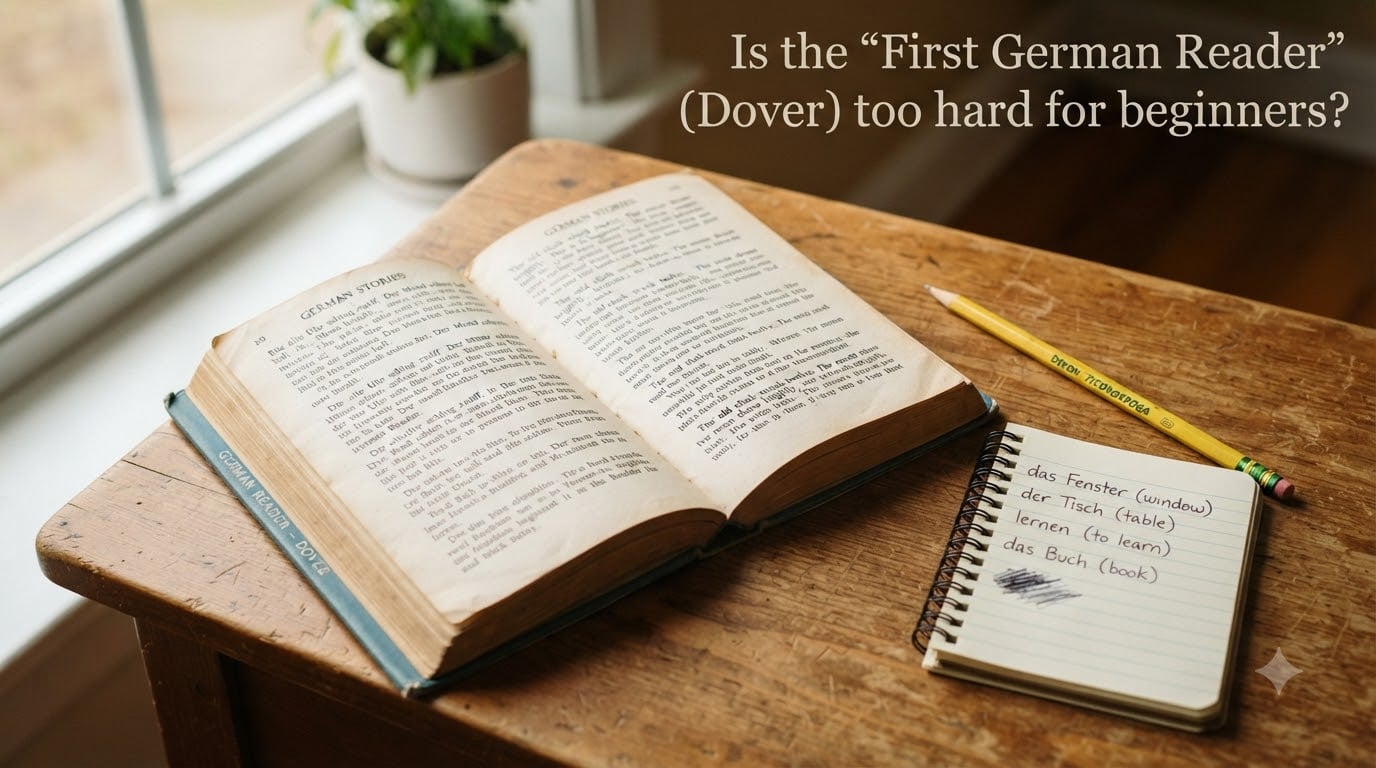
Many learners pick up the First German Reader published by Dover because the cover promises a beginner-friendly introduction to German literature. Then they open it, hit the first paragraph by Gotthold Ephraim Lessing, and wonder if they accidentally bought the wrong book. The short answer is that the book is real, the format is excellent, and the difficulty is almost certainly higher than the title suggests.
If you are asking is the First German Reader (Dover) too hard for beginners, this guide gives you the verdict, the evidence, and a clear next step. I will walk through what the book actually contains, where it sits on the CEFR scale, why so many learners hit a wall on page one, and the alternatives that work better if you are truly starting from zero.
Table of Contents
Is the First German Reader (Dover) Too Hard for Beginners?
Yes, for most beginners it is too hard. The First German Reader edited by Harry Steinhauer and republished by Dover sits closer to B1-B2 than A1, even though the publisher markets it as a beginner dual-language book. The difficulty comes from archaic vocabulary, varied difficulty across the 52 selections, and a literary grammar that assumes you already know cases, subjunctive, and past tenses. Beginners who have completed an A1 course (roughly 60-100 study hours) can use it as a supplementary reader, but absolute beginners will struggle with the very first page.
What the First German Reader (Dover) Actually Is
The First German Reader: A Beginner’s Dual-Language Book was originally published by Bantam in 1964 and reissued by Dover Publications in 2007 under ISBN 9780486461793. It is 224 pages and edited by Harry Steinhauer, a longtime German literature professor.
The anthology collects 52 short stories, poems, essays, and anecdotes from canonical German authors including Goethe, Schiller, Heinrich Heine, Hermann Hesse, Friedrich Hölderlin, the Brothers Grimm, and Bertolt Brecht. The German text appears on the left-hand page, with a precise English translation on the facing right-hand page.
There is also a short back-of-book glossary and a set of comprehension questions in German. The book is well-made, inexpensive, and honestly a pleasure to flip through, once you are ready for it.
What CEFR Level the First German Reader Really Sits At
Most independent reviewers and language-learning forums place this book at B1 to B2 on the Common European Framework of Reference (CEFR) scale, not at A1 or A2 as the title might imply. A1 is “absolute beginner” and B2 is “upper-intermediate,” so the gap matters.
The discrepancy comes from how the difficulty is distributed. A handful of selections, such as the Brothers Grimm fairy tales and some Heine poems, are genuinely approachable. Others, including the opening Lessing passage and several Kant and Nietzsche excerpts, read like upper-intermediate material with subordinate clauses stacked three deep and vocabulary drawn from 18th- and 19th-century German prose.
If you have finished a full A1 course (such as the first half of a textbook like Studio d or a complete Duolingo tree) and you are comfortable with cases and the present and past tenses, the book will be challenging but workable. If you have not, the book will feel punishing.
Why Many Beginners Find the First German Reader Too Hard
Several specific design choices make the book harder than it looks for true beginners.
Archaisms and literary German. Many selections use pre-spelling-reform vocabulary (forms like “daß” instead of “dass” and “Thür” instead of “Tür”), pre-1996 punctuation conventions, and verb-final constructions that rarely appear in spoken German. Words like entzückendes, bewunderten, and gafften appear on page one.
Inconsistent difficulty across selections. Because the book is an anthology rather than a graded reader, the difficulty jumps around. You might coast through a simple fairy tale and then collide with a Nietzsche aphorism. There is no gradual ramp.
No story arc, so vocabulary does not recur. Graded readers like Café in Berlin repeat key words across chapters to reinforce them. The Dover anthology moves from one author to the next, so the new word you struggled with on page 30 will not appear again on page 50.
Poems about death and the sublime. A surprising share of the poetry collection deals with mortality, nature, and transcendence. Several Goodreads reviewers noted that they found it emotionally heavy for a first reader.
Dated cultural content. Some passages reflect mid-20th-century perspectives, including an East-versus-West Germany framing and a passage with attitudes about post-WWII German guilt that will surprise modern readers.
No audio companion. Modern graded readers bundle audio files, comprehension quizzes, and apps. The Steinhauer volume ships with text only, so there is no way to hear what the passages should sound like.
A Look at the First Page: Where Beginners Get Stuck
The first selection is a short descriptive passage by Gotthold Ephraim Lessing. A representative opening sentence reads, in modernized approximation, something like: “The travelers gafften at the entzückendes panorama, bewunderten the strange architecture, and set off again before the rain began.”
A beginner reading that sentence needs to know: that gafften is an archaic past tense of gaffen (to gawk), that entzückendes is a nominalized adjective form meaning “delightful,” that the verb conjugations follow a weak-verb pattern, and that the sentence order places the verb second despite a fronted adverbial phrase. None of those are A1 problems.
That is exactly why so many readers describe opening the book, reading two pages, and putting it back on the shelf. It is not that the book is bad; it is that the first page is a C1 sample of an A1 learner’s textbook.
What Grammar You Should Know Before Opening the Book
Before you commit to the First German Reader, work through this short checklist. If any item feels shaky, finish that grammar topic first or pick a true beginner graded reader instead.
- All four cases (nominative, accusative, dative, genitive) and the question words that trigger them (wer/wen/wem/wessen).
- Present tense conjugation for regular, irregular, and modal verbs (können, müssen, wollen, sollen, dürfen, mögen).
- Past tenses at least passively, including the simple past of sein, haben, and werden, plus the conversational past (Perfekt) with haben and sein.
- Subordinate clauses introduced by weil, dass, wenn, obwohl, als with verb-final word order.
- The subjunctive II (Konjunktiv II) for polite requests and hypotheticals.
- Adjective declension after der-words, ein-words, and in the predicate.
- Basic prepositions that take the accusative, dative, or two-way cases.
If that list reads like a refresher rather than new material, you are ready for the Steinhauer anthology. If half of it is unfamiliar, give yourself another 40-60 study hours with a structured course and a true A1-A2 reader before coming back.
First German Reader vs. True Beginner Alternatives
The Steinhauer book is one option among many. If your goal is to read real German without constant dictionary trips, these three graded readers are designed for beginners in a way the Dover anthology is not.
| Title | CEFR Level | Audio | Story Arc | Vocabulary Consistency |
|---|---|---|---|---|
| First German Reader (Steinhauer, Dover) | B1-B2 | No | None (52 unrelated selections) | Low |
| Café in Berlin (Andrey Klebanov) | A1-A2 | Yes (free online) | Yes (10-chapter mystery) | High (recycled across chapters) |
| Graded German Reader: Erste Stufe (Koffer Wortschatz) | A1 | Optional | Yes (graded short stories) | High |
| Ferien in Frankfurt (Klebanov) | A2 | Yes | Yes (Detective Harry continues) | High |
If you are at zero German, start with Café in Berlin or Erste Stufe. Once you have finished those and feel comfortable with past tenses and cases, the Dover anthology becomes a satisfying reward rather than a punishment.
How to Use the First German Reader If You Are a Determined Beginner
If you already own the Steinhauer book and refuse to put it down, here is a five-step strategy that turns it into a usable study tool rather than a doorstop.
Step 1: Read the translation first. Before opening the German page, read the English translation all the way through. Get the story, characters, and key nouns into your head. You are priming your brain so the German page has anchors to stick to.
Step 2: Re-read the German page sentence by sentence. Cover the English and try to translate each sentence. Uncover the English only after you have given the sentence your best attempt. Highlight the words you did not recognize.
Step 3: Build a personal glossary. Write every highlighted word into a spaced-repetition deck (Anki or paper flashcards). Include the article, plural, and a sample sentence from the book. Add 5-10 new words per sitting, no more.
Step 4: Read the passage aloud. Pronunciation practice exposes you to the rhythm of literary German. Even without an audio companion, your own voice gives you a tactile sense of the sentence.
Step 5: Skip freely. If a passage is over your head, jump to the next. The anthology is unordered by difficulty, so you are allowed to start with the easier Grimm fairy tales and come back to Lessing and Kant in a few months.
This approach takes more time than simply reading cover to cover, but it is the difference between finishing the book and actually learning anything from it.
Who the First German Reader Is Actually Best For
The Steinhauer anthology is genuinely excellent, just not for absolute beginners. It is a great fit for three specific learner profiles.
Intermediate learners (B1-B2). If you have finished an A2 course and want to push into real German literature, this book is a satisfying bridge. The facing-page format lets you work through Goethe and Hesse without constant dictionary trips.
Literature enthusiasts. If your motivation is reading Goethe in the original, not building conversational fluency, this book delivers what no graded reader can. You get curated selections across two centuries of German letters.
Supplementary readers. Even at A2-B1, you can use one selection per week as a Saturday morning challenge, paired with a primary textbook. The book rewards slow, repeated visits.
If none of those describe you, you will get more value out of a graded reader designed for your current level.
Frequently Asked Questions
Is the First German Reader (Dover) really for beginners?
Not really, despite the title. Most learners place it at B1-B2 because the selections use archaic vocabulary, varied difficulty, and literary grammar that assumes you already know German cases and the subjunctive. It works as a beginner book only if you have already completed an A1 course.
What is the best German learning book for beginners?
For pure beginners, Café in Berlin by Andrey Klebanov is the most popular choice because it pairs a 10-chapter mystery with free audio. If you want stories rather than a mystery, the Graded German Reader: Erste Stufe series is a strong A1 alternative with consistent vocabulary.
Can you learn German just by reading?
Reading alone is rarely enough at the beginner stage because you cannot get feedback on pronunciation, grammar choices, or active production. Reading works best as a supplement to a structured course, conversation practice, and listening. Once you reach B1, reading becomes one of the fastest ways to grow your vocabulary and intuition.
What are some easy-to-read German novels for beginners?
Café in Berlin, Mord am Morgen, and Ferien in Frankfurt by Andrey Klebanov are written specifically for A1-A2 learners and include audio. For a more literary flavor, the Dover Dual Language editions of Andersen fairy tales and Brothers Grimm are approachable at A2-B1 once you have some grammar under your belt.
What level is the Steinhauer First German Reader?
Most readers place it at B1-B2 on the CEFR scale. The difficulty varies across the 52 selections, with some Grimm fairy tales sitting closer to A2 and the Lessing, Kant, and Nietzsche excerpts reaching C1. It is best treated as an intermediate or upper-intermediate reader rather than a true beginner book.
Final Verdict on the First German Reader for Beginners
So, is the First German Reader (Dover) too hard for beginners? For absolute beginners, yes. The book is honest about being a literary anthology, and most of its selections assume you already have a working grasp of cases, past tenses, and literary vocabulary. If you are under 60 study hours into German, you will learn more from Café in Berlin or another A1 graded reader.
If you have finished an A1 course and want to read Goethe, Schiller, and Hesse in the original, the Steinhauer anthology is a rewarding, well-edited companion that will grow with you for years. Buy it for the right reason, at the right level, and it stops being too hard.