
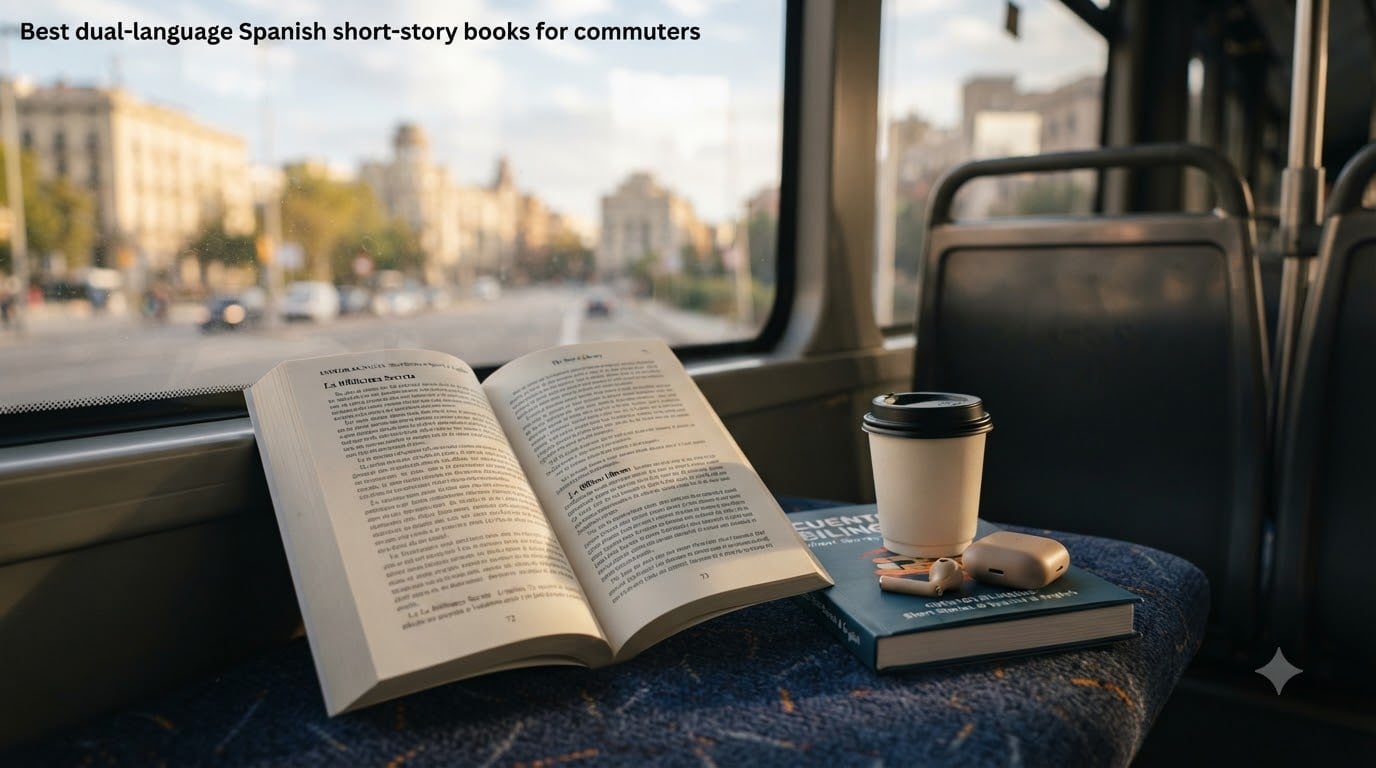
Dead time on the bus or train is a language learner’s secret weapon, and dual-language Spanish short-story books are the easiest way to put it to work. I started carrying one on my commute two years ago and finished my first Spanish novella within a month.
The best dual-language Spanish short-story books for commuters are print editions that present the same story in Spanish and English – usually side-by-side on the same page or on facing pages – so readers can compare the two languages without flipping to a separate translation. Each story is short enough to finish in one or two rides, which matters when your attention is split between traffic announcements and a swaying subway car.
In this guide, our team reviews 10 commute-tested titles grouped by CEFR level, matches them to specific ride lengths, and shares the audio-plus-print tricks that turn a 30-minute bus ride into focused reading practice. No long novels, no dictionary fumbling – just stories you can finish before your stop.
Table of Contents
Quick Picks: Top 3 Dual-Language Spanish Short Story Books
Short on time? These three titles cover the most common commuter scenarios and reader levels.
1. Spanish Stories / Cuentos Espanoles (Dover Dual-Language) – Best Overall
A classic intermediate collection from Dover with 13 stories by authors like Cervantes and Pardo Bazán. Each story runs 5 to 15 pages, fits comfortably in one hand, and uses the side-by-side Spanish-English layout that Dover pioneered. This is the book most commuters I know end up keeping on permanent rotation.
2. Spanish-American Short Stories / Cuentos Hispanoamericanos (Dover) – Best for Variety
Twenty-six stories from Latin America – including Quiroga, Rulfo, and Borges – give you a wider geographic and stylistic range than the Spanish-only collection. It is heavier than a mass-market paperback, so I save this one for train rides with a backpack seat rather than crowded buses.
3. Short Stories in Spanish for Beginners (Olly Richards) – Best for Beginners
Olly Richards’ graded-reader series uses the 1,000 most-frequent-words approach, with each story written specifically for A1-A2 learners. Eight stories, a built-in glossary, and an audiobook download code make this the strongest pick if you are still shaky on subjunctive verb forms.
Best Dual-Language Spanish Short Story Books for Commuters
We grouped our 10 picks by CEFR level so you can pick the right tier for your current Spanish. Each entry includes what makes it commute-friendly, who it is best for, and any honest drawbacks from the reviews we read.
Best Picks for Beginner Commuters (A1-A2)
Short Stories in Spanish for Beginners – Olly Richards
Eight original stories built around the 1,000 most-common Spanish words, with a summary at the end of each chapter and a final comprehension section. The audiobook download code pairs the print book with a hands-free listening option that several SSi Spanish Forum teachers specifically praised for commute use. The paperback is light, and the chapters average 12 to 15 pages, which lines up with a 25 to 30 minute bus ride.
Some readers on Reddit’s r/SpanishLearning call the writing style “clearly translated, no editor” – the prose feels simplified. For a commuter who wants authentic literary fiction, this is a drawback. For a beginner who needs to actually finish a story on the way to work, it is the right tradeoff.
Cajas de Cartón – Francisco Jiménez
A slim bilingual memoir-style novella about a migrant child’s life in California, originally written in English and translated into simple Spanish by the author himself. At roughly 130 pages total, you can finish it across two or three commutes, and the short chapters make it easy to stop at your stop and pick up exactly where you left off. It is a frequent recommendation on r/SpanishLearning for beginners who want something more emotionally grounded than a graded reader.
Be aware that the Spanish side is more literary than graded-reader Spanish, so it works best for true beginners who already know the story in English or for A2 readers building toward real prose.
Madrigal’s Magic Key to Spanish – Margarita Madrigal
A 1950s classic that teaches Spanish through fairy tales, with the Spanish and English versions printed on facing pages. The vocabulary is dated (think “automobile” and “telegram”), but the patterns are clean, and the simple sentence structures help absolute beginners build a reading habit. At about 200 pages with short chapters, it works well for commuters who want a slow-build over a few weeks.
Best Picks for Intermediate Commuters (B1-B2)
Spanish Stories / Cuentos Espanoles – Edited by Angel Flores (Dover Dual-Language)
Thirteen short stories from Spain’s Golden Age through the early 20th century, including pieces by Cervantes, Pardo Bazán, and Valle-Inclán. The side-by-side Spanish-English format is the original Dover style that inspired most of the books on this list. Stories average 5 to 15 pages each, the paperback weighs under 8 ounces, and the type is large enough to read on a moving bus.
The translation is older and occasionally stilted; if you want modern natural Spanish, look at one of the newer Penguin parallel-text editions instead.
Spanish-American Short Stories / Cuentos Hispanoamericanos – Edited by Sara Castro-Klaren and Rodolfo Cortina (Dover Dual-Language)
Twenty-six stories spanning Quiroga’s jungle fables to Borges’ urban parables. This is the most genre-diverse of the Dover bilingual short-story anthologies and the best single volume if you want exposure to multiple Latin American voices. Expect to finish 2 to 3 stories per commute.
The trade-off is weight: at roughly 14 ounces it is heavier than most mass-market paperbacks, and some stories use regional vocabulary that B1 readers may need to look up.
Conversational Spanish Dialogues: Over 100 Spanish Conversations and Short Stories – Lingo Mastery
Built around dialogue rather than narration, this book models the kind of spoken Spanish you hear on a commute through headphones. The bilingual format is paragraph-by-paragraph rather than page-by-page, which several SSi Forum reviewers say helps with the listening-to-reading handoff. There is also an audiobook version that pairs well with the print edition.
The Penguin Book of Spanish Short Stories – Edited by Margaret Jull Costa
Forty stories from Spain and Latin America, ranging from medieval sketches to contemporary fiction. The Penguin edition prints the original Spanish only – no English translation – which makes it a stronger fit for B2 commuters who already read comfortably without a safety net. The paperback is well-bound and survives daily subway abuse better than most competitors.
Best Picks for Advanced Commuters (C1+)
New Penguin Parallel Text: Short Stories in Spanish – Edited by Margaret Jull Costa and Nick Caistor
Penguin’s parallel-text format puts the Spanish and English on facing pages with no glossary, treating the reader as someone ready to handle literary fiction. The stories are short enough to finish one per commute, and the selection – including Cortázar, Quiroga, and Ribeyro – pushes you into authentic prose rhythms.
The Dual-Language Storybook: Spanish and English Holiday Stories
A themed collection of holiday tales from across the Spanish-speaking world, paired with English translations. The seasonal framing makes this a strong gift pick and a good late-year commute book when you want something lighter than Borges.
Short and Easy Spanish Novels for Beginners (Bilingual Edition) – Olly Richards (later series)
Despite the title, the later Olly Richards novels work well for advanced commuters who want page-turner pacing without the literary density. The bilingual format keeps a translation safety net while letting you stretch into longer, plot-driven Spanish.
Dual-Language Spanish Short Story Books at a Glance
Here is the full list in one table for quick scanning. We included CEFR level, page count, and available formats so you can match a book to your commute at a glance.
| Title | Author / Editor | CEFR Level | Pages | Format |
|---|---|---|---|---|
| Short Stories in Spanish for Beginners | Olly Richards | A1-A2 | 240 | Print + Audiobook |
| Cajas de Cartón | Francisco Jiménez | A2 | 130 | |
| Madrigal’s Magic Key to Spanish | Margarita Madrigal | A1 | 200 | |
| Spanish Stories / Cuentos Espanoles | Angel Flores (ed.) | B1-B2 | 272 | |
| Spanish-American Short Stories / Cuentos Hispanoamericanos | Castro-Klaren and Cortina (eds.) | B1-B2 | 336 | |
| Conversational Spanish Dialogues and Short Stories | Lingo Mastery | B1 | 220 | Print + Audiobook |
| The Penguin Book of Spanish Short Stories | Margaret Jull Costa (ed.) | B2-C1 | 320 | |
| New Penguin Parallel Text: Short Stories in Spanish | Jull Costa and Caistor (eds.) | B2-C1 | 256 | |
| The Dual-Language Storybook: Spanish and English Holiday Stories | Various | B1-B2 | 180 | |
| Short and Easy Spanish Novels for Beginners (Bilingual Edition) | Olly Richards | A2-B1 | 200 | Print + Audiobook |
Matching Short Story Books to Your Commute Length
One thing no competitor article covers is mapping stories to specific ride lengths. Here is how I match books to real commutes.
15-Minute Commutes: One Chapter Per Ride
For short bus rides or a single subway stop, stick with graded readers like Short Stories in Spanish for Beginners. Each chapter is 12 to 15 pages, finishes in about 12 minutes, and ends with a summary and comprehension questions so you can close the book at your stop without losing the thread. Cajas de Cartón works the same way – short chapters, clean prose, easy pickup-and-put-down.
30-Minute Commutes: One Full Story Per Ride
This is the sweet spot for the Dover dual-language anthologies. Most stories in Spanish Stories / Cuentos Espanoles run 5 to 15 pages and finish in 20 to 30 minutes, leaving you a few minutes at the end to flip back and re-read the trickiest sentence. Conversational Spanish Dialogues is similarly sized and works especially well if your commute includes a walking portion where you can switch to the audiobook mid-ride.
45 to 60-Minute Commutes: Two or Three Stories Per Ride
Longer train rides give you room for the bigger Dover anthology, Spanish-American Short Stories / Cuentos Hispanoamericanos, where you can power through 2 to 3 stories and still have time for a vocabulary pass. The Penguin parallel-text editions also shine here, because you can read one story in Spanish and immediately check the English facing page without breaking pace.
Audio + Print for Walking and Driving Portions
If part of your commute is on foot or in a car (as a passenger), the audiobook version of the Olly Richards and Lingo Mastery titles lets you keep learning while your eyes are busy. Several SSi Spanish Forum teachers called the audio-plus-text combo “gold” for exactly this reason – reading and listening together builds the kind of pattern recognition that pure reading misses.
What Makes a Dual-Language Book Commute-Friendly
Not every bilingual book survives a real commute. Here is what our team looked for in every pick on this list.
Key Features to Look For
Side-by-side or facing-page layout: The single biggest commute-friendly feature. If the Spanish and English are separated by chapter or by section, you will lose your place every time the bus lurches. Dover and Penguin both use a true side-by-side format.
Story length under 20 pages: Anything longer becomes hard to finish mid-ride. The best commute books pack multiple short stories into a single paperback so you always have a natural stopping point.
CEFR level clearly labeled: You should know within a page whether the vocabulary matches your level. The Olly Richards series, Penguin graded readers, and the Dover editions all mark levels clearly.
Built-in glossary: A glossary at the back of the book saves you from phone lookups, which are awkward on a moving bus and break your reading flow.
Audio + Print Combo for Hands-Free Commuting
If your commute includes walking, cycling (with audio only), or driving, the audiobook companion is the most underrated feature on this list. The Olly Richards and Lingo Mastery titles both include a free audiobook download with the print book. Read on the bus, listen on the walk from the stop to the office, and you double your daily exposure without adding a single minute.
Format, Weight, and Page Layout Tips
Paperback mass-market editions win on the commute. They fit in one hand, weigh under 10 ounces, and survive being shoved in a backpack. Hardcovers and large-format trade paperbacks are better saved for at-home reading.
For shaky bus rides, look for larger print editions. The Dover editions use a slightly larger body type than most Penguin paperbacks, which makes them easier to read on transit.
Where to Buy These Books
Major publishers like Penguin Random House and Dover list their bilingual editions through Amazon, Barnes & Noble, Books-A-Million, and Walmart. Indie bookstores can also special-order any title in this guide. Free online parallel-text resources (Bilinguis, Lonweb, Easy Readers, and Online Spanish Club) are a useful supplement if you want a story to sample before buying the print edition.
Frequently Asked Questions
What are some good dual language books in Spanish?
Top picks for commuters include Short Stories in Spanish for Beginners by Olly Richards for A1-A2, Spanish Stories / Cuentos Espanoles (Dover) for B1-B2, and New Penguin Parallel Text: Short Stories in Spanish for advanced readers. Each pairs Spanish with English on facing pages so you can compare the two without flipping back and forth.
What are some books that are bilingual in both English and Spanish?
The most widely available bilingual English-Spanish books include Spanish Stories / Cuentos Espanoles, Spanish-American Short Stories / Cuentos Hispanoamericanos, Madrigal’s Magic Key to Spanish, Cajas de Cartón, and the Olly Richards short-story series. All five use side-by-side Spanish and English text and are available as mass-market paperbacks.
Are dual-language Spanish books good for commuters?
Yes. Dual-language Spanish short-story books are one of the best resources for commuters because each story is short enough to finish in a single ride, the side-by-side translation removes the dictionary-lookup friction that kills reading momentum, and the paperback format fits in one hand. Pairing the print book with the matching audiobook extends learning to walking and driving portions of the commute.
How long should a Spanish short story book be for commuting?
For a 15-minute ride, choose chapters under 15 pages. For a 30-minute ride, full stories between 5 and 15 pages work best. For 45 to 60-minute train commutes, the bigger Dover or Penguin anthologies with 20 or more stories give you enough material to power through several stories per ride without repeating.
Which bilingual Spanish book is best for beginners?
Short Stories in Spanish for Beginners by Olly Richards is widely recommended for absolute beginners because it uses the 1,000 most-common-words approach, includes a glossary, and pairs the print book with a free audiobook download. Madrigal’s Magic Key to Spanish and Cajas de Cartón are strong alternatives if you want simpler prose or a memoir-style read.
Can I become fluent in 3 months reading Spanish short stories?
Reading Spanish short stories consistently on a daily commute builds vocabulary, grammar recognition, and reading speed, but three months is not enough to reach full fluency on its own. Pair the reading habit with speaking practice and listening exposure (audiobooks, podcasts) for the fastest path to conversational Spanish.
Start Your Spanish Reading Habit on the Commute
The best dual-language Spanish short-story books for commuters are the ones you actually finish. Pick one title that matches your CEFR level and your average ride length, commit to one story per day, and you will add real reading practice to your week without carving out extra study time. Our team still reaches for the Dover Cuentos Espanoles for train rides and the Olly Richards beginner volume for low-energy mornings.
Start with whichever book fits your level, finish one story on your next commute, and let the daily habit build from there.