
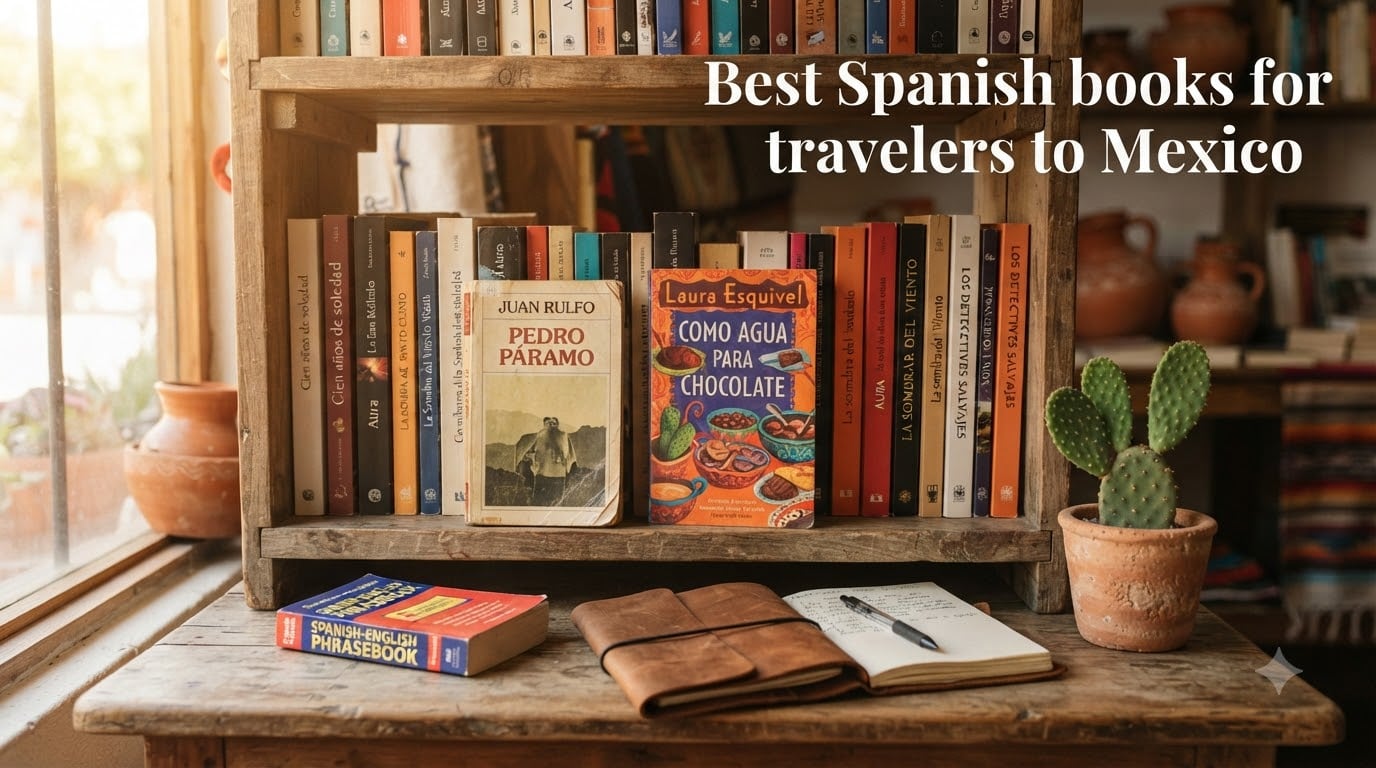
I still remember pulling Laura Esquivel’s Like Water for Chocolate out of my bag at the Mexico City airport, half-expecting a quaint romantic novel. Instead I got a working recipe for mole, a love story told through food, and a fast education in how Mexican families hold memory and magic in the same breath.
If you are planning a trip to Mexico, the right Spanish-language book does the same thing. It pulls you into the country before you board the plane, gives you vocabulary that locals actually use while you are there, and turns the return flight into a second experience of the place.
This guide collects the best Spanish books for travelers to Mexico, mixing Mexican fiction, history, phrasebooks, graded readers, memoirs, and a few newer releases. I read these on flights to Mexico City, in beach hammocks in Tulum, on long bus rides through Oaxaca, and on the deck of a friend’s house in San Miguel de Allende. My goal is to give you a stack that works in all three phases of travel: before, during, and after.
You will find a quick-pick list for time-pressed travelers, deep-dive fiction and non-fiction sections, a dedicated Spanish language-learning section that finally addresses the Mexican-versus-Castilian Spanish problem, region-matched reads for the four most common itineraries, a quick tour of Mexico’s literary destinations, and an FAQ that answers the exact questions travelers type into Google.
Table of Contents
Why Read Spanish Books Before Traveling to Mexico
Most travelers think of books as something to pack in case the beach gets boring. That is a waste. The right book, read at the right time, does three jobs at once. It teaches you words the locals actually use, it frames the history behind the murals and ruins you are about to see, and it makes you a more respectful guest in someone else’s country.
I think of it as a three-phase reading model.
Pre-trip is where you load cultural context. One novel by a writer like Carlos Fuentes or Sandra Cisneros will give you more usable context than a dozen travel videos.
During the trip is when a phrasebook or graded reader earns its space in your daypack. You will be reading on flights, in taxis, and in hotel rooms, so portability matters.
Post-trip is when memoir shine. After you have walked the streets of Oaxaca or the beach paths of Sayulita, books like Tony Cohan’s On Mexican Time re-open the trip and turn it into a longer experience.
Travelers who skip this step usually end up with the same complaint I hear on Reddit and in expat Facebook groups: the phrasebook they bought is full of “vosotros” and “coche,” neither of which anyone says in Mexico. The fix is to choose books built around Mexican Spanish from day one. That distinction is the single most important thing this guide can give you.
Reading also helps you avoid the tourist-cliché problem. A novel set in Mexico City will tell you how people actually eat, greet each other, and talk about politics. You arrive less prone to saying “amigo” to strangers and more likely to greet a taxi driver with the real “buenas, cómo le va” that opens doors.
Quick Picks: 5 Best Spanish Books for Travelers to Mexico
Short on time? Start with this stack. Each pick below covers a different traveler goal: cultural immersion, language prep, history, magical realism, and contemporary Mexican voices.
- Like Water for Chocolate by Laura Esquivel. A food-soaked love story that doubles as a Mexican culture primer. Read this before you eat your first meal in Mexico.
- Pedro Páramo by Juan Rulfo. The 1955 Mexican masterpiece that started Latin American magical realism. Short, dense, and unforgettable.
- Lonely Planet Mexican Spanish Phrasebook & Dictionary. The only mainstream phrasebook written specifically for Mexico, not Spain. Pocket-sized and worth the carry weight.
- The Hummingbird’s Daughter by Luis Alberto Urrea. Historical novel about the Mexican Revolution with warmth, magic, and adventure. Best pre-trip novel on this list.
- Signs Preceding the End of the World by Yuri Herrera. A short, punchy contemporary novel about crossing the US-Mexico border. Read in one sitting, think about it for weeks.
These five will give you the foundation. The rest of this article breaks down the full reading stack, with options by region, genre, language level, and format.
Best Fiction by Mexican and Mexican-Set Authors
Fiction is where most travelers fall in love with Mexico. Novels give you the smells, sounds, and contradictions that guidebooks flatten out. This section covers magical realism, historical fiction, contemporary Mexican voices, and border literature. Pick by mood and itinerary.
Magical Realism Essentials: The Mexican Canon
If you have never read magical realism before, Mexico is where the genre was born. The writers below represent the four pillars most travelers should at least skim before their trip.
Pedro Páramo by Juan Rulfo. A man returns to the ghost village of Comala to find his father and finds only echoes. This is the 124-page novel that taught García Márquez how to write. Travelers to Guanajuato and Jalisco will see Comala in every hillside town.
Like Water for Chocolate by Laura Esquivel. A young woman in revolutionary Mexico channels her emotions through the food she cooks. It reads like a love story and a cookbook at the same time. If you eat at any traditional Mexican kitchen during your trip, you will taste this book.
The Labyrinth of Solitude by Octavio Paz. Not a novel but a set of essays that explain Mexican identity, the pachuco, the macho, and the masks Mexicans wear. Read it before you wonder why a culture feels both warm and reserved.
The Death of Artemio Cruz by Carlos Fuentes. A powerful man dies in a Mexico City hospital and remembers his life, his revolution, his compromises. A portrait of twentieth-century Mexico in one man’s body.
Historical Fiction Set in Mexico
Historical fiction is where the Mexican Revolution comes alive. These novels give you the human faces behind the murals and monuments.
The Hummingbird’s Daughter by Luis Alberto Urrea. A young woman in nineteenth-century Sonora becomes a healer and folk saint. Beautifully written, funny, and tender. Best Mexican Revolution novel for travelers who want warmth.
The Underdogs by Mariano Azuela. The original Mexican Revolution novel, written in 1910 by a doctor who lived it. Short, raw, and honest. Pair it with a visit to any Revolution-era plaza.
Insurgent Mexico by John Reed. The American journalist who embedded with Pancho Villa and wrote the eyewitness account that introduced the Mexican Revolution to the world. Still fresh a century later.
You Dreamed of Empires by Álvaro Enrigue. Hernán Cortés and Moctezuma meet in a hallucinatory, darkly comic historical novel. Travelers to Veracruz, Tenochtitlan, and Mexico City will feel the ground shift under their feet.
Contemporary Mexican Voices
Mexico is not just a country of classics. A new generation is rewriting what Mexican literature can do. These four picks are my favorite contemporary Mexican novels for 2026.
Signs Preceding the End of the World by Yuri Herrera. A young woman crosses the US-Mexico border and the underworld at the same time. Ninety pages long, every sentence matters. Best Mexican novella for travelers who want one flight-read.
The House of the Spirits by Isabel Allende. The Chilean-Mexican literary giant’s classic, set partly in an unnamed Latin American country that is unmistakably Mexico. A family saga across decades.
The Lacuna by Barbara Kingsolver. A novel that sweeps through Mexican muralism, Leon Trotsky’s exile in Coyoacán, and McCarthy-era America. If you visit the Trotsky House in Mexico City, read this first.
Hurricane Season by Fernanda Melchor. A violent, hypnotic novel about a witch and a murder in Veracruz. Recent, contemporary, and unflinching. Travelers who want to read modern Mexico without the postcard lens.
Border and US-Mexico Literature
The border is its own literary world. If you are flying into Tijuana, crossing at Nuevo Laredo, or driving through the Sonoran desert, these four books put you inside the experience.
The Border Trilogy by Cormac McCarthy. All three novels, but especially The Crossing. A teenager crosses into Mexico in 1938 with his father and a wolf. American, but unmistakably Mexican in its heart.
The Moths and Other Stories by Helena María Viramontes. Short stories about Chicana life in California and beyond. Pair with a stop in East Los Angeles or a visit to a Mexican-American community.
Rain of Gold by Victor Villaseñor. A multigenerational memoir-novel of Mexican families crossing into California. Real, vivid, and heartbreaking.
Caramelo by Sandra Cisneros. The Mexican-American novelist’s road-trip novel across Mexico. Funny, generous, and warm. The best “Mexican family” novel in English.
Best Non-Fiction and History Books About Mexico
Non-fiction is where you build the scaffolding to understand what you are seeing. Murals, ruins, and monuments all make more sense when you know the history behind them. This section is organized by era, from pre-Columbian to the modern narco period.
Pre-Columbian and Conquest History
The Broken Spears by Miguel León-Portilla. The Aztec account of the Spanish conquest, told by indigenous voices. Every visitor to the Templo Mayor or Teotihuacan should read this first.
1491: New Revelations of the Americas Before Columbus by Charles C. Mann. The pre-Columbian Americas were not empty wilderness. Mann reconstructs the cities, farms, and civilizations that existed. Essential for understanding Mexico’s deep past.
The Conquest of New Spain by Bernal Díaz del Castillo. A sixteenth-century soldier’s firsthand account of Cortés’s campaign. The original travel memoir. Travelers to Veracruz and Mexico City will recognize every location.
Mexican Revolution and Modern Mexico
Mexico: A Novel by James Michener. The massive, sweeping historical novel that covers Mexico from the Aztecs to the 1960s. Dated but still the best single-volume tour through Mexican history.
The Power of the Dog by Don Winslow. The opening novel of the drug-war trilogy that ends with The Border. Reads like a thriller, teaches you the modern narco economy.
The Dope: The Real History of the Mexican Drug Trade by Benjamin T. Smith. A serious history of how the narco economy actually works. Read this if Winslow’s fiction leaves you wanting the real story.
Insurgent Mexico by John Reed. Already mentioned for fiction, but Reed’s eyewitness reporting is also the gold-standard non-fiction account of the early Revolution. Travelers with limited luggage can skip the rest of the era.
Memoir and Armchair Travel
On Mexican Time: A New Life in San Miguel by Tony Cohan. A couple leaves Los Angeles for San Miguel de Allende and rebuilds their life. The gold standard for “moving to Mexico” memoir. Pair with a trip to San Miguel.
Mexican Days: Journeys into the Heart of Mexico by Tony Cohan. The follow-up to On Mexican Time, covering road trips across the country. Better for travelers who are road-tripping.
The Lacuna by Barbara Kingsolver. Already mentioned above, but it works as memoir too. Kingsolver lived in Mexico and writes the country with intimacy.
Spanish Phrasebooks, Graded Readers, and Language Books for Mexico
This is the section I wish had existed before my first trip to Mexico. Most travelers pack a phrasebook written for Spain, arrive in Mexico City, and immediately discover that half the words are wrong. This section solves that problem.
Mexican Spanish vs Castilian Spanish: What Travelers Need to Know
Mexican Spanish and Castilian (Spain) Spanish are different enough that a phrasebook built for one will frustrate you in the other. Here are the four differences that matter most on the ground.
Vocabulary: Spain says coche for car, Mexico says carro. Spain says ordenador for computer, Mexico says computadora. Spain says vale to agree, Mexico says órale or sale.
Pronouns: Spain uses vosotros for informal “you all,” Mexico uses ustedes for every group. If a phrasebook teaches you vosotros, no Mexican will understand you.
Slang and idioms: Mexican Spanish carries a dense layer of slang that varies by region. Chido (cool) is Mexico City, padre (cool) is more general, chela (beer) is everyday in most of the country. Spain phrasebooks skip this layer completely.
Regional variation inside Mexico: Yucatán has its own accent and vocabulary. Güero means “blond” in most of Mexico but is a generic term for a friend in Yucatán. A serious learner wants materials that flag this.
The right Spanish language-learning book for Mexico is one that teaches ustedes, not vosotros, that uses carro instead of coche, and that includes Mexican slang. Here are the books that do.
Best Phrasebooks for Mexico Travel
Lonely Planet Mexican Spanish Phrasebook & Dictionary. The clearest mainstream phrasebook written specifically for Mexico. Pocket-sized, well organized by travel situation (taxi, restaurant, market, hospital), and updated for current slang. My top pick for travelers who want one book only.
Spanish Phrasebook & Dictionary (Lonely Planet) for travelers who want a slightly slimmer option with Mexican content.
Easy Spanish Phrasebook for Travelers by Aaliyah Mellonie. Newer, beginner-focused, includes Mexican slang section. Good for first-time travelers.
Mexican Spanish: The Spanish of Mexico (Pimsleur). Audio-based, not a book in the traditional sense, but the audio course specifically targets Mexican pronunciation and vocabulary. Best for travelers who want to learn by ear on the plane.
Graded Readers for Beginners
Beginner-friendly reading material is the single biggest gap most travelers hit. Spanish-language children’s books are too childish, classic Mexican novels are too dense, and middle-ground readers are hard to find. Graded readers solve this.
Easy Spanish Reader by William Tardy. A three-part graded reader with simple stories on one side and progressively harder texts on the other. Travelers at A2-B1 Spanish level will find this perfect.
Spanish Short Stories for Beginners by Olly Richards. Short, modern stories written specifically at beginner Spanish. Good audiobook companion for flights.
Madrigal’s Magic Key to Spanish by Margarita Madrigal. A 1950s classic still in print, teaching Spanish through fairy tales. Charmingly dated and effective.
Bilingual Editions for Intermediate Learners
Bilingual Spanish-English editions let you read a real novel while having English fallback. These four are my favorites for intermediate learners.
Pedro Páramo in dual-language edition. Yes, the same Rulfo novel. The dual-language format makes it accessible at B2 level.
La Casa en Mango Street (The House on Mango Street) by Sandra Cisneros. Short, accessible chapters, available in bilingual edition. A1-B1 friendly.
El Alquimista (Paulo Coelho). Not Mexican, but universally available in Spanish with English parallel text, and a popular on-ramp for intermediate readers.
Audiobooks for Flights and Long Bus Rides
Audiobooks change how you can read during travel. A 14-hour flight from New York to Mexico City is one audiobook. A 7-hour ADO bus ride from Mexico City to Oaxaca is two.
Pimsleur Mexican Spanish. Already mentioned above. The audio-first format is perfect for travelers who hate flashcards.
Like Water for Chocolate on Audible. Narrated in Spanish with English subtitles available separately. Great for flights.
Signs Preceding the End of the World on Audible. 90 minutes long. A full novel on a short flight.
Region-Matched Reads: Match the Book to Your Itinerary
Most travelers book a trip to one part of Mexico and want a book that fits that specific region. This section maps the four most common itineraries to specific reading picks.
Yucatán Peninsula: Cancún, Tulum, Mérida
Pedro Páramo by Juan Rulfo. Set in a fictional ghost town but rooted in the rural Mexican mind, with the slow heat and dreamlike flow that travelers feel in the Yucatán.
The Lacuna by Barbara Kingsolver. Includes Veracruz and Mexico City sections but gives the feel of Mexican coastal life.
Lonely Planet Yucatán. If you want a guidebook, not a novel. The Yucatán has enough cenotes, ruins, and haciendas that a guidebook is genuinely useful alongside the novels.
Mexico City and Central Highlands
The Death of Artemio Cruz by Carlos Fuentes. The Mexico City novel, set in the capital’s hospitals and high-rises.
The Labyrinth of Solitude by Octavio Paz. The essay collection every Mexican reader cites as the essential CDMX read.
Hurricane Season by Fernanda Melchor. Veracruz, but Mexico City readers will recognize the same social texture.
Oaxaca and the Pacific Coast
The Hummingbird’s Daughter by Luis Alberto Urrea. Set in Sinaloa and Sonora, but the warmth of the indigenous healer story fits Oaxaca’s Zapotec culture.
On Mexican Time by Tony Cohan. San Miguel de Allende, but the slow-living spirit is the same as Oaxaca’s.
Caramelo by Sandra Cisneros. The family road trip that passes through Oaxaca and other regions. Funny and warm.
Baja California and the North
The Crossing by Cormac McCarthy. Set in the Sonoran desert and the borderlands.
Insurgent Mexico by John Reed. The Pancho Villa era across northern Mexico.
Rain of Gold by Victor Villaseñor. Multigenerational story crossing between Jalisco and California.
Mexico’s Literary Destinations: Where Books Live in the Country
If you love the books on this list, you will love the literary destinations in Mexico. The country treats books like a public good, with libraries, free bookshops, and international book fairs that put most Western countries to shame.
Mexico City Libraries and Bookstores
Biblioteca Vasconcelos in northern Mexico City is one of the most photographed libraries in the world. A giant open hall with books hanging from the ceiling. Free to enter.
Cafebrería El Péndulo. A chain of bookstore-cafés with locations in Polanco, Coyoacán, and Condesa. Order a coffee and read for hours.
Fondo de Cultura Económica. The Mexican publishing institution with its flagship bookstore on Avenida Presidente Masaryk. Buy Mexican classics in their original Spanish editions at very fair prices.
Guadalajara International Book Fair
The Feria Internacional del Libro de Guadalajara (FIL) is the largest Spanish-language book fair in the world. Held every late November through early December, it draws publishers, authors, and readers from across Latin America and Spain. If you can time your trip around it, the city transforms.
Independent Bookstores Across the Country
San Miguel de Allende hosts multiple English-language and bilingual bookstores, many clustered near the Jardín. Travelers staying for weeks will find used-paperback libraries.
Mexico City has a deep indie bookstore scene beyond the chains. Librerías Gandhi, Casa Bosques, and the city’s small-press shops all reward exploration.
Oaxaca and Mérida both have small bookstore culture that has expanded in the last decade. Ask your hotel for the nearest shop.
Frequently Asked Questions
What is the best travel guide book for Mexico?
For a single volume covering the whole country, the Lonely Planet Mexico guide remains the most comprehensive. For cultural depth, pair it with a novel like James Michener’s Mexico or Luis Alberto Urrea’s The Hummingbird’s Daughter. Travelers who want a more curated approach often prefer the smaller Moon Mexico guide, which trades exhaustive listings for better editorial judgment on where to actually go.
What is the best book for learning Spanish phrases for travel?
The Lonely Planet Mexican Spanish Phrasebook u0026amp; Dictionary is the best single phrasebook for travelers heading specifically to Mexico, because it is written for Mexican Spanish rather than Spain Spanish. For audio-first learners, Pimsleur Mexican Spanish is the best audio course. For travelers who also want a graded reader to build real reading skill, Easy Spanish Reader by William Tardy is the best beginner companion.
What is the best book for learning Mexican Spanish?
The single best book is the Lonely Planet Mexican Spanish Phrasebook u0026amp; Dictionary, because it teaches ustedes (not vosotros), carro (not coche), and includes Mexican slang. For learners who want a real course rather than a phrasebook, the Pimsleur Mexican Spanish audio program is the most focused on Mexican pronunciation and vocabulary. For readers who want to learn by reading, Easy Spanish Reader by William Tardy plus a bilingual edition of La Casa en Mango Street by Sandra Cisneros is the best beginner pairing.
What are the top 10 best Spanish books to read?
For travelers to Mexico specifically, the top 10 are: 1) Pedro Páramo by Juan Rulfo, 2) Like Water for Chocolate by Laura Esquivel, 3) The Hummingbird’s Daughter by Luis Alberto Urrea, 4) Signs Preceding the End of the World by Yuri Herrera, 5) The Death of Artemio Cruz by Carlos Fuentes, 6) Caramelo by Sandra Cisneros, 7) The Labyrinth of Solitude by Octavio Paz, 8) Hurricane Season by Fernanda Melchor, 9) The Crossing by Cormac McCarthy, 10) Lonely Planet Mexican Spanish Phrasebook. These cover magical realism, historical fiction, contemporary Mexican voices, border literature, and language prep.
What books should I read before going to Mexico?
Read three: 1) a novel for cultural immersion (start with Like Water for Chocolate or Pedro Páramo), 2) a phrasebook written for Mexican Spanish (Lonely Planet Mexican Spanish Phrasebook), and 3) one history book to frame what you will see (James Michener’s Mexico for breadth or Octavio Paz’s The Labyrinth of Solitude for cultural context). These three books cover culture, language, and history without overlapping. Travelers with more time should add a memoir like Tony Cohan’s On Mexican Time.
Are there books in Spanish that beginners can read?
Yes, and the gap is finally being filled. The best beginner Spanish readers are Easy Spanish Reader by William Tardy (three-level graded stories), Spanish Short Stories for Beginners by Olly Richards (modern stories written at beginner level), and bilingual editions of accessible novels like La Casa en Mango Street by Sandra Cisneros. For absolute beginners, children’s picture books in Spanish work better than adult novels, and Madrigal’s Magic Key to Spanish remains a charming classic that teaches Spanish through fairy tales. Pimsleur Mexican Spanish audio is the best audio-first companion for flights.
Your Mexico Reading List: A Final Curated Stack
The right reading list for Mexico is not one book. It is a small stack that grows with you across the three phases of travel.
For pre-trip, start with Laura Esquivel’s Like Water for Chocolate for cultural flavor, then add the Lonely Planet Mexican Spanish Phrasebook for the Spanish you’ll actually use, then finish with Octavio Paz’s The Labyrinth of Solitude for the deeper context.
For during the trip, swap in a novel that matches your region. Yucatán travelers should pick up Juan Rulfo’s Pedro Páramo, Mexico City travelers should read Carlos Fuentes’s The Death of Artemio Cruz, and Baja travelers should grab Cormac McCarthy’s The Crossing. Keep the phrasebook in your daypack.
For post-trip, settle into Tony Cohan’s On Mexican Time or Sandra Cisneros’s Caramelo. Both turn the trip into a longer experience and make the next flight easier to book.
These are the best Spanish books for travelers to Mexico in 2026. Pack two of them and you arrive a different kind of visitor. Pack five and you arrive a temporary local. Pack the whole stack and you might find, like I did, that the books keep calling you back long after the plane has landed at home.