
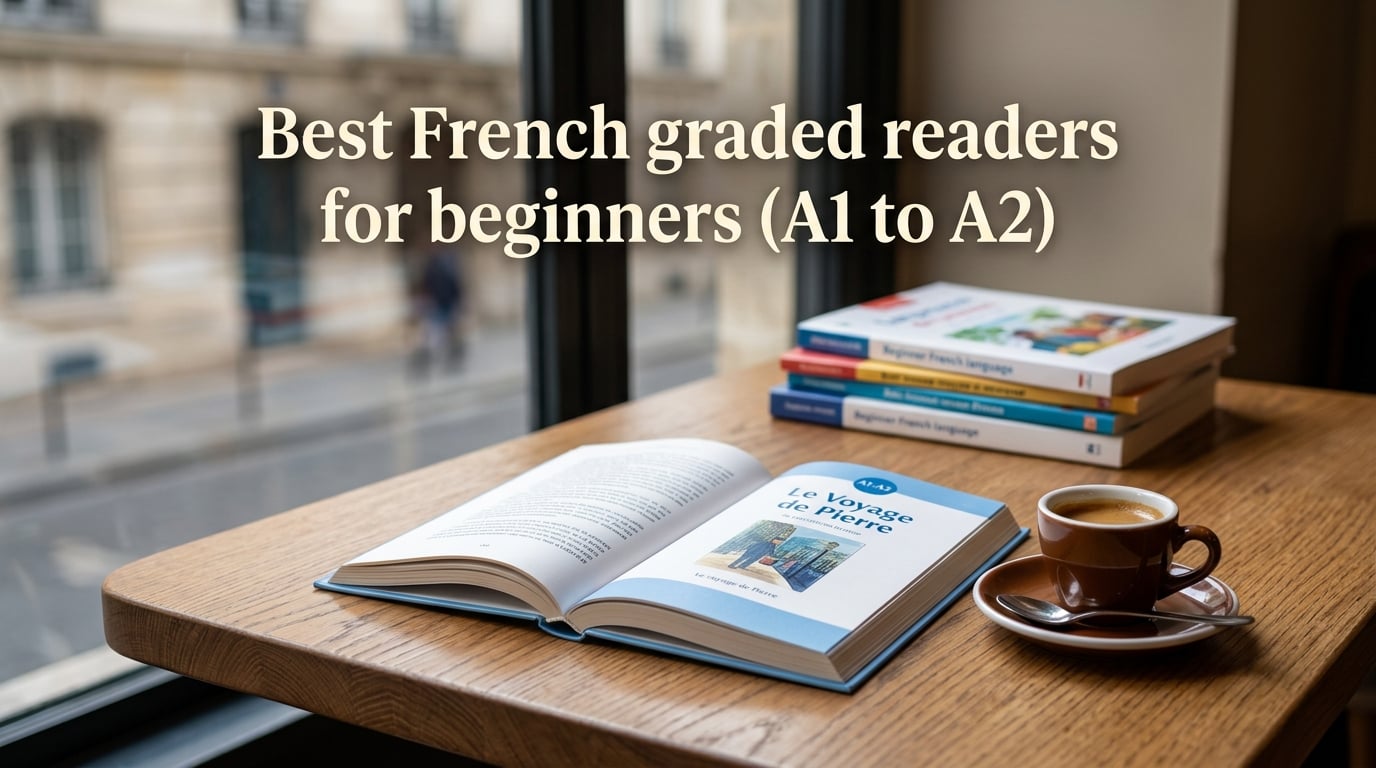
When I started learning French in 2026, I burned through three textbooks before realizing the grammar drills were not building the reading fluency I wanted. The shift happened the week I picked up my first French graded reader, a slim mystery written with just 300 words I already knew, and finished it cover to cover in two evenings. That single book did more for my comprehension than a month of workbook exercises.
If you are searching for the best French graded readers for beginners, you are already on the right track. Graded readers are short stories or chapter books written with a controlled vocabulary and grammar level, so you can read real French from your very first week. In this guide I will walk you through what a French graded reader actually is, how CEFR levels map to reading difficulty, which series adult learners trust most, and exactly how to use a graded reader so every page moves you closer to authentic French novels.
Table of Contents
Quick Picks: The Best French Graded Readers for Beginners at a Glance
Short on time? These six series consistently come up when French learners compare beginner-friendly graded readers for adults. Each one is well suited to the A1 or A2 stage.
- Hachette FLE – Lire en Français Facile: The most established series, with clean layouts, comprehension activities, and answer keys.
- Black Cat-Cideb (Cideb): Beautifully illustrated graded readers across mystery, adventure, and classic adaptations.
- Eli Readers (Hub Editorial): Photographic covers, footnotes, and audiobook pairings that make the format feel grown up.
- Olly Richards Short Stories: Bilingual parallel text and eight engaging stories per volume, ideal for first-time readers.
- Sylvie Laine: Independent author whose A1 mysteries (Le Pendentif) have become cult favorites on r/French.
- Kit Ember: Romantic, A2-level short stories with surprisingly natural dialogue and minimal footnotes.
What Is a French Graded Reader?
A French graded reader is a short book written or adapted with a controlled vocabulary and grammar level matched to a specific stage of language learning, usually labelled A1 to B2 on the CEFR scale, so beginners can read real French stories and understand roughly 90 to 95 percent of the words on each page. Authors achieve that coverage by limiting the number of new words (the headword count), repeating key vocabulary often, and using short sentences in present tense and simple past tense.
The format borrows directly from Stephen Krashen’s comprehensible input hypothesis, which argues that language acquisition happens most efficiently when learners receive input that is just slightly above their current level. Graded readers are the practical application of that theory. Instead of fighting through a native French novel with a dictionary in one hand, you read a story tuned to the words you already know, with the few unfamiliar ones glossed in a sidebar.
For adult beginners, graded readers also solve a problem that textbooks often create: motivation. A textbook might teach you the passé composé through fifteen isolated exercises. A graded reader shows you the passé composé in action, inside a mystery or a love story, where the meaning is clear from context. That emotional pull is what keeps learners turning pages, and the pages are where fluency is built.
How CEFR Levels Map to French Graded Readers
CEFR (the Common European Framework of Reference for Languages) is the scale French publishers use to label graded readers, and it is the single most useful filter when you are choosing your first book. Most adult beginners fall into the A1 (absolute beginner) or A2 (elementary) bands, and the difference between the two shows up clearly in word count, sentence length, and theme complexity.
| CEFR Level | Headword Range | Sentence Length | Typical Tenses | Common Themes |
|---|---|---|---|---|
| A1 | 300 to 800 words | 5 to 10 words | Present, immediate future, near past | Daily life, family, food, travel basics |
| A2 | 800 to 1,500 words | 8 to 14 words | Present, passé composé, imparfait (intro) | Friendship, work, small mysteries, light romance |
| B1 | 1,500 to 2,500 words | 12 to 18 words | Full past tenses, simple conditional | Crime, adventure, slice-of-life drama |
| B2 | 2,500+ words | 15 to 22 words | Subjunctive intro, complex sentences | Novel adaptations, journalism, essays |
The mistake I see most often on r/French and r/learnfrench is learners starting at B1 because they feel A1 looks too easy. A1 is meant to feel easy. If a book is not slightly boring, it is probably above your level. I would rather finish a 60-page A1 mystery in a weekend than stall on page 20 of a B1 thriller and give up French for three months.
Best French Graded Reader Series for Beginners
Not all graded reader series are created equal. The publishers below are the ones adult learners consistently recommend, and each one takes a slightly different approach to the format. Use this comparison to match a series to your goals before you buy.
| Series | Publisher | Levels Covered | Audio | Best For |
|---|---|---|---|---|
| Lire en Français Facile | Hachette FLE | A1, A2, B1, B2 | Select titles | Self-study with comprehension activities |
| Lectures CLE | Didier | A1 to B2 | Select titles | Classroom supplement and DELF prep |
| Black Cat Graded Readers | Cideb | A1 to C1 | CD or download | Visual learners and classic adaptations |
| Eli Readers | Hub Editorial | A1 to C1 | Downloadable audio | Adult readers who want polished design |
| Short Stories in French | Olly Richards | A1, A2, B1 | Audiobook bundle | Bilingual readers new to graded readers |
| Sylvie Laine mysteries | Independent | A1, A2, B1 | Kindle audio | Adult readers bored by textbook-style stories |
| Rencontres rapides | Kit Ember | A2 | Not included | Romance readers ready to drop bilingual text |
Hachette FLE is the most classroom-tested option and the safest first purchase. Black Cat-Cideb and Eli Readers (Hub Editorial) are widely praised on Reddit for their design, photos, and on-page glosses. Olly Richards has earned a strong following because each volume bundles eight short stories with parallel English translation, which lowers the activation energy for someone who has never read French for pleasure before.
Best A1 French Graded Readers for Absolute Beginners
If you have finished a beginner French course, know the present tense and basic passé composé, and can recognize 200 to 400 common words, you are ready for A1 graded readers. These are the titles that come up most often when absolute beginners ask for recommendations.
- Le Pendentif (Sylvie Laine): A 500-headword mystery set in Paris, recommended on r/French for learners who want a real plot from page one.
- Mystère au Louvre (Theresa Marrama): An art-themed mystery that uses museum vocabulary and short present-tense chapters.
- Lire en Français Facile A1 series (Hachette): Pick any theme (detective, real life, adventure); each title is around 50 pages and includes comprehension questions with answer keys.
- Eli Readers A1 titles (Hub Editorial): Look for titles like Jojo et le gâteau or Le voyage de Marco, which use photographic illustrations and glossed vocabulary on each page.
- Black Cat A1 detective stories (Cideb): Short, plot-driven mysteries that pair well with the optional CD audio for listening practice.
The single most common beginner mistake, judging from the Reddit threads I have read, is treating A1 readers as too childish. They are not. The vocabulary limit forces simple sentences, not childish plots. If a story bothers you on day one, try a different genre; mystery, romance, and adventure all exist at A1.
Best A2 French Graded Readers for the Bridge to Real French
A2 is where French graded readers start to feel almost like normal books. Sentences get longer, tenses get richer, and the plot can support something more interesting than a single evening’s read. These titles are widely recommended as the bridge between simplified readers and authentic French novels.
- Rencontres rapides (Kit Ember): Eight short romantic stories written entirely in natural A2 French, no English translation, perfect for learners ready to read monolingually.
- Short Stories in French for Intermediate Learners (Olly Richards): Bilingual parallel text, eight stories per book, with a slightly higher vocabulary range than the beginner Olly Richards volume.
- Lire en Français Facile A2 (Hachette): Same trusted format as the A1 line, with fuller narratives and more passé composé and imparfait.
- Eli Readers A2 stage (Hub Editorial): Look for adaptations like Les Misérables or Le Bossu, which introduce historical and literary vocabulary.
- Lectures CLE A2 (Didier): Slightly more literary than Hachette, often used in French-as-a-foreign-language classrooms and Alliance Française libraries.
By A2, I would recommend dropping the bilingual parallel text if you can. Bilingual format is helpful at A1 because every unknown word feels insurmountable, but at A2 you have enough vocabulary to infer meaning from context. Reading monolingually is what forces your brain to think in French rather than translate from English.
French Graded Readers by Genre (Mystery, Romance, Fantasy, Comedy)
One thing almost no competitor covers is organizing recommendations by genre, yet adult learners often care more about story type than headword count. Here is a quick map of which series to look at when you want a specific feeling, not just a level.
- Mystery and detective: Sylvie Laine’s Le Pendentif trilogy and the Hachette Lire en Français Facile detective theme are the gold standard at A1 to A2.
- Romance: Kit Ember’s Rencontres rapides and Rencontres à Paris are short, A2-level love stories with natural dialogue and no footnotes.
- Fantasy and adventure: Hachette’s Lire en Français Facile fantasy and adventure themes, plus Eli Readers’ Alien au collège and similar young-adult titles.
- Classic adaptations: Black Cat-Cideb’s simplified Les Misérables, Le Comte de Monte-Cristo, and Madame Bovary series, available from A2 up.
- Comedy and slice of life: Olly Richards’ short story collections, which mix humor and everyday situations and read almost like Netflix episodes.
Matching genre to taste is what turns a graded reader from homework into a habit. Pick the story you would actually want on a long flight, then check the headword count to make sure it sits at your current level.
Bilingual vs Monolingual Graded Readers: Which Format Should You Pick?
Bilingual graded readers print the French and English versions side by side or on facing pages. Monolingual readers use only French with a glossary at the back. Each format serves a different stage of the learning journey.
Bilingual text is genuinely useful at A1. When you only know 300 words, one unknown noun can stall an entire paragraph. Having the English sentence right there keeps the story moving and protects your motivation. Most learners say bilingual format starts to feel like a crutch around A2, when you should be trying to infer meaning from context rather than reading the English version first.
Monolingual readers train a different skill. They force you to read the French, not the English, which is the only way to build actual reading speed and inference ability. Olly Richards’ beginner volume is bilingual; his intermediate volume is bilingual too, but as you move into Hachette, Eli, and independent authors, you will mostly find monolingual text with glossaries.
My recommendation: start with a bilingual A1 title for your very first graded reader, then switch to monolingual as soon as you finish it. Keep a bilingual title on hand only as a safety net for when you are tired or distracted.
How to Use a French Graded Reader Effectively (Reading Tips)
Buying a graded reader is the easy part. Getting real fluency out of it takes a small system. These are the habits that helped me, and they are consistent with what serious self-study learners describe on r/French and the LingQ forums.
- Start one level below what you think you can handle. You want to understand 95 percent of the words on the first read without a dictionary. Boredom is a sign you picked the right level.
- Read the same chapter twice. First pass for gist, second pass for vocabulary and grammar. Marking every unknown word on the first pass slows you down and kills the flow.
- Pair the book with audio. Hachette, Eli, and Olly Richards all offer audio companions. Listen to a chapter after you read it to lock in pronunciation and rhythm.
- Keep a small vocabulary notebook. Write down only the words you would actually use. Five new words per chapter is plenty.
- Read for 15 minutes a day, not 90 minutes once a week. Frequency matters more than volume for retention.
- Finish the book. Finishing a 60-page A1 reader matters more than reading half of an A2 novel. Completion builds the habit.
Graded readers also combine well with apps. LingQ lets you import many of these books as text and click on words for instant definitions. Duolingo and Anki handle the drilling. The reader does the deep reading; the apps do the repetition.
Free and Affordable French Graded Reader Options
You do not have to spend much to get started. Several library and free PDF routes exist, and most of them have been confirmed by learners on language learning forums.
- Alliance Française libraries: Many city chapters lend graded readers for free to members. A Stack Exchange thread confirms this as a common pathway outside of buying.
- Public library apps: Libby and Hoopla often carry Hachette and Olly Richards ebooks through your local library card.
- Open Library and Project Gutenberg: Public domain French texts, not graded, but once you finish A1 readers these are a free next step.
- Kindle samples: Most publishers let you download the first chapter free. Use samples to test the level before you buy.
- Used bookstores and ThriftBooks: Hachette and Black Cat readers frequently appear secondhand for a fraction of the cover price.
What to Look for When Buying a French Graded Reader
With so many series on the market, a quick decision framework helps. Use the four filters below before you add anything to your cart.
- CEFR label: Pick a level you can read comfortably, not the level you wish you were at.
- Genre fit: You are more likely to finish a book you actually want to read.
- Audio availability: Audio adds listening practice at no extra time cost.
- Format: Bilingual for absolute beginners, monolingual from A2 onward.
If a graded reader feels too easy or too hard, switch series rather than forcing the level. The best French graded readers for beginners are the ones you actually finish.
Frequently Asked Questions
What are the best French reading books for beginners?
The best French reading books for beginners are graded readers matched to your CEFR level. Top series include Hachette FLE Lire en Francais Facile, Black Cat-Cideb, Eli Readers, and Olly Richards Short Stories in French. Pick an A1 title with audio if you are an absolute beginner, then move to A2 after finishing two or three books.
What are the best books for A1 French beginners?
For A1 beginners, the most recommended books are Hachette FLE Lire en Francais Facile A1 titles, Sylvie Laine’s Le Pendentif, Eli Readers A1 stage, and Olly Richards Short Stories in French for Beginners. Look for books with 300 to 800 headwords, present tense, and comprehension questions with answer keys.
What is the best book for beginners to learn French at A1 level?
A French graded reader is the best starting book at A1 level. Le Pendentif by Sylvie Laine is a strong first pick because it uses about 500 headwords, runs in present tense, and tells a real mystery from page one. Hachette Lire en Francais Facile A1 detective titles are an equally solid, classroom-tested choice.
What are some good books to learn French at A2 level?
At A2 level, good books include Kit Ember’s Rencontres rapides, Olly Richards Short Stories in French for Intermediate Learners, Hachette Lire en Francais Facile A2, Eli Readers A2 adaptations like simplified Les Miserables, and Didier Lectures CLE A2. Aim for 800 to 1500 headwords and start switching from bilingual to monolingual format.
Are French graded readers worth it?
Yes, French graded readers are worth it. They deliver comprehensible input at the right difficulty, which is the fastest way to build reading fluency. Learners who finish a few graded readers consistently report easier transitions to authentic French novels within a few months.
Do French graded readers have audio?
Most major French graded reader series offer audio companions. Hachette FLE, Black Cat-Cideb, Eli Readers, and Olly Richards all publish downloadable audio or CDs for at least some titles. Audio pairing is one of the strongest signals of a quality series.
Conclusion
The best French graded readers for beginners are the ones that match your CEFR level, fit your taste in stories, and pair with audio. Start with one A1 title from a trusted publisher such as Hachette, Eli, or Olly Richards, finish it cover to cover, and let the habit carry you from A1 into authentic French. Once a graded reader feels easy, graduate to the next level, and within a few months you will find yourself reaching for French novels you once thought were impossible.