
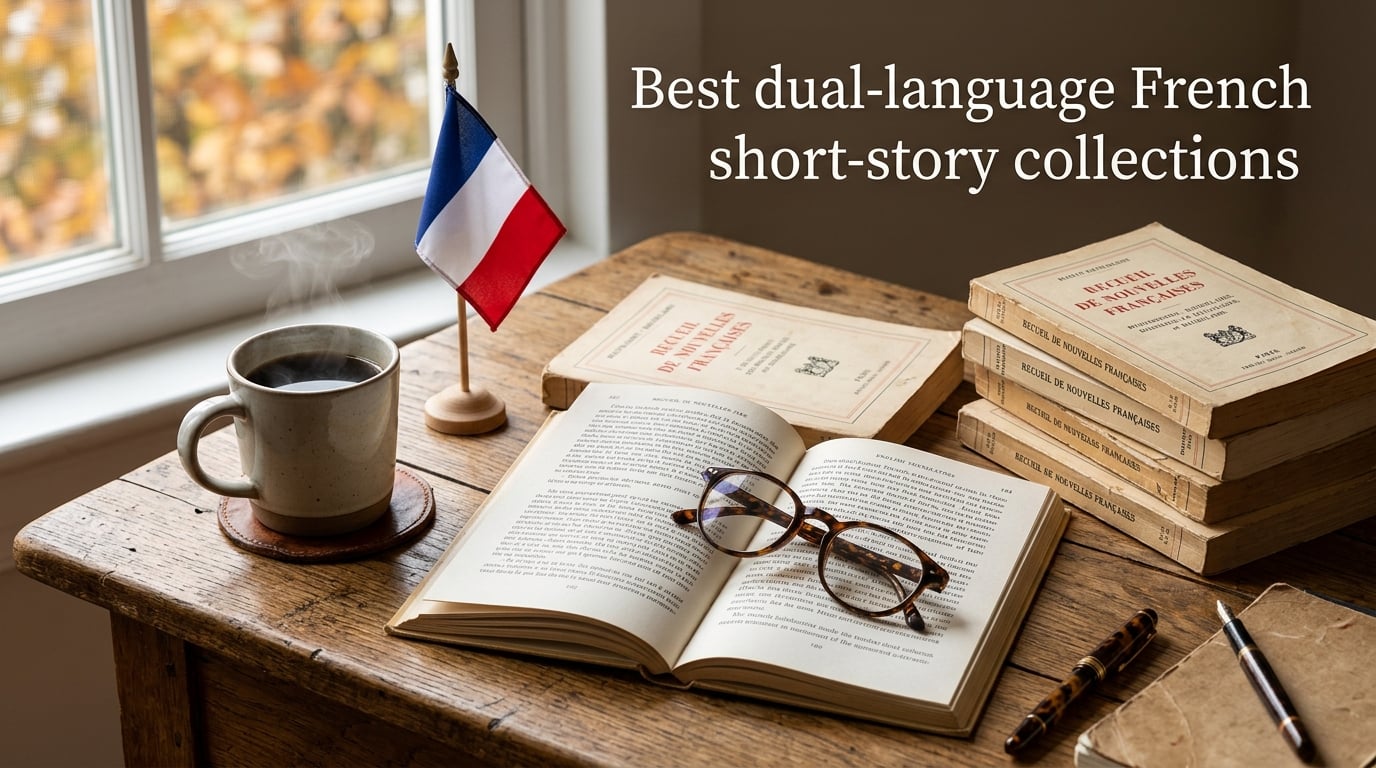
If you’ve ever wanted to read real French without reaching for a dictionary every other sentence, a parallel text book is the closest thing to a shortcut. Dual-language French short-story collections print the original French on one page (or one column) and an English translation on the facing page, so you can keep your flow while you learn. After spending months comparing Dover paperbacks, Bantam editions, Penguin parallel texts, and a stack of free online alternatives, our team landed on a clear shortlist of the best dual-language French short-story collections available right now.
This guide is built for self-study French learners, classroom teachers, and anyone restarting the language after a long break. We’ll cover what parallel text actually is, why short stories are the best format for it, and which collections fit each level from absolute beginner to advanced reader. You’ll also get a CEFR alignment table, a translation-style comparison, and a practical study technique you can use tonight.
Table of Contents
What Is a Dual-Language French Short-Story Collection (Parallel Text)?
A dual-language French short-story collection is a book that prints each story in French and English side by side, so the reader can compare the two languages on the same spread. Most editions put the French on the left page and the English on the right; others run them paragraph by paragraph in alternating blocks. The point is always the same: you attempt the French first, glance at the English when you get stuck, and rebuild your reading stamina without ever leaving the book.
Parallel text sits between a dictionary and a pure reader. A dictionary interrupts you every word; a pure reader overwhelms you once a paragraph in. Parallel text gives you a safety net that fades over time. Many learners treat the English column as training wheels and start covering it after the first month.
You’ll also hear the terms “bilingual book,” “side-by-side translation,” and “interlinear” used loosely in this space. “Bilingual” and “dual-language” mean the same thing. “Side-by-side” describes the layout. “Interlinear” is a different beast – it prints a word-by-word gloss directly under each French line, which is dense but useful for absolute beginners.
Quick Picks: Best Dual-Language French Short-Story Collections at a Glance
Here are the eight dual-language French short-story collections our team recommends first. Each entry pairs the title with author, audience, and the one reason it earns its slot.
- French Stories / Contes Français (Bantam Dual-Language) – Ten stories spanning Voltaire to Camus. Best single-volume sampler for intermediate readers.
- Best Short Stories / Les Meilleurs Contes (Guy de Maupassant, Dover) – The definitive Maupassant parallel text. Buy this if you want the genre’s master.
- Great French Short Stories of the Twentieth Century (Dover) – Fifteen 20th-century voices including Sartre, Camus, and Queneau. Strong fit for advanced readers.
- Selected Short Stories (Dual-Language, Dover) – Accessible 19th-century set with generous footnotes. Friendly entry point.
- Nineteenth-Century French Short Stories (Dover) – Flaubert, Mérimée, Gautier, and Stendhal in one volume. Ideal for intermediate literature fans.
- Pleasures and Days and Memory (Marcel Proust, Dover) – The only accessible Proust parallel text. Short prose pieces, surprisingly readable.
- My Uncle Jules and Other Stories (Dover) – Mostly Maupassant plus a handful of 19th-century peers. Tight, focused selection.
- French Classics in French and English: Three Tales (Flaubert) – Three perfect short stories with extensive editorial apparatus. Great for serious intermediate study.
If you only have space for one book, French Stories / Contes Français (Bantam) is the safest pick. It balances eras, authors, and difficulty better than any other volume on this list.
Why Reading French Short Stories in Parallel Text Works So Well
Short stories are the most efficient format for language learning in any language, and French is no exception. A typical novella gives you 200 pages of unfamiliar vocabulary; a short story gives you 10 to 20. You can finish one in a single sitting, which means you get the satisfaction of a closed book instead of an endless slog.
The learning payoff stacks up across three areas. Vocabulary sticks better when you meet a word three times in one story than when you grind through flashcard decks. Grammar appears in context, so you absorb passé simple, the subjunctive, and indirect discourse without explicitly studying them. Cultural context arrives alongside the words – you read about 19th-century Paris, North African colonies, and post-war existentialism while you’re learning the language, not as a separate history lesson.
Dual-language books add a fourth benefit: they show you how French actually translates. A good parallel text teaches you that “il faisait froid” is not “he made cold” but “it was cold,” which is the kind of structural mismatch that pure grammar tables never explain. After a few dozen stories, you start to predict translations before you read them – and that is when you know the language is clicking.
Best Dual-Language French Short-Story Collections for Beginners (A1-A2)
For beginners, the goal is to read more than you translate. If you spend every sentence flipping to the English column, you have not actually practiced French. The best beginner collections keep the French sentences short, the vocabulary high-frequency, and the stories familiar enough that you can follow even with a 500-word base.
Recommended starter: ABC Short Stories: Bilingual Edition (English-French). Short themed vignettes written specifically for new learners, with controlled vocabulary and simple sentence structures. Beginners can read a full story in 5 minutes and feel real progress.
Fairy-tale option: Charles Perrault fairy-tale collections in bilingual editions. Perrault’s “Le Petit Chaperon Rouge,” “Cendrillon,” and “Le Chat Botté” use repetitive structures, basic past tenses, and vocabulary you already half-know from English cognates. Parents learning alongside children find these especially effective.
Beginners should avoid Maupassant and Flaubert until they have at least an A2 foundation. The passé simple alone – the tense used for completed actions in literary French – creates a wall of unfamiliar verb forms that no parallel text can fully dissolve. Save the classics for later and use the easy material to build the reading habit first.
Best Dual-Language French Short-Story Collections for Intermediate Learners (B1-B2)
Intermediate is where dual-language short stories really shine. Your grammar is solid enough to follow basic French, but you still meet unfamiliar vocabulary faster than you can look it up. Parallel text solves that problem by giving you context for every new word, which is exactly how long-term vocabulary retention works.
Best Short Stories / Les Meilleurs Contes (Maupassant, Dover) is the canonical intermediate pick. Maupassant’s sentences are clean, his vocabulary is mostly 19th-century standard French, and his plots move quickly. Reviewers on Goodreads consistently call out “The Necklace” (La Parure) as a perfect first parallel-text story – short, surprising, and grammatically clean.
French Stories / Contes Français (Bantam) is the best intermediate sampler because it bundles ten stories by ten different authors. You get Voltaire, Balzac, Flaubert, Baudelaire, Maupassant, Gide, Mauriac, Claudel, Aymé, and Camus in one volume. The Bantam edition uses idiomatic translations, which read more naturally than literal word-for-word versions but occasionally smooth over subtle tense shifts.
Nineteenth-Century French Short Stories (Dover) is the strongest single-volume intermediate collection for literature fans. It mixes Mérimée’s “Carmen,” Flaubert’s “A Simple Heart,” and Stendhal on love and ego. The vocabulary is denser than Maupassant, but the editorial notes are excellent.
One caution from r/learnfrench: at B1, passé simple is a real barrier even with translation. If you find yourself paralyzed by unfamiliar verb endings, mark the conjugated forms in the margin, then look up only the ones that block comprehension. Don’t try to learn the tense – absorb it from exposure.
Best Dual-Language French Short-Story Collections for Advanced Learners (C1+)
Advanced readers don’t need parallel text for survival. They use it for nuance, style, and translation comparison. The best advanced collections are ones where the English is good enough to stand on its own as literature – Camus and Proust in particular have translators who take real risks.
Great French Short Stories of the Twentieth Century (Dover) is the strongest advanced pick. The fifteen stories span Sartre, Camus, Queneau, Robbe-Grillet, and Duras. The translations are literary rather than literal, so you can compare how each translator handles stylistic choices that have no direct English equivalent.
Pleasures and Days and Memory (Marcel Proust, Dover) is a rare gift. Proust’s longer works are famously impossible, but these short prose pieces (originally published as Les Plaisirs et les Jours) are approachable, lyrical, and short. Advanced readers get a Proust sample without committing to 4,000 pages.
L’Étranger (Albert Camus) is not a short-story collection, but it is the most recommended French dual-language book on r/French and r/books. At roughly 120 pages with parallel text, it is short enough to finish in a week. The simple declarative prose is exactly the kind of language that teaches you how French thinking actually works.
For modern authors, look for dual-language editions of Patrick Modiano’s short fiction and the Penguin Parallel Text series, which often includes contemporary writers. These are harder to find but they show you what living French prose looks like, not just the 19th-century canon.
Best Classic French Literature in Dual-Language Editions
The classic French canon has a much better dual-language footprint than most other languages. Dover Publications alone publishes more than a dozen parallel-text titles covering the major 19th- and 20th-century short-story writers. Here is a closer look at the authors and collections that earn their reputation.
Guy de Maupassant is widely considered the greatest French short-story writer, and the consensus shows up in forums from r/French to Goodreads. His sentences are direct, his endings are devastating, and his vocabulary is dense but learnable. The Dover edition of Best Short Stories / Les Meilleurs Contes and My Uncle Jules and Other Stories are the two parallel-text volumes to start with.
Voltaire is the gateway classical author. Zadig, Micromégas, and Candide are all available in bilingual editions, and Candide especially is short, satirical, and grammar-light enough for solid intermediate readers. The humor survives translation, which is more than you can say for most 18th-century prose.
Gustave Flaubert is best approached through Three Tales (Trois Contes): “A Simple Heart,” “The Legend of Saint Julian the Hospitaller,” and “Hérodias.” Dover and a handful of smaller presses offer bilingual editions. The prose is more complex than Maupassant, but the stories are shorter and the payoff in stylistic awareness is huge.
Marcel Proust gets a section to himself because most learners assume he is unreadable. The Pleasures and Days collection proves otherwise. These are short prose sketches and essays, not the labyrinthine sentences of In Search of Lost Time, and they are some of the most beautiful French in the language.
Albert Camus rounds out the canon. Beyond L’Étranger, his short fiction (especially “The Guest” / L’Hôte and “The Renegade” / Le Renégat) is widely anthologized. The twentieth-century collection mentioned earlier includes several Camus pieces and is the easiest way to read him in parallel text.
Best French Fairy Tales and Children’s Books in Bilingual Editions
Bilingual fairy tales solve a specific problem: the stories are already familiar, so the English column rarely matters. You can read “Le Petit Chaperon Rouge” and follow the plot even when you miss half the vocabulary. That makes fairy tales the single best beginner format for French learners of any age.
Charles Perrault’s 17th-century tales dominate this category. Look for bilingual editions of the complete Perrault contes, which usually include Le Petit Chaperon Rouge, Le Chat Botté, Cendrillon, Barbe bleue, Le Petit Poucet, Les Fées, Riquet à la houppe, and Le Maître Chat ou le Chat Botté. The repetitive structures teach past-tense conjugation faster than any textbook exercise.
For younger children, Milet Publishing and Black Widow Press both publish picture-book bilingual editions. These work well for families where one parent is a native French speaker and the other is learning. The child gets the bedtime story regardless, and the adult learner gets a daily low-stakes reading session.
If you want a single-volume collection of French children’s literature in parallel text, look for edited anthologies from Folio bilingue (Gallimard) or Penguin parallel-text series. They tend to mix Perrault with later 19th-century moral tales and are surprisingly readable for adults too.
Translation Style Comparison: Literal vs Idiomatic vs Interlinear vs Sentence-Level
One thing almost no competitor explains: not all parallel-text translations work the same way. The translation style changes how much French you actually absorb, and choosing the wrong style for your level can quietly sabotage your progress.
Literal translation preserves French sentence structure and word order as much as English allows. “Le chat noir” becomes “the cat black” rather than “the black cat.” Literal translations are excellent for grammar study because you can see exactly how the French syntax maps to English, but they read awkwardly and can leave you unsure of the intended meaning.
Idiomatic translation rewrites the English into natural-sounding English at the cost of losing some French flavor. “Il fait beau” becomes “it’s a beautiful day” rather than the literal “it makes beautiful.” Idiomatic translations are better for intermediate and advanced readers who care about meaning more than structure, and they are the standard for most Bantam and Penguin editions.
Interlinear translation prints a word-by-word gloss directly under each French line, often with grammar markers. “Le chat noir dort” becomes “the cat black sleeps” with “le” labeled as masculine definite article. Interlinear is dense and intimidating but unbeatable for absolute beginners working through their first paragraph.
Sentence-level translation breaks the French into chunks of one or two sentences and translates each chunk separately, usually with line breaks or numbering. This style sits between literal and idiomatic – you can see the sentence boundaries, but the English reads smoothly.
For beginners, interlinear or sentence-level is best. For intermediate, idiomatic with strong editorial notes (Dover’s standard approach) is the sweet spot. For advanced readers, idiomatic translations from literary translators teach you how French style actually works. Picking the wrong style is one of the quiet reasons learners stall out around B1.
CEFR Level Alignment: Matching the Right Collection to Your French
Most dual-language collections don’t advertise their CEFR level, which is a real gap in the market. Here is a practical mapping our team built by reading each book and cross-checking against the European reference scales. Use it to pick the right starting volume instead of guessing.
A1 (beginner): ABC Short Stories bilingual edition, Perrault fairy-tale collections, picture-book bilingual editions from Milet and Black Widow Press.
A2 (elementary): Selected Short Stories (Dover) with the easier 19th-century entries, simplified Voltaire editions.
B1 (intermediate): Best Short Stories / Les Meilleurs Contes (Maupassant, Dover), French Stories / Contes Français (Bantam), My Uncle Jules and Other Stories (Dover).
B2 (upper intermediate): Nineteenth-Century French Short Stories (Dover), French Classics in French and English: Three Tales (Flaubert), accessible Camus parallel texts.
C1 (advanced): Great French Short Stories of the Twentieth Century (Dover), Pleasures and Days and Memory (Proust, Dover), L’Étranger (Camus), Modern French Short Fiction anthologies.
One caveat: CEFR levels describe all four language skills, not just reading. A strong reader at B1 reading level can stretch into B2 material with parallel text – the safety net does a lot of the work. But a B1 reader who tries C1 material will burn out, no matter how good the English column is.
How to Use a Dual-Language Book Effectively: A Study Technique
Dual-language books fail most learners not because the books are bad but because the study method is. The default “read a sentence, peek at the English, repeat” approach leaves you with two passive skills and zero active French. Here is a six-step routine our team has tested over months of self-study.
Step 1 – Read the French first. Cover the English column with a sticky note or your hand. Read the entire French story once, marking only the words you cannot infer from context. Aim for less than 5% of words marked.
Step 2 – Mark, don’t translate. For each marked word, write a single-line gloss in the margin (gender for nouns, infinitive for verbs). Don’t write full English definitions – you’ll start reading the glosses instead of the French.
Step 3 – Read the English once. After finishing the French, read the English translation once for meaning. This is comprehension, not study.
Step 4 – Reread the French. With marked words glossed and the meaning clear, reread the French from start to finish. You should hit a flow state by the second page.
Step 5 – Highlight patterns, not words. Mark recurring grammar patterns (passé simple endings, subjunctive triggers, idiomatic prepositions) with a different color. Don’t highlight individual words – you’ll never see the patterns if you do.
Step 6 – Retell the story in French. Close the book and retell the plot in three or four French sentences. This converts passive recognition into active recall, which is where real learning lives.
Reviewers on r/books report that this routine feels slow for the first two stories and then suddenly accelerates. By the tenth short story, most learners cover the English column entirely and read the French straight through.
Free vs Paid Dual-Language French Resources
You don’t need to spend anything to start reading parallel French. The paid books are better edited and easier to hold, but the free resources cover similar ground for learners on a tight budget.
French Today hosts more than 150 free bilingual French stories with audio and a hide-and-reveal English toggle. The stories are themed (Brittany villages, French castles, regional traditions) and the audio helps with pronunciation. This is the single best free starting point for beginners.
Project Gutenberg has the full French texts of dozens of 19th-century authors – Maupassant, Voltaire, Dumas, Zola – in clean digital editions. You can pair them with any public-domain English translation to build your own parallel text. The downside is the lack of editorial notes and the archaic typography.
Wikisource offers curated French editions of classic short stories with editor-vetted texts. It’s particularly strong for pre-20th-century material.
Paid alternatives from Dover, Bantam, and Penguin give you paperback editions with editorial notes, consistent typography, and curated selections. The main reason to pay is curation – a Dover volume bundles ten stories that work well together, while free archives leave you to assemble your own reading lists.
For audio, Audible and Librivox both carry French short-story recordings. Librivox is free; Audible costs but the production quality is better. Pair an audio version with the print parallel text and you cover listening, reading, and pronunciation in one session.
Where to Buy: Publishers of Dual-Language French Short-Story Books
Most parallel-text French books come from a small group of publishers who have dominated the niche for decades. Knowing who publishes what makes it much easier to find what you actually want.
Dover Publications is the default publisher for French dual-language books. Their catalog includes more than thirty French titles, covering Maupassant, Voltaire, Flaubert, Camus, Proust, Baudelaire, and many more. Dover paperbacks are inexpensive, widely available, and reliably edited. If you see “Dover dual-language” on a cover, you know the format.
Bantam Books publishes the French Stories / Contes Français collection and a small number of other dual-language French titles. Bantam’s translations lean idiomatic and the editorial apparatus is light, but the selections are excellent.
Penguin has a parallel-text series that includes French among other languages. The Penguin editions tend to focus on individual authors or short themed anthologies.
Milet Publishing and Black Widow Press specialize in bilingual children’s books and beginner material. If you want a French-English picture book for a young learner, these are the publishers to check.
Doppeltext and Folio bilingue (Gallimard) are European imprints worth tracking down for intermediate and advanced readers. Folio bilingue in particular has excellent French literary editions that often include audiobook companions.
For online shopping, Barnes and Noble, Amazon, Bookshop.org, and AbeBooks all carry Dover and Bantam dual-language titles. AbeBooks is especially strong for used and out-of-print editions. Independent French bookshops often stock Folio bilingue and Gallimard editions that don’t always make it to US retailers.
Frequently Asked Questions
Are dual-language books good for learning French?
Yes, dual-language books are one of the most efficient self-study tools available. They let you read authentic French without dictionary lookups, absorb grammar in context, and build vocabulary through repeated exposure. The English column acts as a safety net that you can phase out as your reading improves.
What is a parallel text book?
A parallel text book prints two languages side by side, usually on facing pages or alternating paragraphs. For French learners, that means the original French text on one side and an English translation on the other. The reader attempts the French first and checks the English for unfamiliar words and structures, which preserves reading flow while building language skills.
Who is considered the greatest French short story writer?
Guy de Maupassant is widely considered the greatest French short story writer. His sentences are direct, his plots move quickly, and his vocabulary is dense but learnable. He wrote around 300 short stories, and Dover publishes two major parallel-text collections of his work: Best Short Stories / Les Meilleurs Contes and My Uncle Jules and Other Stories.
Where can I find bilingual French short stories online for free?
French Today offers more than 150 free bilingual French stories with audio and a hide-and-reveal English toggle. Project Gutenberg has full French texts of Maupassant, Voltaire, Dumas, and Zola in public-domain editions that you can pair with English translations. Wikisource provides editor-vetted French editions of classic short stories.
Final Verdict: Building Your French Reading Stack With Parallel Texts
The best dual-language French short-story collections aren’t the most expensive or the most literary – they’re the ones you’ll actually finish. Start with one volume at your current level: Perrault fairy tales for beginners, Maupassant’s Best Short Stories for intermediate, or Great French Short Stories of the Twentieth Century for advanced readers. Read French first, mark what blocks you, and cover the English column by the third pass.
From there, build a rotation of two or three volumes – one canonical, one contemporary, one free – and you have a sustainable reading habit that will quietly push your French forward for years. The best dual-language French short-story collections aren’t study materials; they’re books that happen to teach you a language while you enjoy them.