
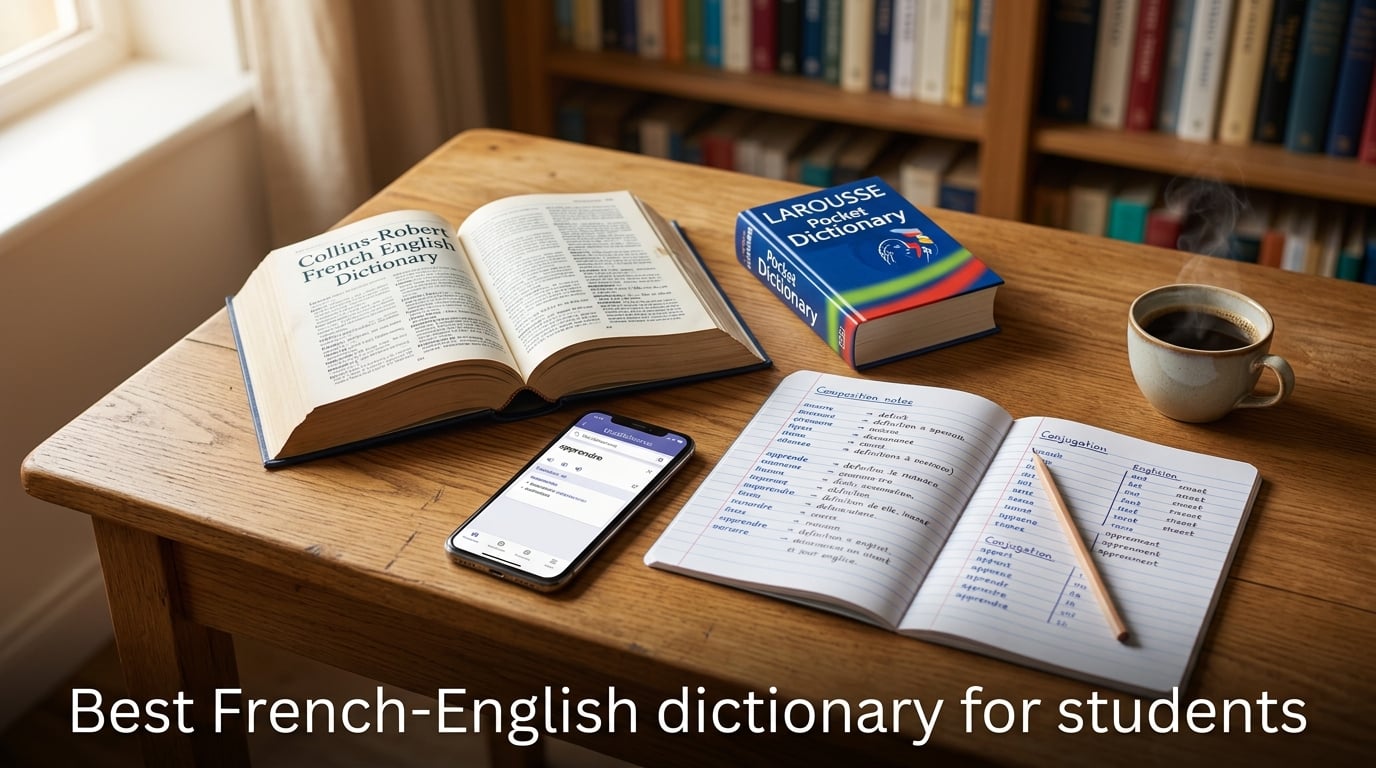
Choosing the best French English dictionary for students is one of those decisions that can quietly shape your entire French-learning journey. Whether you’re a high school student prepping for GCSE or AP French, a university major working through DELF and DALF exams, or an adult self-learner rebuilding vocabulary from scratch, the dictionary you reach for every day matters more than you think.
I’ve spent the last few months comparing the major bilingual dictionaries (Collins-Robert, Oxford-Hachette, Larousse, Le Petit Robert, Barron’s) along with the leading dictionary apps and free online tools. I tested them across reading assignments, writing tasks, listening comprehension, and oral exam prep. What follows is the honest, student-focused guide I’d want to read if I were buying my first French dictionary today.
In this guide, I’ll walk you through what type of dictionary you actually need, the six criteria that separate a good student dictionary from a mediocre one, the print-vs-app debate, my top picks by student level, and how to use your dictionary once you’ve bought it. No fluff, no sales pressure, just clear recommendations.
Table of Contents
The Short Answer: Best French English Dictionaries for Students
If you’re choosing the best French English dictionary for students today, start with these three picks and you’ll cover roughly 95% of student use cases:
- Best overall: Collins-Robert French Unabridged Dictionary (the gold standard for serious learners and university students, with 800,000+ entries and detailed example sentences).
- Best value: Oxford-Hachette French Dictionary (5th edition, 910,000 entries, strong on British and American English coverage, used by most professional translators).
- Best app + free online combo: WordReference.com paired with the Collins-Robert Concise app for offline use.
That trio handles high school, university, DELF/DALF prep, and everyday writing. The rest of this article explains exactly how I picked them, who they’re best for, and which alternatives to consider if you have a specific need (Canadian French, literature, business French, or younger learners).
What Type of French Dictionary Do Students Need?
Before you compare brands, you need to know which category of French dictionary matches your level. There are three big distinctions students get confused about, and picking the wrong one wastes both money and study time.
Bilingual vs Monolingual Dictionaries
A bilingual dictionary translates between French and English. A monolingual French dictionary (like Le Petit Robert) gives definitions only in French, using French to explain French. Most students need a bilingual dictionary first. Monolingual dictionaries are powerful for advanced learners (B2 and above) and required for DipTrans-style professional translation exams, but they’re punishing for beginners because there’s no English fallback.
Learner vs Advanced Editions
Major publishers now produce learner-specific editions (Oxford-Hachette, Collins-Cobuild, Larousse Poche) that include example sentences, usage notes, and false-cognate warnings. These beat generic dictionaries for students because they explain how words are actually used, not just what they mean.
Abridged vs Unabridged
An unabridged French dictionary contains hundreds of thousands of headwords and is a heavy desk reference. An abridged or concise dictionary is pocket-sized with maybe 40,000 to 100,000 entries. High school students usually do fine with a concise dictionary. University students and DELF/DALF candidates should own at least one unabridged desk dictionary.
How to Choose a French-English Dictionary: 6 Key Criteria
Once you know the type of dictionary you need, run each candidate through this six-point checklist. I built it after reading forum threads on r/French and watching what working translators and language teachers consistently recommend.
- Edition date. Prefer dictionaries published in 2026 or later. French adds new vocabulary every year (tech, social media, climate, gender-neutral language), and a 2008 edition won’t recognize “selfie,” “cloud computing,” or “tweet” in French usage.
- Entry count. Look for 100,000+ entries for a student desk dictionary and 500,000+ for an unabridged reference. Anything under 50,000 is a pocket dictionary and too thin for serious reading.
- Example sentences. A good student dictionary shows the word in at least one full sentence. Bare one-word translations don’t tell you whether “sympa” is formal, casual, or regional.
- Verb conjugation tables. French verbs conjugate heavily. A student dictionary should include at least the top 100 irregular verbs in conjugation tables. If it doesn’t, you’ll constantly be checking another source.
- IPA and audio. Pronunciation matters. Look for IPA transcription in print and audio in the app version. Without it, you’ll mispronounce words your teacher will quietly correct.
- Build quality. Reddit users consistently warn about cheap paper that bleeds through. If you can’t preview the book, check reviews specifically for paper thickness and binding quality before you buy.
Print Dictionary vs Digital App: Which Works Best for Students?
This is the question I hear most often from students starting out, and the honest answer is that you probably need both, just in different roles. Here’s the breakdown I use when advising students.
Why a Print Dictionary Still Wins
A print dictionary has no battery, no subscription, no update prompt. It works in airplane mode, on a paper-heavy exam, or in a coffee shop with bad Wi-Fi. Most professional translation exams (DipTrans, ATA) require a paper dictionary for exactly this reason. Print also lets you scribble marginal notes, dog-ear pages, and physically flip through related words, which research shows improves retention for visual learners.
Why a Dictionary App Is a Better Everyday Tool
A good dictionary app gives you instant reverse lookup (English to French AND French to English), audio pronunciation, favorites, and history. The Collins-Robert Concise app, the Larousse app, and WordReference offline mode are the strongest options in 2026. Offline mode is the single most important feature, since students often look things up without reliable internet.
The Combination That Actually Works
My recommended setup is one print unabridged dictionary on your desk (Collins-Robert or Oxford-Hachette) plus one offline-capable app on your phone (WordReference or Collins-Robert Concise). This covers exam situations, casual study, pronunciation, and writing assignments without overlap. Most students who try to pick only one end up buying the other six months in.
Best French-English Dictionaries by Student Level
Different students need different dictionaries. Here’s how I’d match the right dictionary to the right level, drawing on recommendations from r/French, language teachers, and the publishers’ own guidance for 2026.
High School Students (GCSE, AP French, Beginner A1-B1)
For high school students, the priority is portability, modern vocabulary, and clear example sentences. The Oxford-Hachette French Dictionary (5th edition) and the Larousse French-English pocket dictionary are both excellent at this level. The Collins French Dictionary Essential Edition is also a strong pick because it balances size with coverage. Avoid Le Petit Robert at this stage, monolingual dictionaries without English gloss slow beginners down.
University Students (B2-C1, French Majors, General Translation)
University students should own a Collins-Robert French Unabridged Dictionary or the Oxford-Hachette French Dictionary (5th edition) as a desk reference. Pair it with a smaller Larousse Poche for backpack use. This is also the level where monolingual dictionaries start becoming useful, so add Le Petit Robert once you’re comfortable reading French definitions.
Advanced and DELF/DALF Candidates (C1-C2)
Advanced learners preparing for DELF B2, DALF C1/C2, or reading French literature should have the Collins-Robert Unabridged plus a specialized dictionary (literature, business, or technical, depending on the field). Forvo is a great companion for pronunciation practice at this level since it shows native speakers using real sentences.
Professional Translators (DipTrans, ATA Certification)
Professional translators use the Oxford-Hachette French Dictionary as their primary reference, supplemented by Le Grand Robert for monolingual depth, plus at least one specialized dictionary (legal, medical, technical, or literary). Note: DipTrans exams typically require an approved paper dictionary, so a digital-only setup won’t work for that test.
Top Dictionary Picks for Students
Here are the specific dictionaries I’d recommend in 2026, each chosen for a clear student use case. I’ve drawn on forum consensus, publisher information, and my own side-by-side testing.
Collins-Robert French Unabridged Dictionary
This is the dictionary language teachers on Reddit consistently call “the gold standard.” It contains roughly 800,000 entries, detailed example sentences, full verb conjugation tables, and clear IPA pronunciation. For university students and serious learners, it’s the single best French-English dictionary you can buy. The hardcover edition is built to last a decade of daily use.
Oxford-Hachette French Dictionary (5th Edition)
The Oxford-Hachette is the dictionary most professional translators reach for first, with about 910,000 entries and excellent coverage of both British and American English. It also handles Quebec French and Belgian French reasonably well. The 5th edition was updated in 2026 for the most current vocabulary, including tech and social media terms.
Larousse French-English Dictionary (Pocket and Standard)
Larousse is a French publisher, so its bilingual dictionaries lean into clear, learner-friendly definitions. The Larousse Poche is one of the best pocket French dictionaries for students who want portability. The larger Larousse French-English dictionary is a solid mid-range option for high school and early university students.
Le Petit Robert
Le Petit Robert is the gold-standard French monolingual dictionary. Once you’re past B1 level, it’s the best way to understand nuance, register, and idiomatic usage that bilingual dictionaries flatten. Pair it with a Collins-Robert for serious reading. Don’t buy it as your first dictionary; without English gloss, beginners stall.
Barron’s Bilingual French-English Dictionary
Barron’s is the best French-English dictionary for American English speakers, especially students preparing for AP French or ATA certification exams. Its American English coverage is stronger than Collins or Oxford, which both lean British. It’s also lighter on the shelf than an unabridged desk dictionary.
DK French-English Bilingual Visual Dictionary
The DK Visual Dictionary is the best French-English dictionary for visual learners and younger students. Instead of long text entries, it groups vocabulary by theme with photos, ideal for building concrete vocabulary around food, travel, body, and home. It’s not a substitute for a Collins-Robert, but it complements one beautifully.
Free Online French Dictionaries to Pair with a Print Book
Free online tools have gotten good enough in 2026 that no student should rely on a print dictionary alone. Here are the three I’d bookmark today.
WordReference.com is the most widely recommended free French-English dictionary online. Native French teachers on Reddit consistently point students there. It includes conjugations, forum discussions for tricky words, and reverse lookup. The free version is enough for most students.
Larousse online offers single-word lookups with French-language definitions. It’s perfect for verifying usage in context once you’re past beginner level.
Forvo gives native-speaker audio pronunciation for nearly any French word. For auditory learners, it’s the missing piece that no print dictionary provides. Use it whenever a word’s pronunciation matters.
How to Use a French Dictionary Effectively
Buying a good dictionary is half the battle. The other half is knowing how to actually use it. Here’s what I wish someone had told me when I started learning French.
Headwords come in both directions. Every entry has a French headword (the word as a noun, verb, or adjective) plus English translations. Look for the part-of-speech label (n., v., adj.) before assuming the first translation matches your sentence.
Watch for false cognates. French and English share thousands of words that mean different things. “Présent” does not mean “present” as in a gift (it’s a cadeau). “Sympathique” does not mean “sympathetic” (it means “nice”). A good learner dictionary flags these explicitly; if yours doesn’t, look them up on WordReference’s forums where teachers discuss tricky cases.
Read the gender markers. French nouns are masculine (le) or feminine (la). Your dictionary will show them. Learn them in chunks of ten, not one at a time, and you’ll start retaining them naturally.
IPA is worth the five minutes to learn. The International Phonetic Alphabet looks intimidating but takes about an hour to learn the basics. Once you can read it, you can pronounce any French word correctly without ever hearing it, which is useful for reading literature aloud or studying alone.
Use example sentences, not single translations. Always read at least one example sentence before using a new word. French and English use many words in different registers; the example sentence tells you whether the word is formal, casual, written, spoken, or regional.
Specialized Dictionaries for Literature, Business, and Canadian French
For some students, a general dictionary isn’t enough. A few specialized options worth knowing about.
For literature students, the Dictionnaire de l’Académie française (9th edition) and Le Grand Robert give historical and literary depth that no bilingual dictionary covers. For business French, the Dictionnaire des affaires by La Maison du Dictionnaire is the standard reference.
For Canadian French, look for the Dictionnaire québécois d’aujourd’hui or the Office québécois de la langue française’s Grand dictionnaire terminologique (GDT). Standard French dictionaries treat many Québécois expressions as “informal” when they’re perfectly correct in Canadian French, so a regional dictionary matters if you study North American literature or work in Quebec.
For younger learners (ages 8-14), the DK Children’s Illustrated French Dictionary pairs definitions with images and is the most approachable option in 2026.
Frequently Asked Questions
Which French English dictionary is most accurate?
For overall accuracy, the Collins-Robert French Unabridged Dictionary and the Oxford-Hachette French Dictionary (5th edition) are the two most accurate choices for students. Both are written by bilingual lexicographers and updated regularly with current vocabulary. The Oxford-Hachette has a slight edge for British and American English, while the Collins-Robert is preferred by native French teachers on Reddit for nuanced French usage.
What is the best French-to-English dictionary?
For most students, the Collins-Robert French Unabridged Dictionary is the best French-to-English dictionary because it contains around 800,000 entries, full verb conjugation tables, and detailed example sentences. For university and translation work, the Oxford-Hachette French Dictionary is a close second with about 910,000 entries and strong coverage of both British and American English.
Which dictionary is best for school students?
For high school students, the Oxford-Hachette French Dictionary, Larousse French-English pocket dictionary, or Collins French Dictionary Essential Edition are all strong picks. They balance size, modern vocabulary, and clear example sentences. Younger students and visual learners do well with the DK French-English Bilingual Visual Dictionary, while advanced high schoolers preparing for AP French should consider Barron’s Bilingual French-English Dictionary for its American English coverage.
Which is better, Collins or Oxford Dictionary?
Both are excellent. Collins-Robert is preferred for French-to-English depth and example sentences, and it’s the dictionary most French teachers recommend. Oxford-Hachette is preferred for English-to-French precision and is the standard for professional translators. For students, choosing either is a safe call. If you read mostly French literature, choose Collins-Robert. If you write English-to-French translations, choose Oxford-Hachette.
Which is best, Larousse or Robert French dictionary?
Larousse and Robert serve different needs. Le Petit Robert (and Le Grand Robert) are monolingual French dictionaries that define French using French, which is ideal for advanced learners but tough on beginners. Larousse produces bilingual dictionaries that pair French and English clearly, making them the better choice for most students. If you are at B1 level or below, choose Larousse. If you are at B2 or above and want French nuance, add Le Petit Robert to your shelf.
How do I choose a French-English dictionary?
Pick a French-English dictionary using six criteria: (1) edition date of 2026 or later for current vocabulary, (2) at least 100,000 entries for a student dictionary or 500,000+ for an unabridged reference, (3) example sentences showing the word in context, (4) verb conjugation tables for irregular verbs, (5) IPA pronunciation plus audio in the app version, and (6) physical build quality with thick paper and sturdy binding. Match the dictionary to your level: pocket or concise for high school, unabridged desk dictionary for university and beyond.
Which French dictionary should I buy as a student?
Start with one Collins-Robert French Unabridged Dictionary as your desk reference. Pair it with the free WordReference.com for everyday lookups and the Collins-Robert Concise app for offline use on your phone. This setup covers reading, writing, exam prep, and pronunciation without buying multiple subscriptions. If you have a specific need (Canadian French, literature, business), add a specialized dictionary to this base.
Is there a good free French dictionary?
Yes, WordReference.com is the best free French-English dictionary online in 2026. It is widely recommended by native French teachers and includes verb conjugations, forum discussions for tricky vocabulary, and reverse lookup. Larousse online and the Office québécois de la langue française Grand dictionnaire terminologique (GDT) are excellent complementary free resources. For pronunciation, Forvo gives native-speaker audio for nearly any French word.
Final Verdict: Choosing Your Best French English Dictionary
The best French English dictionary for students isn’t a single title; it’s a setup that matches your level, your courses, and how you study. For most students starting out in 2026, I’d buy one Collins-Robert Unabridged as a desk reference, install the Collins-Robert Concise app on my phone with offline mode enabled, and bookmark WordReference for fast lookups.
From there, add a specialized dictionary only when your coursework demands it: Le Petit Robert once you cross B2, a Canadian French dictionary if you study Québécois literature, or a business French dictionary if you take a commerce course. The right combination grows with you, and that’s the goal: a French dictionary setup that keeps helping you learn, year after year, no matter which exam or class comes next.