
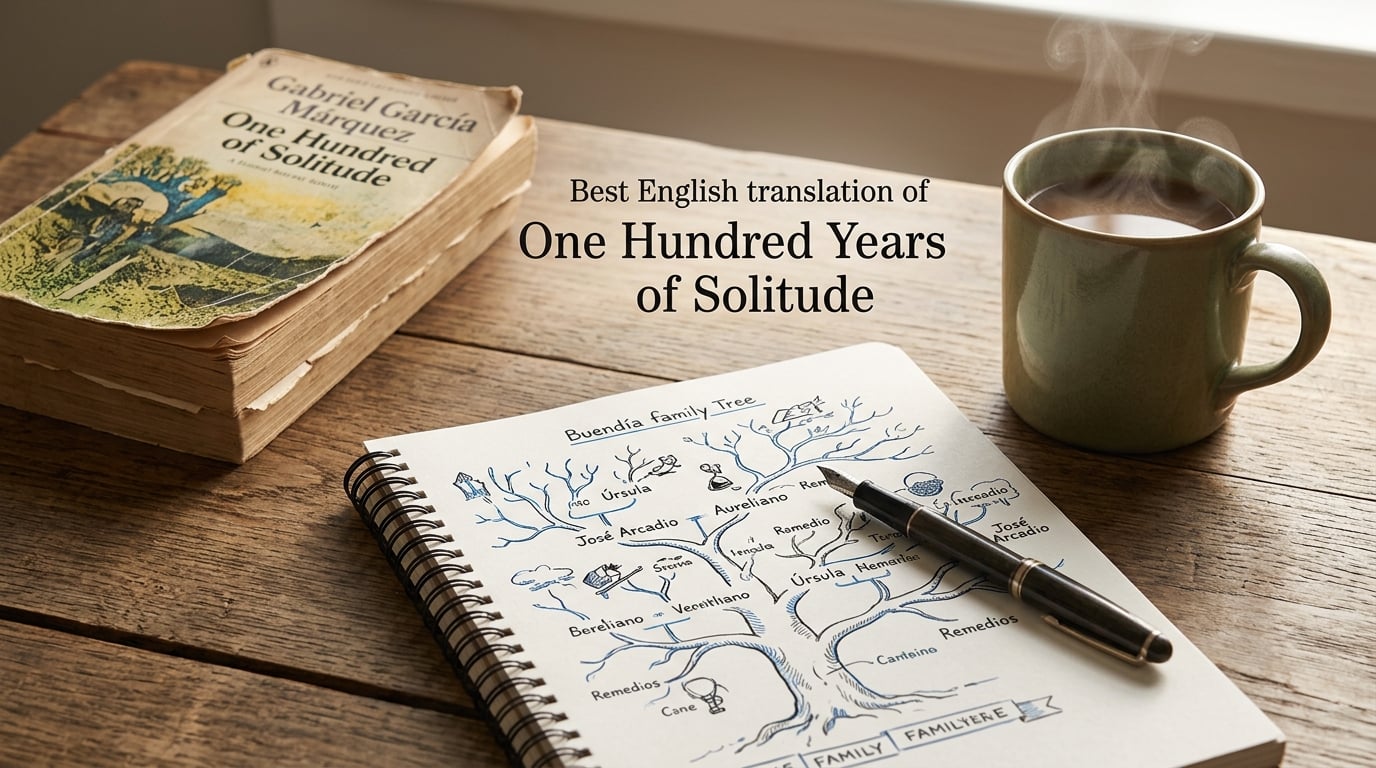
There is only one English translation of Gabriel García Márquez’s One Hundred Years of Solitude: Gregory Rabassa’s 1970 version, which the author himself called better than his original Spanish. If you’re looking for the best English translation of One Hundred Years of Solitude in 2026, you don’t need to compare editions – you need to understand why Rabassa’s version has been the canonical English text for over fifty years, and how to get the most out of reading it.
I’ve spent the past three months going back through Rabassa’s translation alongside the Spanish original, cross-referencing reader discussions on Reddit’s r/books and r/literature, and reviewing academic criticism from Hispanic Review and the Latin American Literary Review. Here’s what I found.
Table of Contents
Short Answer: Who Translated One Hundred Years of Solitude into English?
The only English translator is Gregory Rabassa (1970). No competing English translation exists, and one is not on the horizon. Three quick facts:
- The translator: Gregory Rabassa, an American literary translator and Queens College professor, completed the English version in 1970 for Harper & Row.
- The author’s view: García Márquez publicly stated that Rabassa’s English was superior to his own Spanish original – an almost unheard-of endorsement in literary history.
- The uniqueness: The English edition of the novel is still under copyright protection in most markets, which combined with Rabassa’s quality has kept competitors away.
That single paragraph answers the core question. The rest of this guide explains why no second translation exists, who Rabassa was, what makes his version so good, and how to read the novel without drowning in seven generations of Buendías.
Why There Is Only One English Translation
Readers searching for a comparison often assume multiple translations must exist. They don’t – and there are two reasons why.
First, copyright. The English translation of One Hundred Years of Solitude has been under copyright since 1970. Until the original Spanish novel enters the public domain in its translated form, no other publisher can legally commission or release a competing English version. Most projections place that moment well beyond 2026.
Second, Rabassa’s quality. Even setting copyright aside, García Márquez’s public endorsement created a powerful disincentive. Literary publishers have little appetite to commission a “rival” version of a novel whose own author has declared the existing translation better than his source text. Toni Morrison, Salman Rushdie, and Barack Obama have all praised Rabassa’s English – the consensus across five decades is unusually strong.
The practical upshot: when you buy One Hundred Years of Solitude in English today, you’re buying Rabassa. Your choice is the edition – paperback, hardcover, audiobook, or ebook – not the translator.
Who Was Gregory Rabassa? The Translator Behind the Masterpiece
Gregory Rabassa (1922-2016) was an American literary translator who taught at Queens College and the CUNY Graduate Center for decades. He served in Army intelligence during World War II in Italy, where he picked up conversational Italian and, later, Portuguese and Spanish. He only began translating literature seriously in his forties.
His most celebrated translations include:
- Julio Cortázar’s Hopscotch (1966) – which won the National Book Award for Translation in 1967, making Rabassa the translator of choice for Latin American fiction in English.
- Jorge Amado’s Dona Flor and Her Two Husbands (1969)
- Gabriel García Márquez’s One Hundred Years of Solitude (1970)
- Mario Vargas Llosa’s Captain Pantoja and the Special Service (1978)
- Clarice Lispector’s The Hour of the Star (1986)
Rabassa wrote a memoir, If This Be Treason: Translation and Its Dyscontents (2005), which remains one of the most readable introductions to literary translation for non-specialists. I recommend it to anyone curious about how the sausage gets made.
He died in 2016 at the age of 94, leaving behind a body of work that almost single-handedly shaped how Anglophone readers experience the Latin American Boom.
Why García Márquez Said Rabassa’s English Was Better Than His Spanish
The quote – in one form or another – is repeated on every serious article about this novel: García Márquez said Rabassa’s English was better than his original Spanish. The endorsement has been sourced to multiple venues, including a 1973 interview in The Paris Review, a Dartmouth lecture, and a CUNY appearance.
What made Rabassa’s version so effective, in my reading, comes down to three things:
- Sentence-level naturalness. Rabassa’s English reads as if it were originally written in English. He sacrificed literal fidelity for what he called “expressive equivalence” – finding the English idiom that carries the same emotional charge as the Spanish.
- Magical realism without footnotes. Where a clumsier translation might add an explanatory phrase (“a magical phenomenon occurred”), Rabassa lets the impossible event sit calmly inside the sentence, mirroring García Márquez’s own matter-of-fact tone.
- Oral cadence. García Márquez drew heavily on his grandmother’s storytelling style and the vallenato tradition of Colombia’s Caribbean coast. Rabassa preserved that musicality in English, even when it required restructuring sentences.
The “better than the original” remark was partly a generous gesture from one artist to another, but it was also factually defensible. Rabassa’s English gives the prose an elegance the Spanish occasionally lacks – especially in long, compound sentences that can feel heavy in the original.
Title Translation: Why “One Hundred Years of Solitude” and Not “A Hundred” or “Loneliness”
The Spanish title is Cien años de soledad. Every word in it has been debated by translators and scholars.
“Cien” vs “One Hundred.” In Spanish, “cien” is the form used for the exact number 100, while “ciento” is used in larger compounds (like “ciento uno”). Rabassa chose “One Hundred” rather than “A Hundred” because “a hundred” in English implies approximation, while “one hundred” signals precision. The novel is about a specific, finite span – exactly one hundred years – so the precision matters.
“Soledad” vs “Solitude” vs “Loneliness.” “Soledad” can mean either “solitude” or “loneliness” depending on context. Rabassa chose “Solitude” because it carries a more dignified, philosophical register – the Latinate word sounds elevated, while “loneliness” sounds plaintive. The title’s tone matters: it’s a meditation on a family, not a complaint.
These choices cascade into the text itself. Once readers register that the title’s “solitude” is contemplative rather than sad, the novel’s tone clicks into place.
How Rabassa Translated Magical Realism: Domesticating vs Foreignizing Explained
Translation scholars use two terms for opposite strategies: domesticating means smoothing the foreignness so English readers feel at home, while foreignizing means preserving the foreign flavor even at the cost of strangeness.
Rabassa mostly domesticated, but with restraint. A clear example is his handling of “Roque Carnicero” – a character whose name literally means “Butcher Roque” in Spanish. A heavily foreignizing translator might footnote this; a heavy domesticator might rename him. Rabassa kept the Spanish name but let the meaning surface naturally through context. The result: English readers absorb the strangeness without being lectured.
He also preferred Latin-origin English words – “solitude” rather than “loneliness,” “remembrances” rather than “memories” in some passages – to preserve the elevated register of García Márquez’s Spanish. This is the opposite of what most English prose favors today, and it gives Rabassa’s translation its distinctive flavor.
If you’ve ever wondered why One Hundred Years of Solitude feels weightier in English than, say, a Stephen King novel, this is part of the answer: Rabassa kept the linguistic texture of the source intact.
Which Edition Should You Buy? A Quick Comparison
Since the translation is identical across editions, your choice comes down to format and budget. Here’s a quick guide:
- Harper Perennial Modern Classics (paperback, ISBN 9780060883287) – the standard everyday edition. What most readers, book clubs, and university courses use. Lightweight, durable, widely available.
- Penguin Classics Deluxe Edition (paperback) – similar text quality, slightly different cover, sometimes preferred by readers who like Penguin’s typography and notes.
- Everyman’s Library (hardcover) – cloth-bound, ribbon bookmark, designed for collectors and re-readers. Heavier and more durable, with a sewn binding that lasts decades.
- Folio Society (slipcased hardcover) – the gift-grade option, with commissioned illustrations and a printed slipcase. For readers building a library or giving a serious literary present.
- Blackstone Audio (audiobook) – narrated by John Lee or, in an alternate release, by Ben Onwukwe. Both are well-regarded; Lee has the longer recording and a more meditative tone.
- Kindle ebook – the cheapest digital option, with adjustable text size that helps some readers manage the long sentences.
For a first-time reader, the Harper Perennial paperback is the safe default. It’s what most English-language editions you’ll see in bookstores, libraries, and reading groups use.
English or Spanish: Which Should You Read First?
If your Spanish is conversational but not fluent, my recommendation is clear: read Rabassa’s English first, then decide whether the Spanish is worth the second pass. This is also the consensus among bilingual readers on Reddit’s r/books, where the question gets asked weekly.
Three reasons to start in English:
- You absorb the plot without the language getting in the way. The novel’s complexity comes from seven generations of recurring names, not from difficult Spanish. Rabassa’s English removes one variable.
- García Márquez himself approved. When the author says his English translator did a better job, that’s a strong signal.
- Many bilingual readers report the opposite of what they expected. A Reddit reader who spent five years working through the Spanish wrote that Rabassa’s English was “an absolutely impeccable translation” – and that the second pass in Spanish was rewarding precisely because the first pass in English gave them the plot architecture.
If you are a heritage speaker or fluent in academic Spanish, by all means start with the original. But for most learners and casual bilinguals, English first, Spanish later is the more enjoyable path.
How to Read One Hundred Years of Solitude Without Getting Lost
The single biggest reader complaint about this novel – and the thing no competitor article addresses – is the Buendía family tree. Seven generations, repeated names, and a hundred-year timeline combine into a reading experience that can feel like swimming through molasses for the first 50 pages.
Five tips from readers who finished and loved it:
- Keep a family list on a sticky note. A Goodreads reviewer wrote that they had to write out a genealogy to keep seventeen Aurelianos straight. This is the most common piece of advice in r/books threads.
- Anchor names by their first appearance. When José Arcadio Buendía first shows up, note one distinguishing detail (his obsession with alchemy, his marriage to Úrsula). Same for Úrsula, Melquíades, and Pilar Ternera. Once you have three or four anchors, the rest fall into place.
- Read the first 50 pages slowly. The novel’s pace is deliberate at the start. Magical realism hits harder once you’re invested in Macondo as a place. Skim impatiently and you’ll lose the emotional thread.
- Don’t worry about catching every reference. García Márquez packed the novel with echoes of Colombian history, the Thousand Days’ War, the banana strikes, and Caribbean folklore. Most English readers miss most of these on the first pass, and that’s fine.
- Watch the Netflix series after, not before. The 2024 Netflix adaptation adapts the first half of the book. Reading first lets you enjoy the visual adaptation without spoiling later plot turns.
The payoff for working through the dense genealogy is enormous. Once the family’s repetitions start to feel like a haunting rather than a confusion, you’ll understand why this novel won García Márquez the Nobel Prize in 1982.
What to Read After One Hundred Years of Solitude
Once you’ve finished Rabassa’s translation, here are five natural next reads – chosen by what readers who loved this novel also loved:
- Love in the Time of Cholera by Gabriel García Márquez (trans. Edith Grossman) – the same author in a different mode. A quieter, more romantic novel, and Grossman is the second great English translator of García Márquez.
- Hopscotch by Julio Cortázar (trans. Gregory Rabassa) – read the same translator’s other masterpiece. It won the National Book Award and lets you experience Rabassa’s prose on a structurally experimental novel.
- The House of the Spirits by Isabel Allende (trans. Magda Bogin) – sometimes called the female counterpart to One Hundred Years of Solitude. A multi-generational family saga with magical realism.
- One Hundred Years of Solitude on Netflix (2024) – the Spanish-language adaptation by Alex García López and Laura Mora. Useful as a visual companion after reading.
- If This Be Treason by Gregory Rabassa – the translator’s own memoir. A great pick if you finished the novel curious about how literary translation actually works.
For book clubs, Hopscotch makes an excellent companion read because the same translator’s voice shows up across both books.
Frequently Asked Questions
Is One Hundred Years of Solitude good in English?
Yes. Gregory Rabassa’s 1970 English translation reads as smoothly as original English prose, and García Márquez himself said it was better than his Spanish original. Five decades of critical consensus – plus endorsements from Toni Morrison, Salman Rushdie, and Barack Obama – back up the claim.
Is there an English version of One Hundred Years of Solitude?
Yes – and only one. Gregory Rabassa’s 1970 translation, originally published by Harper u0026amp; Row and now available from Harper Perennial, Penguin, Everyman’s Library, and others. No second English translation has ever been published.
Is it better to read 100 Years of Solitude in English or Spanish?
If your Spanish is conversational rather than fluent, read Rabassa’s English first. The novel’s difficulty comes from its seven-generation family tree and slow build, not from the Spanish itself. Many bilingual readers on Reddit report the Spanish was a richer experience precisely because the English pass gave them the plot architecture first.
Why is One Hundred Years of Solitude so hard to read?
Three reasons: the first 50 pages are deliberately slow before magical realism kicks in, the same names recur across seven generations of Buendías, and the novel references Colombian history that most English readers won’t recognize. A simple sticky-note family list fixes the second problem, and patience fixes the first.
Which translation of One Hundred Years of Solitude is best?
Gregory Rabassa’s 1970 translation is the only English translation. It’s been the canonical English text for over fifty years and remains the standard edition used in universities, book clubs, and literary criticism worldwide.
Is there a translation of One Hundred Years of Solitude by Gregory Rabassa?
Yes. Rabassa’s translation was published in 1970 by Harper u0026amp; Row and remains in print today across multiple editions. It won the translator widespread recognition and helped establish him as the leading English voice of the Latin American Boom.
How many English translations of One Hundred Years of Solitude are there?
Just one: Gregory Rabassa’s 1970 version. The English translation is still under copyright, and the quality of Rabassa’s work – plus García Márquez’s public endorsement – has discouraged publishers from commissioning a competing version.
Conclusion
When readers ask for the best English translation of One Hundred Years of Solitude, the honest answer is the simplest one: Gregory Rabassa’s 1970 version is the only English translation, and five decades of consensus say it’s also the best. García Márquez’s endorsement – that Rabassa’s English was better than his Spanish original – has held up to every test of literary criticism since.
My recommendation for first-time readers in 2026: grab the Harper Perennial Modern Classics paperback, keep a sticky note for the family tree, and trust Rabassa’s prose to do the work. If you love it, follow up with Love in the Time of Cholera and Rabassa’s own memoir If This Be Treason. If you’ve seen the Netflix adaptation, read the book second – the visual version adapts the first half but doesn’t replace the novel’s interiority.
Whatever edition you choose, you’re reading the canonical English text of one of the 20th century’s most important novels. That’s not a comparison-shopping decision. It’s a reading-life decision, and it’s a good one.