
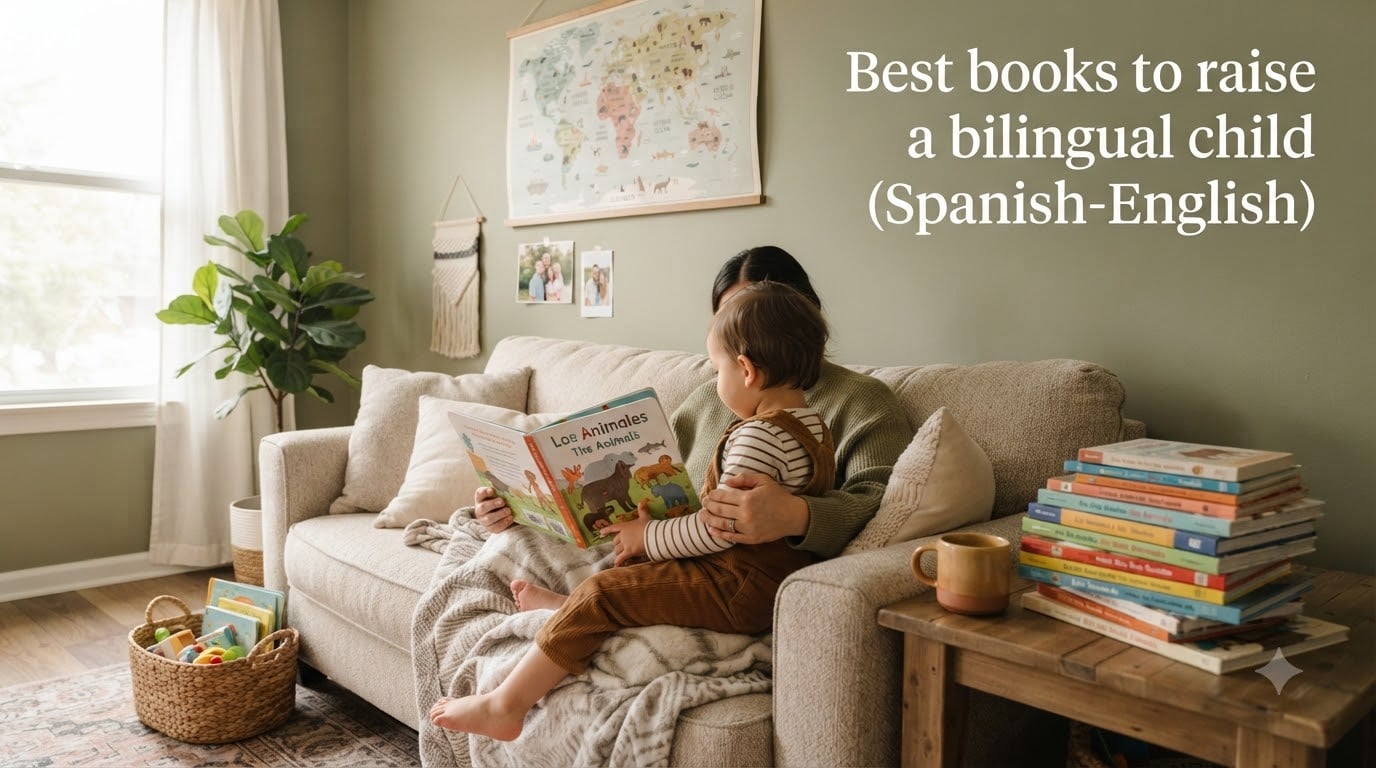
Bilingual Spanish-English children’s books are books that present text in both languages, either side-by-side on the same page, on facing pages, or with Spanish and English woven into a single narrative. They help children build vocabulary in both languages at the same time and are one of the most effective tools for parents raising bilingual or multilingual children. In this guide, I’ll walk you through the best books to raise a bilingual child in Spanish and English, organized by age, theme, and reading strategy, so you can build a home library that actually grows both languages.
Whether you’re a heritage speaker, a non-native Spanish parent, or somewhere in between, books are the most accessible immersion tool when Spanish doesn’t surround your child at school or on the playground. I’ll show you which titles my family and our bilingual-parent community keep reaching for, how to spot a quality translation, and how to actually use these books as a language strategy rather than just decoration on a shelf.
Below is a quick list of the best books to raise a bilingual child, organized by the question parents search most: which books do I actually start with? I’ll expand each recommendation throughout the article.
Table of Contents
Quick Picks: Best Books to Raise a Bilingual Child at a Glance
- Los Pollitos / Little Chickies by Canticos — best board book for babies 0-2
- Hola, Hombre Lobo / Hello, Wolf by Sébastien Braun (Spanish edition) — best for ages 2-4
- Dreamers by Yuyi Morales — best picture book for ages 4-8
- Frida Kahlo and Her Animalitos by Monica Brown — best biography for ages 4-7
- The Rooster Who Would Not Be Quiet! / ¡El gallo que no se callaba! by Carmen Agra Deedy — best Spanish-first narrative for ages 4-8
- My Name Is Yoon / Me llamo Yoon — best for ages 5-8
- Sopa de frijoles / Bean Soup by Jorge Argueta — best rhyming reader for ages 4-7
- De colores / Bright in the Sky nursery rhyme collection — best for sing-along immersion
Now let’s get into the research, the criteria, and the full age-by-age roadmap so you can choose with confidence.
Why Bilingual Books Work for Language Development
Books work because they give a child’s brain repeated, contextual exposure to both languages through stories, rhymes, and illustrations. The brain links new Spanish words to familiar English concepts, which accelerates vocabulary growth and pronunciation in the minority language. Research consistently shows that dual-language exposure from birth supports, rather than delays, language development.
For families who don’t live in a Spanish-speaking neighborhood or send their child to a Spanish-immersion school, books are the most reliable daily dose of the heritage language a child will get. A 10-minute read-aloud in Spanish before bed, repeated nightly over months, builds vocabulary faster than occasional weekend Spanish lessons.
Busting the “Confusion” Myth
One of the most common worries I hear from parents, especially non-native Spanish speakers, is that exposing a child to two languages at once will confuse them or delay speech. The research is clear: bilingual children reach language milestones on the same timeline as monolingual peers. They may mix grammar rules in the early years, which is a normal part of bilingual development called code-switching, not a sign of confusion. By age 4 or 5, most bilingual kids cleanly separate the two languages depending on context.
The American Academy of Pediatrics, the American Speech-Language-Hearing Association, and Colorin Colorado all affirm that early dual-language exposure is beneficial. So if you’ve been holding off, the best time to start is today. It is never too late, but the earlier the better.
What the Research Shows About Reading Aloud in Two Languages
Studies on dual-language learners show that children who hear stories read aloud in both their home and community languages develop stronger executive-function skills and stronger literacy in their first language than monolingual peers. Reading aloud in Spanish, even when the parent is not perfectly fluent, exposes children to vocabulary they will not pick up from English-only media.
In our household, we read in Spanish at bedtime and in English during the day. Over six months, my daughter’s Spanish vocabulary more than doubled, and she began self-correcting code-switches around age 4. The books were the lever.
What Makes a Great Bilingual Book: How to Choose Quality Titles
A great bilingual book does three things at once: it tells a story a child wants to hear again, it models natural Spanish (not stilted translation), and it represents culture accurately. Here’s how I evaluate any bilingual children’s book before adding it to our shelf.
Selection Criteria Worth Using
- Authentic Spanish voice. Look for books originally written in Spanish or co-authored by a native Spanish speaker. Avoid titles whose Spanish reads as a stiff word-for-word translation. If the Spanish sounds awkward when read aloud, your child will notice before you do.
- Side-by-side or facing-page format. Dual-language layouts let a non-native parent follow along without flipping. This is a non-negotiable for many families in our community.
- Cultural accuracy. Illustrations should reflect the diversity of Latinx communities rather than relying on stereotypes. Authors who live the culture they depict produce stronger books.
- Age-appropriate format. Board books for 0-2 (chewable, durable), picture books for 3-5, early readers and chapter books for 6-9.
- Repetition and rhyme. Predictable patterns help children anticipate words in either language, building fluency through memorization.
Bilingual Eng/Sp vs. Spanish-First vs. Dual-Language Editions: What’s the Difference?
Parents in our community often ask whether to buy a side-by-side bilingual edition, a Spanish-only original, or a dual-language translation. Each serves a different purpose in your library. Here is a simple breakdown.
| Format | Best For | Watch Out For |
|---|---|---|
| Side-by-side bilingual (English on one page, Spanish on the other) | Non-native Spanish parents who want to read confidently; mixed-language households | Some translations read stiffly; not always faithful to cultural nuance |
| Spanish-first original (written in Spanish, sometimes translated later) | Heritage speakers; families prioritizing authentic Spanish voice and rhythm | Harder for non-native parents to read fluently without prep |
| Dual-language single narrative (Spanish and English woven into one story) | Older children (5+) who can follow code-switching in context | Less ideal for absolute beginners; works best as a “next step” book |
| English-only translated to Spanish (e.g., Eric Carle in Spanish) | Children who love a familiar English story and want the Spanish version | Quality varies; some translations lose the rhyme scheme |
My recommendation: build a mixed library. Start with side-by-side bilingual books in infancy (so you can read confidently), then add Spanish-first originals as your own Spanish grows, then layer in dual-language narratives for older kids.
Best Bilingual Books by Age: A Developmental Roadmap
This is the section most competitor articles skip. I’ll walk you through what to read at each stage and why, based on how bilingual children acquire language between birth and age 9.
Ages 0 to 2: Board Books for Babies
Babies don’t need storylines; they need rhythm, repetition, and faces. The best board books for this age lean on lullaby-style Spanish, simple vocabulary, and durable pages that survive teething. Start reading in Spanish from day one, even if your Spanish is limited. Your baby is soaking up pronunciation and melody, not grammar.
Our top picks for ages 0-2:
- Los Pollitos / Little Chickies by Canticos. A bilingual take on the classic nursery rhyme “Los pollitos dicen pío pío.” Catchy, durable, and adored by babies from 6 months up.
- Besos de abeja / Bee Kisses by Dori Staehle. Sweet lift-the-flap concept book pairing English and Spanish opposites.
- Hola, hola, Spanish ABC by Susie Jaramillo. Canticos alphabet board book that doubles as a Spanish primer.
- Buenos días / Good Morning (Canticos series). Simple morning routine vocabulary with bright illustrations.
- Little Sunny Sunshine / Sol Solecito by Canticos. A musical board book that pairs with the original Spanish lullaby; many families sing along.
Canticos board books are the most repeated recommendation in r/Mommit and bilingual-parent Facebook groups for one reason: they are designed for heritage households and feature authentic Spanish alongside English. They are also priced affordably, which matters when babies destroy books.
Ages 3 to 5: Picture Books for Toddlers and Preschoolers
Between ages 3 and 5, your child’s attention span grows, their vocabulary expands rapidly, and they begin asking “what does that mean?” in both directions. This is the sweet spot for bilingual picture books with richer stories, more text per page, and cultural themes.
Our top picks for ages 3-5:
- Dreamers by Yuyi Morales. A 2019 Pura Belpré Award winner about a mother and son immigrating to a new country. Stunning illustrations, emotional depth that older 4- and 5-year-olds connect with.
- The Rooster Who Would Not Be Quiet! / ¡El gallo que no se callaba! by Carmen Agra Deedy. A Spanish-first narrative translated by Alma Flor Ada. Lyrical, funny, and a great read-aloud.
- Marisol McDonald Doesn’t Match / Marisol McDonald no combina by Monica Brown. A mixed-heritage heroine whose Spanglish identity is celebrated, not corrected. Beloved by bilingual kids.
- My Name Is Yoon / Me llamo Yoon by Helen Recorvits. A gentle immigration and identity story; available in dual-language editions.
- Round Is a Tortilla / Redondo es una tortilla by Roseanne Greenfield Thong. A bilingual concept book celebrating Latino culture through shapes, food, and family.
This is also the age where authors like Lulu Delacre, Monica Brown, and Alma Flor Ada shine. Look for the Pura Belpré Award seal on the cover; it is the strongest trust signal for authentic Latinx children’s literature.
Ages 6 to 9: Early Readers and Chapter Books
Once your child is reading independently in English, introduce Spanish-first chapter books and bilingual early readers. This is the age where dual-language narratives work best, because kids can follow code-switching in context without losing the thread.
Our top picks for ages 6-9:
- Esperanza Rising by Pam Muñoz Ryan (Spanish edition: Esperanza renace). A beloved immigration and resilience story with rich Spanish vocabulary and Mexican cultural context.
- The Dreamer / El soñador by Pam Muñoz Ryan. A biographical picture book about Pablo Neruda, available in dual-language editions, perfect for advanced early readers.
- De cómo la gente celebra el Día de los Muertos / The Day of the Dead by Bob Barner. A bilingual cultural concept book that older children can read alone or with a parent.
- Juana y Lucas by Juana Medina (Spanish-first original). A chapter book set in Bogotá, written with humor and warmth. A 2017 Pura Belpré Honor Book.
- Lowriders in Space / Mateo y la máquina de hacer Lowriders by Cathy Camper. A bilingual graphic-novel-style early reader with Latino culture at its core.
By ages 8 or 9, many bilingual kids prefer to read in Spanish on their own. Stock your shelves with Spanish-first originals so they have somewhere to land. Books like Juana y Lucas, Esperanza renace, and the works of Gabriel García Márquez for younger readers are excellent bridges.
Themed Bilingual Book Collections Worth Building
Beyond age, theme matters. A well-rounded bilingual library covers songs and rhymes, alphabet and counting, folktales, biographies, and cultural celebrations. Here is how to build a themed collection that strengthens language while honoring heritage.
Spanish Nursery Rhymes and Song Books
Song-based books are the secret weapon of bilingual parenting. Children who resist vocabulary drills will happily sing “Los pollitos” or “De colores” fifty times. My favorite is De colores / Bright in the Sky, a bilingual anthology of traditional Spanish songs with English translations.
Other great picks: Buenos días, animales and the Canticos musical board book series. Pair these with the original recordings on Spotify or YouTube; the song repetition is what cements vocabulary.
Alphabet and Counting Books
Alphabet books double as vocabulary primers. Canticos’ Hola, hola, Spanish ABC is excellent for the 0-3 range. For ages 4-7, try ¡Olinguito, de la A a la Z! by Lulu Delacre, a Latin American alphabet adventure featuring lesser-known animals and places.
For counting, Uno, dos, abrocha los zapatos by Theresa Howell and a counting-themed version of Round Is a Tortilla work well. Keep one counting and one alphabet book in rotation through age 5.
Folktales and Legends
Folktales anchor children to the cultural roots of a language. Look for retellings by Latinx authors rather than abridged translations of English tales. The Bossy Gallito / El gallo de bodas by Lucía M. González is a Cuban folktale retold in lyrical Spanish. Martina the Beautiful Cockroach / Martina, la cucarachita más linda by Carmen Agra Deedy is a Cuban-American retelling that doubles as a manners story.
For older children, look for collections of Latin American folktales like those by Alma Flor Ada and F. Isabel Campoy.
Picture Book Biographies of Latino Figures
Biographies give children real-world role models. Frida Kahlo and Her Animalitos by Monica Brown, illustrated by John Parra, is a 2018 Pura Belpré Honor Book. The World of Max Estrella is a good parent read-aloud for older kids. My Name Is Gabriela / Me llamo Gabriela by Monica Brown introduces Gabriela Mistral, the Nobel-winning poet.
For musical families, My Name Is Celia / Me llamo Celia by Monica Brown is a beautiful tribute to Celia Cruz, the Queen of Salsa. Lil’ Libros’ Celia Cruz: Little Libro of Music board book is a great intro for younger children.
Cultural Celebration Books
Holidays are the natural hook for cultural conversation. Day of the Dead / Día de los Muertos by Bob Barner, Celebrating Las Posadas by Diane de Anda, and Festival of Lights / Festival de luces by Dianne de Anda are reliable picks.
Pair a cultural celebration book with a real family tradition. Reading El día de los muertos before your family’s ofrenda gives the vocabulary a context your child will remember.
How to Read Bilingual Books With Your Child: Practical Strategies
Having the right books is only half the work. The other half is using them well. Here are the techniques our bilingual-parent community uses daily to actually grow Spanish at home.
The OPOL Method (One Parent, One Language)
OPOL is a popular strategy where each parent speaks a single language with the child. A Spanish-speaking parent always speaks Spanish, an English-speaking parent always speaks English. For our family, that meant I read Spanish books at bedtime while my partner read English during the day. OPOL gives the child clear language anchors per person.
The Point-and-Name Technique
For non-native Spanish parents, this is the most confidence-building technique. As you read, point to the picture and say the word or phrase in Spanish, then in English. “Mira, un gato. Look, a cat.” Repeat it. Children learn vocabulary through pointing and naming far faster than through passive listening.
Paired Reading in Both Languages
Read the same story in Spanish and English on different nights. Children love repetition, and pairing lets them compare structures and vocabulary between languages. We read Dreamers in Spanish on Monday and in English on Wednesday for two weeks straight.
Reading Tips for Non-Native Spanish Parents
If you are not a fluent Spanish speaker, you are not disqualified from reading aloud in Spanish. Here is what experienced non-native parents in our community recommend:
- Practice the book before reading it aloud. Read it once silently to yourself the day before so unfamiliar words roll off your tongue.
- Use the side-by-side bilingual layout as your safety net. Keep your eyes on the Spanish page; glance at English only when needed.
- Add audio. Pair the book with a YouTube read-aloud by a native speaker so your child hears the proper pronunciation.
- Don’t panic over mistakes. Your child learns Spanish with you, not from you. A slightly off pronunciation is far better than no Spanish exposure.
This is the pain point we hear most from Reddit and Facebook: non-native parents feel too self-conscious to read aloud. The fix is preparation, a side-by-side book, and the willingness to be imperfect. Your child benefits from hearing your voice in Spanish far more than from a perfect stranger’s audio.
Building a Reading Routine
A simple routine beats an ambitious plan. Try this with your child:
- Morning (5 minutes): One Spanish nursery rhyme or alphabet book at breakfast.
- Afternoon (10 minutes): Free reading in either language after nap or school.
- Bedtime (15 minutes): Read-aloud in Spanish, the language most at risk of being lost.
Thirty minutes a day, split across short sessions, builds stronger Spanish than an hour once a week. Consistency matters more than duration.
Where to Find Bilingual Books (and How to Save Money)
Building a bilingual library adds up. Here are realistic ways to access good books without overspending.
Public Libraries and Interlibrary Loan
Most public libraries now carry Spanish-English children’s books, and library apps like Libby let you borrow Spanish picture books digitally. Stanford’s Cubberley Education Library maintains a bilingual collection that is open to researchers by appointment, and many university libraries host community read-aloud events.
Subscription Boxes for Discovery
Subscription boxes are a smart way to discover new titles without committing to a full purchase. Lil’ Libros Club delivers monthly board books featuring Latino icons. Sol Book Box curates bilingual picture books for ages 0-7. Books del Sur ships Spanish-first children’s books from Latin America.
Subscription boxes are particularly useful for non-native parents who don’t know which authors and series to start with. The curation does the work for you.
Online and Independent Bookstores
Independently owned Latino and Spanish-language bookstores, like Books del Sur, Librería Martínez de Chapman University, and Barrio Books, curate authentic Spanish-first titles that big-box stores often miss. Online retailers like Language Lizard and Multilingual Books specialize in bilingual editions across language pairs.
Frequently Asked Questions
What are some good bilingual English and Spanish children’s books?
Strong starter picks include Los Pollitos / Little Chickies by Canticos (board book, 0-2), Dreamers by Yuyi Morales (picture book, 4-8), The Rooster Who Would Not Be Quiet! by Carmen Agra Deedy (Spanish-first narrative, 4-8), Frida Kahlo and Her Animalitos by Monica Brown (biography, 4-7), and Juana y Lucas by Juana Medina (chapter book, 6-9). Mix side-by-side bilingual editions with Spanish-first originals for the strongest results.
What are some books that are bilingual in English and Spanish?
Reliable bilingual Eng/Sp titles include Hola, Hombre Lobo / Hello, Wolf, Round Is a Tortilla / Redondo es una tortilla, Marisol McDonald Doesn’t Match / Marisol McDonald no combina, My Name Is Yoon / Me llamo Yoon, and the Canticos board book series. These are widely recommended by bilingual educators and parents because they hold up in both languages without losing rhyme or cultural nuance.
What is the best book for kids to learn Spanish?
For absolute beginners, Los Pollitos / Little Chickies by Canticos is the most repeated recommendation because it pairs a familiar Spanish nursery rhyme with simple English text. For slightly older learners (4-7), Dreamers by Yuyi Morales works beautifully, and for early chapter-book readers, Juana y Lucas by Juana Medina is a Spanish-first original that holds attention while building vocabulary.
What are some good dual language books for children?
Dual-language picture books that handle code-switching well include The Rooster Who Would Not Be Quiet! / ¡El gallo que no se callaba!, Esperanza Rising / Esperanza renace, and My Name Is Yoon / Me llamo Yoon. For board books, Canticos titles like Besos de abeja and Buenos días work well. Look for the Pura Belpré Award seal as a trust signal.
What are the best board books for toddlers?
Top board books for toddlers learning Spanish and English include Los Pollitos / Little Chickies, Hola, hola, Spanish ABC, Besos de abeja / Bee Kisses, Little Sunny Sunshine / Sol Solecito, and Lil’ Libros’ Celia Cruz board book. All are durable, age-appropriate, and feature authentic Spanish with rhythmic text that holds toddler attention.
Can a baby learn both English and Spanish at the same time?
Yes. Research from the American Academy of Pediatrics, the American Speech-Language-Hearing Association, and Colorin Colorado confirms that babies can learn two languages from birth without confusion or speech delay. Code-switching in early years is normal bilingual development, not a sign of confusion. The earlier you start reading in both languages, the stronger both vocabularies become.
Do bilingual books confuse children?
No. The idea that bilingual exposure confuses children is a persistent myth, but it has been thoroughly debunked. Bilingual children reach language milestones on the same timeline as monolingual peers, and most cleanly separate their languages by age 4 or 5. Code-switching in younger children is a normal stage of learning, not confusion.
How many bilingual books do I need to raise a bilingual child?
There is no fixed number, but a practical starter library of 15 to 25 well-chosen titles across ages 0 to 9 will carry you through the early years. Rotate 5 to 10 books at a time, with 3 to 5 read nightly on a steady loop. Quality and consistency matter far more than quantity. Pair books with daily read-aloud, even 10 minutes a day, and the volume compounds quickly.
Conclusion: Your Starter Library
Building a bilingual home library does not happen overnight, but the best books to raise a bilingual child share one trait: they make you and your child want to return to them. Start with five titles from this guide: one board book for ages 0-2, two picture books for ages 3-5, one biography or folktale, and one Spanish-first original.
Read aloud every night, in Spanish if you can manage it, even imperfectly. Pair books with audio. Add a new title every month. By the time your child is 5, you’ll have a 30-book collection that has shaped both languages and a lasting relationship with reading.
The single biggest takeaway from this guide: consistency beats perfection. A daily 10-minute Spanish read-aloud with a good book compounds faster than any weekend program. Start with the books above, build from there, and trust the process. Your bilingual child will thank you in two languages.