
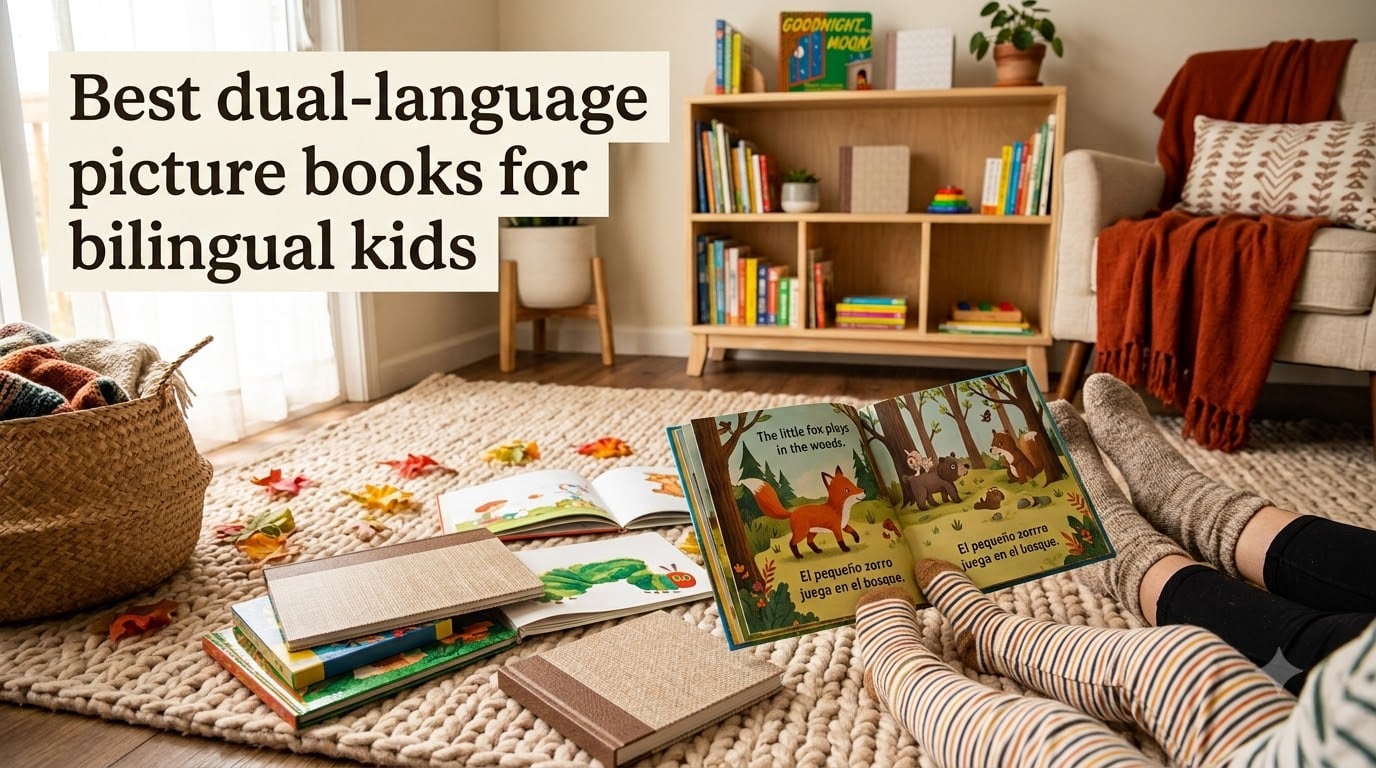
I remember sitting on the kitchen floor with my nephew, flipping through a Spanish/English board book and watching him point at a gallo and shout “rooster!” He had never spoken Spanish at home, but the bright illustration and the repeating phrase locked it in by the second read. That moment is exactly why I wrote this guide to the best dual-language picture books for bilingual kids in 2026 — because the right book at the right age can do more for heritage language and second-language literacy than almost any other tool a parent owns.
Below, I’ll walk you through what makes a book “dual-language,” how to pick the right format for your child’s age, twelve specific titles organized from babies to early readers, and the reading strategies that actually work at home. No product roundup, no pressure to buy — just a curated reading list and the reasoning behind it.
Table of Contents
What Is a Dual-Language Picture Book?
A dual-language picture book is a children’s book that tells the same story in two languages, usually laid out as parallel text — the English on one side of the page and the second language on the other, or alternating page spreads. These books help bilingual children keep their heritage language strong while building English literacy, and they help monolingual families add a second language naturally through read-aloud time.
The key distinction parents should know: dual-language is not the same as a dual-edition. A dual-edition is two separate books — one Spanish, one English — sold together. A dual-language picture book combines both languages in a single volume, side-by-side, so a child can see how “manzana” and “apple” live on the same page. Parallel text is the format that delivers the strongest bilingual learning because it allows direct word-by-word comparison.
Two more terms appear often. Heritage language means the language your family speaks at home, passed down from parents or grandparents. Receptive bilingual describes a child who understands a language but doesn’t yet speak it — common in mixed-language families, and a perfect fit for picture books because kids absorb vocabulary even when they only answer in their dominant language.
Best Dual-Language Picture Books for Babies and Toddlers (Ages 0-3)
For babies and toddlers, you want board books — thick pages that survive chewing, simple vocabulary, and bright illustrations. The four titles below cover English paired with Spanish, French, Mandarin, and Arabic so the youngest readers in bilingual households see their language from day one.
1. “My First Bilingual Library” Set by Gloo Books
Age range: 0-3. Language pair: English/Spanish. A small-format box set of sturdy board books covering animals, numbers, colors, and everyday objects. Parents on bilingual forums consistently mention this set as one of the most-durable introductions to Spanish vocabulary for babies who mouth everything. The chunky pages hold up to teething, and the simple word-and-picture format is perfect for short attention spans.
2. “¡Mambo Mucho Mambo! / Mucho Mambo” by Elisa Squittieri, illustrated by Alicia Baladan
Age range: 2-5. Language pair: English/Spanish. A rhythmic board-book celebration of Latin dance that doubles as a Spanish vocabulary lesson on movement words — bailar, saltar, girar. The English text mirrors the Spanish rhythm, so caregivers can clap along and reinforce both languages through music. It is one of the rare board books where the onomatopoeia actually teaches accent patterns rather than just object names.
3. “My First French Words” Board Book Series by Milet Publishing
Age range: 0-3. Language pair: English/French. Milet publishes parallel-text board books covering colors, numbers, animals, and the home. The illustrations are gentle rather than oversaturated, which works well for bedtime reading. For French/English families, this series is the most consistently available option in mainstream bookstores and libraries — a real plus, since parents in r/multilingualparenting threads often complain that French/English board books are surprisingly hard to find.
4. “I Love You / Wo Ai Ni” Mandarin-English Edition
Age range: 0-3. Language pair: English/Mandarin. A short board book pairing simple English phrases with their Mandarin equivalents, written in both pinyin and simplified Chinese characters. It works equally well for adopted families, heritage Mandarin speakers, and monolingual families introducing tonal sounds early. The brevity — about ten phrases — keeps the pacing right for babies who lose interest past one minute.
Best Dual-Language Picture Books for Preschoolers (Ages 3-6)
Preschoolers can sit longer, follow a story, and begin to notice that the same idea sounds different in two languages. The five titles below lean into cultural storytelling — books where the language pair is inseparable from the family, food, and place being depicted.
5. “Mango, Abuela, and Me” by Meg Medina, illustrated by Angela Dominguez
Age range: 4-8. Language pair: English/Spanish. Abuela is moving in, and Mia’s English-and-Spanish household suddenly shifts. Medina, a Cuban-American author who later won the Newbery, writes Spanish naturally — as words the family actually uses, not translation filler. This book is widely cited by speech-language pathologists as a model for how to weave code-switching into a children’s story without making either language feel like the “other.”
6. “Spanish Is the Language of My Family” by Judy Goldman, illustrated by Edmée Cannistra
Age range: 5-8. Language pair: English/Spanish. A child narrator recounts her grandfather’s journey and the Spanish he carried with him. The bilingual moments are sparse but meaningful — single words or short phrases that act as anchors to identity. The book works well for English-dominant children who don’t speak Spanish yet but want to honor a heritage language spoken by older relatives.
7. “My Name Is Yoon” (French/English classroom edition) by Helen Recorvits
Age range: 4-7. Language pair: English/French (bilingual classroom edition). Yoon’s family has just moved from Korea, and her teacher asks her to write her name in English. The bilingual edition adds French parallels for ESL/ELL classrooms serving francophone newcomers. Although the story itself is about Korean-American identity, the French parallel text shows how the same emotional arc translates across multiple languages.
8. “Bowwow Powwow” English/Anishinaabemowin Edition by Brenda J. Child, translated by Gordon J. Christianson
Age range: 5-9. Language pair: English/Anishinaabemowin (Ojibwe). A powwow scene seen through a dog’s eyes, with Anishinaabemowin words — mgawanjigan (bag), giizhigad (day) — woven naturally into the English narrative. This is the kind of heritage language book Indigenous families have asked for in library-focused forums for years, and one of very few children’s books where the second language is not Spanish or French. Pair it with the Ojibwe resources from your local tribal library.
9. “Yasmin” series in Spanish/English by Aisha Saeed, illustrated by Hatem Aly
Age range: 4-8. Language pair: English/Spanish. The Yasmin books follow a Pakistani-American second-grader through school, family, and community. Selected titles in the series appear in side-by-side Spanish/English editions that work for early readers and read-alouds alike. Saeed’s bilingual Spanish editions are also widely stocked in Scholastic book fairs, which makes them one of the more affordable classroom-friendly options.
Best Dual-Language Picture Books for Early Readers (Ages 6-9)
Early readers — roughly ages 6-9 — benefit from longer sentences and chapter-style picture books. The bilingual editions below give independent readers a confidence boost: they can lean on the English side to decode new vocabulary in the second language without losing the plot.
10. “The Cat in the Hat” Bilingual Editions (English/French, English/Spanish)
Age range: 6-9. Language pair: English/French or English/Spanish. Dr. Seuss’s controlled vocabulary is a surprisingly effective bilingual reading tool because the rhyming structure works in both languages. Parents in r/childrensbooks have repeatedly asked for parallel-text editions of beloved classics, and these Seuss bilingual editions are the most consistent answer. A child who knows the English by heart can follow the Spanish by pattern-matching.
11. “Charlotte’s Web” Spanish/English Parallel Edition
Age range: 7-10. Language pair: English/Spanish. The classic chapter book in parallel text. For Spanish-speaking heritage readers, seeing Wilbur and Charlotte described in two languages side-by-side is a gateway to longer Spanish reading. For English-dominant kids, the Spanish side is challenging enough to feel like a real accomplishment by the final chapter.
12. “Am I Small?” / “Mol ke idik?” by Philipp Winterberg
Age range: 4-8, with bilingual editions extending to older readers. Language pairs: English/Tamil, English/Ukrainian, English/Arabic, and 100+ other combinations. This title is one of the more remarkable stories in bilingual publishing — a single children’s picture book translated into over 100 languages, available as parallel-text editions. For families searching for rare pairs like Russian/English, Tagalog/English, or Vietnamese/English, this is often the only affordable parallel-text option on the market.
How to Choose the Right Dual-Language Picture Book
Choosing a bilingual picture book is less about finding a “best” title and more about matching format, language, and cultural authenticity to your child’s life. Here is the framework I use.
Format matters first. Board books work for ages 0-3 because they survive hands, mouths, and stroller drops. Hardcover picture books suit ages 3-6 and tend to hold up to repeated library checkouts. Paperback chapter books and parallel-text early readers suit ages 6-9 and are easier to slip into a school backpack. Avoid bilingual textbooks in this age range — the layout is dense and illustrations are sparse, which kills the read-aloud joy.
Language pair should mirror the household. If your family speaks Spanish at home but English at school, a Spanish/English book is the obvious pick. If you are a monolingual family hoping to introduce a second language, choose a language pair you actually intend to maintain — buying a Mandarin/English book and never reading the Mandarin side wastes the format.
Illustration style and cultural authenticity are the trust signals parents talk about most in forums. Books illustrated by artists from the represented culture — Angela Dominguez for Mexican-American stories, Floyd Cooper for Black American histories, Julie Flett for Cree-Métis stories — tend to depict food, clothing, and family structure with a specificity that translation-only books miss.
Where to find affordable copies: public libraries are the first stop — most systems now allow you to request bilingual acquisitions. Scholastic book clubs carry several titles in this list at lower price points. Independent publishers like Language Lizard, KidKiddos, Lil’ Libros, Bilibri, and Viel & Mehr specialize in rare language pairs and often have educator discounts. Used book sites frequently stock out-of-print bilingual editions that are otherwise hard to find.
How to Use Dual-Language Books With Your Child
The best bilingual book in the world won’t help if the read-aloud habits don’t match your family. Here are four strategies that consistently work, drawn from speech-language pathologist recommendations and parent forums.
Try the one-language-per-pass method. Read the whole book in English tonight, the whole book in Spanish tomorrow. Parents in r/multilingualparenting consistently report this builds fluency faster than mixing languages within a single sitting, because the child hears full immersion in each pass. Alternate once your child is comfortable with both.
Point and label, even before your child talks. Babies and receptive bilinguals absorb vocabulary from picture pointing even when they answer only in their dominant language. Label objects in both languages every time you read — gallo and rooster, luna and moon — and the parallel word pairs will start to stick by the third read.
Ask open-ended questions in both languages. What is the dog doing? ¿Qué hace el perro? These questions invite the child to translate internally and respond in either language. The goal is metabilingual awareness — the understanding that the same idea can be said two ways.
Repeat favorites without shame. Bilingual vocabulary acquisition is repetition-driven. Reading the same book ten times in two weeks is more valuable than reading ten books once. Build a small rotation of three to five favorites rather than chasing new titles every week.
Frequently Asked Questions
What are some good bilingual picture books for children?
Strong picks across ages include Mango, Abuela, and Me by Meg Medina (Spanish/English, ages 4-8), Yasmin in Spanish/English editions (ages 4-8), My First Bilingual Library by Gloo Books (Spanish/English board books, ages 0-3), Bowwow Powwow in English/Anishinaabemowin (ages 5-9), and Am I Small? in rare language pairs like English/Tagalog or English/Russian (ages 4-8). Choose based on your child’s age and the language pair your family actually speaks.
What are the best books for raising a bilingual child?
The best books for raising a bilingual child are the ones your family reads consistently in both languages. Board books like My First Bilingual Library work for ages 0-3, picture books like Mango, Abuela, and Me work for ages 4-8, and parallel-text chapter books like Charlotte’s Web in Spanish/English work for ages 7-10. The format matters less than the routine — daily read-aloud in the heritage language is the single strongest predictor of long-term bilingualism.
What are some good dual language books for children?
Good dual language books for children include parallel-text editions of beloved classics like The Cat in the Hat (English/French or English/Spanish), heritage-language stories like Bowwow Powwow (English/Anishinaabemowin), and culturally specific picture books like Yasmin (English/Spanish) and My Name Is Yoon (English/French bilingual classroom edition). Look for parallel text on the same page rather than dual-edition separate books for stronger bilingual learning.
What are some good bilingual books for kids that are both Spanish and English?
Top Spanish/English bilingual picture books include Mango, Abuela, and Me by Meg Medina (ages 4-8), Spanish Is the Language of My Family by Judy Goldman (ages 5-8), Yasmin by Aisha Saeed (ages 4-8), My First Bilingual Library by Gloo Books (ages 0-3), and Spanish Is My Superpower from the Sesame Street line (ages 3-6). For early readers, Charlotte’s Web and The Cat in the Hat both have well-regarded Spanish/English parallel-text editions.
How do bilingual children learn to read in two languages?
Bilingual children learn to read in two languages by transferring decoding skills between their languages. Once they understand that letters map to sounds in one language, they can apply that awareness to the second language with shorter vocabulary lessons. Dual-language picture books accelerate this transfer by showing the same word and concept in both languages side-by-side, which strengthens metabilingual awareness. Daily read-aloud time, repetition of favorite titles, and the one-language-per-pass reading method are the strongest home-based supports for bilingual reading development.
Final Thoughts on Building a Bilingual Home Library
The best dual-language picture books for bilingual kids are the ones you actually read aloud — the well-worn paperbacks with the torn spine and the post-it notes on favorite pages. Start with one book that matches your child’s age and your home language, read it ten times in two weeks, and let the bilingual reading habit build itself from there.