
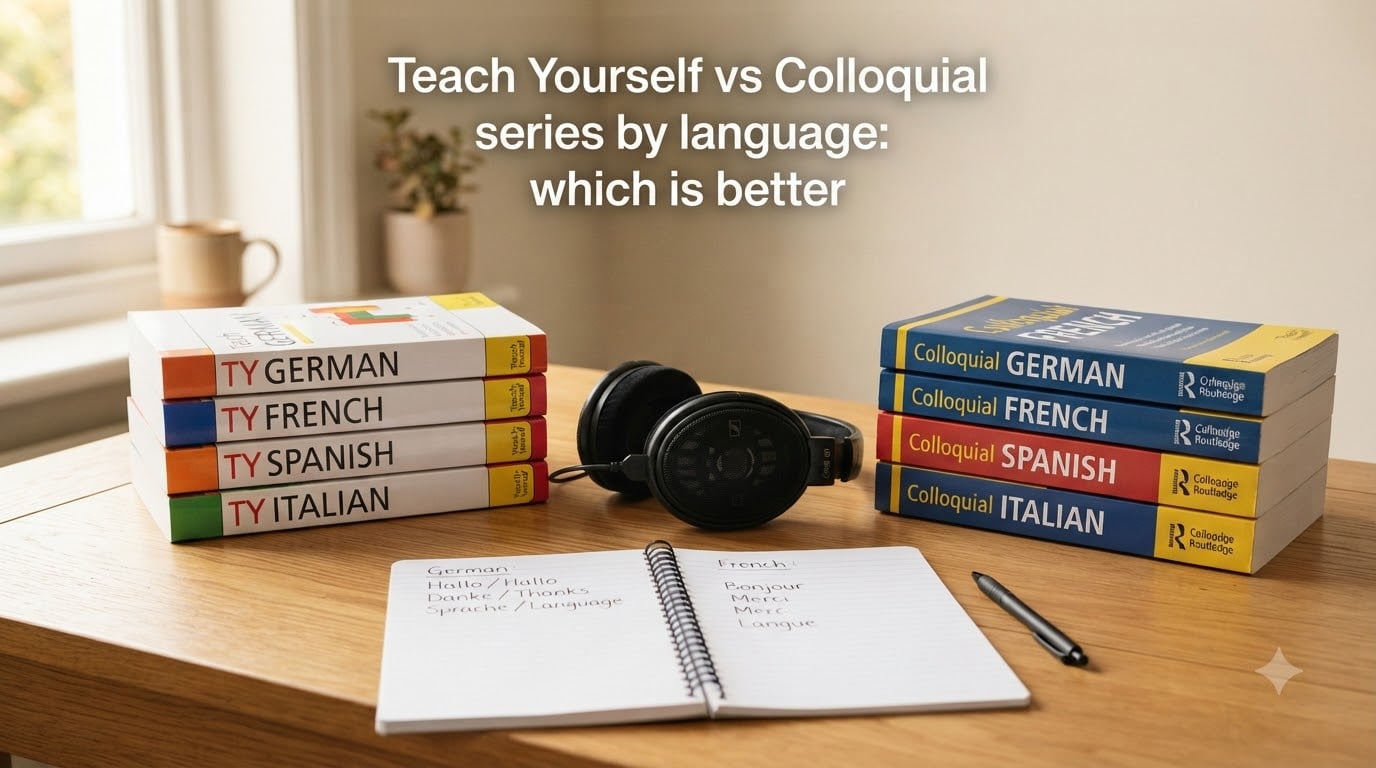
Choosing between the Teach Yourself and Colloquial language series comes down to your target language, your learning style, and how deep you want to go. Teach Yourself (Hodder Education) covers 65+ languages across four CEFR-aligned tiers using a Discovery Method. Colloquial (Routledge, part of Taylor & Francis) focuses on a single “Complete Course for Beginners” format per language with explicit grammar explanations. Both are credible – the right pick depends on whether you prefer inductive learning or a more textbook-style approach.
I have worked through titles from both series over the years, and the honest answer is that neither is universally “better.” What matters is which series has the strongest current edition for your specific target language, and whether your study style matches how that series teaches. This guide breaks down the history, structure, audio, pedagogy, and per-language fit of each series so you can decide in under five minutes.
Table of Contents
Teach Yourself vs Colloquial at a glance
Teach Yourself is the better pick for learners who want a CEFR-aligned progression (Get Talking, Get Started, Complete, Enjoy) and a discovery-based, inductive approach. Colloquial is the better pick for learners who want one self-contained “Complete Course for Beginners” volume per language, with explicit grammar explanations and a more textbook-style layout. For widely taught European languages, both work; for less-resourced languages, availability usually decides it.
| Feature | Teach Yourself | Colloquial (Routledge) |
|---|---|---|
| Publisher | Hodder Education | Routledge (Taylor & Francis) |
| Founded | 1938 | <tdLate 1980s (modern series)|
| Languages covered | 65+ | ~50 languages and dialects |
| Levels per language | 4 tiers (Get Talking, Get Started, Complete, Enjoy) | Mainly 1 tier (Complete Course for Beginners), some intermediate Colloquial 2 titles |
| CEFR alignment | Yes – tier names map to A1, A2, B1-B2 | Partial – aligned to A1 to B1 in Complete Course volumes |
| Pedagogy | Discovery Method (inductive) | Linear, explicit grammar explanations |
| Audio | Bundled with most print titles; some sold separately | Companion audio sold separately for many titles |
| Format | Multiple shorter books per language | One main book per language |
| Price band per language | Lower per volume, but you may buy 2-3 tiers | Higher per volume, often just one |
| Best for | Self-directed learners, polyglots stacking several languages | Learners who want a single, structured, classroom-feel textbook |
The “by language” angle matters more than the series name. Colloquial Polish is one of the strongest beginner Polish textbooks on the market, while Teach Yourself Polish is a reasonable but thinner alternative. For Mandarin Chinese, both have decent editions, but the choice often comes down to whether you want pinyin-only or script-first instruction. We will walk through the per-language verdict later in this guide.
The Teach Yourself language series explained
Publisher and history
Teach Yourself was founded in 1938 by English Universities Press, later absorbed into Hodder & Stoughton and now published by Hodder Education. The original 1938 series covered hundreds of subjects from astronomy to beekeeping; the modern Languages range grew out of the 1960s relaunch and became the brand’s flagship product line.
An interesting bit of trivia: Hodder published a 1962 book titled Teach Yourself Colloquial Arabic. That title is sometimes mistaken for the Routledge Colloquial series, but it predates Routledge’s modern Colloquial line by more than two decades. Today’s Colloquial imprint is unrelated to that earlier Hodder title.
Four CEFR-aligned tiers (Get Talking, Get Started, Complete, Enjoy)
Teach Yourself Languages now uses a four-tier structure that maps roughly onto the Common European Framework of Reference (CEFR). The tiers are designed so a learner can progress from absolute beginner to upper-intermediate within a single imprint.
- Get Talking (around A1): short phrasebook-style books, ten focused topics, audio-led.
- Get Started (around A1-A2): short beginner course, audio-led, lighter on grammar.
- Complete (around A2-B1): the main full beginner-to-intermediate course; this is the tier most learners buy.
- Enjoy (around B1-B2): intermediate, focused on reading and culture.
The tier structure is a strength if you want a clear progression path. It is also a source of confusion for first-time buyers who do not know whether to start with Get Started or jump straight to Complete.
Discovery Method pedagogy
Teach Yourself’s 2012 refresh introduced the Discovery Method. The idea is to present language in short dialogues and then ask you to notice and deduce the grammar rules before they are stated explicitly. This inductive approach mimics how many polyglots say they prefer to learn, and it tends to suit learners who are comfortable with ambiguity and experimentation.
The trade-off is that learners who want every rule explained up front can feel lost. If you learn best by reading a grammar table, working through examples, and then doing exercises, the Discovery Method can feel under-explained.
Languages covered and companion audio
Teach Yourself covers 65+ languages, including widely-taught European languages, major non-European languages (Arabic, Mandarin, Japanese, Korean, Russian), and a long tail of less-resourced languages (Welsh, Irish, Catalan, Icelandic, Afrikaans, Azerbaijani, and many more). Most Complete and Get Started titles ship with downloadable audio via a Hodder website access code, although a few older titles still bundle a CD.
The breadth is Teach Yourself’s biggest single advantage over Colloquial. If your target language is a less-resourced one, there is a strong chance Teach Yourself has a current edition when Colloquial does not.
The Colloquial Routledge series explained
Publisher and history
The Colloquial Series is published by Routledge, which is part of the Taylor & Francis academic publishing group. Routledge launched the modern Colloquial line in the late 1980s as an academic-adjacent self-study series aimed at adult learners, university students, and travelers. The series name was chosen to signal colloquial, real-world language use rather than formal textbook dialogue.
Over the years Routledge has expanded the catalog to roughly 50 languages and dialects, including several that are not covered by mainstream competitors (Mongolian, Uzbek, Tibetan, Pashto). Some titles, like Colloquial Polish, have been through multiple editions since the 1980s and are now in their third or fourth revision.
The Complete Course for Beginners format
Each Colloquial language title is labeled “The Complete Course for Beginners” and is structured as a single self-contained volume. There is no “Get Talking” or “Complete Level 2” equivalent within the main line. A small number of languages do have a second volume called Colloquial 2 (or “Further Learning”) that picks up around A2-B1.
The single-volume format is convenient: one book, one decision, one audio download. Many learners prefer this simplicity over Teach Yourself’s multi-tier structure.
Lesson layout: dialogues, grammar, cultural notes, revision
A typical Colloquial lesson opens with a dialogue or short text, followed by vocabulary notes, explicit grammar explanations with examples, cultural notes, and practice exercises. Every few units a revision unit recycles earlier material. Many titles also include an answer key at the back and full audio transcripts.
The layout feels closer to a university textbook than to Teach Yourself’s lighter, dialogue-led layout. Learners who want every grammar rule written down often find Colloquial easier to work through on their own.
Languages covered and companion audio
Colloquial covers about 50 languages and dialects. Audio is increasingly sold as a separate download rather than bundled with the print book. Buyers sometimes complain that they expected audio to be included – it is worth checking the product page before you assume the audio is in the box.
The Colloquial catalog skews toward languages of academic interest: Welsh, Scottish Gaelic, Tibetan, Uzbek, Mongolian, Yoruba, Swahili, Latvian, Lithuanian, and Pashto are all in the series. For these languages, Colloquial is often the only credible beginner textbook on the market.
Teach Yourself vs Colloquial: key differences
Pedagogical approach
Teach Yourself uses the Discovery Method: dialogues first, grammar inferred, then confirmed. Colloquial uses a linear, deductive approach: grammar explained, examples given, exercises follow. There is no objective winner here – it is a style preference.
If you have studied a language in school and liked the feeling of a textbook, Colloquial will feel familiar. If you have learned a language on the road or through immersion, Teach Yourself’s inductive style will feel more natural.
Audio component
Teach Yourself more often bundles audio with the print book or includes it as a download code inside the cover. Colloquial more often sells the audio as a separate purchase, even though the book references audio tracks throughout. Both publishers have moved away from physical CDs toward downloadable audio files.
Practical tip: before you buy, check whether the listing shows “audio download included” or “audio sold separately.” The audio is not optional – both series use it heavily.
CEFR alignment and progression
Teach Yourself explicitly markets its tiers as CEFR-mapped. A learner who finishes Complete can move into Enjoy for upper-intermediate work without switching imprints. Colloquial covers A1 to B1 in its main Complete Course volume, with a small number of Colloquial 2 continuations for A2-B1. Colloquial does not have a built-in upper-intermediate tier equivalent to Teach Yourself’s Enjoy line.
Catalog breadth and depth
Teach Yourself has broader catalog breadth (65+ languages) and a deeper tier ladder per language. Colloquial has narrower catalog breadth (~50 languages) but tends to give a single, more thorough volume per language. If your target language has a strong Colloquial edition, the depth is often excellent.
Skill coverage: reading, writing, listening, speaking
| Skill | Teach Yourself | Colloquial |
|---|---|---|
| Reading | Strong in Complete and Enjoy tiers | Strong; dialogues and short readings throughout |
| Writing | Exercises included, less emphasis | Written exercises included, less emphasis |
| Listening | Bundled audio in most tiers | Companion audio; sold separately for some titles |
| Speaking | Repetition drills in Get Talking and Get Started | Dialogue repetition and pronunciation notes |
| Culture | Cultural sidebars in Complete and Enjoy | Dedicated cultural notes in every unit |
Neither series is a substitute for real conversation practice. Both are reading-and-listening heavy by design, and both lean on you to find a conversation partner, tutor, or app to drill the speaking side.
Which series wins by language
This is the section that most competitor articles skip, and it is the part that matters most if your target language is in the table below. “Edge” means the stronger current edition; “Either” means both are workable and the choice comes down to study style.
| Target language | Better series (typical) | Why |
|---|---|---|
| French | Either | Both have strong current editions; pick by study style |
| German | Either | Both are widely used; Teach Yourself Complete is more popular for self-study |
| Spanish | Either | Plenty of choice; Colloquial Spanish is well-regarded for grammar clarity |
| Italian | Either | Both work; Teach Yourself Complete Italian is a common self-study pick |
| Portuguese | Either | Both editions are solid; check for European vs Brazilian Portuguese variants |
| Arabic | Colloquial (edge) | Colloquial Arabic by Routledge is widely used in university courses |
| Mandarin Chinese | Either | Colloquial Chinese is more grammar-explicit; Teach Yourself Chinese is more dialogue-led |
| Russian | Either | Both have strong current editions; Teach Yourself Complete Russian is a popular choice |
| Japanese | Teach Yourself (edge) | Teach Yourself Complete Japanese has long been a self-study favorite |
| Korean | Either | Both work; check for the most recent edition before buying |
| Polish | Colloquial (edge) | Colloquial Polish is one of the strongest beginner Polish textbooks available |
| Welsh | Teach Yourself (edge) | Teach Yourself Complete Welsh has broader coverage and current audio |
| Turkish | Either | Both editions are workable for self-study beginners |
| Greek | Either | Colloquial Greek is more grammar-led; Teach Yourself Greek is dialogue-led |
| Dutch | Either | Both work; Teach Yourself Complete Dutch is a common pick |
For languages outside this table – Mongolian, Tibetan, Uzbek, Yoruba, Swahili, Latvian, Lithuanian, Pashto – Colloquial is often the only mainstream beginner textbook in print. For Azerbaijani, Catalan, Icelandic, Irish, and Afrikaans, Teach Yourself is often the only credible choice. Availability frequently decides it before preference does.
Who each series is best for
Teach Yourself is best for
- Absolute beginners who want a clear, tiered progression from A1 to B2 within one imprint.
- Self-directed learners who like inductive learning and figuring out patterns from examples.
- Polyglots and language enthusiasts who study several languages and want consistent formatting across imprints.
- Learners of less-resourced languages where Teach Yourself is the only current edition available.
Colloquial is best for
- Learners who prefer a single, structured textbook rather than a tier ladder.
- Students who like explicit grammar explanations and a more academic, classroom-feel layout.
- University students supplementing a course with a parallel self-study book.
- Learners of languages with a strong current Colloquial edition (Polish, Arabic, Mongolian, Tibetan).
If you have never studied a language before, Teach Yourself’s Get Started or Complete tier is often the gentler on-ramp. If you studied languages at school and remember how a textbook should look, Colloquial will feel more familiar.
How to combine Teach Yourself and Colloquial for one language
Many learners finish one Colloquial book and then pick up a Teach Yourself title for the same language, or vice versa. There is nothing wrong with stacking them – the two series cover the same ground from slightly different angles, and the overlap is more reinforcing than redundant.
Why stack them
Each series has its strengths. Teach Yourself’s inductive style can rescue you when Colloquial’s grammar explanations feel too dense, and Colloquial’s explicit grammar tables can rescue you when Teach Yourself feels under-explained. Audio exposure from two slightly different native-speaker casts also helps your ear.
A simple 12-week stacked plan
- Weeks 1-4: Work through the first 4 units of Colloquial for your target language. Focus on dialogues, vocabulary, and the audio tracks.
- Weeks 5-8: Switch to Teach Yourself Complete (or Get Started) for the same language. Work the matching CEFR units; the overlap will reinforce what you already met.
- Weeks 9-12: Pick whichever series you preferred and push through to the end of its beginner volume. Use the audio from the other series for extra listening practice.
If you finish the 12-week plan and want to keep going, the natural next step is Teach Yourself’s Enjoy tier (B1-B2) or a Colloquial 2 continuation, depending on which series had the stronger edition for your language.
Teach Yourself vs Colloquial vs Assimil and other series
Readers comparing three or more options usually end up adding Assimil to the mix. Here is the short version of how the four best-known self-study series stack up.
- Assimil: French-origin series built around bilingual dialogues and a “wave” of passive-then-active learning. Excellent for European languages and Japanese. Less coverage of less-resourced languages. Higher price per title.
- Teach Yourself: broad catalog, four CEFR tiers, Discovery Method, audio mostly bundled.
- Colloquial: single-volume beginner courses, explicit grammar, strong coverage of academic-interest languages.
- Michel Thomas: audio-only method focused on building spoken sentences from a small set of core words. Good for absolute beginners who fear grammar; weak on reading and writing.
- Pimsleur: audio-only, spaced-repetition method. Strong for pronunciation and conversational confidence; no reading or writing.
- Lonely Planet phrasebooks: not a course – a phrasebook for travelers. Useful as a pocket supplement, not as your main textbook.
For most self-studiers, the realistic answer is one textbook series plus one audio-only method plus a tutor or conversation partner. Which textbook series you pick matters less than how consistently you show up to study.
Decision framework: 4 questions to pick the right series
Before you spend money, answer these four questions honestly. Your answer decides which series to buy.
- Do you want a single book or a tiered progression? Single book: Colloquial. Tiered progression: Teach Yourself.
- Do you prefer grammar explained up front or figured out from examples? Up front: Colloquial. From examples: Teach Yourself.
- Is your target language one where only one series has a current edition? Buy whatever edition is in print.
- Is your goal travel, academic study, heritage refresh, or hobby? Travel: Teach Yourself Get Started or Get Talking. Academic: Colloquial. Heritage refresh: Teach Yourself Complete or Enjoy. Hobby: either.
If you answered “either” to questions 1 and 2 and your target language is on the “either” list in the table above, either series will serve you well. Pick the cheaper current edition and start studying – the best textbook is the one you actually open.
Frequently Asked Questions
What is the difference between Teach Yourself and Colloquial language courses?
Teach Yourself (Hodder Education) is a multi-tier CEFR-aligned series covering 65+ languages with an inductive Discovery Method. Colloquial (Routledge, part of Taylor u0026amp; Francis) is a single Complete Course for Beginners volume per language, covering around 50 languages with explicit grammar explanations and a more textbook-style layout.
Which is better, Teach Yourself or Colloquial?
Neither is universally better. Teach Yourself is the stronger pick for learners who want a tiered A1 to B2 progression within one imprint. Colloquial is the stronger pick for learners who want one self-contained beginner volume with explicit grammar. For widely taught European languages, both work; availability usually decides it for less-resourced languages.
Are Teach Yourself language books any good?
Yes, Teach Yourself language books are generally good for self-study. Their strength is catalog breadth (65+ languages), a clear four-tier CEFR-aligned structure (Get Talking, Get Started, Complete, Enjoy), and the Discovery Method pedagogy. The main weakness is that the Discovery Method can feel under-explained for learners who want every grammar rule stated explicitly.
Are Colloquial Routledge language books any good?
Yes, Colloquial Routledge books are generally good for self-study. Their strength is a single, thorough Complete Course for Beginners volume per language with explicit grammar explanations and cultural notes. The main weaknesses are that audio is often sold separately and the catalog is narrower than Teach Yourself’s.
How many languages does Teach Yourself cover?
Teach Yourself covers 65+ languages, including widely-taught European languages, major non-European languages (Arabic, Mandarin, Japanese, Korean, Russian), and a long tail of less-resourced languages (Welsh, Irish, Catalan, Icelandic, Afrikaans, Azerbaijani).
How many languages does Colloquial cover?
The Colloquial Series covers roughly 50 languages and dialects, including several not covered by mainstream competitors (Mongolian, Uzbek, Tibetan, Pashto, Yoruba, Swahili). Some languages also have a Colloquial 2 continuation volume.
Do Teach Yourself and Colloquial books come with audio?
Teach Yourself more often bundles audio with the print book or includes a download code inside the cover. Colloquial more often sells audio as a separate purchase even though the book references audio tracks throughout. Always check the product listing for whether audio is included or sold separately before you buy.
Teach Yourself vs Colloquial vs Assimil – which should I use?
For most self-studiers, one textbook series plus one audio-only method plus a conversation partner is the realistic answer. Teach Yourself is the broadest catalog. Colloquial is the strongest single-volume beginner textbook for academic-interest languages. Assimil is excellent for European languages and Japanese if you can afford the higher price per title.
Which series is best for beginners?
Both series work for beginners. Teach Yourself’s Get Started or Complete tier is often the gentler on-ramp for absolute beginners, while Colloquial’s single Complete Course for Beginners volume is often easier for learners who already know how a textbook should look. The choice usually comes down to study style rather than skill level.
How long does it take to finish one course book?
A typical Teach Yourself Complete or Colloquial Complete Course for Beginners volume takes 3 to 6 months of regular study (around 30 minutes a day, 4-5 days a week). Get Talking and Get Started volumes can be finished in 6 to 10 weeks. Enjoy tier and Colloquial 2 volumes typically take another 3 to 6 months on top of the beginner volume.
Final verdict on Teach Yourself vs Colloquial
The honest verdict on Teach Yourself vs Colloquial is that neither series beats the other across the board – the right pick depends on your target language and your study style. Teach Yourself wins on catalog breadth, tiered CEFR progression, and bundled audio. Colloquial wins on single-volume focus, explicit grammar, and depth for academic-interest languages. For widely taught European languages, both work and personal preference decides it. For less-resourced languages, availability usually decides it before preference does.
Pick the series whose current edition matches your target language, commit to a 12-week study plan, and add a conversation partner or tutor for speaking practice. The best textbook is the one you actually open – and the series you finish matters more than the series you start.