
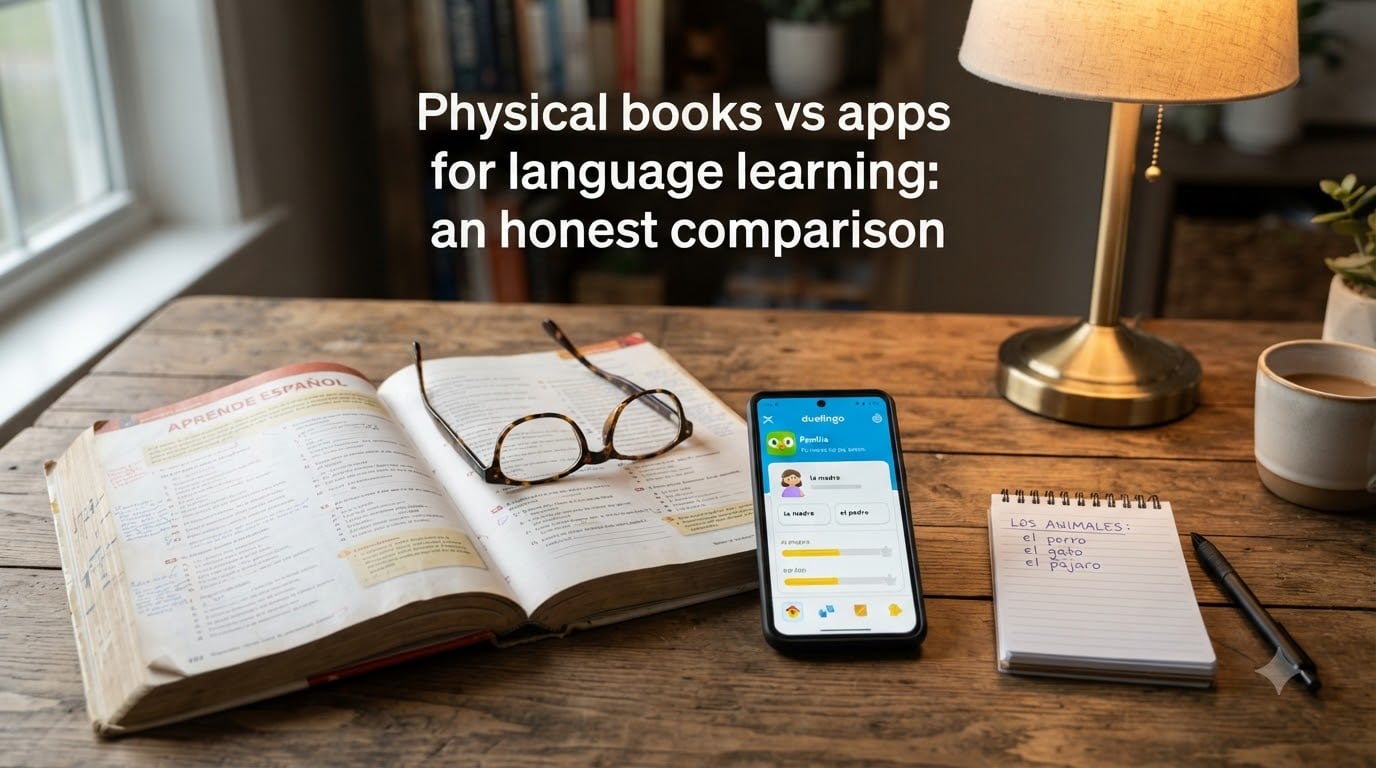
After spending more than 600 hours across both Duolingo and a stack of Teach Yourself textbooks, I can give you the honest verdict on physical books vs apps for language learning: neither method alone is sufficient, and the best learners use both strategically. Apps build vocabulary and daily habits faster, but physical books deliver grammar depth, writing practice, and the kind of structured thinking that actually produces fluency. This guide breaks down what each method does well, where each one fails, and how to combine them without burning out.
If you have ever finished a 200-day Duolingo streak and still couldn’t order coffee in Spanish, you already know part of the answer. The other part involves the muscle memory of flipping through a textbook and writing out verb conjugations by hand. Let me walk you through the full comparison.
Table of Contents
Why Language Apps Became So Popular
Language apps exploded in the 2010s because they solved a problem that books never could: friction. Opening a textbook takes willpower. Opening an app takes a thumb swipe.
The psychology is simple and frankly brilliant. Apps borrow gamification mechanics from video games. You earn streaks, collect gems, level up, and watch your progress bar fill. Each completed lesson releases a small hit of dopamine, which keeps you coming back tomorrow. Researchers studying mobile-assisted language learning (MALL) have repeatedly found that this kind of instant feedback loop produces higher daily engagement than traditional study methods.
Apps also lowered the financial barrier. Most of the popular options have generous free tiers, and the premium upgrades cost less per month than a single paperback textbook. For millions of curious learners, the price of trying became zero.
Convenience played an equally large role. You can run a 5-minute lesson while waiting in line at the grocery store. That kind of accessibility simply doesn’t exist with a 400-page grammar book.
What Language Apps Do Well
Apps excel at three things that traditional books struggle to match.
First, vocabulary drilling. Spaced repetition systems (SRS) inside apps like Anki, Duolingo, and Babbel surface words right before you forget them. Research published by Karpicke and Roediger in 2008 confirmed that spaced retrieval produces dramatically better long-term retention than massed study. Apps automate this beautifully.
Second, habit formation. Streaks and daily reminders turn study into a routine rather than a heroic act. Behavioral scientists call this the “implementation intention” effect: you decide in advance when and where you’ll study, and the app acts as the cue.
Third, listening and pronunciation exposure. Most major apps ship with native-speaker audio and speech recognition that gives instant feedback on your pronunciation. This alone puts apps ahead of nearly every printed textbook on the market.
The Limitations of Language Learning Apps
Here is where I have to be blunt: apps also have serious weaknesses that their marketing pages rarely mention.
- Shallow interaction. Most app lessons test recognition, not production. You tap the right translation from four options, which feels productive but barely engages the deeper parts of your brain that handle real communication.
- The illusion of progress. A 365-day streak looks impressive on your profile, but it does not equal fluency. Many learners on r/languagelearning describe exactly this frustration: a full year of daily Duolingo and still struggling to hold a basic conversation.
- Grammar gaps. Apps teach grammar through pattern repetition, not explanation. You memorize that “le” goes before the verb in French without understanding why. That works for simple phrases but collapses when you meet complex sentence structures.
- Plateau at intermediate. Most apps top out at A2-B1 on the CEFR scale. After that, the lesson pool thins out and the gains per hour drop sharply.
- Motivation crashes. A lost streak can feel devastating, and users frequently report abandoning apps entirely after 2-3 months once the novelty wears off.
None of these flaws make apps useless. They make apps incomplete.
Why Physical Books Still Matter for Language Learning
Physical books do something that apps structurally cannot: they treat you like an adult learner who wants to understand the system, not just survive the lesson.
Grammar explanations in a quality textbook run for pages, with examples, exceptions, and context. Compare that to the two-sentence grammar notes in most app lessons, and the difference is obvious. If you have ever stared at a Spanish subjunctive and felt completely lost, you understand why a 30-page chapter on the subjunctive mood is worth more than a hundred app drills.
There is also the tactile dimension. Flipping pages, writing in margins, and physically highlighting vocabulary creates a different kind of memory trace than tapping a screen. Studies on note-taking have consistently shown that handwriting activates more encoding processes than typing, which leads to better retention.
Books also reduce screen fatigue. After eight hours of work on a laptop, the last thing many learners want is another glowing rectangle. A paperback is a break, not an extension of the workday.
What Physical Books Do Better Than Apps
Beyond grammar depth, physical books offer three concrete advantages.
Reading comprehension flourishes with extended text. A graded reader or bilingual novel forces you to sustain attention across paragraphs, infer meaning from context, and build vocabulary in clusters rather than isolated flashcards. Apps almost never offer this kind of continuous reading practice.
Writing practice requires a real writing surface. When you translate, conjugate, or compose sentences in a notebook, you engage motor memory and produce output that you can review later. App exercises give you multiple-choice taps instead.
Reference value is another underrated strength. A good grammar reference book becomes a trusted companion for years. You can flip to the conditional tense section when you need it, read until you understand, and move on. That kind of on-demand lookup is nearly impossible inside an app.
The Weaknesses of Traditional Books
Books have their own honest weaknesses that serious learners should know about.
The biggest one is motivation. A textbook does not send you a notification. It does not celebrate your 100th day. It sits on your shelf and waits for you to bring the discipline, which is exactly when most people give up.
Listening and speaking practice are also limited. Most textbooks include audio CDs or QR codes to native-speaker recordings, but they do not check your pronunciation or force you to respond in real time. Books are silent partners.
Finally, the upfront time cost is real. A serious textbook can feel like a mountain when you open it. Most learners need 30-45 minutes per session to make progress, which is harder to squeeze into a busy day than a 5-minute app lesson.
Apps vs Books for Vocabulary Learning
For pure vocabulary acquisition, apps win on efficiency and apps lose on depth.
Apps expose you to thousands of words quickly, reinforce them through spaced repetition, and adjust to your forgetting curve. No book can match that throughput. A serious app learner can recognize 2,000-3,000 common words within six months of consistent use.
Books add something apps cannot: context. When you meet a new word inside a paragraph about a family dinner or a train station, you remember it differently than when you meet it on a flashcard. That contextual memory sticks in long-term recall in ways that isolated word lists rarely do.
The honest takeaway: use apps for vocabulary volume, use books for vocabulary depth, and read in your target language to merge both.
Apps vs Books for Grammar Instruction
Grammar is where the comparison tilts firmly toward physical books.
A textbook dedicates entire chapters to complex topics like the German cases, the French subjunctive, or Japanese particle usage. Each chapter builds on the last, with explanations, examples, and progressively harder exercises. That cumulative structure is hard to replicate in bite-sized app lessons.
Apps do teach grammar, but mainly through drills. You complete dozens of fill-in-the-blank exercises until the correct form feels automatic. That works for patterns but fails when you need to understand the underlying rules or apply grammar in novel sentences.
If grammar is your weak point, a used copy of a quality textbook like Assimil, “Practice Makes Perfect,” or the “English Grammar in Use” series will do more for you in one weekend than three months of casual app use.
Apps vs Books for Speaking and Listening
Speaking is the one area where both methods lose to a third option: another human.
Apps give you pronunciation feedback through speech recognition and access to native-speaker audio. Babbel and Duolingo both do this reasonably well for beginners. But no app can simulate the unpredictability of a real conversation, the back-and-forth negotiation of meaning, or the pressure to actually produce language under a time limit.
Books develop a different kind of speaking skill. Heavy reading builds your “inner speech” — the silent voice in your head that thinks in the target language. Over time, that internalized voice makes spontaneous speaking easier because you are essentially narrating from a richer mental library.
For real speaking fluency, apps and books are both stepping stones. Conversation practice with a tutor, language exchange partner, or patient friend remains irreplaceable.
The Psychology Behind Why Learners Prefer Apps
Apps feel easier than books for reasons that go deeper than convenience.
Every completed app lesson gives you a small reward: a level-up animation, a streak counter, a congratulatory message. Behavioral psychologists call these “variable ratio reinforcements,” and they are the same mechanism that keeps people pulling slot machine levers. The lesson never feels like work because your brain keeps expecting the next reward.
Books reward you on a much longer timeline. You might study for an hour and feel like nothing happened. That delayed gratification is genuinely harder for the human brain, especially when you are tired or stressed.
This explains a pattern that shows up constantly on r/languagelearning: learners start with an app, fall in love with the streaks, plateau around the intermediate level, and eventually return to books once they realize real fluency requires deeper work. That is not a failure of the app. It is the natural arc of a serious learner.
Beginner vs Intermediate vs Advanced: Matching Method to Level
The right method depends heavily on where you are in your learning journey.
Beginners benefit most from apps. You need to build basic vocabulary, learn pronunciation, and form the daily habit of studying. An app lowers friction at exactly the moment you have the least motivation. Pair the app with one beginner textbook chapter per week and you have a balanced start.
Intermediate learners should shift the balance toward books. Apps start to plateau at this stage, and grammar depth becomes the bottleneck. A graded reader series like “Penguin Readers” or a structured textbook like “Living Language” will push you past the plateau faster than another app refresh.
Advanced learners should mostly abandon both in favor of native content. Read newspapers, watch TV shows, listen to podcasts, and write journal entries in your target language. Use apps and books only as targeted reference tools when you hit a specific grammar gap or vocabulary wall.
Cost Comparison: Free App Tiers vs Textbooks
Cost rarely gets discussed in depth, but it matters.
Most major apps offer strong free tiers. Duolingo, Memrise, and Busuu all let you study indefinitely without paying. Premium tiers add things like offline mode and grammar explanations, and they typically run less per month than a single cup of coffee.
Textbooks cost more upfront. A new edition of a quality textbook like “Colloquial French” or “Teach Yourself German Complete” runs around the price of a decent dinner out. Used copies and older editions drop the price dramatically, and most public libraries carry the popular series.
For learners on a tight budget, the practical answer is to use free apps for daily vocabulary and habits, then borrow or buy a single textbook for grammar depth. That combination costs almost nothing and covers both halves of the learning equation.
The Balanced Learning Ecosystem: Combining Apps and Books
The most successful language learners I have studied do not pick a side. They build an ecosystem.
Here is a sample weekly routine that combines both methods well.
- Monday to Friday, morning (10 minutes): Open your app and complete one lesson. Focus on vocabulary and listening.
- Monday to Friday, evening (30 minutes): Work through one chapter of a textbook. Read the grammar explanation, do the written exercises, write five of your own example sentences.
- Saturday (45 minutes): Read one chapter of a graded reader or bilingual book in your target language. Look up unfamiliar words in a notebook, not on your phone.
- Sunday (30 minutes): Review your vocabulary notebook, watch one episode of a target-language show with subtitles, and plan the next week.
For app recommendations, Duolingo works well for beginners, Babbel is stronger for conversation-focused learners, and Anki is the gold standard for serious vocabulary drilling. For books, Assimil is famous for its intuitive approach, Teach Yourself offers structured depth, and graded readers from Penguin or Oxford provide reading practice at every level.
If you are currently stuck on an app, transition gradually. Drop from five daily lessons to two, and redirect those saved minutes into a textbook chapter. Within a month you will likely feel progress that the app alone never delivered.
Frequently Asked Questions
Are physical books better than apps for language learning?
Neither method alone is best. Apps win for vocabulary drilling, daily habit building, and pronunciation exposure, while physical books win for grammar depth, writing practice, and reading comprehension. The strongest results come from combining both methods strategically rather than picking one.
What are the disadvantages of using apps for language learning?
The main disadvantages are shallow interaction that tests recognition instead of production, a false sense of progress from streaks, shallow grammar explanations, plateauing at intermediate level, motivation crashes when streaks break, and translation-heavy exercises that slow real thinking in the target language.
Can you learn a language just from reading books?
Yes, especially at intermediate and advanced levels, provided you actively look up words, study grammar from a reference text, and practice speaking separately. Pure book study is harder at the beginner stage because apps and audio provide the pronunciation and listening exposure that books cannot deliver on their own.
Is Duolingo better than textbooks?
Duolingo is better for building vocabulary volume, daily habit, and initial listening exposure. Textbooks are better for grammar depth, writing practice, and sustained reading comprehension. For most learners, Duolingo is a strong starting tool but should be paired with a textbook once you reach the intermediate level.
What is the best way to learn a new language book or app?
The best approach combines both. Use an app for 10-15 minutes a day to build vocabulary and listening exposure, work through a textbook chapter for grammar depth, read graded readers for comprehension, and practice speaking with a real person weekly. This layered method covers every core skill without burning out.
Do language apps actually work for fluency?
Language apps work for vocabulary acquisition and habit building, which are important foundations, but they rarely produce fluency on their own. Research on mobile-assisted language learning shows that apps produce stronger gains when paired with output practice like writing, speaking, and extended reading.
Why are language apps so popular compared to textbooks?
Language apps are popular because they lower friction, gamify the learning process, send daily reminders, and offer generous free tiers. Apps also fit into short attention windows throughout the day, while textbooks typically require longer focused sessions that are harder to fit into a busy schedule.
Should you combine language apps with books?
Yes, combining apps with books is widely considered the most effective approach for self-study. Apps handle vocabulary drilling and daily consistency, while books handle grammar depth, writing, and reading comprehension. Most successful polyglots describe using both rather than relying on just one method.
Final Verdict on Physical Books vs Apps for Language Learning
The honest comparison is not a competition. Apps and physical books are complementary tools that solve different problems. Apps make you consistent and give you vocabulary volume, while physical books make you think deeply, write actively, and understand grammar structures that no drill can teach.
If you are starting a new language this year, my practical recommendation is simple: open an app today to build the habit, and pick up a used textbook this weekend to build the depth. Spend ten minutes on the app each morning and thirty minutes in the book each evening. Within a few months, you will likely find yourself reading simple articles, writing short paragraphs, and feeling the kind of real progress that single-method learners rarely experience.
The fastest path to fluency is the one that uses every tool available. Choose the ecosystem, not the team.