
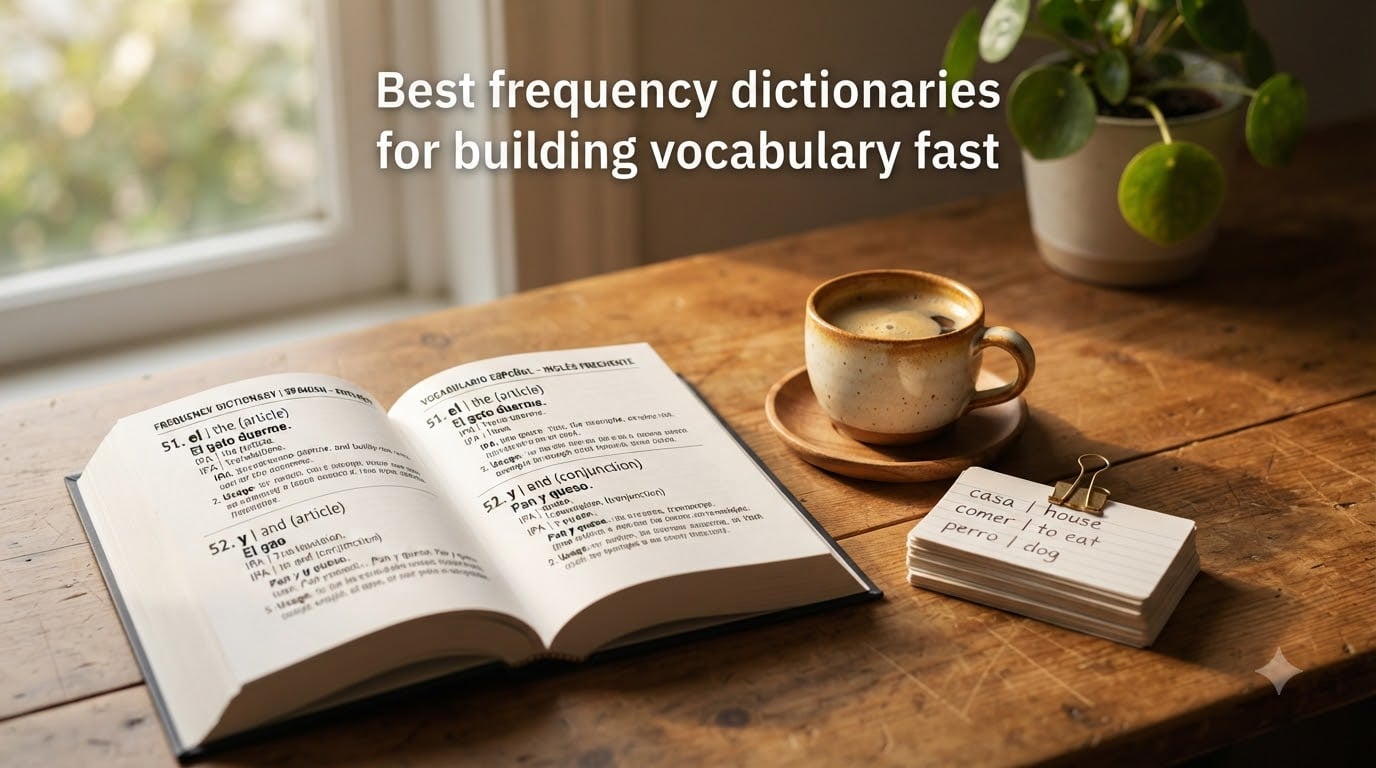
A frequency dictionary is a reference book that lists the most commonly used words of a language, ranked by how often they appear in real-world text and speech. If you want to build vocabulary fast in Spanish, French, German, Italian, or English, the best frequency dictionaries give you the highest-leverage words first, the ones that unlock 80 to 95 percent of everyday reading and conversation.
In this guide, our team breaks down the top picks by language, compares free vs paid options, shares the coverage statistics that actually matter, and walks through a 30-day study plan that turns a frequency dictionary into real fluency.
Table of Contents
What Is a Frequency Dictionary
A frequency dictionary is a reference book (or digital list) that ranks the words of a language from most to least common based on a large corpus of real text, subtitles, or transcripts. Unlike a regular dictionary, which is alphabetical, a frequency dictionary is ordered by how often each word actually shows up in the wild.
Most frequency dictionaries include four things for each entry: the frequency rank, a translation, an IPA pronunciation guide, and at least one example sentence. The best ones also tag parts of speech and group words into bands like the top 500, 1,000, 2,500, and 5,000 words.
Think of it as the difference between a phone book and a leaderboard. A regular dictionary tells you every word that exists; a frequency dictionary tells you which words are worth learning first.
How it differs from a regular dictionary
A regular dictionary is alphabetical and exhaustive. A frequency dictionary is ranked and selective. If you open a regular Spanish dictionary, you might land on the word “azar” (chance) on page 50, even though you will hear “hola” ten thousand times before you ever hear “azar.” A frequency dictionary puts “hola” on page one and saves “azar” for page 400.
Why Frequency-Based Learning Works
Frequency-based learning works because of a pattern called Zipf’s law: in any language, a tiny number of words account for the vast majority of what people actually say and write. The single most common word appears roughly twice as often as the second most common, three times as often as the third, and so on down a steep curve.
This means you do not need to learn 20,000 words to read a novel or hold a conversation. You need the right few thousand. Linguist Paul Nation’s research at Victoria University of Wellington showed that the top 2,000 to 3,000 word families cover around 80 to 95 percent of everyday text, depending on the language.
For learners, this is the single most useful insight in second language acquisition. Every hour you spend on a high-frequency word pays back ten times more than an hour spent on a rare word.
Coverage at a glance
- Top 100 words: roughly 50 percent of everyday speech
- Top 1,000 words: roughly 75 to 85 percent of written text
- Top 2,500 words: roughly 85 to 90 percent of written text
- Top 5,000 words: roughly 93 to 95 percent of written text
The Best Frequency Dictionaries by Language
The best frequency dictionaries for building vocabulary fast fall into three camps: paid bilingual series like MostUsedWords, free academic lists built from modern corpora, and language-specific gems for less-common languages. Below are our top picks grouped by what you are most likely studying.
Best for Spanish, French, German, and Italian (paid)
The MostUsedWords series is the strongest paid option for the major European languages. Each book is split into Essential (2,500 words), Intermediate (2,500 more), and Advanced (2,500 more) volumes, with IPA, part-of-speech tagging, and example sentences for every entry. A companion spaced-repetition app is included with the bundle.
If you want one resource that covers Spanish, French, German, Italian, Dutch, and Greek with a consistent format and an SRS app, the MostUsedWords series is our top pick for 2026.
Best for English learners (free and paid)
For English as a second language, the gold standard is the General Service List (GSL) and its modern successor, the New General Service List (NGSL). Both were built from large spoken and written corpora and identify the highest-value words for ESL learners. They are free and available as CSV files you can import straight into Anki.
For native speakers or advanced learners, the Corpus of Contemporary American English (COCA) frequency list gives you the most up-to-date ranking of English words in modern American usage. COCA is free to access online and far more current than older lists built on the Brown Corpus in the 1960s.
Best for Chinese learners
Chinese frequency dictionaries take a different shape because characters, not words, are the unit of measure. The HSK word lists (HSK 1 through HSK 6) are the closest thing to a mainstream frequency list, covering roughly 5,000 words. For a true frequency-based approach, the SUBTLEX-CH list and the Beijing Language and Culture University (BLCU) frequency tables are the two academic sources our team recommends. Both are free and pair well with Pleco or Anki.
Best free, multi-language picks
If you want to try a frequency dictionary without spending anything, three free resources cover most languages. Wiktionary maintains frequency lists for over 90 languages, the Leipzig Corpora Collection gives you frequency data drawn from web news in dozens of languages, and the SUBTLEX project provides subtitle-based word counts that closely mirror real spoken frequency. Reddit users on r/languagelearning consistently recommend starting with these free lists before investing in a paid book.
Free vs Paid Frequency Dictionaries Compared
Free frequency dictionaries give you ranked lists you can download and import into any flashcard tool. Paid frequency dictionaries add the polish that turns raw lists into a study system. The table below compares the two side by side.
Format and features comparison
- Free options (Wiktionary, SUBTLEX, Leipzig, GSL, NGSL): Ranked word lists, often as CSV or text files. No IPA in most cases, no example sentences, no part-of-speech tagging. Best for learners who already use Anki and are comfortable building their own flashcards.
- Paid options (MostUsedWords series): Bilingual translations, IPA pronunciation, example sentences, part-of-speech tags, and a companion spaced-repetition app. Best for beginners who want a turnkey study system.
- Hybrid approach: Use a free academic list as your source of truth, then add IPA and example sentences manually from a free dictionary like Wiktionary. Costs nothing and rivals most paid books in quality.
For most beginners, a paid frequency dictionary like the MostUsedWords Spanish Essential 2,500 pays for itself by saving you 20+ hours of deck-building. For self-sufficient learners, the free GSL plus Anki is a perfectly viable path.
How Many Words Do You Need for Fluency
For most European languages, knowing the top 2,000 to 3,000 words covers roughly 80 to 90 percent of everyday text and 95 percent or more of common speech. Real fluency requires more, but comprehension comes much earlier than most learners expect.
Here is a coverage snapshot by language based on published corpus studies:
- English (top 3,000 words): about 95 percent of everyday text, 90 percent of spoken English
- Spanish (top 2,500 words): about 90 percent of written Spanish, 85 percent of spoken Spanish
- French (top 2,500 words): about 88 percent of written French, 84 percent of spoken French
- German (top 3,000 words): about 85 percent of written German, 80 percent of spoken German
- Italian (top 2,500 words): about 87 percent of written Italian, 82 percent of spoken Italian
The 95 percent threshold is where most learners can start reading native material without a dictionary, even if they cannot speak fluently yet. Crossing 98 percent usually requires another 5,000 to 10,000 words and is where collocations and idioms start to matter.
How to Use a Frequency Dictionary Effectively
To use a frequency dictionary effectively, pair it with a spaced-repetition system, anchor each word to a real example sentence, and consume native media so the vocabulary sticks. Below is the five-step process our team recommends after testing it across Spanish, French, and German.
Step 1: Pick the right starting band. Beginners should start with the top 1,000 words. If you already know around 500 words in your target language, jump straight to the 1,000 to 2,500 band. Trying to learn all 5,000 at once is the most common mistake and a fast path to burnout.
Step 2: Add 10 to 20 words per day to a spaced-repetition system. Anki is free and the most widely used SRS tool among r/languagelearning users. Import your frequency list as a CSV, split it into manageable daily decks, and add IPA and an example sentence to each card before reviewing.
Step 3: Review daily with spaced repetition. Anki automatically schedules reviews based on how well you remember each card. Stick to a daily review habit. Twenty minutes a day for 90 days will lock in roughly 2,000 words, which is enough to read most beginner novels in your target language.
Step 4: Anchor words to native content. Reading one short article or watching one YouTube video per day in your target language gives you context the dictionary cannot. When you meet a word from your frequency list in the wild, your retention jumps dramatically compared to flashcards alone.
Step 5: Track and prune. After 60 days, audit your deck. Drop words you have memorized, mark words you keep forgetting for deeper study, and add new words from the next frequency band. A frequency dictionary is a living tool, not a one-time read.
What to Look for in a Frequency Dictionary
A good frequency dictionary should include IPA pronunciation, example sentences, part-of-speech tags, frequency rank, and ideally integrate with a spaced-repetition app or Anki. If a frequency dictionary is missing any of these, keep shopping.
Must-have features
- IPA pronunciation: without it, you risk learning every Spanish word with a hard “j” or every French word as if it were English. Beginners in particular need IPA to anchor pronunciation from day one.
- Example sentences: words in isolation are easy to forget. Words in context stick. Aim for at least one natural example per entry.
- Frequency rank and band: knowing that a word is in the top 500 vs the top 5,000 helps you prioritize. A clean band system (top 1,000, top 2,500, top 5,000) is ideal.
- Part-of-speech tagging: a noun and a verb that look the same in your target language behave very differently. Tagging removes ambiguity and speeds grammar acquisition.
Nice-to-have features
- Spaced-repetition app integration (MostUsedWords, LingQ, or Anki export)
- Modern corpus (post-2000 data, not Brown Corpus from 1967)
- Bilingual format with mother-tongue translations alongside target-language definitions
- Word-family grouping (so “run,” “runs,” and “running” count as one family)
Red flags to avoid
- Frequency lists built from 1950s or 1960s corpora with no updates
- No IPA and no pronunciation guide of any kind
- No example sentences, just isolated words and translations
- Rankings that contradict what native speakers actually say
Limitations of Frequency Dictionaries
Frequency dictionaries do not teach grammar, context, or pronunciation on their own, and most are weighted toward written text rather than everyday speech. Knowing the top 5,000 Spanish words does not help you conjugate “haber” or tell the difference between “ser” and “estar.”
Most frequency dictionaries are also built from written corpora (books, news, web pages) or subtitles. Subtitles are closer to spoken language, but no list is perfect. Learners targeting conversational fluency should pair their frequency dictionary with a listening-heavy resource like podcasts, YouTube, or language exchange.
There is also the boredom problem. Reviewers on r/languagelearning consistently flag that frequency dictionaries can feel like a chore without context. The fix is to never study words in isolation. Always pair a new word with a real sentence and try to use it within 48 hours.
Finally, coverage gaps remain. For Hindi, Tamil, Bengali, Kannada, and Malayalam, high-quality frequency dictionaries are scarce. If you are learning an Indian language, expect to assemble your list from academic papers, Wikipedia frequency lists, and crowd-sourced Anki decks rather than a single polished book.
Frequently Asked Questions
Are frequency dictionaries helpful or a waste of time?
Frequency dictionaries are one of the most helpful tools available for language learners. Knowing the top 2,000 to 3,000 words of a language covers 80 to 95 percent of everyday text, so you spend your study time on the words that pay back the most.
What is the difference between a frequency dictionary and a regular dictionary?
A regular dictionary lists every word in a language alphabetically. A frequency dictionary lists the same words but ranks them by how often they appear in real text or speech, so the most common words come first and the rarest come last.
How many words do you need to be fluent in a language?
For most European languages, the top 2,500 words cover roughly 85 to 90 percent of written text and 80 to 85 percent of spoken language. Reaching true fluency usually requires 5,000 to 10,000 words plus extensive listening and speaking practice.
Do frequency dictionaries include example sentences?
Most modern frequency dictionaries include at least one example sentence per entry, though free academic lists like the GSL and SUBTLEX typically do not. Paid bilingual series like MostUsedWords include example sentences, IPA pronunciation, and parts of speech for every word.
How do you use a frequency dictionary effectively?
Pick the right frequency band for your level, add 10 to 20 words per day to a spaced-repetition app like Anki, review daily, and anchor new words to native content like articles or podcasts so the vocabulary sticks.
What is the best frequency dictionary for beginners?
For beginners, the MostUsedWords Essential 2,500 series is a strong starting point for Spanish, French, German, Italian, Dutch, and Greek. For English learners, the free New General Service List (NGSL) is the best beginner-friendly option and pairs perfectly with Anki.
Final Verdict
A frequency dictionary is the fastest shortcut to functional vocabulary in a new language. The single most useful thing you can do this week is pick one, commit to 20 minutes a day, and pair it with Anki.
If you are learning Spanish, French, German, Italian, Dutch, or Greek, the MostUsedWords Essential 2,500 series is our top recommendation for 2026. It bundles IPA, example sentences, and a spaced-repetition app in one place. If you prefer free resources, start with the New General Service List for English or the Wiktionary frequency lists for your target language, then build your own Anki deck.
Whichever route you take, the principle is the same. Learn the high-frequency words first, anchor them in real content, and let repetition do the heavy lifting. That is how you build vocabulary fast.