
Yes, red light therapy masks do work for anti-aging, but the honest version of that answer needs a caveat. Studies on photobiomodulation support a real effect on collagen, elastin and fine lines when you use red wavelengths around 630 to 660 nm and near-infrared around 830 to 880 nm consistently, over weeks rather than days. What no mask can do is replace sunscreen, and what most disappointing buyers actually did wrong was use a device for two weeks and expect a visible change.
This is our 2026 guide to the best LED light therapy masks for wrinkles. We compared ten of the most-reviewed masks on the market, weighing their wavelength output, irradiance, coverage, build, session length and the pattern of what owners actually report after months of use. Ten masks, one question: which ones earn a spot on your bathroom shelf and which ones end up in a drawer after a fortnight.
Two groups of people should stop reading and skip this category entirely. If you take photosensitizing medication, you have finished a course of isotretinoin, you are pregnant, or you recently had in-office laser or IPL work, light therapy is not for you without clearance from your dermatologist. Everyone else should know that adherence matters more than the spec sheet. The recurring theme across r/30PlusSkinCare and r/Over50Skincare discussions in our research is that people get results from the mask they actually keep using, not the one with the longest feature list.
Last updated: October 2026. We re-checked specifications, ratings and owner-review patterns for this update. All ratings and review counts shown are copied from the current listing data, and every product below carries its own verified ASIN.
Table of Contents
Top 3 LED Light Therapy Masks for Wrinkles (October 2026)
Our three headline picks cover the three ways people actually buy these devices: the most proven all-rounder, the strongest multi-wavelength premium option, and the most capable entry-tier model with genuine near-infrared output.

NEWKEY 4D LED Mask
- 630nm red and 465nm blue
- 450 light-emitting chips
- up to 75mW/cm2
- 10-minute auto shut-off

iRestore LED Face Mask
- 360 LEDs
- 635nm red with 830nm infrared and 415nm blue
- dual-strap fit
The NEWKEY 4D leads this guide because the numbers behind it are the least arguable in the category: 450 light-emitting chips delivering 630 nm red and 465 nm blue at up to 75 mW/cm², in a contoured shell with a 10-minute automatic shut-off, backed by the largest review base of any mask we examined.
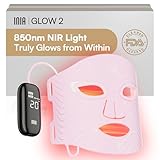
The iRestore is the pick for anyone who wants a three-wavelength premium frame, pairing 635 nm red with 830 nm infrared and 415 nm blue across 360 LEDs. The INIA is the value answer, and one of the few entry-tier masks here that puts genuine 850 nm near-infrared on your face alongside 630 nm red.
Best LED Light Therapy Masks for Wrinkles in 2026 at a Glance
Every mask in this roundup, with the wavelengths and the reason we picked it. Detailed verdicts follow below.
| Product | Specs | Action |
|---|---|---|
| NEWKEY 4D LED Red Light Therapy Mask |
|
Check Latest Price |
 Aphrona Moonlight FDA Cleared LED Mask Aphrona Moonlight FDA Cleared LED Mask |
|
Check Latest Price |
| INIA Red Light Therapy Mask 850nm NIR |
|
Check Latest Price |
 Shark CryoGlow LED Face Mask Shark CryoGlow LED Face Mask |
|
Check Latest Price |
| iRestore LED Face Mask for Youthful Skin |
|
Check Latest Price |
 CurrentBody Skin LED Face Mask Series 2 CurrentBody Skin LED Face Mask Series 2 |
|
Check Latest Price |
 INIA GLOW 4D Wireless Mask INIA GLOW 4D Wireless Mask |
|
Check Latest Price |
 INTEO Red Light Therapy Mask Face and Neck INTEO Red Light Therapy Mask Face and Neck |
|
Check Latest Price |
 Ulike Red Light Therapy Mask 360 Coverage Ulike Red Light Therapy Mask 360 Coverage |
|
Check Latest Price |
 wavytalk Glow Time LED Face Mask wavytalk Glow Time LED Face Mask |
|
Check Latest Price |
Two things stand out immediately. First, red light is the constant across the list, and where manufacturers publish an exact figure it sits in the 630 to 635 nm band most associated with wrinkle work. Second, eight of the ten carry an infrared channel, which reaches deeper and is the band most associated with collagen and elastin stimulation. That is a meaningfully differentiator from the 7-colour marketing you see elsewhere, where most of those colours do very little for wrinkles.
1. NEWKEY 4D LED Red Light Therapy Mask – Best Overall for Wrinkles
NEWKEY 4D LED Red Light Therapy Mask for Face Skin Glowing,630nm Led Light Therapy Face Mask Anti Wrinkle, Blue Light Therapy Face Mask for Acne,Home use,450 LED Chips,Birthday gift,Plug in
630nm red plus 465nm blue
450 light-emitting chips
Up to 75mW/cm2
10-minute auto shut-off
Pros
- Largest review base of any mask we examined
- 630nm red with 465nm blue for acne
- 4D contour reduces light leakage
- corded design never runs out mid-session
- simple 10-minute auto shut-off
Cons
- Corded plug-in restricts where you can wear it
- no near-infrared channel for deeper work
- 2.6 pound weight feels solid rather than light
This is the mask I recommend to people who ask me a single question and then want one answer: which one. It has been on sale since 2016, it holds a 4.3-star average across more than 3,600 reviews, and it ranks in the top twenty of the wrinkle and anti-aging device category. That combination of longevity and review volume is unusual, and it is the closest thing to a settled verdict you will find in this category.
The optical side is straightforward in a way that should reassure you. You get 150 LEDs built from 450 light-emitting chips, red at 630 nm and blue at 465 nm, with an output listed at up to 75 mW/cm². The 4D contoured shape is moulded to facial bone structure and holds a 5 mm working distance, which is why reviewers repeatedly mention even coverage and very little light leakage around the edges. The timer is set at ten minutes with automatic shut-off, so you can put it on, do something else, and never have to watch the clock. The rigid frame is what keeps that distance stable, and a stable distance is what keeps your dose predictable.
Weighing it at 2.6 pounds, it is not a featherweight device, and that is deliberate. A rigid frame holds the light at a consistent distance, which matters because dose is a function of irradiance multiplied by time. Masks that feel weightless in your hand tend to drift, and drifting distance means inconsistent energy per session.
The one genuine friction point is power. This is a plug-in design, so your ten minutes are tethered to a wall. For a lot of people that is a feature rather than a bug: there is no battery to degrade, no charging cable to fail, and no session cut short because the controller ran flat. Reviewers also report visible softening of forehead creases and nasolabial folds after roughly four weeks of regular use, which sits in line with what the clinical literature would suggest for collagen remodeling.
Owners do raise two consistent caveats. The cord restricts movement, so this is not the mask to wear while moving around the house. And with red plus blue only, there is no near-infrared channel, so anyone whose goal is deeper dermal work has to look elsewhere in this list. Both are fair criticisms of a design that prioritises reliability and price over versatility.
Is the NEWKEY 4D worth buying over a premium silicone mask?
If your priority is a proven, low-friction device that you will use three to five times a week for the next six months, yes. The optical output is respectable, the timer is automatic, and there is no learning curve. It is also the mask in this roundup with the deepest public record of long-term owner satisfaction, which is worth more to most buyers than an extra wavelength.
If your priority is cordless wear, deeper penetration or a mask you can use while working, skip it. Those priorities point to the INIA GLOW 4D or the CurrentBody, both of which cover them and both of which we cover later in this guide.
Who should skip the NEWKEY 4D?
Skip it if you want a single device that handles wrinkles, acne and redness across multiple wavelengths. The blue channel here is aimed at acne, and there is no amber or near-infrared option, so you are buying for one goal and paying for one goal.
Also skip it if you are sensitive to being wired to a cable while you relax. A surprising number of owners treat the tethered design as a reason to skip sessions, and skipped sessions are worse than a slightly less powerful mask used every week.
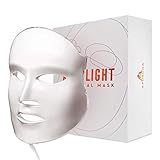
2. Aphrona Moonlight LED Mask – Best for Verified FDA Clearance
Aphrona® | FDA cleared Moonlight LED Facial Mask Skin Care Mask, LED Light Therapy for face, Red light Blue light for Acne Removal Wrinkle Reduction,450 Powerful LED Chips
FDA 510(k) cleared Class II
630nm red and 415nm blue
450 high-purity chips
5-50 minute sessions
Pros
- Listed as an FDA 510(k) cleared Class II medical device
- 450 high-purity 99 percent narrow-spectrum chips
- session length adjustable from 5 to 50 minutes
- US-based customer support
Cons
- No near-infrared channel
- longest sessions run well past most people's routine
- cord is required so it is not fully wireless
For a lot of shoppers, FDA clearance is the deciding factor, and it is the one claim on a spec sheet that means something specific rather than something promotional. In this roundup, the Aphrona Moonlight is the mask listed as an FDA 510(k) cleared Class II medical device. That is not an FDA approval, and it does not mean the device treats disease, but it does mean the manufacturer submitted a 510(k) premarket notification and cleared it as substantially equivalent to a predicate device.
Why that matters practically: clearance requires a defined intended use, and any wrinkle-related claim attached to a cleared device is tied to that use. Devices sold with no clearance at all are making cosmetic claims only, which is not a knock on them, but it does mean you have one fewer data point to check a claim against. Forum readers in the skincare communities we studied asked for exactly this filter, and among the entry-tier masks here only one answers it.
The optical specification is honest and unglamorous. You get 450 high-purity narrow-spectrum chips at 99 percent purity, red at 630 nm plus or minus 5 nm and blue at 415 nm plus or minus 5 nm, with output listed between 30 and 80 mW/cm². The tight tolerance bands on the wavelengths are the detail worth noting. A chip that is nominally 630 nm but drifts to 610 nm is delivering a different protocol than the one the study was run on.
What sets this mask apart from other entry devices is the session control. Treatment time is adjustable from 5 to 50 minutes, with a 15-minute default. That flexibility is genuinely useful, because a 5-minute session works as a morning top-up and a longer session works on a low-commitment evening, and you can build up gradually rather than starting with a punishing 30 minutes on irritated skin.
The trade-off is that a 50-minute maximum invites overdoing it. Most of the literature suggests short, frequent sessions at a controlled dose outperform long ones, so the upper end of this range is more useful as a flexibility feature than as a recommendation. Roughly 2,100 reviews at a 4.3 average with 68 percent five-star ratings puts it alongside the NEWKEY as one of the more consistently well-regarded options we looked at.
Does FDA clearance actually make a mask better?
Not automatically better at delivering light, and not a guarantee of results. What it does is give you a verifiable regulatory record to check before you buy, which is a meaningful advantage in a category where spec-sheet claims are frequently unverifiable. Treat it as a filter for honesty, not as a ranking of optical performance.
Used that way, the Aphrona passes cleanly. We would still choose a mask with a near-infrared channel if deeper dermal work is your primary goal, because collagen sits beneath the surface and red-only devices are working the more superficial layer.
Who should skip the Aphrona Moonlight?
Skip it if you want wrinkle results from near-infrared light, because there is no infrared channel here. It is a red-and-blue device with a wide adjustment range, and treating it as a multi-depth tool would be overstating what it does.
Skip it if you are the kind of person who will max out every dial. The 50-minute ceiling is the main risk factor, and reviewers do occasionally report initial peeling or dryness after pushing too hard early on. Start at the shorter settings and hold there for the first fortnight.
3. INIA Red Light Therapy Mask with 850nm NIR – Best Budget Pick
INIA Red Light Therapy Mask for Face, 850nm NIR, Red/Blue LED Light 4 Modes
620nm and 630nm red with 850nm NIR
220 high-energy LED chips
Up to 105mW/cm2
10, 20 or 30-minute timer
Pros
- Genuine 850nm near-infrared alongside 630nm red
- high listed output of up to 105mW/cm2
- rechargeable 2600mAh controller with selectable timer
- four modes plus optional infrared
Cons
- Wired controller so it is not truly cordless
- 10 percent one-star share hints at mixed durability or fit experiences
- no eye-blocking detail is specified in the listing
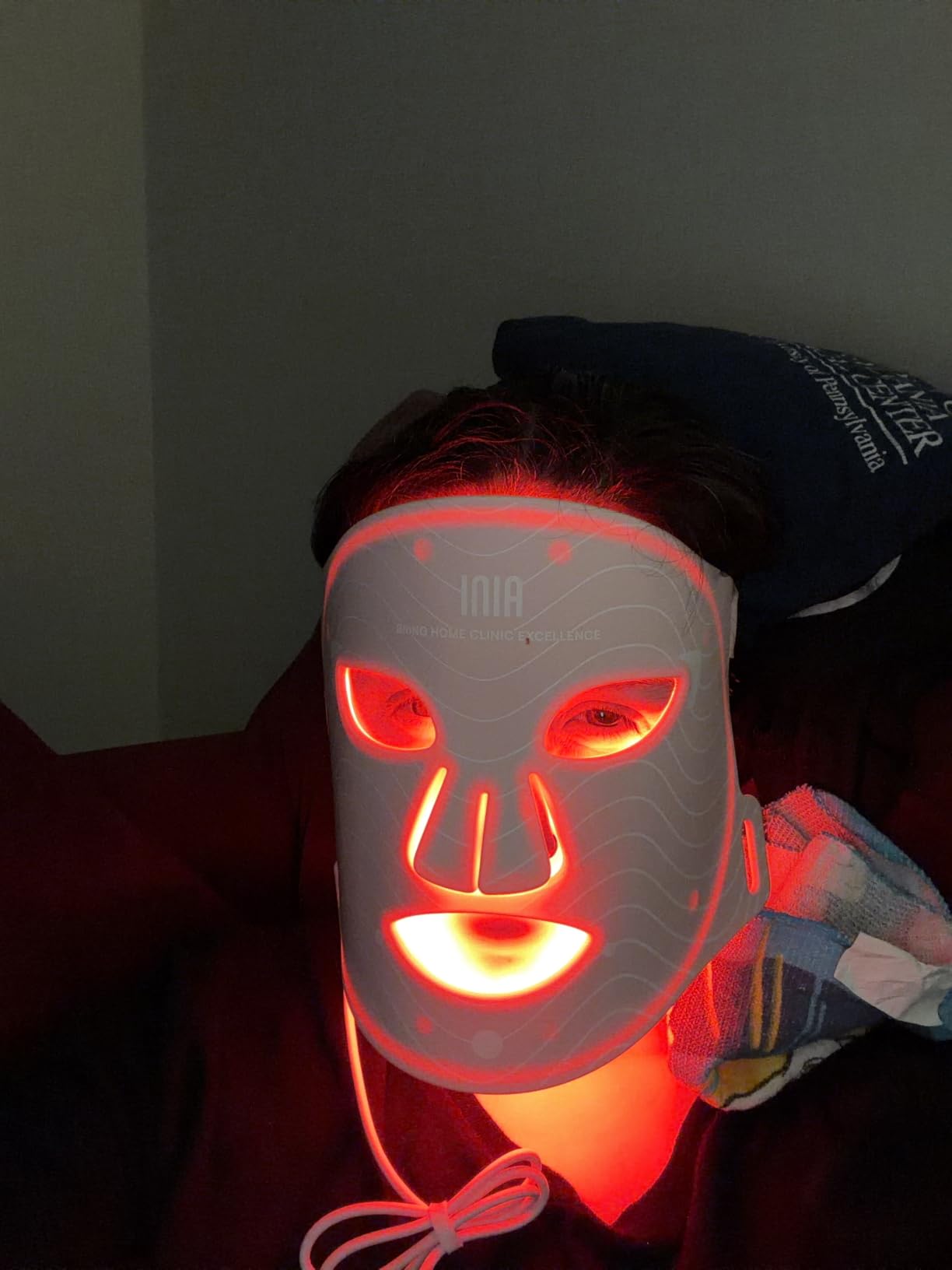
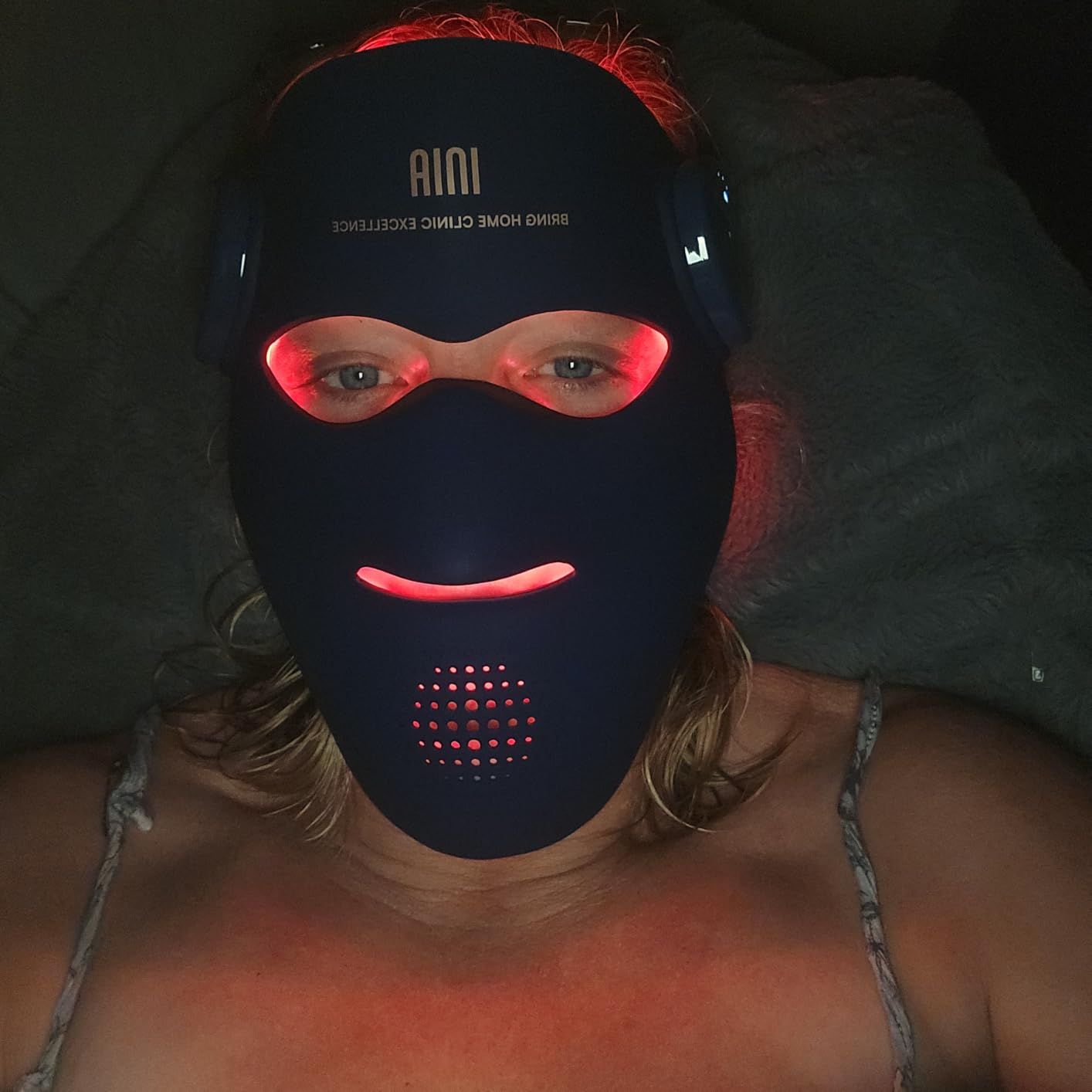
Here is the thing most buyers in the low-cost end get wrong: they assume near-infrared is a premium feature. On this mask it is not. The INIA pairs red light at 620 nm and 630 nm with genuine 850 nm near-infrared, and it does so on one of the lower-priced devices we examined. If near-infrared penetration matters to your wrinkle strategy, this is where the money is best spent in the entry tier.
The output figure is 105 mW/cm² across 220 high-energy LED chips, which is a higher listed number than most masks twice its size. Treat that number as a marketing-adjacent figure rather than a lab result, since manufacturers rarely state the measurement distance or the calibration method. What is verifiable is the chip count and the channel selection, and both are solid here.
Control is handled by a 2600mAh rechargeable controller with a timer offering 10, 20 or 30-minute sessions and an automatic shut-off. Recommended use is three to seven sessions per week. That upper end of seven is more often than the research suggests is necessary, but the shorter 10-minute option is the one we would use, and it is the option most owners appear to use.
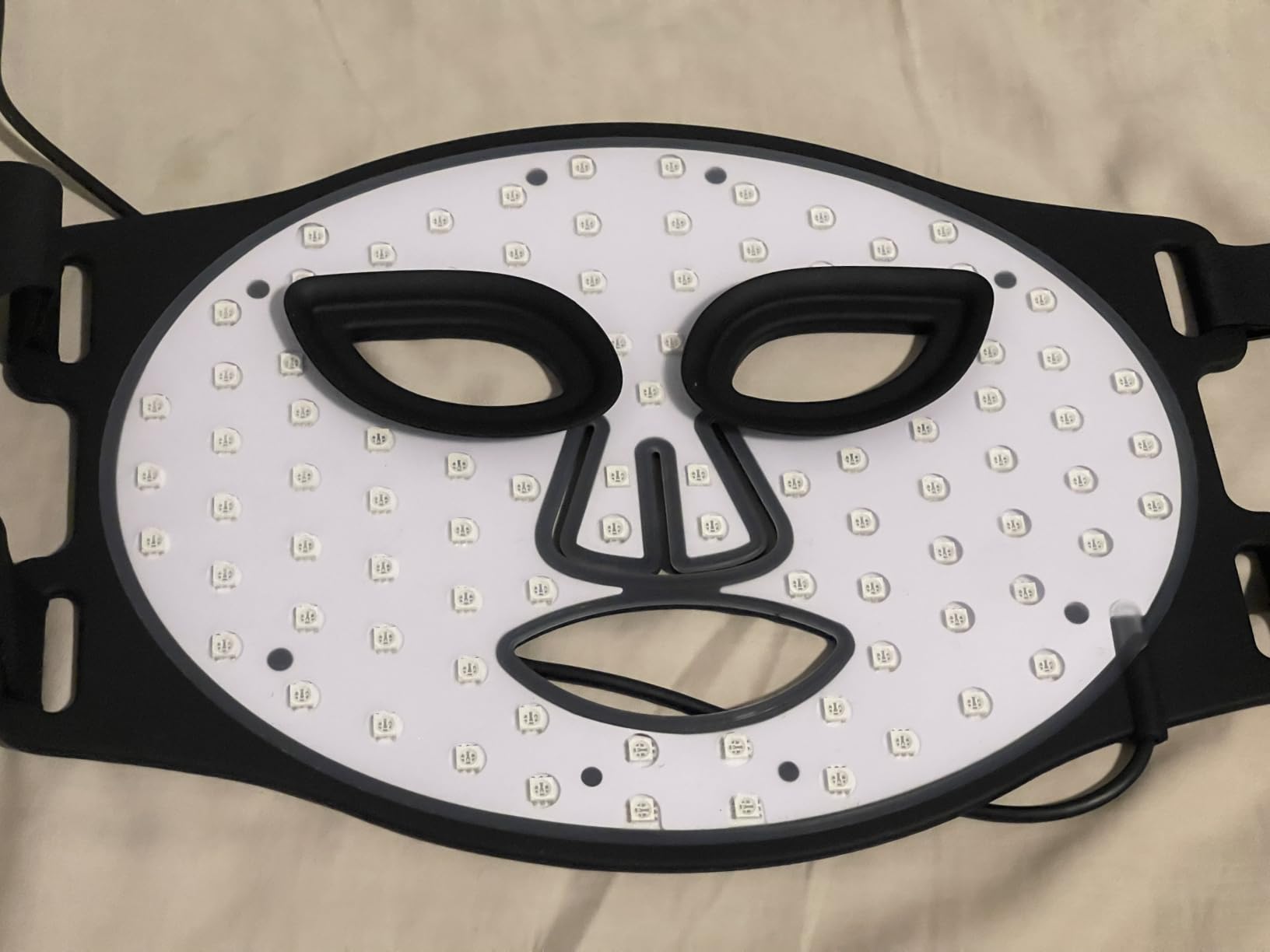
Owners consistently report brighter skin and firmer feel within the first few weeks, and the presence of a dedicated near-infrared channel is the most likely reason. The four selectable modes cover red-low, red-high, blue at 460 to 470 nm, and a red-plus-blue combination, with near-infrared as an add-on rather than a standalone mode, which lets you layer it over a red session.
The honest drawback is the review distribution. At 1,486 reviews and a 4.2 average, 10 percent of buyers leave a one-star rating, a noticeably larger share than the most-reviewed masks in this guide carry. That is not alarming for an entry device, but it does indicate a split group of buyers, and the complaints cluster around durability and fit rather than around results. If you want a mask that feels premium in the hand, this is not that mask.
Is an 850nm mask better than a 630nm-only mask for wrinkles?
For deeper work, yes. Red light at 630 to 635 nm is absorbed nearer the surface, which is well suited to texture and superficial fine lines. Near-infrared at 850 nm penetrates further, and it is the band most often associated with stimulating fibroblasts to build collagen and elastin deeper in the dermis.
Neither replaces the other. The ideal protocol uses both, which is why we prefer a mask that can do both rather than one that optimises for a single channel. The red channel here handles the superficial layer and the infrared handles the deeper one, in the same session.
Who should skip the INIA 850nm?
Skip it if appearance and build quality are priorities for you. The plastic has a noticeably lower-grade feel than the silicone frames in this roundup, and several owners mention a chemical smell on first use that fades after a few sessions.
Skip it if you need a genuinely cordless mask. The controller is wired to the mask, which means you are not free to walk around, though the short cable is far less restrictive than a mains plug. Given the near-infrared channel at this level, most buyers will accept that trade.
4. Shark CryoGlow LED Face Mask – Best for Short Sessions and Under-Eye Care
Shark CryoGlow LED Face Mask, Red Light Therapy, Under-Eye Cooling, FW312PL
Red, blue and infrared LEDs
Four named treatments
4-8 minute sessions
Clip-on chill pads
Pros
- Short sessions that slot into a busy morning
- listed as FDA-cleared and tested on 119 participants by an independent third party
- clip-on cooling pads add a depuffing effect
- remote control with intensity selection
Cons
- Fixed metal chill inserts cannot be removed
- no red light coverage under the eyes
- battery covers only 3-4 cycles and takes hours to recharge
The Shark CryoGlow is the mask that solves the adherence problem rather than the power problem. Sessions run four to eight minutes depending on mode, which makes it the quickest device in this roundup to put on and take off, and the Best Sellers ranking in wrinkle and anti-aging devices sits at number two. When the most common failure mode is a mask sitting in a drawer at week three, a device that asks for six minutes is solving the real problem.
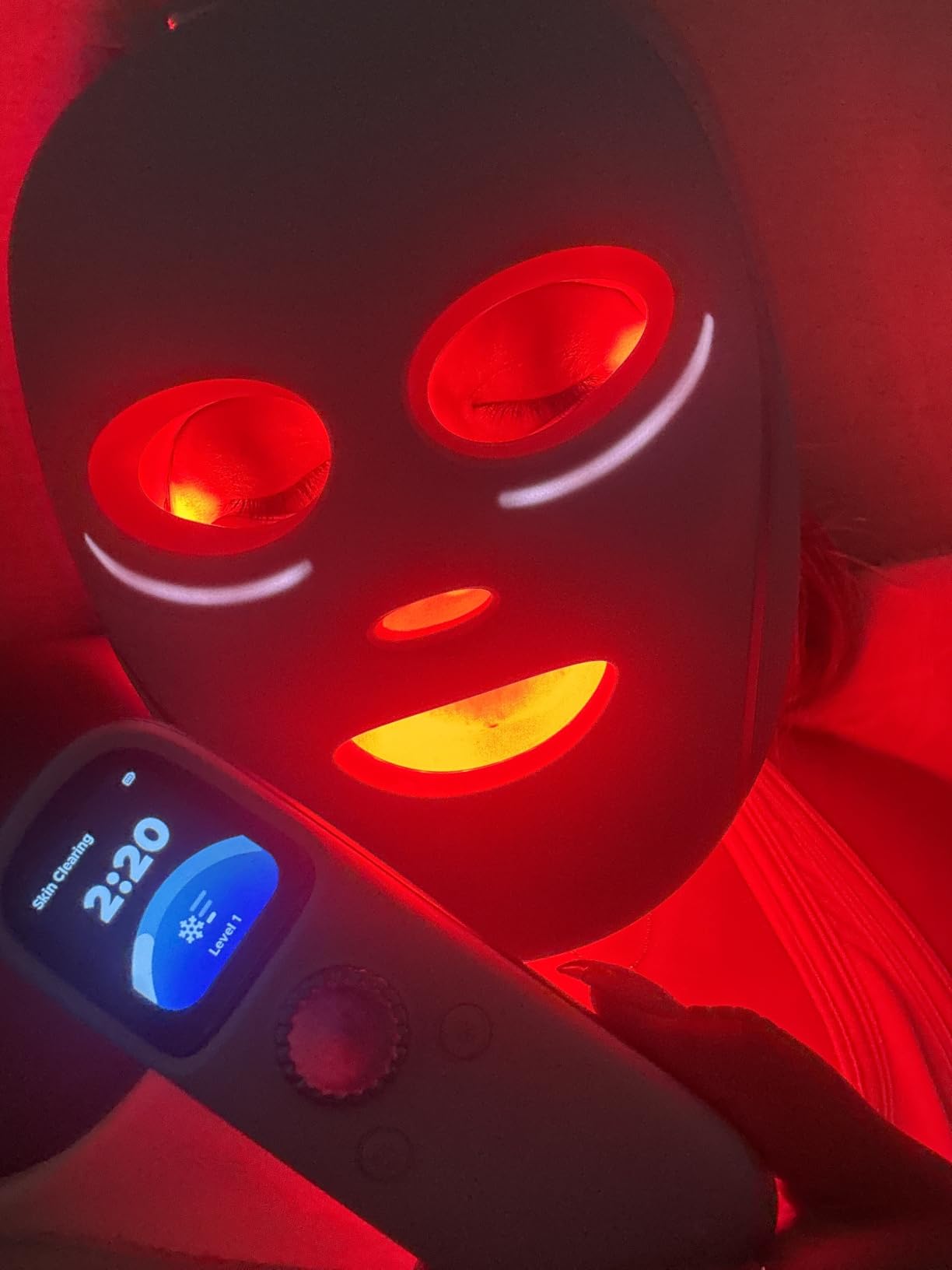
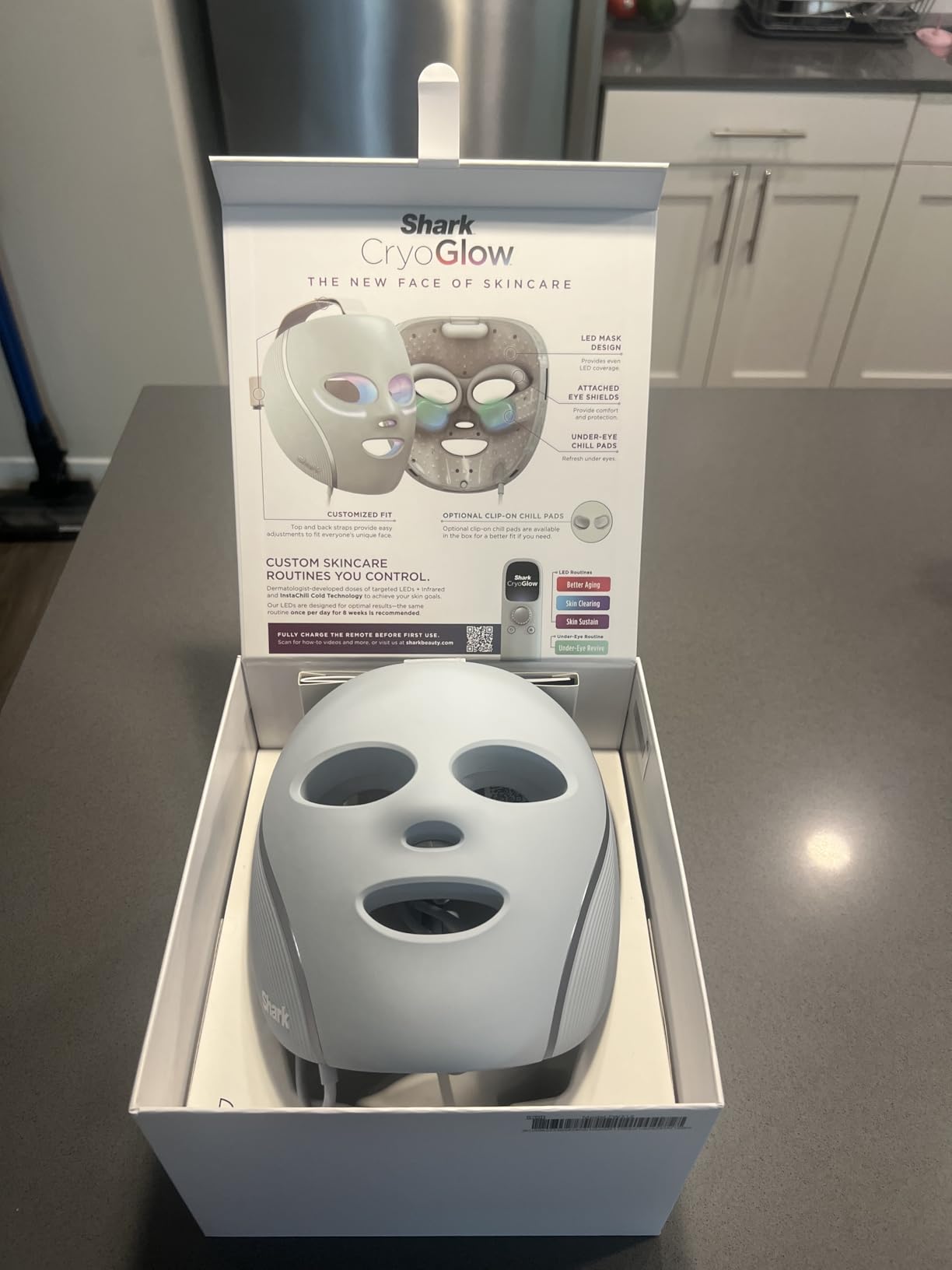
It comes with four dermatologist-developed treatments. Better Aging is a 6-minute session using red and infrared LEDs. Skin Clearing runs 8 minutes using blue, infrared and red. Skin Sustain is the maintenance mode. Under-Eye Revive is a 5 to 15 minute treatment that pairs with the cooling. That menu structure is more useful than it sounds, because it removes the daily decision about what to do.
The cooling is what separates it from everything else on this list. Clip-on chill pads with three chill levels use what Shark calls InstaChill technology, and the depuffing effect is genuinely noticeable, particularly in the morning. The box includes the mask, the chill pads, a remote and a USB-C cable. The remote tracks treatments and lets you select intensity, which sounds minor until you are doing it half-asleep.
The device is listed as FDA-cleared and clinically tested on 119 participants by an independent third party. Sample size aside, third-party testing is the credibility marker that readers in the skincare forums consistently said they wanted, because it is rare in a category dominated by seller claims. At 1,007 reviews and a 4.4 average with 76 percent five-star ratings, the owner experience is broadly positive, and the most common praise is for skin quality and tone rather than for wrinkles specifically.
The complaints are physical and specific. The metal chill inserts are not removable, so you cannot use the mask without a cold element, and reviewers report they feel icy enough to puff the skin temporarily. The battery covers only three to four treatment cycles and takes hours to recharge. The eye shields leak enough light to cause brief afterimage brightness. And some face shapes report the mask does not reach the jawline, which is a real limitation if your definition of anti-aging includes jaw definition.
Do four to eight minute sessions actually work?
The dose is what matters, not the clock. A mask delivering a high irradiance over six minutes can deliver the same energy as a low-output mask over twenty. The 6-minute Better Aging treatment is the one built for wrinkle work, and using it consistently three to five times a week is a reasonable protocol.
The short duration is a genuine advantage for people who dread 20-minute treatments. It also removes the most common excuse for skipping. The counterargument is that the brief window leaves less room for error if you fall asleep wearing it, though the automatic shut-off handles that case.
Who should skip the Shark CryoGlow?
Skip it if crow’s feet are your main concern, because there is no red light coverage under the eyes. The Under-Eye Revive mode handles puffiness and dark circles, but the wrinkle work stops at the orbital rim, and crow’s feet sit inside it.
Skip it if you travel or need the mask to survive in a bag without a full charge overnight. A battery that covers three to four cycles is fine on a home bathroom shelf and frustrating anywhere else. Owners also report a small number of units failing or blinking irregularly within weeks, so check the return terms carefully if you are sensitive to early failure.
5. iRestore LED Face Mask – Best Premium Multi-Wavelength Pick
iRestore LED Face Mask for Youthful Skin, Red Light Therapy for Face, Red, Blue & Infrared Therapy for Wrinkles, Fine Lines, Dark Spots with 360 LEDs, Skincare Device for Women & Men
360 LEDs
635nm red, 830nm infrared, 415nm blue
10-minute sessions
Dual-strap eye-blocking fit
Pros
- Three-wavelength coverage with 830nm infrared
- lightweight dual-strap design allows multitasking
- eye light blocking for safer use
- 5 percent one-star share is the smallest in the roundup
Cons
- Only three wavelengths with no amber mode
- higher price than most of the field with fewer documented clinical figures
- single AA battery requirement listed for the controller
iRestore holds a 4.5-star average across 1,007 reviews, with 78 percent five-star and only 5 percent one-star. That distribution matters more than the average: a high average with a large unhappy minority usually signals a product that works well for some people and badly for others, whereas a high average with a small unhappy group tends to mean a broadly smooth experience. iRestore is the second pattern.
The optical configuration is the reason to look here if you want depth. You get 360 LEDs across three wavelengths: red at 635 nm, infrared at 830 nm, and blue at 415 nm. The 830 nm infrared is the same near-infrared band used in the professional literature on dermal remodeling, and pairing it with 635 nm red covers both the superficial and the deeper layer in one session.
The session is 10 minutes, three to five times per week, which is the protocol most consistent with the published work on photobiomodulation. Sessions can be done over serums and moisturisers, since red light is frequently paired with a treatment step in the routines owners describe. Applying light over a layer of product is fine, but applying it over a strong active like a high-strength retinoid on the same night is a separate question we cover later.
Fit is handled by a lightweight dual-strap frame that blocks direct light from the eyes. At 1.81 pounds it is a light mask, and reviewers specifically mention being able to relax or multitask during a session. That is the adherence factor again: comfort and eye safety determine how many of the recommended weekly sessions you actually complete.
Why is a 360 LED count not the reason to buy this mask?
Because LED count measures quantity, not quality or reach. A mask can carry 360 low-output diodes spread thinly across the face and deliver a lower irradiance than a 220-chip mask with tighter optics. The useful numbers are the wavelengths and the irradiance at a stated distance, and LED count is a marketing figure that correlates with neither consistently.
What the count does tell you is coverage. More emitters usually means better distribution across forehead, cheeks and jaw rather than a hot spot over the nose. Read the count as a coverage proxy, not a power proxy, and check the wavelength list next to it.
Who should skip the iRestore?
Skip it if you want a fourth channel. Three wavelengths is plenty for wrinkles and acne, but there is no amber for redness and tone, and owners who wanted a fourth mode are the ones who feel the gap most.
Skip it if you are buying on published clinical figures. The mask is well-reviewed and well-liked, but the documented numbers in the public record are thinner than the ones attached to the Shark or the Aphrona, so you are buying on owner experience and brand track record rather than on cited studies. That is a reasonable trade, but it is a trade.
6. CurrentBody Skin LED Face Mask Series 2 – Best for Jawline Coverage
CurrentBody Red Light Therapy LED Face Mask: Series 2
633nm red, 830nm and 1072nm near-infrared
236 LED bulbs
Flexible liquid silicone
10-minute auto shut-off
Pros
- Extends down over the jawline and chin
- sturdy build that holds its shape without collapsing
- per-mask Veritace NFC card documenting output
- 10-minute auto shut-off
- includes eye pads
Cons
- Highest one-star share in the roundup at 18 percent
- velcro straps shed fibres onto the mask
- several owners report unit or battery failure within weeks to months
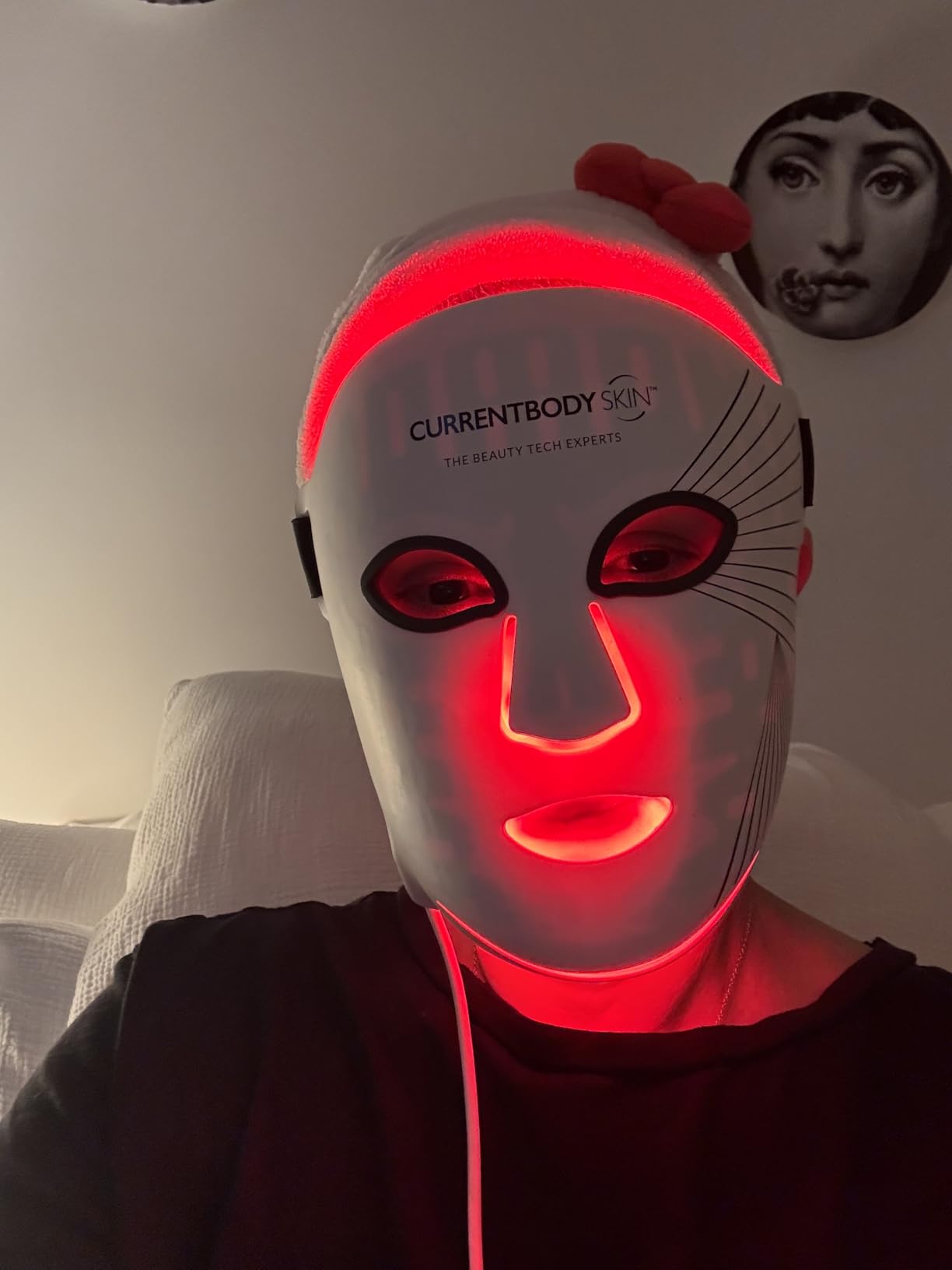
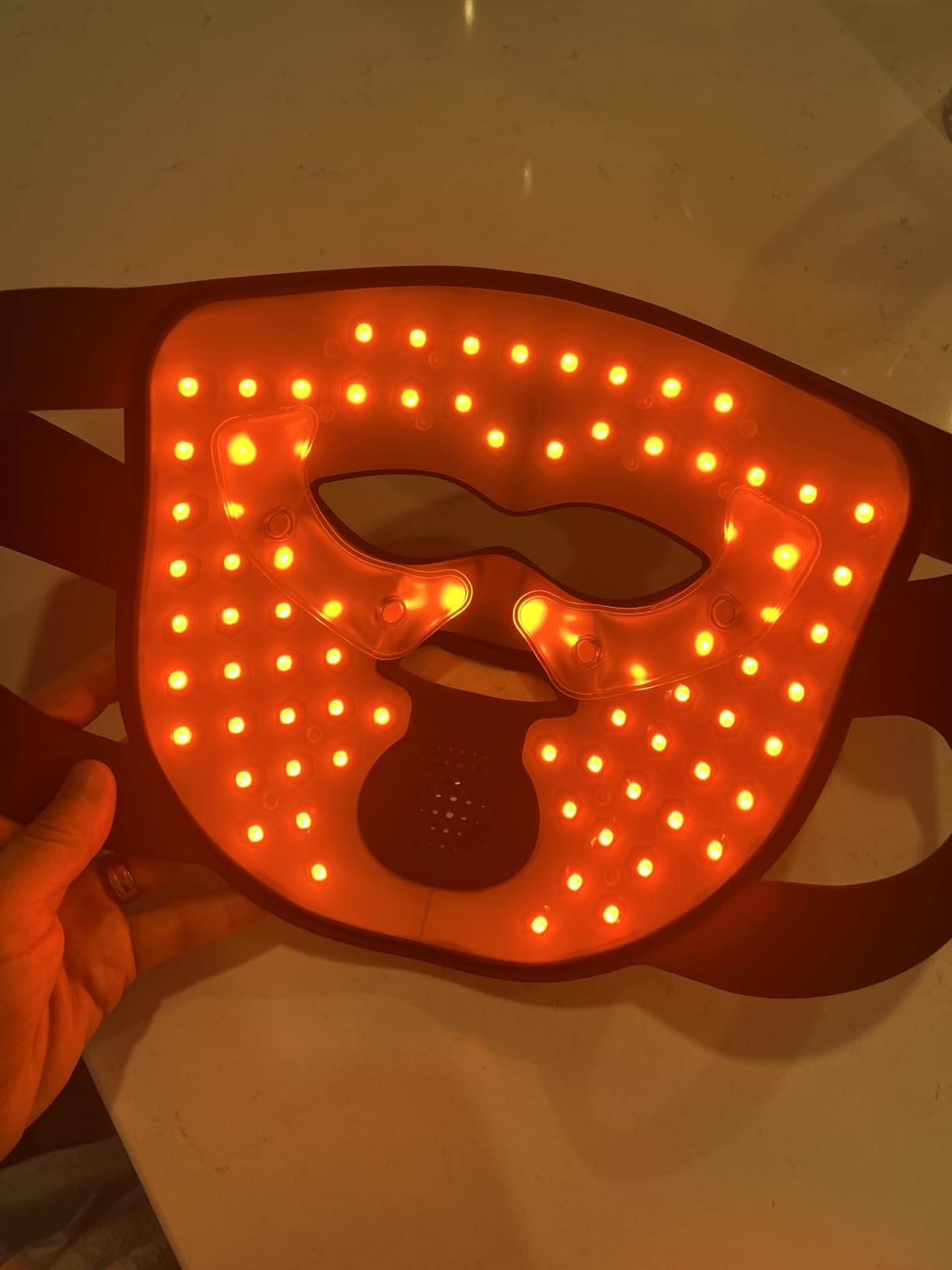
The CurrentBody is the most interesting specification sheet in this roundup, and the most polarising owner experience. It is also the only mask here with 1072 nm deep near-infrared, alongside 633 nm red and 830 nm near-infrared across 236 LED bulbs. If your interest is in the depth of penetration rather than the surface, that third channel is the reason to keep reading.
Deep near-infrared at 1072 nm is at the far edge of what LED face masks typically output. Longer wavelengths scatter more as they travel, and a mask that can deliver a meaningful dose at 1072 nm alongside two shorter channels is doing something that most devices in the category are not. The three-wavelength set is presented as the clinically recognised combination, which is a specific claim rather than a vague one.
The shell is flexible liquid silicone in what the brand calls a Best-Fit shape, tested across thousands of face shapes, and the coverage extends down over the jawline and chin. For anyone whose anti-aging concern is the lower face, that extension is the differentiator. At 2.95 pounds this is the heaviest mask here, which is the cost of a solid frame and full-face silicone.
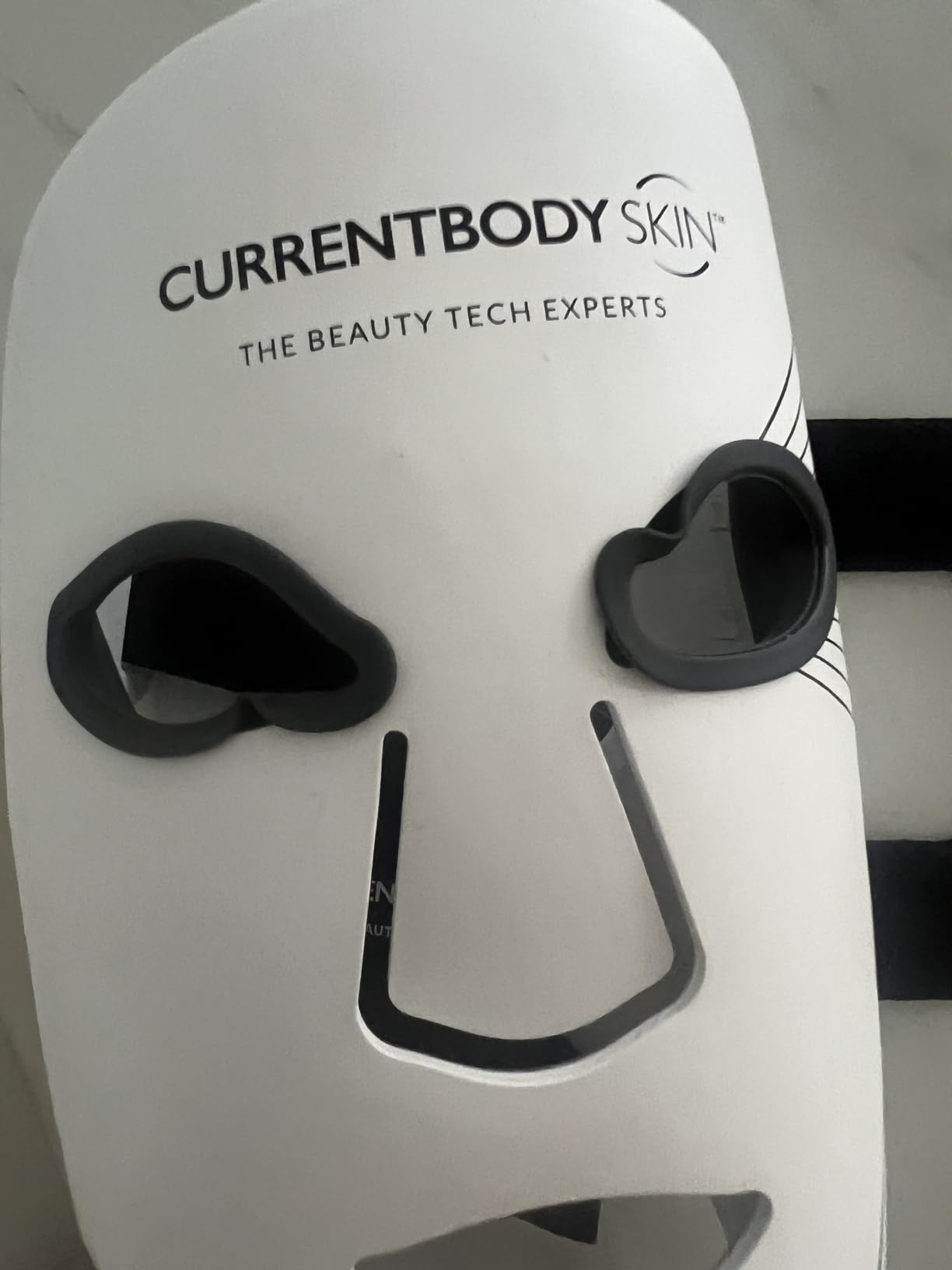
Two details are worth flagging as unusual. Each mask ships with a unique Veritace NFC card documenting that individual unit’s output, which is an attempt to address the counterfeit and underpowered-unit problem that runs through this category. Eye pads are included to soften light reaching the eyes, which matters more on a deep-infrared mask because you cannot see the light but the exposure still happens.
Now the difficult part. At 652 reviews and a 4.0 average, this mask has 67 percent five-star and an 18 percent one-star group, the largest negative share in the roundup. Enthusiasts praise the coverage and the build, and report reduced crow’s feet, less redness and better texture. The negative pole is concentrated and specific: units that stopped powering on within weeks, batteries failing within months, velcro straps shedding fibres onto the mask, and strap adjustment that reviewers describe as unintuitive and poorly covered in the manual.
Is the CurrentBody Series 2 worth the premium tier price?
Only if you specifically want deep near-infrared and jawline coverage, because those two things are where this mask genuinely differentiates. The premium in this category otherwise buys materials, software and brand rather than light, and the research in the skincare communities is consistent on that point: a mask you use every week beats a better mask you use twice.
The durability complaints are the deciding factor for most people. An 18 percent one-star share concentrated on early power failure is not a rounding error, and the fix is to confirm the return terms before you commit rather than after a unit dies in week six.
Who should skip the CurrentBody Series 2?
Skip it if reliability underpins your budget, because early-failure reports are the defining weakness here. Also skip it if you are sensitive to Velcro against the skin, or if the 2.95-pound weight is going to make a ten-minute session feel like a chore.
Skip it if you already own a working red-and-near-infrared mask. Adding 1072 nm is a genuine improvement, but it is an incremental one on top of an established routine rather than the missing piece that makes a routine work.
7. INIA GLOW 4D Wireless LED Mask – Best Cordless Design
INIA GLOW 4D Wireless Red Light Therapy Mask for Face, Dual NIR, 320 LEDs
320 LEDs
Dual near-infrared channels
Red, blue, amber and combo modes
Wireless silicone
Pros
- Truly wireless silicone so you can move
- work or watch TV
- 4D coverage extending to the jawline
- four light modes plus dual near-infrared
- magnetic cooling gel pad soothes puffy eyes
Cons
- Heavier than lighter masks and reported to sag
- forehead and cheekbone pressure can cause headaches
- no built-in timer on this model
Cordless is the feature that changes behaviour, and the INIA GLOW 4D is the most refined cordless silicone mask in this roundup. At 1.9 pounds with a lithium ion battery built into the shell, you can wear it while moving around, working at a desk or watching television. Owners mention that flexibility as the main reason they kept using it, and kept usage is the variable that decides results in this category.
The optical spec is strong for a cordless frame. You get 320 LEDs in flexible medical-grade silicone with dual near-infrared channels that work at multiple skin depths, plus four light modes: red, blue, amber and a combination. Amber is a channel most masks in this roundup skip, and it is the one most associated with redness and tone rather than wrinkles, so it broadens what the device is useful for.
Coverage is the other strength. The 4D layout reaches forehead, cheeks, chin and jawline, and reviewers specifically call out jawline coverage as better than lighter masks manage. Removable magnetic eye patches block light, and a magnetic cooling gel pad for puffy eyes is included, which is a nice touch on a device meant for morning use.
The criticism is physical, and it is consistent. Owners report the mask feels heavy and sags on the face, and that pressure on the forehead and cheekbones can build into a headache when seated for a long session. A single strap needs adjusting to seat the lower face properly. There is no built-in timer on this model, unlike the Glow 2, so you are relying on your own phone. There is also a light plastic chemical smell on first use, and the eye patches heat up quickly with only one set included.
At 497 reviews and a 4.3 average with 71 percent five-star, the skincare results are praised consistently, which suggests the light is doing its job. The complaints are about how it feels on your face, not about what it delivers, and that distinction matters when deciding whether the device will survive contact with your routine.
Is a wireless LED mask better than a corded one?
For adherence, often yes, because you can use the device in situations where a cable makes it impractical. The sessions here are long enough, ten to thirty minutes depending on mode, that a tether is genuinely limiting and many people skip sessions rather than sit still.
For optical consistency, a corded design has an edge. A fixed light source with a consistent distance and a stable power supply delivers a more predictable dose, and a wireless mask that sags on your face changes that distance. The trade is adherence against precision, and for most people adherence wins by a wide margin.
Who should skip the INIA GLOW 4D?
Skip it if you get headaches from pressure. The reported forehead and cheekbone pressure is not a minor complaint, and it appears often enough that we would treat it as a known characteristic rather than an unlucky unit. Skip it if you have a smaller face and the 320-LED frame sits heavy on you.
Skip it if you rely on a built-in timer to stop you overdoing sessions. Without one, you are trusting your own discipline, and this mask is also the one where we would caution most against the longer session settings. Use a phone timer, and start short.
8. INTEO Red Light Therapy Mask for Face and Neck – Best for Face, Neck and Chest
Red Light Therapy Mask for Face & Neck, Wireless LED Face Mask, 4 Modes
680 light beads covering face, neck and chest
630nm, 460nm, 605nm and 850nm
Cordless magnetic controllers
10-30 minute timer
Pros
- Only mask in the roundup with dedicated neck and chest coverage
- cordless rechargeable magnetic controllers remove cable clutter
- near-infrared output noticeably stronger with a tangible warming effect
- highest average rating in the group
Cons
- Eye protectors can press uncomfortably
- lesser known brand with clinical evidence limited to seller claims
- two separate controllers to keep charged
At 4.7 stars across 492 reviews, with 83 percent five-star and 2 percent one-star, the INTEO has the most uniformly positive rating profile in this roundup. That is a small review base compared with the leaders, so we would not over-read the average, and it is worth knowing about.
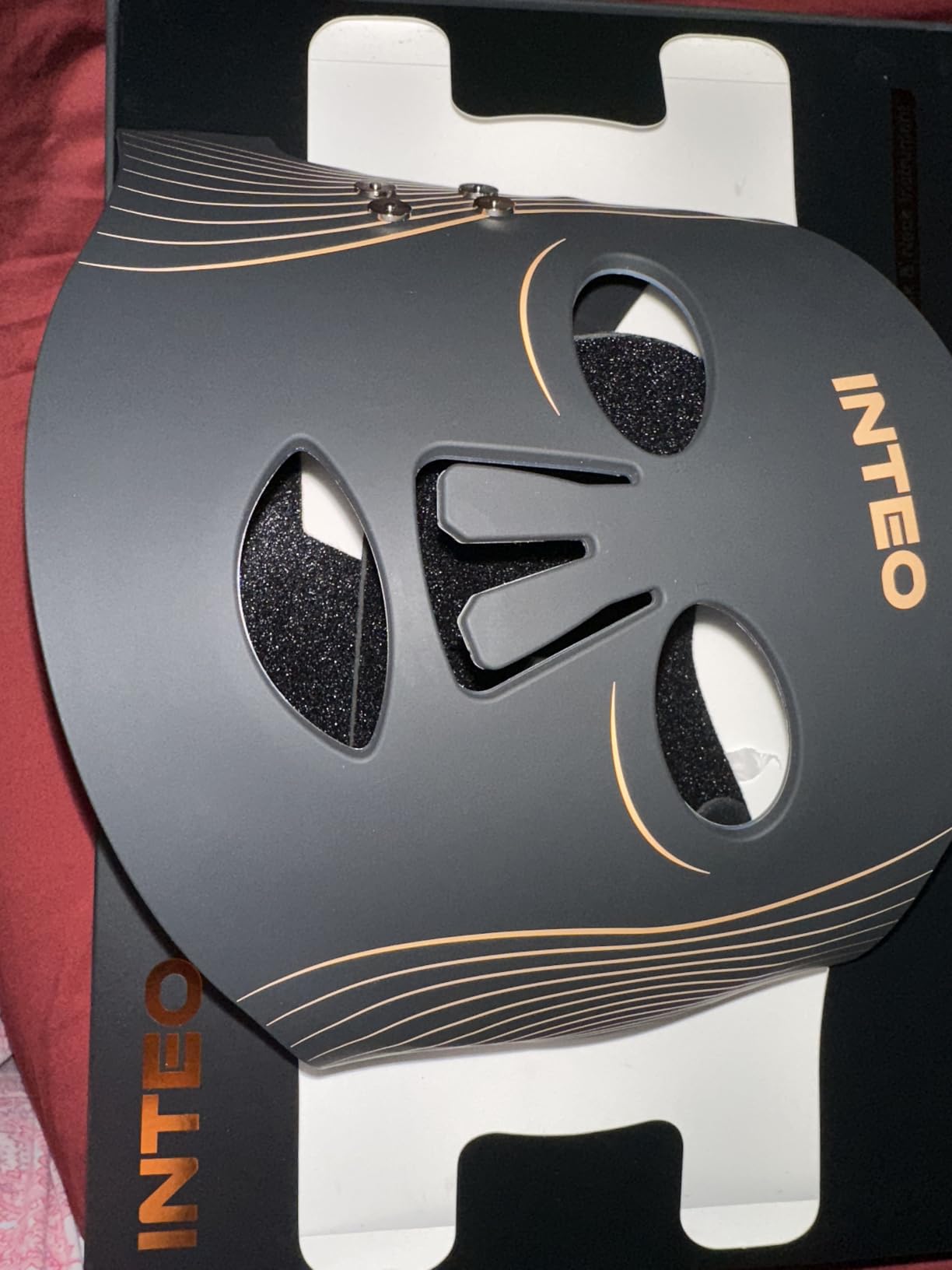
What makes it structurally different from everything else here is coverage. This is the only mask in the roundup with dedicated neck and chest coverage alongside the face, using 680 light beads. Neck skin is thinner, more mobile and more exposed than facial skin, and it is frequently the first place people notice creping and banding after 40. A face-only mask simply does not treat it.
The wavelengths are a four-channel set: 630 nm red, 460 nm blue, 605 nm amber and 850 nm near-infrared. That is one of the more complete lists on the market, and the near-infrared output is described by owners as noticeably stronger than cheaper units, with a tangible warming effect on the neck and chest. Soft skin-friendly silicone and light-blocking eye protection are built into the construction.
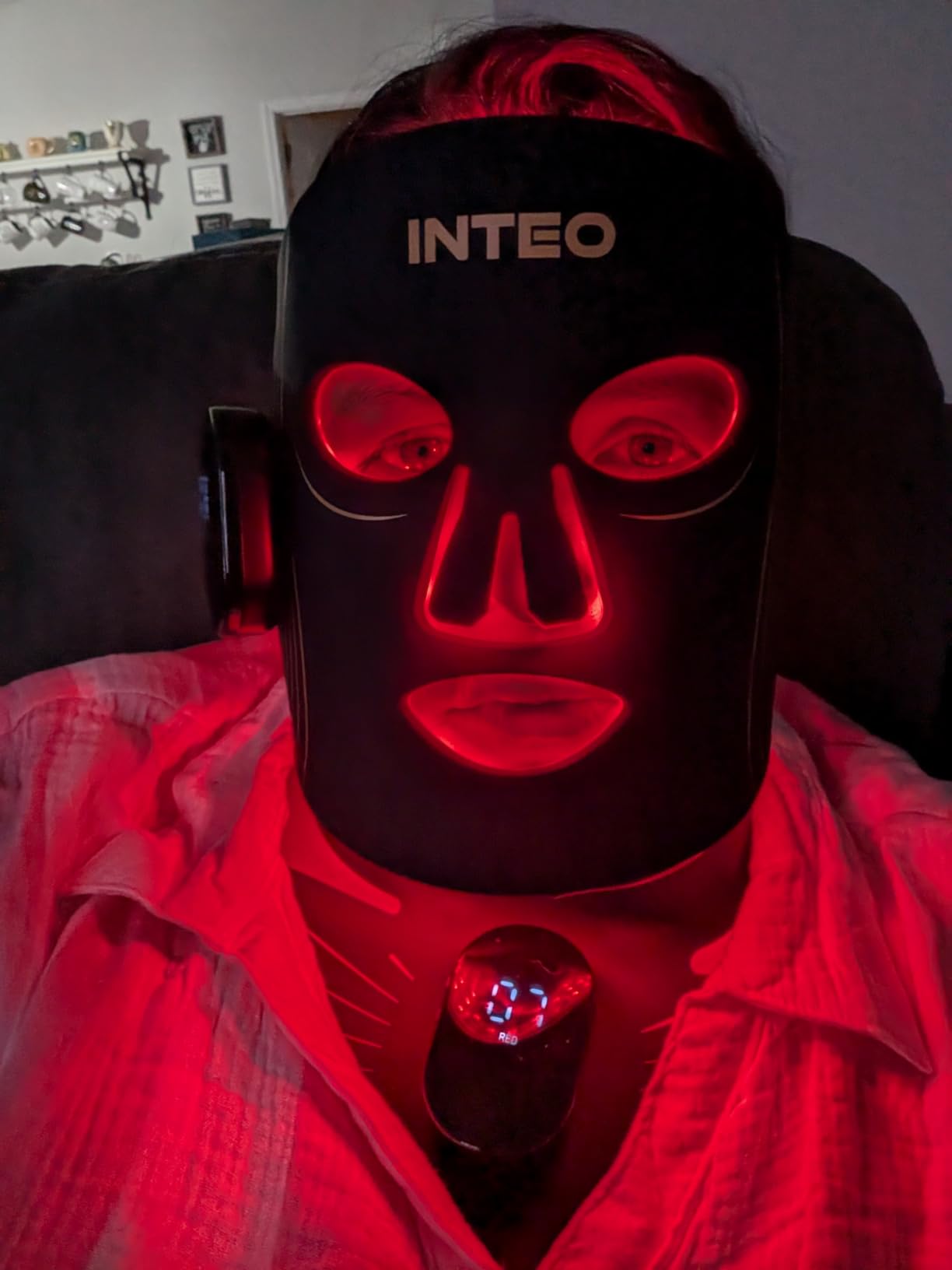
Power is handled by cordless magnetic battery controls, a 2000mAh rechargeable Type-C unit rated at 120 minutes of use per week, which maps neatly onto a three-to-four-session-a-week protocol. The recommended protocol in the listing is three to four sessions per week at 20 minutes, with a timer offering 10, 15, 20, 25 or 30-minute settings and automatic shut-off. Owners often compare it favourably against cheaper masks they previously owned, which is a reasonable signal on build and output.
Two drawbacks are worth stating plainly. First, this is a lesser-known brand, and the clinical evidence in the public record is limited to seller claims, so you are buying on owner experience rather than cited independent testing. Second, the face and neck controllers charge separately, so there are two batteries to keep charged, and the eye protectors can press uncomfortably on some face shapes.
Does treating the neck and chest make a difference?
Yes, if you care about the neck, because no face-only device will get there. Neck and chest skin shows photoaging earlier than the face because it is thinner, less shielded by clothing in summer and frequently exposed to driving posture and sun angles. Treating it alongside the face is simply completing the job rather than adding a new one.
It also changes the session economics. Covering face and neck means roughly double the surface area, so a twenty-minute session across both is comparable in effort to two shorter face-only sessions. If you are the kind of person who would not sit still for twenty minutes, the value here is questionable.
Who should skip the INTEO?
Skip it if you want independently documented clinical evidence, because the public record here is thin and the rating, while impressive, rests on 492 reviews. It is a strong owner-satisfaction pick and a weaker evidence pick, and readers who weight the evidence heavily should look at the Shark or the Aphrona instead.
Skip it if managing two controllers sounds like friction. Battery logistics are the least glamorous reason a device fails to become a habit, and two units is twice the opportunity to arrive at a session with a dead pack.
9. Ulike Red Light Therapy Mask – Best for Daily Consistency
Ulike Red Light Therapy Mask for Face,360° full face coverage
272 light beads
360 degree full face coverage
Four named modes
8-minute daily sessions
Pros
- Eight-minute daily protocol that is easy to stay consistent with
- 360 degree coverage raising listed irradiance by 77.4 percent versus direct exposure
- 1 cm light gap and silicone eye shield for safe home use
- four named modes for glow
- firmness
- rejuvenation and clarity
Cons
- Remote must be charged separately or the mask may not operate
- woven strap design feels less refined than silicone or dual-strap rivals
- results in fine lines build over roughly four weeks
The Ulike is built around a short, repeatable commitment at eight minutes per day, and that is the whole pitch. If your history with light therapy masks is a row of barely opened boxes in a cupboard, the question worth asking is not which mask is strongest but which one you will actually put on tomorrow. Eight minutes is an answer most people can live with.
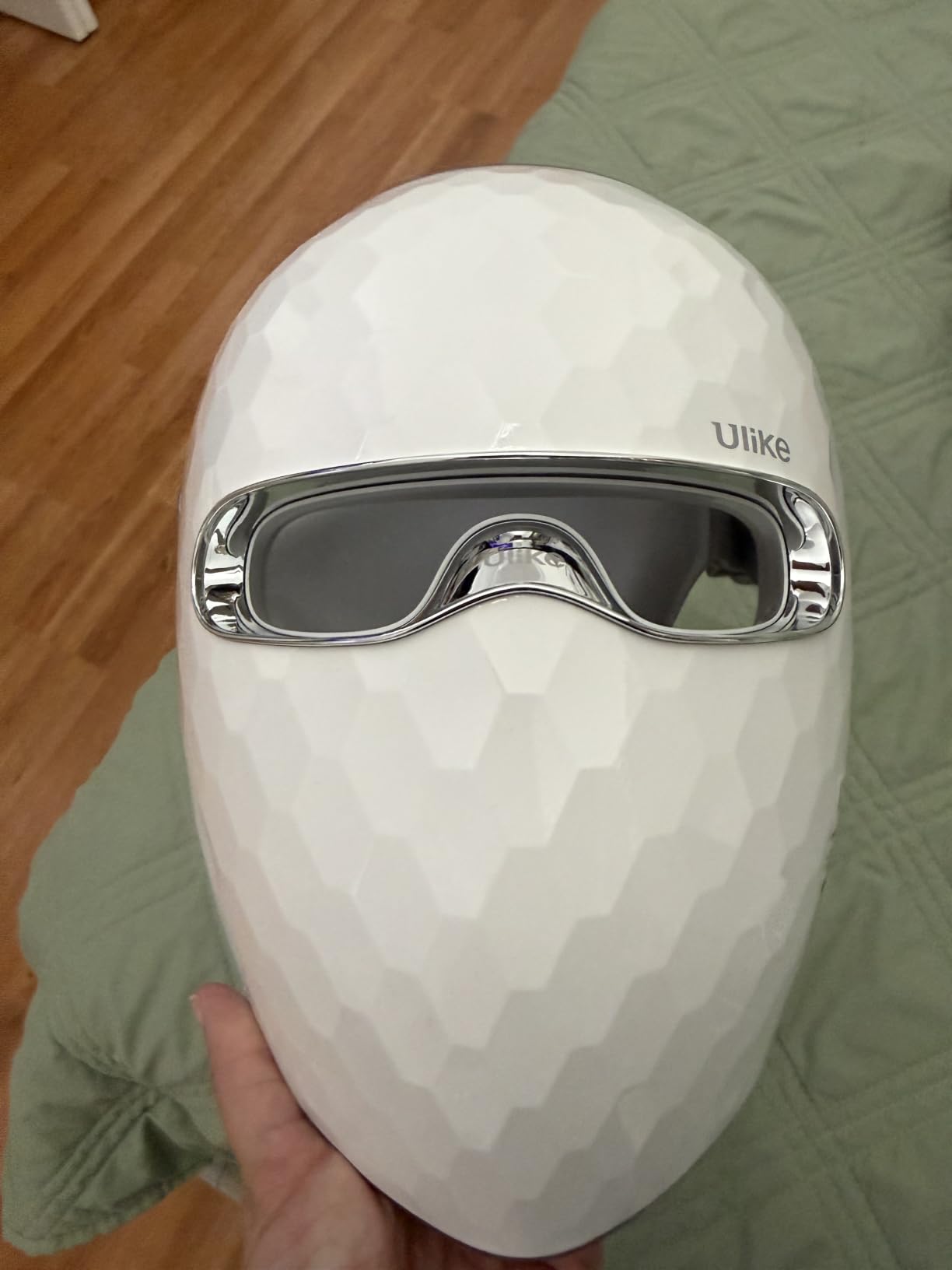
The coverage design is the technical story. This mask uses 272 light beads in a one-slot, four-light arrangement arranged for 360-degree full face coverage, which the manufacturer says raises irradiance by 77.4 percent compared with direct exposure. A 1 cm gap between the mask and skin is specified to prevent overheating, and a silicone eye mask is included for protection. The four modes are named for intent rather than wavelength: Glow, Firm, Rejuvenate and Clear.
Naming modes for outcomes rather than colours is a small but genuine usability improvement. When a device offers red, green, blue, purple and seven other colours with no explanation, the user has to guess. Offering Firm and Rejuvenate means you can pick based on your goal, and the Firm mode is the one to use for wrinkles.
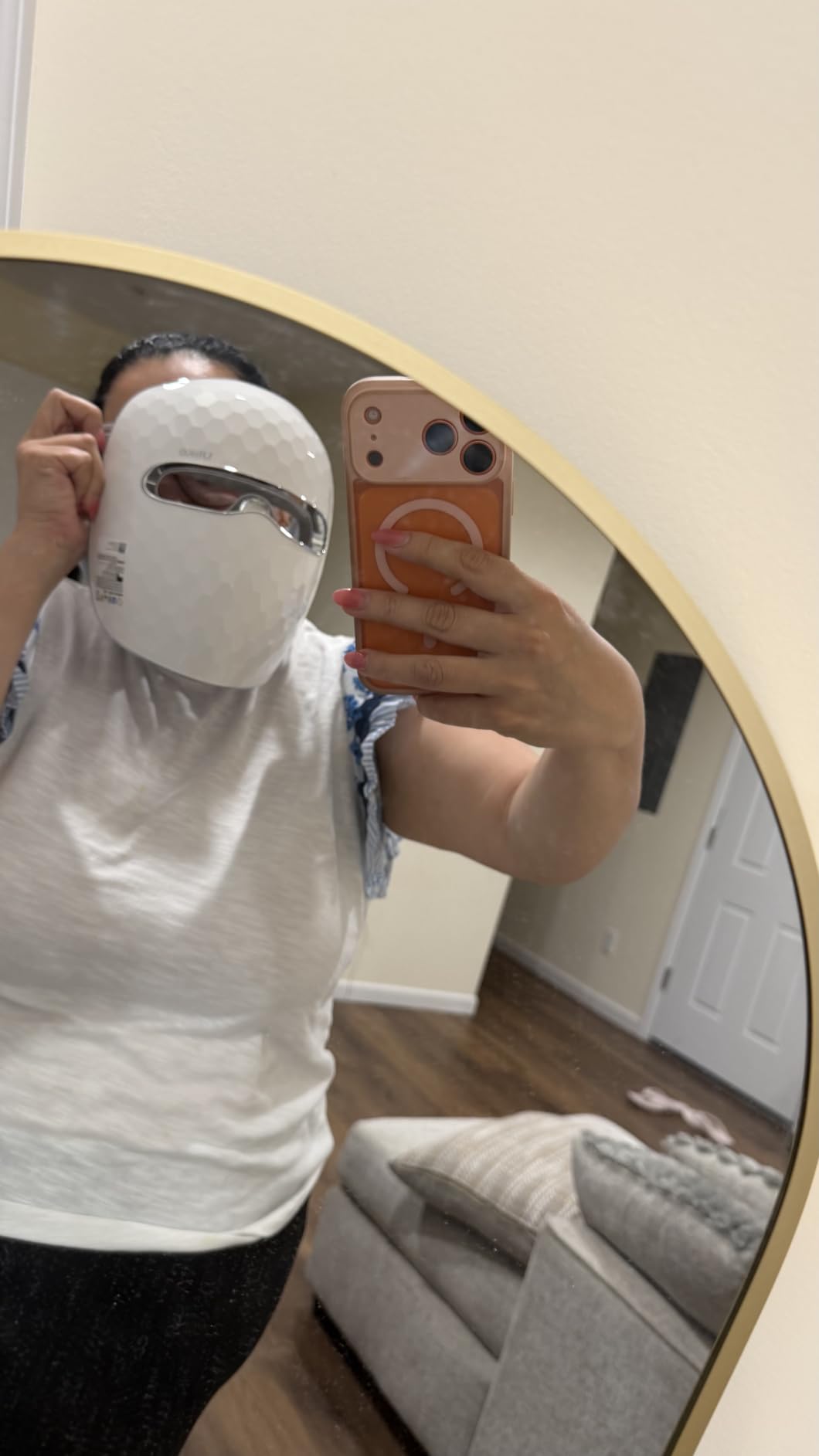
At 485 reviews and a 4.5 average with 80 percent five-star and 6 percent one-star, the owner experience is positive and the complaints are practical rather than fundamental. The leading one is the remote: it must be fully charged before use, and if it is not, the mask may not operate. A device that will not work because a plastic remote is flat is a real design failure regardless of how good the light is.
The second is the strap. A 4D ergonomic design with contoured woven straps is serviceable, but reviewers compare it unfavourably to the silicone or dual-strap systems on competitors, and the fit has to seat the mask for the 360-degree coverage to be worth anything. Third, and more plainly, results on fine lines build over roughly four weeks. That is consistent with the biology rather than a fault, but it is the number that decides whether you keep going.
Is an eight-minute daily session better than a twenty-minute weekly one?
For most people, yes, because frequency beats duration in adherence terms. The underlying dose-response relationship means there is a point past which additional time in a session stops adding useful benefit, and short frequent sessions usually sit closer to it than long occasional ones.
The counterargument is that a daily commitment requires a daily mood. Someone who will happily sit for twenty minutes three times a week may find eight minutes every single day harder to sustain than they expect. Choose the protocol you will genuinely keep, not the one that sounds most disciplined.
Who should skip the Ulike?
Skip it if you are buying on published wavelength figures, because the listing describes red, yellow, blue and infrared without exact nanometer values for three of the four channels. If the numbers matter to you, several other masks here publish exact wavelengths with tolerances.
Skip it if you travel. A daily device with a separate remote to charge is fine on a bathroom shelf and a nuisance in a suitcase. Also be aware the 360-degree coverage depends on the mask sitting at the right distance, so a loose strap undermines the main technical claim.
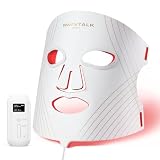
10. wavytalk Glow Time LED Face Mask – Best Multi-Colour Mode Set
wavytalk Red Light Therapy Mask for Face, Glow Time LED Face Mask 850nm NIR
630nm red, 850nm NIR, 415nm blue, 590nm amber
456 high-purity LED chips
40mW/cm2
10, 15 or 20-minute sessions
Pros
- Four wavelengths including amber at 590nm
- soft liquid silicone with light-sealing eye pads and adjustable straps
- targeted delivery to the T-zone and U-zone
- 2500mAh battery with safety lock charging
Cons
- Several owners report units shorting out or dying within months
- 30-minute setting described in the manual is not selectable
- 5V/1A charger not included
- 4.1 average sits at the lower end of the roundup
The wavytalk covers four wavelengths, which is as broad a channel set as anything in this roundup: red at 630 nm, near-infrared at 850 nm, blue at 415 nm and amber at 590 nm. Delivered across 456 high-purity LED chips at 40 mW/cm². If you want one device that covers wrinkles, acne, redness and tone without a second purchase, the channel list is the argument for it.
The modes are organised by goal rather than by colour, which is the right instinct. Anti-Fine Line combines 630 nm red with 850 nm infrared, which is the closest thing here to a purpose-built wrinkle protocol. Anti-Acne pairs 415 nm blue with 630 nm red. Rejuvenation runs the 590 nm amber on its own. The targeting is described as delivering to the T-zone and U-zone, which is a sensible way to describe how the mask is shaped around the areas that show ageing first.
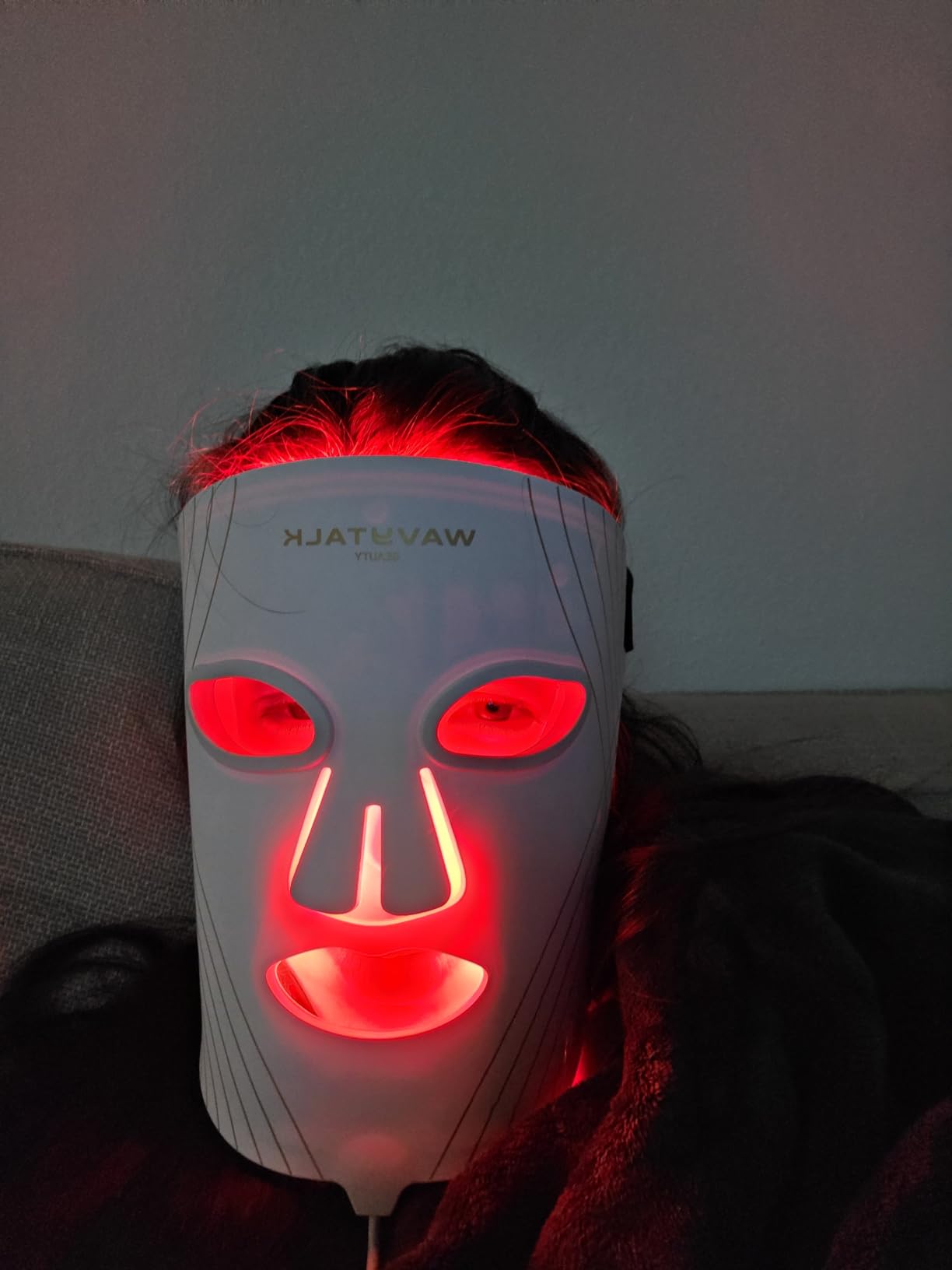
Construction is soft liquid silicone with light-sealing eye pads and adjustable straps, a 2500mAh battery with safety lock charging, and session settings at 10, 15 or 20 minutes with recommended use three to five times weekly. Comfort comes up repeatedly in the reviews, and the light-sealing eye pads are called out as a genuine positive rather than an afterthought.
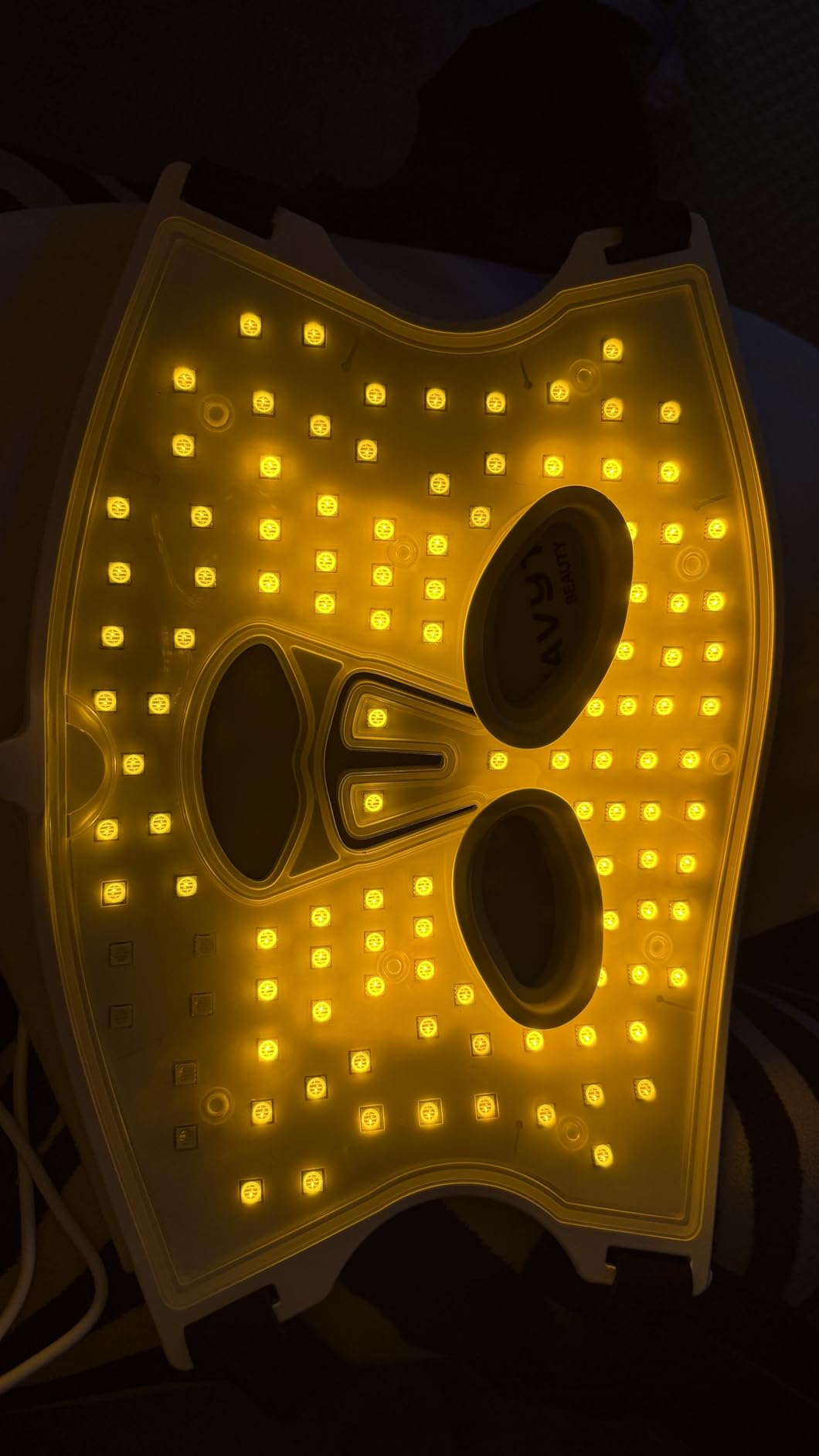
The problem is the review profile. At 350 reviews this is the smallest base in the roundup, and at a 4.1 average with 65 percent five-star and 14 percent one-star it is one of the more polarised score profiles here. The dividing issue is durability, and the reports are specific: several owners describe units shorting out or dying within months. One of those accounts mentions a fast replacement from the brand, which is worth something.
Two smaller frictions compound it. The manual describes a 30-minute setting that is not selectable on the device, which is the kind of small mismatch that erodes trust in every other number on the spec sheet. And a 5V/1A charger is not included, only a USB-C cable, so if you do not already own a suitable charger you will need to source one. The eye cut-out shape is also reported not to suit everyone.
Do you need a seven-colour mask for wrinkles?
No. Amber and green are nice-to-haves for redness and tone, and blue is for acne, but the wrinkle work is done in the red and near-infrared bands. A four-channel mask with 630 nm and 850 nm genuinely covers the anti-aging goal, and a two-channel mask with those two wavelengths covers it just as well.
Judge the extra channels by whether you will use them, not by whether they are impressive on a spec sheet. Buy a wide channel set if you know you want to treat acne and redness alongside wrinkles. Otherwise you are paying for a feature you will never touch, and the same money on a mask with better output on the two wavelengths that matter.
Who should skip the wavytalk?
Skip it if durability is your top concern. At 14 percent one-star concentrated on units dying within months, this is one of the riskier buys in the roundup, and no rating average compensates for a device that stops working in your fourth month. Confirm the warranty and return terms before you order.
Skip it if you want certainty on specifications. A manual that describes a setting the device does not have is a small signal about how carefully the rest of the documentation was checked, and for a buyer who reads spec sheets critically that is disqualifying.
How to Choose an LED Light Therapy Mask for Wrinkles
The mask that changes your skin is the one you use consistently, so start from your behaviour rather than the spec sheet. That is the single most useful piece of advice in this guide, and it is the one that maps most cleanly onto how people actually succeed or fail with these devices.
1. Choose on wavelength, not LED count. Look for red light between 630 and 660 nm, and near-infrared between 830 and 880 nm if you can get it. Those are the bands most associated with wrinkle work in the published literature. LED count is a coverage proxy, not a power proxy, and a mask with 272 well-placed diodes will outperform a mask with 360 scattered ones.
2. Understand irradiance and dose together. Irradiance is light power delivered per square centimetre, measured in mW/cm². Dose is irradiance multiplied by time. The worked example that makes this click: 20 mW/cm² over 600 seconds equals 12 J/cm² of energy. That is the number that actually describes what your skin received, and it is why two masks with the same session length can deliver very different amounts of light.
3. Read the measurement conditions, or assume the worst. Almost no consumer mask states the distance at which its irradiance figure was measured, and the same LED reads very differently at two centimetres versus five. A higher number is not automatically a better mask if the distance is unstated.
4. Judge fit by coverage and comfort, in that order. Check whether the mask reaches the jawline and chin, since facial sagging and jowls are where most people want help. Then check the weight and strap system, because a heavy mask that causes pressure headaches will not survive month three.
5. Prefer silicone over hard plastic. Flexible silicone follows facial curvature and holds LED-to-skin distance more consistently, which improves both coverage and dose uniformity. Rigid shells can deliver good light but drift, and drifting distance means an inconsistent dose from session to session.
6. Pick a protocol you can sustain. Six to ten minutes, three to five times a week, for a four to six week initial course. Anything that asks for twenty minutes daily will work better on paper and worse in practice for most people.
7. Check the return and warranty terms before you buy. Restrictive windows are the specific deal breaker that people in these communities complain about most, and they are also the thing that most changes the risk profile of an unknown brand. A device that fails in month two is a nuisance if you can return it and a write-off if you cannot.
8. Check eye protection. Look for a physical light barrier rather than relying on instructions. Crow’s feet treatment happens at the orbital rim, and masks that block direct eye exposure let you use a higher output comfortably and multitask while wearing them.
Results Timeline: What to Expect Week by Week
The most common reason people abandon these devices is a mis-set expectation, not a bad mask. Here is roughly what the biology supports, based on how collagen and elastin remodelling actually works and on the timelines owners describe in their reviews.
Week 1. Expect very little. Skin may feel warm, and you may notice an immediate plumpness that fades within a day or two. That initial effect is a temporary hydration and circulation change, not collagen, and it is the source of the scepticism that light therapy is a scam. It is real, and it is also not the result.
Weeks 2 to 3. Texture is usually the first thing owners report, along with a general brightness that they describe as healthy rather than dewy. Pigmentation and redness can begin to soften. The one warning sign here is a temporary flare or purge-like reaction in the first week, which owners frequently misread as either proof of efficacy or evidence of failure. It is neither.
Weeks 4 to 6. This is where the first real change shows. Fine lines around the eyes and the forehead begin to look shallower, and the Ulike reviews in particular describe a roughly four-week mark for visible fine-line improvement. If you have reached week six with nothing at all, check two things: whether you are actually completing three to five sessions a week, and whether you are using the red or near-infrared mode rather than the wrong channel.
Weeks 7 to 12. Collagen and elastin remodelling produces the firmer skin and improved elasticity that people describe as the payoff. Skin that looked softer at week six starts to look tighter. This is also the point at which the initial course ends and maintenance begins.
Beyond week 12. Results do not hold indefinitely without maintenance. Two to three sessions a week sustains most of the improvement; a few weeks away and the gains fade gradually over a couple of months. Give a skipped week back when you can, and do not treat a missed fortnight as a verdict on the device.
How to Layer LED Masks With Retinoids, Vitamin C and Sunscreen
Light therapy does not conflict with your existing routine as long as ordering is sensible, and there is a straightforward way to think about it. Retinoids and exfoliating acids work on a nightly cycle. Sunscreen is a morning requirement. Red light fits into either slot without competing.
For a morning routine, use the mask first on clean, dry skin, then apply vitamin C, then moisturiser, then SPF. Eight to ten minutes of light is a reasonable thing to do while the coffee brews. Avoid layering vitamin C underneath the mask, since the light is not doing work through a serum film and you will simply have product on your face for the duration.
For an evening routine, either use the mask on nights you are not applying a retinoid, or use it before your retinoid with a gap. The concern people raise most in skincare communities is that retinoids increase skin sensitivity and some photosensitising skin types can react to light exposure on the same night as a strong active. Alternating nights is the simplest solution and costs nothing.
Do not use a mask on broken, inflamed or actively flaring skin, and stop if you develop persistent peeling. Sustained use of a retinoid matters far more to the look of fine lines over a year than a session-level conflict you could have avoided by moving your schedule.
Safety, Side Effects and Who Should Skip an LED Mask
Red and near-infrared light is one of the better-tolerated things in at-home skincare, and adverse reactions are uncommon. The commonest reports are a temporary warm feeling, mild dryness or flaking after early sessions, and brief afterimage brightness when light leaks past the eye shields. All three resolve. The fourth, a temporary facial flush from a cool mask placed on warm skin, also resolves immediately.
Wearing a mask on broken, infected or actively inflamed skin is the one clear no. Applying it over a recent chemical peel, microdermabrasion or in-office laser or IPL treatment is also a no, and the waiting period is the interval your clinician specifies rather than a number you choose. Anyone with a history of photosensitivity, or who takes photosensitising medication, needs clearance from a dermatologist first.
Pregnancy and breastfeeding are areas where the evidence base is thin and the prudent position is to ask your doctor. Isotretinoin and similar oral retinoids carry their own light-sensitivity considerations, and you should not start light therapy while taking them without explicit medical advice.
Finally, the hygiene point that almost nobody mentions. Wipe the mask surface before and after every session, and do not share a mask. Skin-contact silicone harbours oil and bacteria, and a mask used weekly for months without cleaning is a low-grade infection risk that has nothing to do with light. It is the cheapest risk to eliminate in this entire guide.
Frequently Asked Questions
Do red light therapy masks really work for anti-aging?
The evidence supports a real but modest effect. Red light at 630 to 660 nm and near-infrared at 830 to 880 nm stimulate fibroblasts, increasing collagen and elastin production over a consistent course of use. Most people see texture change first, then visible softening of fine lines at around four to six weeks. Results depend far more on completing three to five sessions a week than on which mask you buy.
How long does red light therapy take to get rid of wrinkles?
It does not get rid of them, and any mask claiming otherwise is overselling. Expect texture and brightness changes in weeks two to three, the first visible softening of fine lines between weeks four and six, and firmer skin from week seven to twelve. Maintenance at two to three sessions a week is needed to hold the gains, and they fade gradually over a couple of months if you stop entirely.
What is the best wavelength for an LED face mask?
Red light between 630 and 660 nm for surface texture and fine lines, and near-infrared between 830 and 880 nm for deeper dermal work and collagen stimulation. A mask offering both is better than one offering either alone. Blue at 415 to 470 nm targets acne, and amber near 590 nm targets redness and tone. For wrinkles specifically, red plus near-infrared is the combination to look for.
Can you overdo red light therapy on your face?
Yes, and the usual result is dryness, flaking or a temporary flush rather than injury. More sessions are not better: there is a point past which extra time in a session stops adding benefit. Stick to a consistent protocol of ten minutes, three to five times a week, and start shorter if your skin is sensitive. Stop and speak to a dermatologist if you develop persistent peeling, redness or swelling.
Does more LEDs mean a better LED mask?
No, not reliably. LED count measures how many diodes a mask carries, which is mostly a coverage proxy, not a power or quality proxy. What determines dose is irradiance measured in mW/cm² multiplied by treatment time, and how evenly that light is distributed across the face. A 220-chip mask with tight optics can outperform a 360-chip mask with scattered low-output diodes.
Are expensive LED masks worth it?
Sometimes, but not for the reason most buyers assume. Higher prices buy materials, flex-fitting silicone shells, multiple wavelengths, cooling and brand support. The optical difference is usually smaller than the price gap suggests. The exception is deep near-infrared around 1072 nm, which genuinely reaches further than standard 830 to 850 nm. The best mask remains the one you will use every week for months.
Which LED mask is better, the Shark CryoGlow or a red and infrared mask?
The Shark CryoGlow wins on adherence and cooling. Its sessions run four to eight minutes, it is listed as FDA-cleared and tested on 119 participants by an independent third party, and the clip-on chill pads add a depuffing effect nothing else matches. A dedicated red and infrared mask wins on wrinkle work, because the Shark has no red light coverage under the eyes. Choose the one that matches your problem.
How often should I use an LED face mask?
Three to five times a week for an initial four to six week course is the protocol most consistent with the published research. Ten minutes per session is the sweet spot for most devices. After twelve weeks, two to three sessions a week maintains the improvement. Daily use is fine if the device is built for it, but the marginal benefit falls off and adherence, not frequency, is what determines results.
Final Verdict on the Best LED Light Therapy Masks for Wrinkles
If you want one recommendation from this roundup, take the NEWKEY 4D. It combines the largest review base in the category, a 630 nm red channel at up to 75 mW/cm², a contoured shell that holds a consistent light distance and a 10-minute automatic shut-off, which is a more reliable foundation than any spec-sheet superlative.
If your budget stretches further and you want a proven three-wavelength premium frame, the iRestore is the pick, with 635 nm red, 830 nm infrared and 415 nm blue across 360 LEDs and only 5 percent one-star ratings. If you want the shortest commitment, the Ulike at eight minutes a day is the most likely to survive contact with a busy week. If you want deep near-infrared and jawline coverage, the CurrentBody Series 2 is the only option in this guide that offers both, with the durability warnings spelled out above.
Whatever you choose, give it a four to six week initial course at three to five sessions a week before you judge it, and keep sunscreen in the routine. Light therapy is a supporting player with a good supporting cast, not a replacement for the boring basics that do most of the work.