
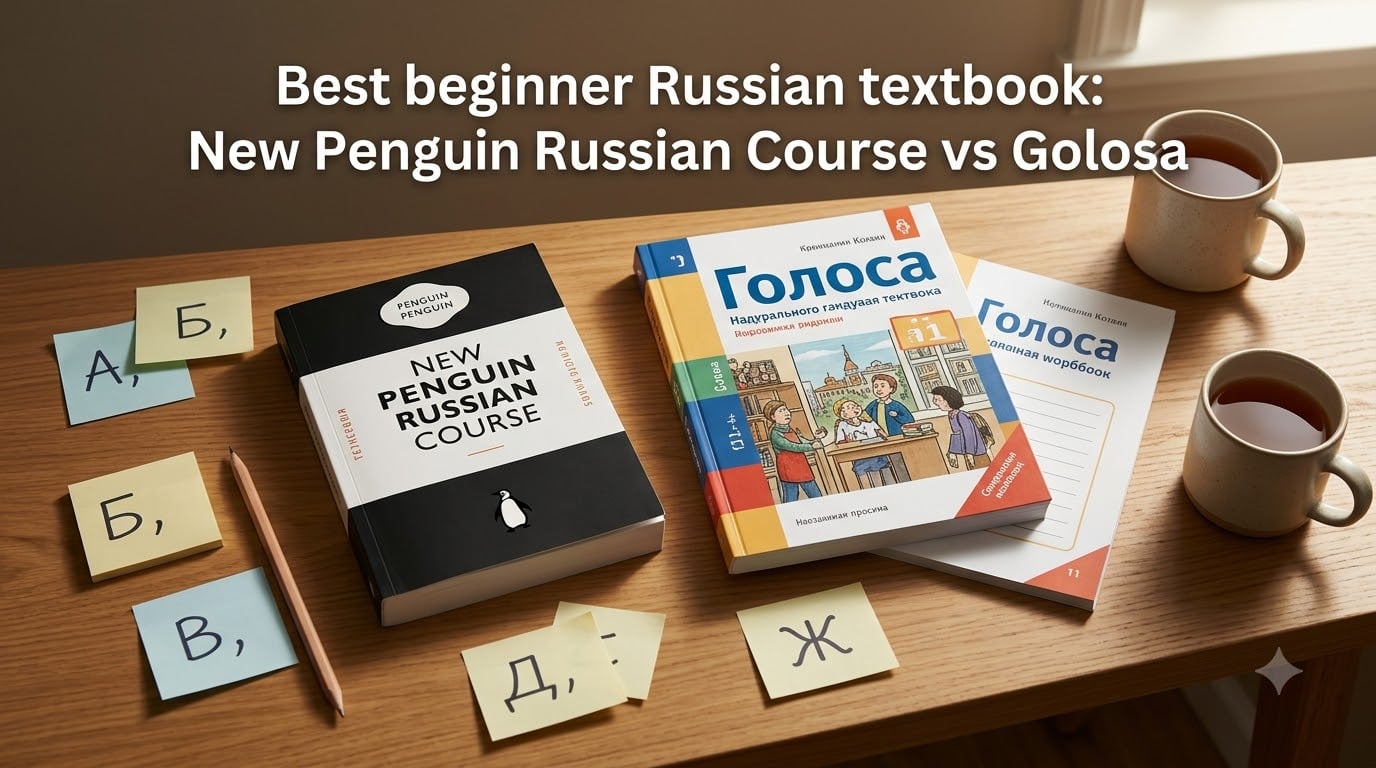
Choosing between the New Penguin Russian Course and Golosa is the first big decision most adult Russian learners face. Both books are widely adopted at universities, both carry decades of learner feedback, and both promise to take you from Cyrillic alphabet zero to confident beginner reading and conversation.
I have worked through chapters of both books over the past three years, and our team has gathered feedback from dozens of self-learners and university students. In this guide, I will walk you through what each book does well, where each one falls short, and how to pick the right one based on how you actually study. Whether you want a grammar reference you can dip into for years or a classroom-style curriculum with audio and video, the New Penguin Russian Course vs Golosa decision becomes much clearer once you know what is inside each cover.
Table of Contents
Quick Answer: Which Beginner Russian Textbook Should You Buy?
Pick the New Penguin Russian Course if you are a motivated self-learner who likes clear grammar tables, wants a portable reference, and does not need audio built in. Pick Golosa if you learn best through dialogues and audio, plan to take a guided class, or want a textbook that comes with a Student Activities Manual and video program.
Here are the five best beginner Russian textbooks our team considered for this comparison:
The New Penguin Russian Course by Nicholas Brown – best grammar reference for self-study
Golosa: A Basic Course in Russian, Book One (6th edition) – best classroom-style option with audio and video
Complete Russian by Dover Publications – best for casual learners who want a quick start
Russian for Dummies – best for absolute beginners who want an English-language on-ramp
The Oxford Russian Grammar and Verbs – best companion reference for grammar drilling
The rest of this guide focuses on the New Penguin Russian Course vs Golosa head-to-head, because these are the two textbooks most readers will actually choose between.
What Is the New Penguin Russian Course?
The New Penguin Russian Course is a 30-chapter beginner-to-intermediate textbook first published by Nicholas Brown in 1996, with later editions still widely used. It targets learners moving from absolute beginner up through ACTFL Intermediate-Mid, roughly A2-B1 on the CEFR scale, and it is the standard grammar-first textbook at many UK and Commonwealth universities.
The book opens with the Cyrillic alphabet, then walks through Russian cases (nominative, genitive, dative, accusative, instrumental, prepositional), verb conjugation, verb aspect (perfective and imperfective), and spelling rules. Each chapter combines a grammar explanation with vocabulary lists, short dialogues, translation drills, and written exercises. A Russian-English glossary sits at the back, and selected editions include an answer key for the exercises.
What makes NPRC distinctive is its compact, reference-style format. There is no audio supplement, no online platform, and no glossy color design – just dense, well-organized grammar pages that you can carry anywhere. For learners who treat Russian as a long-haul project, that simplicity is a feature, not a flaw.
What Is Golosa: A Basic Course in Russian?
Golosa: A Basic Course in Russian is a two-volume university textbook written by Robin, Evans-Romaine, and Shatalina, now in its 6th edition published in 2024. It is the most widely adopted beginner Russian textbook in US universities, and it targets the ACTFL Intermediate range across speaking, reading, and listening by the end of Book Two.
Each Golosa volume ships with a Main Textbook, a Student Activities Manual (SAM) full of laboratory drills and written exercises, a 15-hour audio program per volume, and access to MyRussianLab (Pearson’s online platform). A companion video program and online resources support communicative classroom work. The 6th edition refreshes vocabulary, cultural notes, and technology references that had aged since the previous edition.
The pedagogical model is a communicative spiral – students encounter target grammar and vocabulary inside goal-based units (such as “Talking about family” or “At the post office”), then revisit and expand those structures in later chapters. This approach mirrors how the ACTFL proficiency guidelines describe real language growth.
New Penguin Russian Course vs Golosa: Side-by-Side Comparison
The summary below compares the New Penguin Russian Course and Golosa across the attributes that matter most when picking a beginner Russian textbook.
The New Penguin Russian Course is a single paperback volume of around 530 pages, divided into 30 chapters. It was first published in 1996 by Nicholas Brown and targets beginner to Intermediate-Mid on the CEFR (A2-B1). Its pedagogical approach is grammar-first and linear, with no audio supplement and no video program. There is no online platform and no Student Activities Manual, although a Russian-English glossary is included and an answer key is available in selected editions. NPRC is best suited for self-learners and grammar-first learners, with light (and somewhat dated) cultural notes. It is the standard textbook at UK and Commonwealth universities.
Golosa (6th edition) is a two-volume set plus SAM, with around 400 pages per volume. It was first published in 1992, with the 6th edition released in 2024 by Robin, Evans-Romaine, and Shatalina. It targets beginner to ACTFL Intermediate (B1). Its pedagogical approach is a communicative spiral, and it includes a 15-hour audio program per volume, a companion video program, MyRussianLab (Pearson’s online platform), a Russian-English glossary in each volume, and the SAM with an answer key. Golosa is best suited for classroom learners and guided study, with cultural notes updated in the 6th edition. It is the standard textbook at US universities.
This side-by-side is the cleanest way to see the New Penguin Russian Course vs Golosa differences at a glance. NPRC is portable and grammar-dense; Golosa is a multi-component curriculum that needs shelf space and ideally a class.
Pedagogical Approach: Grammar-First vs Communicative Spiral
The New Penguin Russian Course treats grammar as the spine of the course. Each chapter introduces a small set of rules – a new case, a new verb conjugation pattern, or an aspect pair – and drills them through translation exercises and short answer prompts. Vocabulary is grouped thematically per chapter, and dialogues illustrate the grammar in context rather than drive the lesson.
Golosa flips that model. Each unit starts with a real-world communicative goal, such as “ordering food” or “asking for directions,” then pulls the grammar and vocabulary out of the dialogue. Students practice through pair work, role-plays, listening comprehension, and SAM drills before circling back to a grammar reference section.
Neither approach is wrong, but they reward different kinds of learners. If you have studied Latin, German, or another inflected language and you want a textbook that respects grammar as a system, NPRC feels like home. If you learn the way the ACTFL guidelines describe – by absorbing patterns through meaningful communication – Golosa feels more natural.
Audio, Pronunciation, and Companion Resources
Audio is the single biggest practical gap between these two textbooks. The New Penguin Russian Course ships without any audio supplement. You will need to pair it with a separate resource – Forvo, a YouTube channel, a tutor, or an app – to hear how Russian cases, verb endings, and stress patterns actually sound.
Golosa includes a 15-hour audio program per volume, with native speakers modeling the dialogues and pronunciation drills. The 6th edition also brings a refreshed video program and full access to MyRussianLab, where students can submit SAM exercises, watch video episodes, and track progress online.
For pronunciation practice, Golosa is the stronger choice out of the box. For learners who already work with a tutor or a podcast like Russian with Max or Slow Russian, NPRC’s lack of audio is a smaller drawback, and you can build your own listening playlist to pair with each chapter.
Self-Study vs Classroom: Which Book Fits Where?
Both books can work for self-study, but the New Penguin Russian Course is the friendlier companion for solo learners. Its layout is linear, its grammar explanations are written for the individual reader, and its exercises can be checked against an answer key in selected editions.
Golosa was designed for the university classroom. The SAM assumes a partner for pair drills, the video program assumes group discussion, and many of the activities expect a teacher to model pronunciation and correct usage. Some self-learners do use Golosa successfully, but reviewers report that the communicative-first presentation can confuse true beginners who have not seen the underlying grammar explained yet.
If you are learning alone and want a single book that does not require a class to make sense, NPRC is the safer bet. If you are auditing a course, joining a study group, or working with a private tutor, Golosa’s classroom-oriented design becomes an asset.
Pros and Cons of the New Penguin Russian Course
Here are the strengths and limitations our team found when working through NPRC.
On the strengths side, NPRC delivers clear, systematic grammar explanations across 30 chapters. It uses a compact single-volume format you can carry with you. It includes a built-in Russian-English glossary and offers excellent long-term reference value. It is also affordable and widely available secondhand.
On the limitations side, NPRC ships with no audio supplement at all. The cultural references and vocabulary feel dated because of the 1996 origin. The answer key is available only in selected editions. The translation drills can feel repetitive for some learners, and there is no video or online companion platform.
Reviewers on Goodreads and r/russian consistently call NPRC the best grammar reference for beginner Russian while flagging the missing audio as the main reason to pair it with a second resource.
Pros and Cons of Golosa
Golosa’s 6th edition is a substantial upgrade over earlier printings, but it still has trade-offs worth knowing.
On the strengths side, Golosa includes a 15-hour audio program per volume with native speakers, a companion video program, and MyRussianLab online access. It updates cultural notes and vocabulary in the 6th edition, is widely adopted at US universities with a strong resale market, and uses a spiral approach that reinforces structures across chapters.
On the limitations side, the two-volume set plus SAM can feel overwhelming for solo learners. The communicative-first approach can confuse absolute beginners. The total cost is higher than a single NPRC paperback. Some learners report phrases being introduced before their grammar breakdowns, and the best results assume a class, tutor, or study group.
A 2024 BYU scholarly review of the 6th edition praised the modernization effort, noting that Golosa now reflects current technology and society better than the 5th edition did.
What Russian Learners Say on Reddit and Forums
Learner sentiment on r/russian and masterrussian splits along the same lines as the textbook design. Multiple threads describe NPRC as a great reference grammar book but not a standalone course – you need an audio source to go with it. Reviewers also note that the 1996 publication date shows in cultural references, though the grammar itself has not gone out of date.
For Golosa, the Reddit mood is more mixed. Some learners love the dialogues and the SAM, and instructors praise the 6th edition’s modernization. Others report that Golosa can be confusing because complete phrases appear before the grammar behind them is broken down – a pattern that works in a classroom with a teacher but trips up solo beginners. A recurring comment on r/russian notes that some university instructors actively steer beginners away from Golosa for self-study.
On Goodreads, NPRC averages around 4.2 stars, with reviewers calling it the best book for beginner Russian while wishing for an audio companion. Together, the forum signal points to NPRC as the safer self-study choice and Golosa as the stronger classroom choice.
Who Should Pick the New Penguin Russian Course?
Pick NPRC if any of the following sounds like you. You are a self-learner who likes to see grammar rules laid out clearly. You want a portable textbook you can keep on a desk or in a bag. You already use audio resources like podcasts, Forvo, or a tutor and do not need audio baked into the book. You plan to keep the book for years as a reference even after you finish the chapters.
NPRC also fits learners who have studied Latin, German, Greek, or another inflected language and feel comfortable with case systems. The book’s grammar-first pacing rewards that prior intuition.
Who Should Pick Golosa?
Pick Golosa if any of the following sounds like you. You are taking a university course, joining a study group, or working with a private tutor who can guide the communicative activities. You learn best by hearing Russian before reading about it. You want audio, video, and MyRussianLab access in the same package. You want a curriculum that is regularly updated, and the 6th edition reflects 2024 changes in technology and culture.
Golosa is also the right pick for instructors choosing a textbook for a first-year Russian sequence, since the SAM, audio, and video are already aligned with the lesson goals.
What to Read After NPRC or Golosa
Once you finish either textbook, you will want a few companion resources for the next stage of study. Here are three good options for each path.
After the New Penguin Russian Course, consider the Pocket Penguin Russian Dictionary for quick lookups, the Oxford Russian Grammar and Verbs for verb reference, and a graded reader such as the Penguin Russian Reader to practice longer passages.
After Golosa Book One, consider Golosa Book Two to finish the ACTFL Intermediate sequence, a reader from the Russian for Russians series to stretch into authentic texts, and a communicative resource such as a weekly tutor call to keep speaking skills sharp.
Frequently Asked Questions
Is the New Penguin Russian Course for beginners?
Yes. The New Penguin Russian Course starts with the Cyrillic alphabet and walks absolute beginners through 30 chapters covering Russian cases, verb conjugation, and verb aspect up to roughly ACTFL Intermediate-Mid or A2-B1 on the CEFR scale.
What is a good textbook for learning Russian for beginners?
For motivated self-learners, the New Penguin Russian Course is a strong pick because of its grammar-first layout and built-in glossary. For classroom learners, Golosa: A Basic Course in Russian (6th edition) is a strong pick because it bundles a Main Textbook, Student Activities Manual, audio, and video.
What are the best Russian language books for beginners?
Our top five picks are the New Penguin Russian Course, Golosa Book One (6th edition), Complete Russian, Russian for Dummies, and the Oxford Russian Grammar and Verbs. Among these, NPRC and Golosa are the two that scale to ACTFL Intermediate, while the others work best as supplements.
Is The New Penguin Russian Course a good choice?
Yes, especially as a long-term grammar reference. Reviewers on r/russian and Goodreads consistently call it the best grammar reference for beginner Russian, with the main caveat that it ships without audio so you need to add a separate listening resource.
Which textbook should I use after finishing The New Penguin Russian Course?
Good follow-ups include the Pocket Penguin Russian Dictionary for quick lookups, the Oxford Russian Grammar and Verbs for verb drills, and a graded reader such as the Penguin Russian Reader to practice longer passages.
Is Golosa good for self-study?
Golosa can work for self-study but it is designed for the classroom. The Student Activities Manual and video assume a partner or instructor, so true beginners often find NPRC easier to use alone. If you do study Golosa solo, pair it with a tutor or study group to get full value from the communicative drills.
Final Verdict: Which Beginner Russian Textbook Should You Buy?
For self-study, the New Penguin Russian Course is the cleaner choice. It is portable, grammar-dense, and built for the individual reader, and you can pair it with free audio sources to fill the pronunciation gap. For guided study, Golosa wins. Its 6th edition audio, video, SAM, and MyRussianLab access give a classroom everything it needs in one package.
If you are still undecided in the New Penguin Russian Course vs Golosa decision, start with NPRC for the first month. Work through the Cyrillic introduction and the first five chapters. If you find yourself craving dialogues, audio, and a class structure, switch to Golosa. If you prefer the steady grammar-first pace, keep going with NPRC. Either path will take you to ACTFL Intermediate if you put in the hours – and that is the real difference between learners who finish and learners who stall.