
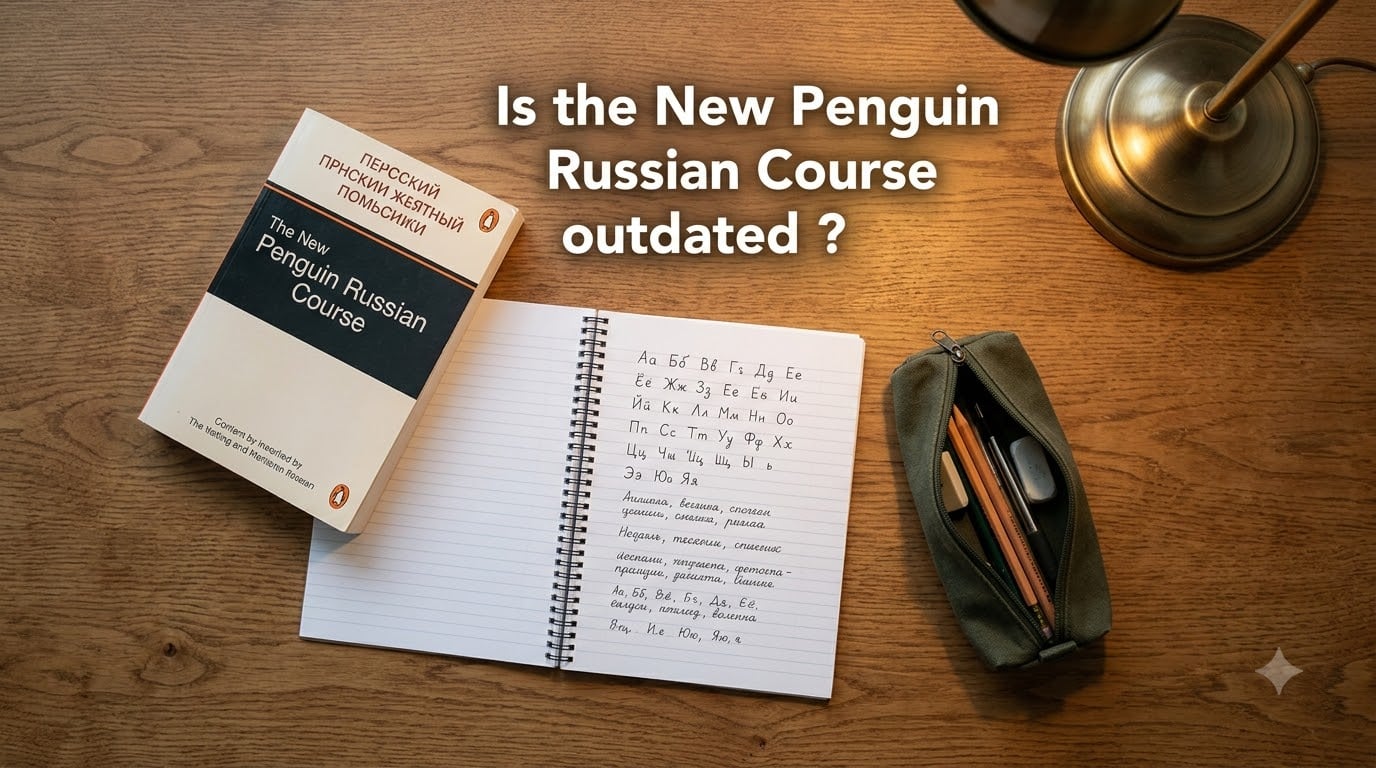
The New Penguin Russian Course is not outdated in 2026. Its core content — Russian grammar rules, the six-case system, verb conjugation patterns, and aspect distinctions — has remained fundamentally unchanged since the book was published in 1996. However, some vocabulary, cultural references, and the complete absence of audio materials reflect its era and may require modern supplements for today’s learners.
Table of Contents
What Is the New Penguin Russian Course?
The New Penguin Russian Course (NPRC) is a 528-page self-study Russian textbook written by Nicholas J. Brown and published by Penguin Books in 1996. It contains 30 lessons that systematically cover the Cyrillic alphabet, all six Russian grammatical cases, verb conjugation, noun declension, verb aspect, and spelling rules.
Each lesson includes exercises with an answer key, a Russian-English glossary, and an English-Russian glossary. The book was designed as a comprehensive course for English-speaking beginners and has remained in print for nearly three decades. As of 2026, there is no revised edition — the version you buy today is the same text from 1996.
How Has the Russian Language Changed Since 1996?
The short answer is: not much, and certainly not enough to make NPRC obsolete. Russian grammar is conservative and slow-moving. The fundamental rules governing cases, verb aspect, and sentence structure that Brown teaches in NPRC are identical to what any modern Russian textbook covers.
That said, a few areas have shifted over the past 30 years:
Loanwords and technology vocabulary. Russian has absorbed hundreds of new words since 1996, especially related to technology. Words like компьютер (computer), интернет (internet), and смартфон (smartphone) did not exist when NPRC was written. However, these are vocabulary items, not grammar rules — and NPRC focuses on grammar, not conversation.
Orthographic reforms. Russia made minor spelling rule adjustments in 2006, but these were largely cosmetic and did not change the fundamentals Brown teaches. If you learn from NPRC and encounter a modern Russian text, you will not notice any discrepancies in spelling rules.
Cultural references. Some of NPRC’s example sentences reference the Soviet-era cultural context, which can feel dated to modern learners. References to specific institutions, social norms, and political structures from the 1990s may confuse learners encountering 2026-era Russian media.
Registers and colloquial speech. Modern Russian has evolved in informal registers — slang, social media language, and youth speech patterns have shifted. NPRC teaches formal, literary Russian, which is excellent for reading and writing but may not prepare you for casual conversation with native speakers.
What the New Penguin Russian Course Still Gets Right
NPRC remains one of the most thorough beginner-to-intermediate Russian textbooks available. Here is why it still works in 2026:
Complete grammar coverage. Brown covers all six Russian grammatical cases with full declension tables, verb conjugation patterns, and the tricky distinction between imperfective and perfective verb aspects. This grammar-first approach gives learners a structural foundation that many modern apps lack.
Systematic progression. The 30 lessons build on each other logically. Each chapter introduces new grammar, provides examples, and reinforces previous material through exercises. Learners on r/russian frequently recommend working through NPRC slowly — one chapter per week — because the pacing rewards patience.
Comprehensive exercises with answers. Every lesson includes practice exercises, and the answer key lets self-study learners check their work. This is a significant advantage over many modern textbooks that omit answer keys or push learners to online platforms.
Detailed reference tables. The declension and conjugation tables in NPRC are some of the most detailed in any beginner textbook. Even learners who complete the book keep it on their shelf as a reference resource — a use that has nothing to do with whether the content is current.
Thorough coverage of spelling rules. Russian spelling rules (governed by vowel position and consonant clusters) are taught systematically throughout the book. These rules have not changed and are unlikely to change.
Where NPRC Shows Its Age in 2026
No book is perfect, and NPRC has clear weaknesses that become more noticeable as time passes.
No audio component. This is the most frequently cited complaint among learners. NPRC was published without any accompanying audio materials — no CDs, no downloads, no companion recordings. For a language where pronunciation and listening comprehension are critical, this is a genuine gap. Learners on forums consistently report that pairing NPRC with a podcast or audio resource is essential, not optional.
Dated example sentences. Some vocabulary and cultural references in the example sentences reflect the 1990s. Learners studying from NPRC may find that certain words or phrases feel out of place in modern Russian media.
Limited vocabulary scope. The glossaries contain approximately 1,500 words total. While this is enough to work through the lessons, it is insufficient for reading modern Russian texts, following conversations, or using Russian in real-world settings.
Early pacing can frustrate beginners. Several learners report that the first few chapters move slowly, covering basics that more modern courses teach more efficiently. The pace picks up significantly in later chapters, which can create an uneven learning experience.
No digital or interactive elements. NPRC is a purely print-based textbook. It has no app, no online exercises, no spaced repetition integration, and no progress tracking. In 2026, many learners expect at least some digital component.
Who Should Still Use the New Penguin Russian Course?
NPRC is still the right choice for certain learner profiles in 2026:
Grammar-focused self-studiers. If you want a complete, systematic grammar foundation and you are willing to supplement with audio resources, NPRC remains one of the best options available. Its depth of coverage is difficult to match.
Heritage Russian learners. If you grew up hearing Russian at home and want to formalize your knowledge of grammar rules, NPRC’s structured approach can fill gaps that everyday exposure leaves.
University students and TORFL candidates. NPRC covers grammar topics through the A1-A2-B1 levels of the Common European Framework. Its exercise-based approach aligns well with academic study methods.
Learners who prefer print. If you learn better from a physical book than from apps, NPRC is a comprehensive, self-contained course that does not require internet access.
NPRC may not be the best fit if you are a complete beginner who needs audio guidance, if you want conversational Russian quickly, or if you prefer interactive, app-based learning. For those learners, alternatives like the Russian Made Easy podcast combined with a modern textbook may work better.
How to Supplement NPRC with Modern Resources in 2026
The consensus among experienced learners is that NPRC works best when paired with modern tools. Here is what 2026 learners use alongside it:
Russian Made Easy Podcast. This free podcast is the most commonly recommended audio companion for NPRC. It covers pronunciation, listening comprehension, and conversational Russian in a structured format that complements NPRC’s grammar-heavy approach.
Language learning apps. Apps like Duolingo, Babbel, or Busuu can fill NPRC’s vocabulary gaps and provide interactive practice. They are not substitutes for grammar instruction, but they address the vocabulary and listening weaknesses.
YouTube channels. Channels focusing on Russian pronunciation and listening practice can replace the audio component NPRC lacks. Many learners recommend watching Russian content with subtitles to build listening skills.
A modern Russian-English dictionary. NPRC’s glossaries are limited to 1,500 words. A dedicated dictionary — print or digital — is essential for expanding vocabulary as you progress through the lessons.
Anki or other spaced repetition tools. Creating flashcard decks for the vocabulary and grammar paradigms in NPRC can significantly improve retention and address the book’s lack of built-in review systems.
Frequently Asked Questions
Is The New Penguin Russian Course good for beginners?
Yes, NPRC is well-suited for beginners who want a thorough grammar foundation. Its 30 lessons progress systematically from the Cyrillic alphabet through intermediate grammar. However, absolute beginners with no language-learning experience may find the early chapters slow and the lack of audio frustrating. Pairing it with a podcast or audio resource is strongly recommended.
Does The New Penguin Russian Course include audio?
No, NPRC does not include any audio materials — no CDs, downloads, or companion recordings. This is its most significant weakness. Learners consistently recommend pairing NPRC with the Russian Made Easy podcast or similar audio resources to develop pronunciation and listening skills.
How long does it take to finish The New Penguin Russian Course?
Most self-study learners complete NPRC in 6-12 months, working at a pace of one chapter per week. The book contains 30 lessons with exercises, and rushing through them defeats the purpose. Learners on Reddit recommend a slower pace for better retention, with some taking over a year to complete all 30 chapters.
Is The New Penguin Russian Course better than Duolingo?
NPRC and Duolingo serve different purposes. NPRC provides deep, systematic grammar instruction that Duolingo cannot match. Duolingo offers vocabulary building, listening practice, and interactive exercises that NPRC lacks. Most experienced learners recommend using both together rather than choosing one over the other.
What should I buy with The New Penguin Russian Course?
The most important companion is an audio resource — the Russian Made Easy podcast is free and highly recommended. You should also consider a modern Russian-English dictionary to supplement NPRC’s limited glossaries, and optionally a language app like Duolingo for vocabulary practice and listening comprehension.
Is The New Penguin Russian Course worth it?
Yes, NPRC is worth buying in 2026 if you want a comprehensive grammar foundation for Russian. It is still one of the most thorough beginner-to-intermediate textbooks available. Its grammar coverage, exercise system, and reference tables remain unmatched by most modern alternatives. The key is to supplement it with audio resources and vocabulary-building tools.
Final Verdict: Is the New Penguin Russian Course Outdated in 2026?
The New Penguin Russian Course is not outdated — it is incomplete for modern learners. Its grammar instruction remains excellent and up-to-date because Russian grammar has not fundamentally changed since 1996. The case system, verb aspect, conjugation patterns, and spelling rules that Brown teaches are exactly what you need to read, write, and understand Russian.
What has changed is how people learn languages. In 2026, we expect audio, interactive exercises, and digital tools. NPRC provides none of these. But that does not make the book outdated — it makes it a foundation that needs modern supplements.
If you are serious about learning Russian grammar thoroughly, NPRC is still one of the best investments you can make. Pair it with the Russian Made Easy podcast for audio, a language app for vocabulary and listening practice, and a modern dictionary for expanding your word knowledge. With those supplements, a book from 1996 can absolutely be your primary Russian resource in 2026.