
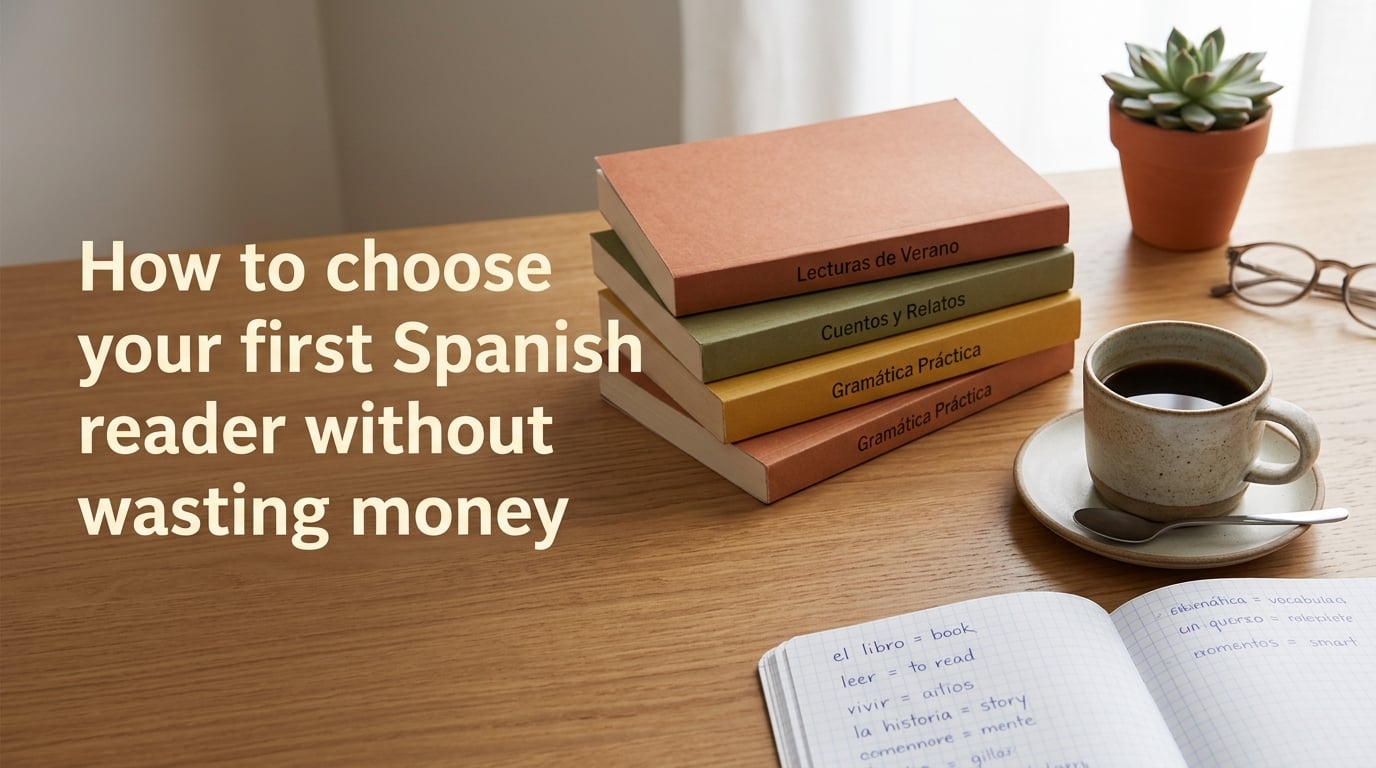
Most people who try to learn Spanish by reading pick the wrong book on the first try. They buy something beautiful on Amazon, flip to page one, hit a wall of unfamiliar verbs, and quietly shelve it forever. That’s the “wasting money” problem this guide is built to solve.
I’m going to walk you through exactly how to choose your first Spanish reader – the right level, the right format, and the right price – so you start with a book you can actually finish. No fluff, no affiliate hype, and no recommendations you can’t test for free first.
Table of Contents
Tips for Choosing Your First Spanish Book
- Match your level first. Absolute beginners need A1, not “classic literature.”
- Keep it short. Aim for 100 to 150 pages so you can finish in 3 to 4 weeks.
- Pick a format that fits your style. Graded readers, parallel texts, and familiar stories all work.
- Test before you spend. Use the Kindle sample, a library app, or a free PDF first.
- Re-read, don’t rush. Finishing a short book twice beats struggling through a long one.
- Choose what you already enjoy. Familiar plots carry you through unknown vocabulary.
- Skip the dictionary for the first read. Guess from context; only look up words that block the meaning.
What Counts as a ‘Spanish Reader’ Anyway? (And Why the Type Matters)
The phrase “Spanish reader” gets thrown around like it’s one thing, but there are actually four very different formats on the market, and each one fits a different kind of learner.
A graded reader is a book written specifically for language learners. The author controls the vocabulary and grammar to a target level – usually labeled CEFR A1, A2, B1, or B2 – and the result reads like a story written in simple Spanish. Think short chapters, repeating sentence patterns, and a glossary in the back. The classic “First Spanish Reader” from Dover and the “Easy Spanish Reader” by Tardy fall in here.
A parallel text (also called a dual-language book or bilingual edition) puts the Spanish on one page and the English translation on the facing page. You read a paragraph in Spanish, then check the English only when you’re lost. Penguin Parallel Texts and many of Olly Richards’ short story collections use this format.
A children’s book in Spanish is just what it sounds like – books written for native Spanish-speaking kids. They’re often short, use simple present-tense verbs, and rely on repetition. Many adult learners swear by El principito (The Little Prince) and Manolito Gafotas.
An authentic beginner book is a real book written for adults in plain language – not for children, not simplified for learners, but accessible because the author chose simple language naturally. “La casa en Mango Street” by Sandra Cisneros is the most common example.
Why does the type matter? Because picking the wrong one is how most people waste money. A graded reader at A2 will feel boring to someone at B1. A children’s book will feel patronizing to an adult who just wants to read something grown-up. A parallel text is wonderful for short sessions but can become a crutch if you never push past it. Each format has its place, and your job is to pick the one that matches your level, your personality, and your goal for the next month.
Graded Reader vs. Parallel Text vs. Children’s Book vs. Authentic Beginner Book
Here’s the side-by-side comparison. Use it to pick a format before you pick a specific title.
| Format | Level fit | Pros | Cons | Best for |
|---|---|---|---|---|
| Graded reader | A1 to B1 | Level is labeled; vocabulary is controlled; finishable in weeks | Can feel artificial; short shelf life once you level up | True beginners who want a guaranteed level match |
| Parallel / dual-language | A2 to B2 | Read Spanish first, English as backup; great for short stories | Tempting to lean on English; not a true “reading” workout | Learners who want confidence and a story they can finish |
| Children’s book | A1 to A2 | Short chapters, simple verbs, often free online | Adults can feel patronized; plot may not interest you | Beginners who don’t mind short, simple language |
| Authentic beginner book | A2 to B1 | Reads like a “real” book; great cultural exposure | No built-in glossary; harder to find the right title | Learners who want to feel like they’re reading Spanish, not learning it |
A quick honesty note: I started with parallel texts because they felt the safest. A friend of mine swears by graded readers. Another friend jumped straight to El principito. All three of us are still reading Spanish years later. Pick the format that you’ll actually open tonight, not the one that looks best on a spreadsheet.
How to Know Your Level (CEFR A1 and A2 in Plain English)
Before you spend a single dollar, you need to know your level. Almost every beginner Spanish reader is labeled with a CEFR level – A1, A2, B1, B2, C1, C2. The “A” levels are beginner, “B” levels are intermediate, and “C” levels are advanced. For your first reader, you’re choosing between A1 and A2.
A1 (Beginner): You know the present tense, basic vocabulary (family, food, colors, numbers up to 100), and a few common verbs like ser, estar, tener, ir. You can read a short paragraph and recognize most words, even if you can’t say them yet.
A2 (Elementary): You can handle past tenses (pretérito and imperfecto), have around 1,000 to 1,500 words under your belt, and can read a simple newspaper headline without panicking.
Here’s a 60-second self-check. Open any Spanish news page (BBC Mundo or similar). Skim the first 200 words of an article. If you recognize at least 70 percent of the words and can roughly follow the topic, you’re at A2. If you’re drowning and need to look up one word in three, you’re at A1. If you understand almost everything, you’re at B1 and should be reading authentic books, not graded readers.
Don’t lie to yourself here. Most wasted money on Spanish books comes from someone at A1 buying a B1 book because they wanted a “real” book. The book didn’t get harder; the level just didn’t match.
Quick Picks: 7 First Spanish Readers Worth Your Money
These are seven books our team consistently recommends for first-time Spanish readers. Mix and match free and paid options to find your starting point.
1. “First Spanish Reader” (Dover Publications) – A1
A classic graded reader with simple adaptations of Spanish stories and bilingual notes. Excellent if you want a level-labeled book with a clear progression from very easy to slightly harder.
2. “A First Spanish Reader” (Project Gutenberg) – A1, free
A public-domain graded reader available as a free PDF and HTML. It’s older in tone, but for absolute beginners testing the waters at midnight, it costs nothing and works.
3. “Easy Spanish Reader, 3rd Edition” by William Tardy – A1 to A2
Three graded stories progressing in difficulty, with exercises at the end of each chapter. A classroom staple for a reason.
4. “Short Stories in Spanish for Beginners” by Olly Richards – A1 to A2
Eight short stories written specifically for learners, with a glossary on each facing page. The most popular parallel-text-style option in the beginner Spanish world.
5. “El principito” by Antoine de Saint-Exupéry (Spanish edition) – A2
Short sentences, a story you already know, and the kind of book you can finish in two sittings. Most beginners finish this and feel like they’ve read a “real” Spanish book.
6. “Manolito Gafotas” by Elvira Lindo – A2
A four-book series about a Spanish kid growing up in Madrid. Authentic Spanish, funny, and not patronizing for adult learners.
7. “La casa en Mango Street” by Sandra Cisneros (Spanish edition) – A2 to B1
Short vignettes, beautiful prose, and one of the most commonly recommended “first authentic book” choices across learner forums.
How to use this list: don’t buy all seven. Pick one free option and one paid option. Read the free one first to confirm your level, then decide if the paid one is worth the spend.
The Five-Finger Rule (and Other Ways to Test a Book Before You Buy)
The five-finger rule is a fast, free way to know if a book is at your level before you spend any money. Here’s how it works.
Step 1: Pick up the book, open to any random page (page 25 or later is usually a good test – the first 20 pages are often easiest).
Step 2: Read the first full paragraph.
Step 3: Hold up one finger for every word you don’t know.
Step 4: Count your fingers.
- 0 to 1 fingers: too simple. Move up a level.
- 2 to 3 fingers: just right. Buy it.
- 4 to 5 fingers: too hard for now. Pick something easier.
- More than 5 fingers: way too hard. Put it back and try a graded reader first.
The five-finger rule is brilliant because it works on a sample page, a library copy, or even a friend’s book. You don’t need to buy anything to test it.
But the five-finger rule isn’t the only way to test before you buy. Here are three more zero-risk options.
Use Kindle’s “Look Inside” or “Send a Sample” feature. Amazon lets you preview the first 10 to 20 percent of most Kindle books for free. That’s plenty of text to apply the five-finger rule.
Borrow the book from a library app. Apps like Libby and OverDrive let you borrow Spanish ebooks from your local library with just a library card. If your library doesn’t have the title, most apps let you put it on hold and they’ll email you when it’s available.
Read the free public-domain PDFs first. Project Gutenberg has “A First Spanish Reader” available as both HTML and a free PDF download. Other classics like “Platero y yo” by Juan Ramón Jiménez are also available as free ebooks.
The rule is simple: never spend money on a Spanish book you’ve never read at least one chapter of in some form. If you can’t preview it, you probably shouldn’t buy it yet.
Free vs. Paid: How to Avoid Wasting Money on the Wrong Book
This is the section I wish someone had written for me three Spanish books ago. Most beginner Spanish learners don’t have a budget problem – they have a “bought the wrong book three times in a row” problem. Here’s a tier-by-tier framework that fixes that.
Tier 1: $0 – Test your level first
Before you pay for anything, use free tools to confirm your level.
- Project Gutenberg’s “A First Spanish Reader” – free PDF, A1
- BBC Mundo – free news to self-assess your level
- Your local library’s digital collection via the library app – free borrow
- Kindle sample / “Look Inside” on Amazon – free preview of any Kindle book
Goal: confirm your level and find one free book you actually enjoy.
Tier 2: Low cost – Buy one paperback or Kindle
If you’ve completed at least one free book and want more, buy one book at a low entry point.
- Used paperback from a thrift shop or second-hand site
- Kindle ebook (no shipping, often cheaper than print)
- Paperback from a local used bookstore
Goal: have one physical or digital book you can hold, mark up, and finish.
Tier 3: Higher investment – Build a small library
Once you know you can finish a Spanish book, you can invest a little more.
- Buy a graded reader series you can progress through (Tardy’s Easy Spanish Reader line)
- Get a parallel-text collection you can read and re-read
- Buy the physical edition of a book you’ve already finished digitally
Goal: build a small library of 3 to 5 books at your current and next CEFR level.
Recovery plan if you bought the wrong book
You bought a book and it’s way too hard. Now what? Three options.
Return it. Amazon’s Kindle returns are painless for ebooks bought within the last 7 days. Paperbacks can usually be returned within 30 days if unopened or in like-new condition. Don’t feel guilty – this is exactly what the return policy is for.
Swap it. Bring it to a used bookstore, list it on a second-hand site, or give it to a friend. Money back isn’t the point – getting the wrong book off your shelf is.
Downgrade. Put the too-hard book on a shelf for three months. Pick up an A1 graded reader now. Come back to the harder book when you’ve leveled up. There’s no rule that says you have to read every book the moment you buy it.
How to Actually Read Your First Spanish Book (Without Burning Out)
Choosing the right book is half the battle. The other half is reading it without giving up at chapter 3. Here’s the three-phase routine that works for most beginners.
Before you read: set up for success
Pick a time and place you can stick to – 10 to 15 minutes a day, same chair, same time. Reading is a habit, and habits need a trigger. Don’t tell yourself you’ll read “whenever I have time.” You’ll never have time.
Decide on a “look up” rule. My personal rule: if I can’t guess the word from context and it’s blocking the meaning of the sentence, I look it up. Otherwise, I skip it. Looking up every unknown word is the #1 reason beginners quit.
During the read: trust context
Read one paragraph in Spanish first. Don’t flip to the English yet. Try to get the gist. If you’re truly stuck, peek at the English. Then re-read the Spanish paragraph.
Mark words you skipped, but don’t write them down yet. Just mark them. You’ll re-read the book, and on the second read, you’ll see how many of those “unknown” words you can now figure out from context. That’s how the language sticks.
After the read: lock it in
Finish a chapter, then close the book. Don’t rush to the next one. Take a day off or re-read the chapter you just finished. The re-read is where the magic happens – that’s when grammar and vocabulary start to feel natural instead of foreign.
After two or three re-reads of the same short book, you’ll notice something strange: you understand more than you think you do. That’s the point.
One quick confidence boost for chapter one: cognates. Spanish and English share thousands of words with the same meaning – “important,” “situation,” “animal,” “momento,” “problema.” When you see these, you don’t need to translate them. You already understand them. Skim the first chapter looking for cognates, and you’ll realize you understand 20 to 30 percent more than you thought.
Common Beginner Mistakes (What Reddit Learners Wish They’d Known)
I spent a few evenings reading through r/Spanish and similar forums to find what real beginners regret. Five mistakes repeat over and over.
1. Starting with Harry Potter. Yes, you know the plot. Yes, that’s an advantage. But the Spanish translation uses complex past tenses, formal vocabulary, and longer sentences than the English original. Most beginners who try HP first give up within 30 pages. Wait until you’re at B1.
2. Starting with García Márquez or Cortázar. Beautiful books, wrong level. Magical realism uses metaphor-heavy prose, irregular past tenses, and cultural references even native speakers debate. Save it for later.
3. Buying an expensive edition before knowing your level. Hardcovers and leather-bound Spanish classics look beautiful on a shelf. They also collect dust if you can’t read them. Start cheap, upgrade later.
4. Looking up every unknown word. Beginners who hit the dictionary on every new word turn reading into a translation exercise. They burn out fast. Trust context. Skip the word. Re-read later.
5. Treating graded readers as “cheating.” They’re not. They’re a tool. Every published author of Spanish-learning materials I know recommends starting with graded readers. There’s no shame in scaffolding.
If you’ve already made one of these mistakes, you’re in good company. Most Spanish learners on Reddit report the same regrets. The good news: every one of them is fixable. Return the book, pick up a graded reader, and try again.
Bonus: Where a First Reader Fits in Your Overall Spanish Plan
A first reader isn’t the end goal – it’s a bridge. Here’s how it fits into a long-term Spanish plan.
A1 (true beginner): Focus on building vocabulary and getting comfortable with present tense. Your first reader should be a graded reader or parallel text. Goal: finish one book.
A2 (elementary): Add past tenses. Move to slightly harder graded readers and short authentic books like El principito. Goal: finish a second book, ideally one with no English backup.
B1 (intermediate): Time for authentic books. La casa en Mango Street, Manolito Gafotas, short novels by contemporary Spanish authors. Goal: read a real book in Spanish without flipping to English.
B2 (upper intermediate): Now you can read newspaper articles and most modern novels comfortably. You’re past the “first reader” stage. Many learners consider B2 “functional fluency” for reading purposes, even if speaking lags behind.
The point of the first reader is to get you from “I have a Duolingo streak” to “I finished a book in Spanish.” That’s the milestone that makes everything else feel possible.
Frequently Asked Questions
What is a good Spanish reading book for beginners?
For absolute beginners, the most consistently recommended first Spanish readers are graded readers like ‘First Spanish Reader’ (Dover) or ‘A First Spanish Reader’ (Project Gutenberg, free). At A1 to A2, ‘Short Stories in Spanish for Beginners’ by Olly Richards and El principito are the most-mentioned picks across learner forums.
What is a graded reader in Spanish?
A graded reader is a book written specifically for language learners with controlled vocabulary and grammar at a target CEFR level – usually A1, A2, or B1. The author deliberately limits word count and sentence complexity so the book reads as a story, not a textbook. Most have a glossary in the back.
Are bilingual editions worth it for Spanish?
Yes, especially for short stories and your first few books. Bilingual or parallel-text editions let you read Spanish first and check English only when stuck, which builds confidence. The risk is leaning on the English too much – use Spanish first, English as a backup, not the other way around.
Should I read children’s books in Spanish?
Children’s books are a valid first step, especially if you find one with a plot you actually enjoy. They use simple present-tense verbs, short sentences, and lots of repetition. The downside is some learners find them patronizing as adults. If that bothers you, switch to a graded reader instead.
How do I know if a Spanish book is too hard?
Use the five-finger rule: open to a random page, read one paragraph, hold up a finger for each unknown word. Zero to one fingers is too easy, two to three is just right, four or more is too hard. Test on a free sample chapter or library loan before buying.
What is the 80/20 rule for Spanish?
The 80/20 rule for Spanish learning says that roughly 20 percent of the language’s most common words cover about 80 percent of everyday speech and writing. Focus on mastering the 1,000 to 2,000 most frequent Spanish words first – they unlock most beginner reading material faster than studying grammar in isolation.
What is the most effective way for a beginner to learn Spanish?
Combine three habits: daily comprehensible input (graded readers, podcasts with transcripts, beginner YouTube), 10 to 15 minutes of active study (vocabulary, grammar drills, Anki flashcards), and weekly output practice (a tutor, a language exchange, or a self-recorded speaking session). Reading is the lowest-pressure of the three, which is why it sticks.
Conclusion: Your One-Sentence ‘Start Here’ Rule
Here’s your decision rule, the one sentence I wish I’d had when I started: Match your level (A1 or A2), test it free (sample, PDF, or library), then spend only if you’ll actually read it this month. That single rule, applied twice, is how you choose your first Spanish reader without wasting money.
If you remember nothing else from this guide, remember the Free vs. Paid tiers: confirm your level with a $0 option first, buy one book at the lowest tier that fits, and upgrade only after you’ve finished it. Most learners who do this finish their first Spanish book in 30 days. Most learners who don’t end up with a shelf of half-read paperbacks and a slight guilt complex.
Pick your free reader tonight. Read 10 pages. If you can follow most of it, you’re ready. If not, drop down a level. Either way, you’ll know your level before you spend a cent, which is the entire point.