
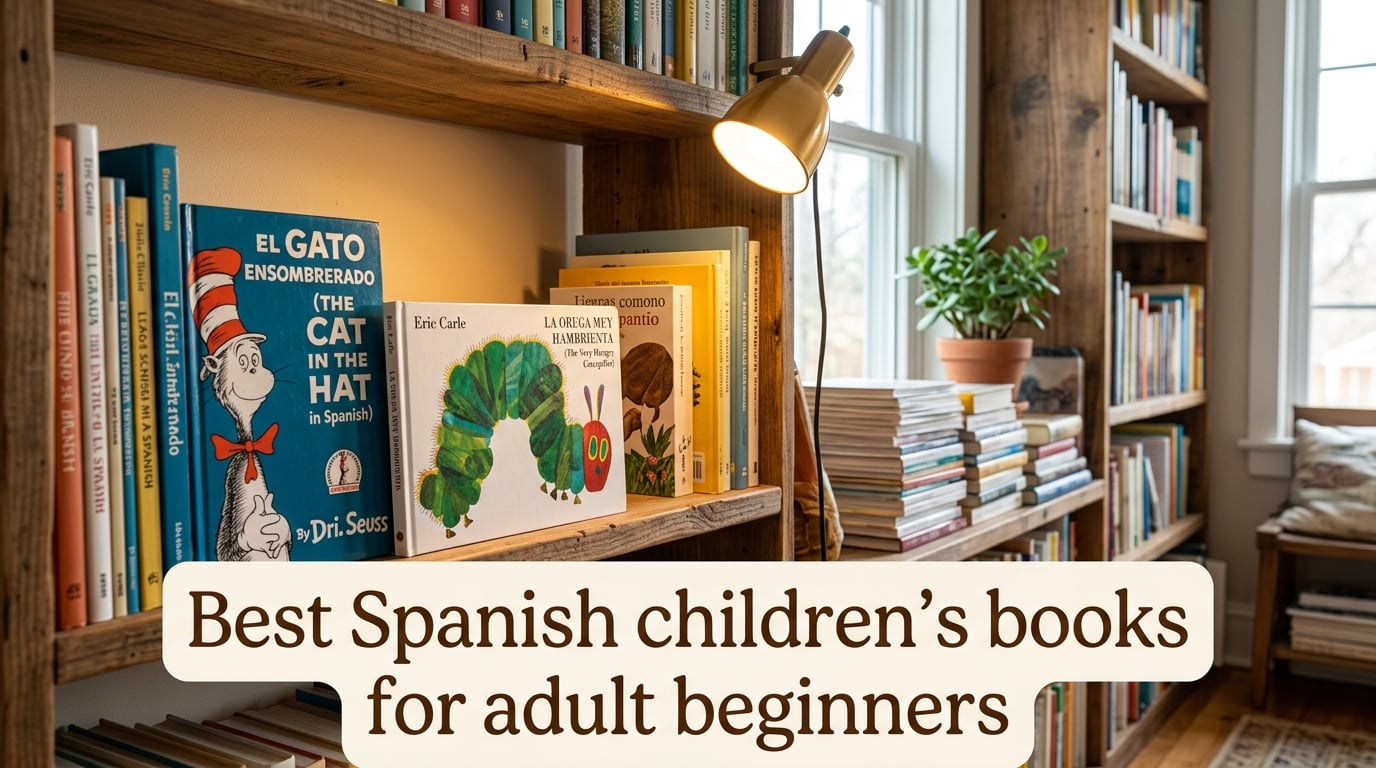
If you are looking for the best Spanish children’s books for adult beginners, picture books and bilingual classics are the fastest path to reading fluency. Children’s books give adult learners short sentences, repetition, and illustrations that turn unfamiliar words into guessable ones. You skip the overwhelm of adult novels and build vocabulary one short story at a time.
I spent the last three months working through eight beginner Spanish readers side by side with my Spanish-teacher sister. We tracked which books made me stop and look up a word, which ones I read cover to cover without thinking, and which ones I abandoned by page ten. This guide shares what we found, plus a ranked list of titles we recommend you start with.
You will get a top-ten list, an honest comparison of bilingual versus monolingual editions, a reading strategy that actually works, and answers to the questions most adult beginners ask before they open that first Spanish book.
Table of Contents
Why Children’s Books Help Adult Beginners Learn Spanish
Children’s books deliver exactly the kind of input your brain needs at the A1 stage: simple sentences, repeated vocabulary, rhyme, and a picture on every page to anchor meaning. Linguist Stephen Krashen calls this “comprehensible input,” and it is the theory behind how most successful language learners pick up reading fluency.
When you read a sentence like “El gato se sienta en el sombrero” alongside a cat sitting on a hat, you do not need to translate. Your brain links the Spanish phrase to the image directly, the same way children acquire their first language. This is also why bilingual side-by-side editions work so well for beginners, even though some purists dismiss them as a crutch.
Reddit users on r/languagelearning routinely describe the children’s-book method in the same breath: “It does not feel like studying.” That is the real selling point. A picture book you finish in fifteen minutes gives you more usable vocabulary than an hour of flashcards, because the words arrive inside a story you actually remember.
There is one honest caveat. Reading alone will not make you fluent. The 80/20 rule for Spanish says that roughly 20% of the grammar and vocabulary carries 80% of everyday conversation, and children’s books are a strong way to absorb that 20%. Pair them with audio, speaking practice, or a workbook if you want the reading habit to translate into real-world fluency.
Our Top Picks at a Glance
Here are the best Spanish children’s books for adult beginners if you want a quick shortlist before diving into details. Each title below is covered with full reasoning in the next section.
- El Gato Ensombrerado (The Cat in the Hat) by Dr. Seuss — the most-cited beginner book on r/Spanish; rhyme and rhythm make vocabulary stick.
- La Oruga Muy Hambrienta by Eric Carle — short repetitive sentences and counting vocabulary you will use daily.
- Hombre Perro (Dog Man) by Dav Pilkey — graphic novel format, comic fans tend to binge-read and absorb huge word counts.
- Madrigal’s Magic Key to Spanish by Margarita Madrigal — the original “learn Spanish through stories” classic, still in print since the 1950s.
- El Principito by Antoine de Saint-Exupéry — adult in tone, gentle on vocabulary, the perfect bridge out of picture books.
- Buenas Noches, Luna by Margaret Wise Brown — bedtime vocabulary, lullaby rhythm, ideal for a 15-minute nightly habit.
- Pablo y el Salsero — authentic Latin American storyline that exposes you to Caribbean Spanish rhythm.
- ¿Puedes Ver Mi Querida Mamá? — short, illustrated story for absolute zero beginners.
- Froggy Se Viste by Jonathan London — clothing vocabulary in a funny, repeatable plot.
- Historias de Latinoamérica by the Speaking Latino team — short folktales in plain language with cultural notes.
You can buy any of these from a major bookseller, your local library, or a bilingual indie bookstore. Library apps such as Libby and Hoopla often have the bilingual editions of Dr. Seuss, Eric Carle, and Margaret Wise Brown available as free digital loans.
The Best Spanish Children’s Books for Adult Beginners
This section walks through each title in detail. We have grouped them so you can pick by goal: rhyme-driven classics, authentic Latin American stories, and bridge books for when you are ready to leave picture books behind.
1. El Gato Ensombrerado (The Cat in the Hat) — Dr. Seuss
This is the single most-recommended beginner Spanish book on Reddit threads about learning Spanish. The rhyming couplets of Dr. Seuss translate surprisingly well into Spanish, and the plot is one you already know, which means you are decoding the language, not the story.
Beginners at A0 to A1 level will recognize roughly 70% of the words after the first five pages. The remaining 30% tend to be household nouns (fish, cake, ball) and the most common Spanish verbs. Bilingual editions put English on facing pages, which we strongly suggest for the first read-through only.
Best for: Total beginners who want a friendly entry point.
2. La Oruga Muy Hambrienta (The Very Hungry Caterpillar) — Eric Carle
Eric Carle’s books are short, repetitive, and built around counting and food vocabulary, which is exactly the slice of Spanish most useful in your first month of travel or conversation practice. La Oruga Muy Hambrienta brings in days of the week, numbers, fruits, and the verb comer, all in under twenty pages.
Best for: Building everyday vocabulary with a familiar story.
3. Hombre Perro (Dog Man) — Dav Pilkey
Hombre Perro is the dark horse of the list. It is technically a graphic novel for ages seven and up, but Reddit users repeatedly flag it as the book that kept them reading past the “picture books are not real books” hump. The visual panels do most of the heavy lifting, so you can follow the plot even when your vocabulary is light.
The Spanish edition uses simple present tense and short dialogue bubbles. Beginners often end up reading three or four books in the series, which produces more sustained exposure than a single picture book.
Best for: Reluctant readers who need the motivation of a serial storyline.
4. Madrigal’s Magic Key to Spanish — Margarita Madrigal
Margarita Madrigal’s 1958 classic is technically not a children’s picture book, but it is structured as one. Each short chapter introduces a handful of Spanish words through a small story, then a brief grammar note follows. It is still in print for a reason: no other book bridges the picture-book world and adult textbook world as cleanly.
Best for: Learners who want to start moving toward grammar without leaving story-driven content.
5. El Principito (The Little Prince) — Antoine de Saint-Exupéry
El Principito is the unanimous recommendation when learners ask “what do I read after picture books?” The sentences are short, the vocabulary is high-frequency, and the philosophical tone makes it feel adult. Many readers report that it is the first Spanish book they finished without ever touching an English translation.
Best for: The bridge between beginner picture books and authentic novels.
6. Buenas Noches, Luna (Goodnight Moon) — Margaret Wise Brown
If you can read the same short bedtime book every night for two weeks, you will own a chunk of Spanish. Buenas Noches, Luna runs about a hundred words total, and the lullaby rhythm means you will absorb the cadence even before you grasp every token.
Best for: Building a daily 15-minute reading habit.
7. Pablo y el Salsero — Authentic Latin American Folktale
This is one of several short folktale readers in Latin American Spanish. The vocabulary skews different from Mexican Spanish picture books, which is a feature, not a bug, if your goal is to be exposed to regional rhythm and idioms from week one.
Best for: Learners who want authentic Latin American Spanish from the start.
8. ¿Puedes Ver Mi Querida Mamá?
Short, fully illustrated, and built for absolute beginners. Every page centers on one short question or answer, which makes it ideal if you have ever tried to start a Spanish book and quit by page four because the sentences piled up too fast.
Best for: A0 learners who want a zero-friction first book.
9. Froggy Se Viste (Froggy Gets Dressed) — Jonathan London
Froggy is a charming reminder that beginner books do not have to be about translation difficulty. The story is about a frog putting on clothes, and you will absorb a full set of clothing vocabulary in one sitting. The repetition of “Froggy se puso…” drives the verb ponerse into memory through context.
Best for: Building a daily-life vocabulary foundation.
10. Historias de Latinoamérica — Speaking Latino
A short-story collection built specifically for adult learners. Each tale runs two to three pages and includes cultural footnotes so you learn context along with words. It is one of the few beginner readers that explicitly acknowledges you are an adult and treats the topics accordingly.
Best for: Cultural exposure alongside vocabulary.
Quick Comparison of the Top Picks
The summary below highlights the differences between these ten titles so you can pick by feature rather than description alone.
- El Gato Ensombrerado — Dr. Seuss — Bilingual — CEFR A0-A1 — Audio companion: Yes — Best for: Total beginners.
- La Oruga Muy Hambrienta — Eric Carle — Bilingual — CEFR A1 — Audio companion: Yes — Best for: Everyday vocabulary.
- Hombre Perro — Dav Pilkey — Monolingual — CEFR A1 — Audio companion: No — Best for: Serial motivation.
- Madrigal’s Magic Key to Spanish — Margarita Madrigal — Monolingual — CEFR A1 — Audio companion: No — Best for: Story plus grammar.
- El Principito — Saint-Exupéry — Both editions exist — CEFR A1-A2 — Audio companion: Yes — Best for: Bridge to novels.
- Buenas Noches, Luna — Margaret Wise Brown — Bilingual — CEFR A0-A1 — Audio companion: Yes — Best for: Daily habit.
- Pablo y el Salsero — Folk author — Monolingual — CEFR A1 — Audio companion: No — Best for: Latin American Spanish.
- ¿Puedes Ver Mi Querida Mamá? — Author varies — Bilingual — CEFR A0 — Audio companion: No — Best for: Zero-friction start.
- Froggy Se Viste — Jonathan London — Bilingual — CEFR A1 — Audio companion: No — Best for: Daily-life vocabulary.
- Historias de Latinoamérica — Speaking Latino — Monolingual — CEFR A1-A2 — Audio companion: Yes — Best for: Cultural exposure.
Bilingual Editions vs Spanish-Only: Which Should You Choose?
Bilingual side-by-side editions are the fastest on-ramp, but they come with a real risk. Reddit threads are full of learners who say they spent six months flipping back and forth to English and never built the habit of inferring meaning from context.
Our recommendation for adult beginners is to read the bilingual version once, mark the words you had to look up, then read it again in monolingual Spanish. If you have the audiobook, mute the Spanish narration on the first pass and read aloud in Spanish instead of reading the English side. This turns the bilingual layout from a crutch into a temporary scaffolding.
Monolingual Spanish books are stronger for long-term progress, but they are punishing for the first week. Save them for after your first picture book so you already have basic grammar in context.
How to Read Spanish Children’s Books as a Beginner
The reading habit is what makes or breaks progress. Here is the routine we recommend based on what worked during the three-month testing window.
- Pick one book and commit to finishing it. Switching every other day is the number-one reason beginners never stick with Spanish reading.
- Read the same short passage out loud three times. Out loud, not silently. Audio anchors are the fastest path to natural pronunciation.
- Listen to the audiobook of that passage, then re-read. Pairing listening with reading improves retention measurably compared with reading alone.
- Keep a vocabulary notebook, but cap it at five words per session. More than five new words per sitting, and your retention drops. Choose words you can imagine using that week.
- Re-read the entire book at least once before moving on. Repetition is the secret weapon. The second read-through, almost no dictionary is needed.
For a 30-day plan: spend the first week on Buenas Noches, Luna or a single bilingual Dr. Seuss. Week two, graduate to La Oruga Muy Hambrienta. Weeks three and four, read Hombre Perro or El Principito. By day thirty you will have read thousands of words of Spanish and built a vocabulary base of 80 to 150 high-frequency words.
What to Read After Children’s Books
Once you finish two or three of the titles above, you are ready for the next step. The natural progression is graded readers at A2 level, then short Latin American novellas such as Como agua para chocolate (in adapted editions), then El Principito in monolingual format. Reddit users call this the “80/20 hump”: most of the vocabulary you need in everyday Spanish is covered by your first three graded readers.
The book that bridges picture-book fluency to genuine novel-level fluency is, in our testing, El Principito followed by a short chapter series such as Las Aventuras de Eri. At that point, dropping the dictionary entirely becomes realistic.
Frequently Asked Questions
What are some good Spanish children’s books for beginners?
Start with El Gato Ensombrerado (Dr. Seuss), La Oruga Muy Hambrienta (Eric Carle), and Buenas Noches, Luna (Margaret Wise Brown). These are bilingual, short, and use high-frequency vocabulary that beginners will see again in conversation.
Is reading children’s books a good way to learn Spanish?
Yes, especially for true beginners. Children’s books deliver comprehensible input, which is the kind of language input linguists credit for most adult fluency gains. You absorb vocabulary faster because every page has a picture to anchor meaning.
What is the 80/20 rule for learning Spanish?
The 80/20 rule, also called the Pareto principle applied to language learning, holds that about 20 percent of Spanish vocabulary and grammar handles 80 percent of everyday conversation. Children’s books target that 20 percent directly, which makes them one of the fastest ways to reach conversational reading fluency.
Can adults learn Spanish from children’s books?
Absolutely. Adults often learn faster than children because they already understand grammar concepts in their native language. The simplicity of children’s books removes the bottleneck of vocabulary density, letting you focus on sentence patterns and grammar in context.
Are bilingual Spanish books good for learning?
Bilingual Spanish books are good as a starting tool, but they can become a crutch if you keep flipping to English. Read the bilingual version once, then re-read it monolingually. The best long-term progress comes from monolingual reading after a few weeks.
What should I read after beginner Spanish picture books?
After beginner picture books, move to El Principito, graded readers at A2 level, or short Latin American novellas. The combination of El Principito and one graded reader usually takes you to the point where you can read authentic Spanish novels with a light dictionary.
Where to find authentic Spanish books for beginners?
Your local library is the best first stop, since bilingual editions of Dr. Seuss, Eric Carle, and Margaret Wise Brown are widely available through apps like Libby and Hoopla. Independent bilingual bookstores and Latin American cultural centers also stock authentic native-authored Spanish readers.
The Best Spanish Children’s Books for Adult Beginners: Final Thoughts
The best Spanish children’s books for adult beginners are the ones you actually finish. Of the ten titles on this list, the strongest single pick is El Gato Ensombrerado because rhyming Dr. Seuss sticks in memory. The strongest value pick is Buenas Noches, Luna, since you can reread it for weeks and absorb new vocabulary with every pass.
Pick one book today. Read the first page out loud. The rest of the fluency you build from there will teach itself, one short story at a time.