
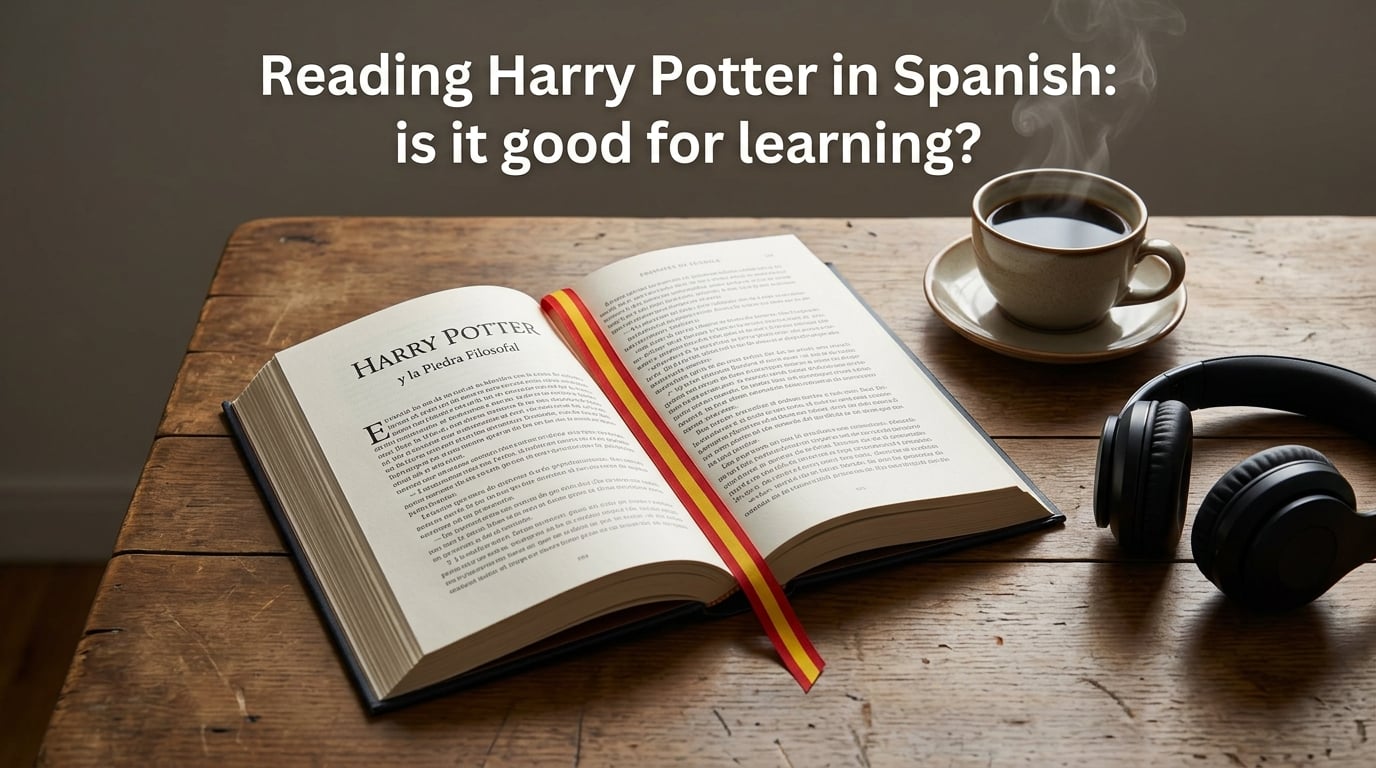
Reading Harry Potter in Spanish is genuinely good for learning, especially once you reach a CEFR A2 level and already know the plot in English. The combination of familiar storyline, gradual difficulty across seven books, and widely available Spanish audiobooks makes the series a strong extensive-reading tool. The trade-offs are real too: the magic vocabulary will not help you order coffee in Madrid, and starting the series before you are ready can stall your momentum.
I have worked through the Spanish editions myself and coached learners who used the books to push past the intermediate plateau. In this guide I will share what works, what to watch out for, and the exact step-by-step method our team recommends.
Table of Contents
Quick Verdict: Yes, With One Big Caveat
Harry Potter in Spanish is a good learning resource for intermediate learners (CEFR A2 and up) who already know the story. The series works because Rowling’s writing is conversational, the vocabulary builds gradually, and you can pair the books with audiobooks and the dubbed films for full immersion.
The big caveat is that the books are not a beginner starting point. If you have never read a graded reader in Spanish, jumping straight into Harry Potter y la Piedra Filosofal will leave you looking up a word every few seconds and burning out fast. Used as the next step after you finish beginner material, though, the series is one of the most rewarding reading journeys you can take.
Why Harry Potter Works as a Spanish Reading Resource
Three things make Harry Potter unusually effective for language learning: plot familiarity, incremental difficulty, and availability.
Most English-speaking learners already know every plot twist in the series. That matters more than it sounds. When you already know Harry is going to face a troll in the bathroom, your brain skips decoding the story and focuses on decoding the Spanish. You infer meaning from context instead of getting lost in the narrative. That is the core of comprehensible input working for you rather than against you.
The series also gets harder in a controlled way. Book 1 is written for middle-grade readers. By Book 7 the prose is dense, the politics are complex, and the vocabulary has expanded to cover war, ideology, and emotional vocabulary. You can stay inside one story world for the full A2 to C1 stretch instead of hunting for new books at every level.
Availability closes the loop. The Spanish editions are easy to find as print, Kindle, and audiobook. The films have professional Spanish dubs across Castilian and Latin American editions. Flashcards, vocabulary lists, and chapter summaries in Spanish are all over Anki and Quizlet. You never have to hunt for materials.
What CEFR Level Is Harry Potter in Spanish?
Harry Potter in Spanish starts at around CEFR A2 for the first book and climbs to C1 by the seventh. The full series maps roughly like this:
- Book 1 — Harry Potter y la Piedra Filosofal: A2
- Book 2 — Harry Potter y la Cámara Secreta: A2 to B1
- Book 3 — Harry Potter y el Prisionero de Azkaban: B1
- Book 4 — Harry Potter y el Cáliz de Fuego: B1 to B2
- Book 5 — Harry Potter y la Orden del Fénix: B2
- Book 6 — Harry Potter y el Misterio del Príncipe: B2 to C1
- Book 7 — Harry Potter y las Reliquias de la Muerte: C1
If you are at A1, start with a graded reader first and come back to the series when you have a few hundred words under your belt. If you are at B1, you can jump into Book 3 directly and enjoy the ride.
Pros of Reading Harry Potter in Spanish
The biggest pro is Rowling’s writing style. She writes in short, clear sentences with lots of dialogue. Spanish translators preserve that style well, so the books read like natural spoken Spanish rather than formal prose. You absorb conversational patterns, idioms, and connective phrases you will actually use.
The next pro is incremental progression. Each book adds vocabulary and complexity without ever feeling like a jump to a different genre. You build reading stamina without the whiplash of switching books.
The third pro is the multi-modal reinforcement. The Spanish audiobook is widely available, and the films have professional Spanish dubs. You can read a chapter, listen to the same chapter on a walk, and then rewatch the matching scene with Spanish audio and English subtitles. That triple loop locks vocabulary into long-term memory far better than reading alone.
The final pro is vocabulary range. Yes, you will learn words like varita (wand) and caldero (cauldron). But you will also learn school vocabulary, family vocabulary, food words, weather words, and emotional vocabulary. The mix is richer than it first looks.
Cons and Common Pitfalls
The magic vocabulary is the most obvious con. Muggle, quidditch, horrocrux, and expelliarmus will not help you in a real Spanish conversation. You will spend real reading energy learning words you will never use outside a Harry Potter context. That is fine if you accept it as the price of admission.
The second pitfall is pace. Without a vocabulary system, you hit what Anki users call lexical bankruptcy: the pile of unknown words grows faster than you can clear it, and reading stops being fun. The fix is a flashcard workflow, not a willpower problem.
The third pitfall is needing to already know the plot. If you have never read or watched Harry Potter, the books will be much harder. The familiar storyline is doing half the work. Without it, you are reading a Spanish middle-grade novel with no anchor, and the experience falls apart.
The fourth pitfall is edition confusion. There is no single “Spanish” Harry Potter. There is a Castilian edition translated for Spain and several Latin American editions for the rest of the Spanish-speaking world. The differences are small but real, and they can confuse beginners.
Castilian vs Latin American Spanish Editions
The Castilian edition (published by Salamandra in Spain) uses tú and standard Peninsular Spanish vocabulary. The Latin American editions use ustedes instead of vosotros and lean toward neutral Latin American vocabulary. Both are excellent translations, and the meaning is identical. The differences show up in pronunciation when you listen to the audiobooks.
Pick based on the accent you want to learn. If your goal is Spain Spanish, go with the Castilian edition and audiobook narrated by a Spanish speaker. If your goal is Latin American Spanish, choose a Latin American edition and audiobook. Mixing editions is fine if you already know which is which, but pick one to start so you do not get whiplash between vosotros forms one day and ustedes the next.
How to Read Harry Potter in Spanish: A Step-by-Step Method
Here is the method our team has used with intermediate learners who want to work through the series without burning out.
Step 1: Build a vocabulary base first. Finish at least one graded reader or a short easy novel in Spanish before you start. Aim for around 1,000 words of active vocabulary. Anything less and the first chapter of Piedra Filosofal will feel like a wall.
Step 2: Start with the first book. Resist the urge to jump in at Book 4 because you like that story most. The first book is the easiest and the one that builds your foundation. Read it cover to cover before you move on.
Step 3: Read one chapter at a time and log new vocabulary. Read a chapter without stopping to look up words. Mark the ones that appeared three or more times, look those up, and add them to Anki or Quizlet. Review the flashcards daily. This is the workflow that prevents lexical bankruptcy.
Step 4: Listen to the audiobook on replay. After you finish a chapter, listen to the Spanish audiobook of it once. You will catch words you skimmed in print, and you will train your ear to native pacing.
Step 5: Watch the matching film scene with Spanish audio. Find the dubbed version of the scene you just read. Watch it with Spanish audio and Spanish subtitles to reinforce listening without leaning on English. This is where the series shines: the familiar visual context plus Spanish audio plus Spanish subtitles gives you a triple anchor.
Repeat for each chapter. By the end of Book 1 you will have read several thousand words of natural Spanish, learned hundreds of new words, and trained your ear on audiobook and film audio. That is a serious win for a few weeks of effort.
Best Alternatives to Harry Potter for Spanish Reading
Harry Potter is not the only option. A few similar choices work just as well or better depending on your taste.
Percy Jackson (Percy Jackson y los Dioses del Olimpo). Rick Riordan writes in the same middle-grade, high-dialogue style. The Spanish translations are equally clear, and the mythology theme gives you a different vocabulary set.
Comprehensible Input graded readers. Books from publishers like Olly Richards or LingQ are written specifically for language learners at A1 to B1. They are easier than Harry Potter and a good bridge if the first chapter of Piedra Filosofal still feels too hard.
Carlos Ruiz Zafón adult fiction. Once you are at B2 and want to move on from middle-grade, Zafón’s La Sombra del Viento and the rest of the Cemetery of Forgotten Books series are gorgeous Spanish prose and a step up in difficulty.
Short story collections. For daily practice without committing to a 300-page novel, short story collections in Spanish let you finish a story in one sitting. That sense of completion keeps motivation high.
Frequently Asked Questions
What reading level is Harry Potter in Spanish?
The first book, Harry Potter y la Piedra Filosofal, is roughly CEFR A2. Each subsequent book climbs in difficulty, with Book 4 (Caliz de Fuego) at B1 to B2, and Book 7 (Reliquias de la Muerte) reaching C1. Most learners find the series most useful between A2 and B2.
Is reading books in Spanish a good way to learn?
Yes. Reading Spanish books builds vocabulary, internalizes grammar patterns through context, and trains reading stamina. Harry Potter is a particularly good choice because the familiar plot lets you infer meaning instead of getting stuck on the storyline. Pair reading with a flashcard system to keep new words from piling up.
Which Harry Potter book should I read first in Spanish?
Start with Harry Potter y la Piedra Filosofal. It is the easiest in the series and the foundation for everything that follows. Even if you already know the story well, Book 1 is the right entry point because its vocabulary and grammar are the simplest.
How long does it take to read Harry Potter in Spanish?
Most intermediate learners finish the first book in 4 to 6 weeks reading a few chapters per week. Working through all seven books typically takes 8 to 12 months at a steady pace. Audiobook listening speeds up exposure without adding reading hours.
Can I become fluent in Spanish by reading Harry Potter?
No single book or series will make you fluent on its own. Harry Potter is a powerful piece of the puzzle because it builds reading and listening stamina, but fluency also needs speaking practice, real conversation, and exposure to a wider range of Spanish than one fantasy series can offer.
Final Verdict: Is Reading Harry Potter in Spanish Worth It?
Yes. Reading Harry Potter in Spanish is one of the most rewarding reading choices an intermediate learner can make. The familiar plot, the incremental progression, the natural dialogue, and the audiobook plus film pairing make the series a near-perfect extensive-reading tool.
Use it as the next step after you finish beginner material, not as the first Spanish book you ever open. Build a flashcard habit so the magic vocabulary does not bury you. Pick a single edition so you are not bouncing between Castilian and Latin American Spanish. Then read, listen, and watch your way through seven books that grow with you.
If you finish all seven, you will have read a full novel series in Spanish. That alone is a milestone worth aiming at.