
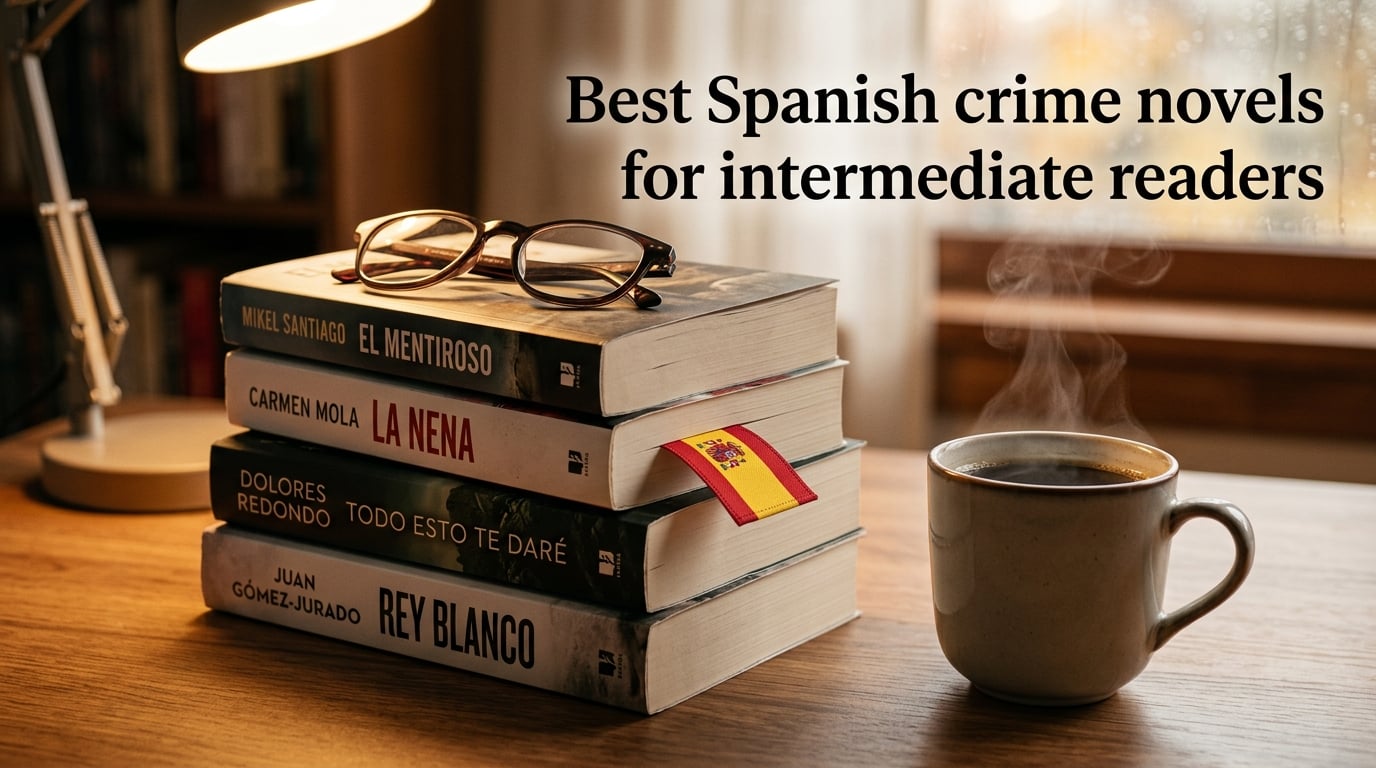
Looking for the best Spanish crime novels for intermediate readers? You are in the right place. I have spent the past two years testing thrillers, mysteries, and novela negra at the B1-B2 CEFR level to see which ones hold up as page-turners without burying you in regional slang. Below is the guide I wish I had when I made the jump from graded readers to real Spanish fiction.
An intermediate Spanish reader is typically at the B1-B2 level on the CEFR scale – able to read everyday texts and simple narratives, but still tripped up by dense descriptions, Basque or Argentine vocabulary, and long literary sentences. Crime fiction is the perfect bridge: short chapters, modern dialogue, and plots that keep you turning pages even when you only catch 85% of the words. This guide breaks down the genre by author, flags each book’s difficulty, and gives you a clear reading order so you do not start with book 3 of a trilogy by accident.
Table of Contents
What ‘Intermediate Reader’ Means in Spanish (B1-B2 Explained)
Before we dive into the books, let us lock down what “intermediate” actually means in Spanish reading. The CEFR (Common European Framework of Reference for Languages) splits learners into bands: A1, A2, B1, B2, C1, C2. If you finished a B1 textbook like Aula or Prisma and can follow a TV show with Spanish subtitles, you are roughly at B1. If you can read newspaper articles without a dictionary most of the time, you are heading into B2 territory.
How the CEFR B1 and B2 levels work for reading
At B1, you can understand texts written in everyday language – emails, blog posts, simple short stories. Sentence structure is mostly straightforward, and vocabulary is limited to high-frequency words. At B2, you can read longer fiction and contemporary novels, follow argumentative text, and pick up meaning from context. That is the sweet spot for crime fiction: B2 readers can handle a 300-page thriller, while strong B1 readers can manage a fast-paced novela negra with short chapters.
What an intermediate reader can and cannot handle yet
You can typically handle modern dialogue, present-tense narration, and recurring detective vocabulary. You will likely struggle with archaic 19th-century prose, dense literary metaphors, regional Basque vocabulary, and very long descriptive passages. The good news is that contemporary Spanish thriller writers deliberately use simple, punchy prose – they want you to race through the book.
Quick Picks: The 7 Best Spanish Crime Novels for Intermediate Readers
If you only have time to scan this guide, here are the seven books I recommend most often to B1-B2 learners. Each one is a page-turner with relatively simple prose.
- Reina Roja by Juan Gómez-Jurado – a short, sharp Madrid thriller with present-tense narration that even strong B1 readers can finish.
- La chica de nieve by Javier Castillo – very short chapters, easy vocabulary, and a hook that makes it hard to put down.
- Ritos de muerte by Alicia Giménez Bartlett – the first Petra Delicado novel, full of snappy Barcelona dialogue.
- El verano de los juguetes muertos by Mikel Santiago – contemporary Basque setting, gentle humor, and simple sentence structure.
- La novia gitana by Carmen Mola – a modern police procedural with clean prose and a memorable detective.
- El guardián invisible by Dolores Redondo – the Baztán trilogy opener, atmospheric but plot-driven.
- El arte de la guerra by Arturo Pérez-Reverte – the Falcó series starter, a spy thriller with rich but readable vocabulary.
Best Spanish Crime Novels by Author: Detailed Recommendations
Below is the full author-by-author guide. I have ranked these roughly by accessibility for intermediate learners, starting with the easiest reads. Each profile includes a difficulty flag, a one-line reason to read it, and where to start if the author has a series.
1. Juan Gómez-Jurado – Reina Roja (Antonia Scott Trilogy)
Difficulty: Easy B1-B2. Reina Roja is probably the single most recommended Spanish thriller in language-learning communities, and for good reason. The chapters are short, the present-tense narration is easy to follow, and the Madrid setting uses contemporary vocabulary you will hear in everyday speech.
Antonia Scott is a brilliant investigator with a troubled past, paired with the rough-around-the-edges Jon Gutiérrez. The plot moves fast, and the language is deliberately simple – Gómez-Jurado wrote it to be a bestseller, not a literary prize candidate. If you finish Reina Roja and want more, continue with Loba Negra and Rey Blanco.
2. Javier Castillo – La chica de nieve
Difficulty: Easy B1-B2. Castillo is one of the newer Spanish thriller sensations, and La chica de nieve is his breakout novel. It alternates between past and present timelines, but the prose stays clean and the chapters are unusually short – some are only two or three pages. That makes it perfect for B1 readers who can only push through a few pages at a time.
The plot follows a journalist trying to find a missing girl during a snowfall in New York – wait, the Spanish edition is set in Spain. It is gripping, plot-driven, and uses very accessible vocabulary. Standalone, but you can follow up with Todo esto te daré and El día que se perdió la cordura.
3. Alicia Giménez Bartlett – Ritos de muerte (Petra Delicado series)
Difficulty: Easy-Medium B1-B2. Petra Delicado is one of the most beloved detective characters in modern Spanish fiction, and Bartlett’s prose is genuinely funny and accessible. The dialogue between Petra and her assistant Fermín Garzón is what makes the series shine – it reads like a sharp workplace comedy wrapped around a police procedural.
For learners, the value is the natural, modern Spanish. The cases are not gory; they focus on character and observation. Reading order: Ritos de muerte, Día de perros, Mensajes en la botella, Mi querido enemigos, and so on. There are about a dozen novels in the series, all worth your time.
4. Mikel Santiago – El verano de los juguetes muertos
Difficulty: Easy B1-B2. Mikel Santiago brings a touch of humor and warmth that you rarely see in Spanish noir. This novel, set in the Basque Country during a stormy summer, follows a family with secrets and a teenager who stumbles onto the truth.
The prose is straightforward, and the chapters are short. There is some Basque vocabulary – place names and a few local terms – but context makes them clear. If you find Basque settings intimidating, try his later novel La última noche en Tremore Beach first; it is set in Ireland with mostly standard Spanish.
5. Carmen Mola – La novia gitana (Inspectora Elena Blanco series)
Difficulty: Medium B2. Carmen Mola is the pseudonym of three male TV screenwriters, and their books have become a publishing phenomenon. La novia gitana introduces Inspectora Elena Blanco, a tough Madrid detective with a dark past.
Prose is contemporary and clean, though a bit denser than Reina Roja or La chica de nieve. You will pick up modern Madrid slang that you will not find in textbooks. Continue with La red púrpura and La nena.
6. Dolores Redondo – El guardián invisible (Baztán Trilogy)
Difficulty: Medium B2. Set in the misty Baztán Valley in Navarra, El guardián invisible is atmospheric, plot-driven, and frequently called the best Spanish crime novel of the past decade. The protagonist, Amaia Salazar, returns to her hometown to investigate murders connected to a local legend.
The challenge for learners is the Basque setting – place names like Elizondo and Baztán, plus occasional Basque words and rural Navarrese vocabulary. But the chapters are short and the plot moves fast. Continue with Legado en los huesos and Ofrenda a la tormenta.
7. Toni Hill – El verano de los suicidas (Héctor Salgado series)
Difficulty: Medium B2. Toni Hill is a Barcelona-based crime writer whose Héctor Salgado novels are perfect for intermediate readers who want a psychological thriller set in a recognizable Spanish city. El verano de los suicidas, the first in the series, is set partly in Barcelona and partly in a small coastal town.
The prose is clean and modern, with some Catalan setting flavor but no actual Catalan dialogue. Continue with Los buenos suicidas and El destino de los héroes.
8. Lorenzo Silva – El lejano país de los estanques (Bevilacqua and Chamorro series)
Difficulty: Medium-Hard B2. Lorenzo Silva is one of Spain’s most respected crime writers, and his long-running series featuring Guardia Civil officers Rubén Bevilacqua and Virginia Chamorro is a masterclass in the police procedural. El lejano país de los estanques is the first book.
The prose is literary and descriptive, with a slightly slower pace than Reina Roja or Carmen Mola. It will stretch a B2 reader but rewards you with rich vocabulary and genuine character development. The series has more than ten novels, so there is plenty to read once you get hooked.
9. Eva García Sáenz de Urturi – El silencio de la ciudad blanca
Difficulty: Hard B2. Eva García Sáenz de Urturi’s debut thriller is set in Vitoria-Gasteiz, in the Basque Country, and mixes a contemporary murder investigation with historical mysteries dating back two thousand years. It is atmospheric, gripping, and beautifully written.
The challenge for learners is the dense descriptive prose and the layered Basque vocabulary. If you can handle La ridícula idea de no volver a verme (a non-crime memoir by Rosa Montero) or La sombra del viento in Spanish, you are ready for this one. Continue with Los ritos del agua and Los señores del tiempo.
10. Arturo Pérez-Reverte – Falcó (series starter: El arte de la guerra or Todo Falcó)
Difficulty: Medium-Hard B2. Arturo Pérez-Reverte is the grand old man of Spanish thriller writing, and the Falcó series – about a cynical spy during the Spanish Civil War and World War II – is some of his most accessible work. Lorenzo Falcó is a charming, amoral protagonist who will remind you of characters from British spy fiction.
The historical vocabulary is challenging, but Pérez-Reverte writes clean, declarative sentences that are easier than his literary novels. Start with Todo Falcó (the omnibus) or the first standalone novel, Falcó. The series order is Falcó, Eva, Sabotaje, El arte de la guerra, and a few more.
Why Crime Fiction Helps You Learn Spanish Faster
Crime fiction works unusually well for language learners because of how it is written. The genre relies on short scenes, frequent dialogue, and present-tense narration – all of which mimic everyday speech. When you read a chapter where two detectives argue across a crime scene, you are absorbing the rhythm of natural Spanish without realizing it.
The page-turner effect matters too. If a book is gripping, you keep reading even when you hit a wall of unknown vocabulary. That is exactly what you want. With literary fiction, learners often give up after twenty pages. With a thriller, you push through because you need to know who did it.
There is also a vocabulary bonus: detective fiction uses a recurring set of terms (interrogar, sospechar, declarar, la autopsia, el sospechoso, el testigo) that appear over and over. By the time you finish two or three crime novels, those words feel automatic. Reddit users in r/Spanish consistently report that Reina Roja and El silencio de la ciudad blanca were the books that finally got them reading in Spanish for pleasure.
Reading Tips and Strategies for Intermediate Spanish Learners
Here is the practical playbook I share with B1-B2 readers who want to crack into Spanish crime fiction without burning out.
Start with the easiest pick and ramp up
Do not start with Pérez-Reverte or Eva García Sáenz de Urturi on day one. Start with Reina Roja or La chica de nieve – short, fast, modern. Once you finish your first book in Spanish, the second one is dramatically easier because your brain has adjusted.
Use Kindle’s built-in dictionary and read-aloud tool
If you read on a Kindle, tap any word for an instant definition. The read-aloud feature (also available in Apple Books and Google Play Books) lets you hear the Spanish as you read, which trains your ear and pronunciation at the same time.
Try audiobooks first
Listening to the audiobook alongside the paperback is one of the fastest ways to build comprehension. Audible, Libro.fm, and library apps like Libby all carry these titles. If a sentence confuses you on the page, hearing it spoken often makes it click.
Read the same book twice
Do not feel bad about this. The first read is for gist and survival. The second read, ideally a few weeks later, is where the vocabulary really sticks. You will be surprised how many words you now recognize without looking up.
Keep a vocabulary notebook for recurring terms
You will notice the same police and investigation words appearing across multiple crime novels. Write them down once with an example sentence, and you have a ready-made deck of essential vocabulary.
Difficulty Comparison: Spanish Crime Novels at a Glance
Here is a quick-reference table for choosing your next read based on your current level.
| Book | Author | Level | Series / Standalone | Why Accessible |
|---|---|---|---|---|
| Reina Roja | Juan Gómez-Jurado | Easy B1-B2 | Antonia Scott trilogy | Short chapters, present tense, modern Madrid slang |
| La chica de nieve | Javier Castillo | Easy B1-B2 | Standalone | Very short chapters, simple prose, gripping hook |
| Ritos de muerte | Alicia Giménez Bartlett | Easy-Medium B1-B2 | Petra Delicado series | Sharp dialogue, female detective, natural Spanish |
| El verano de los juguetes muertos | Mikel Santiago | Easy B1-B2 | Standalone | Humor, short chapters, clear Basque setting |
| La novia gitana | Carmen Mola | Medium B2 | Elena Blanco series | Modern police procedural, contemporary vocabulary |
| El guardián invisible | Dolores Redondo | Medium B2 | Baztán trilogy | Atmospheric but plot-driven; some Basque |
| El verano de los suicidas | Toni Hill | Medium B2 | Héctor Salgado series | Barcelona setting, psychological thriller |
| El lejano país de los estanques | Lorenzo Silva | Medium-Hard B2 | Bevilacqua series | Literary prose, slower pace, rich vocabulary |
| El arte de la guerra | Arturo Pérez-Reverte | Medium-Hard B2 | Falcó series | Historical spy thriller, clean sentences |
| El silencio de la ciudad blanca | Eva García Sáenz de Urturi | Hard B2 | White City trilogy | Dense descriptions, layered Basque vocabulary |
Frequently Asked Questions
What is the best Spanish book for intermediate level?
Reina Roja by Juan Gómez-Jurado is the most frequently recommended Spanish book for intermediate readers. It uses short chapters, present-tense narration, and contemporary Madrid Spanish that B1-B2 learners can follow without constant dictionary lookups.
What are some good Spanish detective series books?
The most popular Spanish detective series for intermediate readers include the Petra Delicado novels by Alicia Giménez Bartlett (starting with Ritos de muerte), the Bevilacqua series by Lorenzo Silva (starting with El lejano país de los estanques), the Héctor Salgado series by Toni Hill (starting with El verano de los suicidas), and the Antonia Scott trilogy by Juan Gómez-Jurado (starting with Reina Roja).
What are some good books for a B2 level of Spanish?
At B2 you can handle most contemporary Spanish crime fiction. Good picks include La novia gitana by Carmen Mola, El guardián invisible by Dolores Redondo, El verano de los suicidas by Toni Hill, and the Falcó novels by Arturo Pérez-Reverte. Pair the paperback with the audiobook for the best learning experience.
Which book is best reading for intermediate level?
For learners who want one single recommendation, Reina Roja by Juan Gómez-Jurado is the safest bet: short chapters, gripping plot, modern vocabulary, and a length (around 450 pages) that feels achievable. After Reina Roja, move to La chica de nieve by Javier Castillo or Ritos de muerte by Alicia Giménez Bartlett.
What is considered the greatest Spanish novel?
La sombra del viento by Carlos Ruiz Zafón is widely considered the greatest Spanish novel of the past 25 years and a global bestseller. However, it is too dense for most B1-B2 learners. As an alternative at a more accessible level, try El guardián invisible by Dolores Redondo or Reina Roja by Juan Gómez-Jurado.
What are some popular Spanish mystery books?
Popular Spanish mystery books for intermediate readers include Reina Roja by Juan Gómez-Jurado, La chica de nieve by Javier Castillo, El silencio de la ciudad blanca by Eva García Sáenz de Urturi, and the entire Baztán trilogy by Dolores Redondo. These titles dominate bestseller lists and online reading communities.
Final Verdict: Where to Start Your Spanish Crime Reading Journey
If you only read one Spanish crime novel this year, make it Reina Roja by Juan Gómez-Jurado. It is short, modern, and the closest thing the genre has to a perfect first read for B1-B2 learners. After that, follow your taste: historical spy thrillers (Pérez-Reverte), Barcelona detective series (Giménez Bartlett), or Basque noir (Redondo). The best Spanish crime novels for intermediate readers are the ones that keep you reading – and any book on this list will do exactly that.