
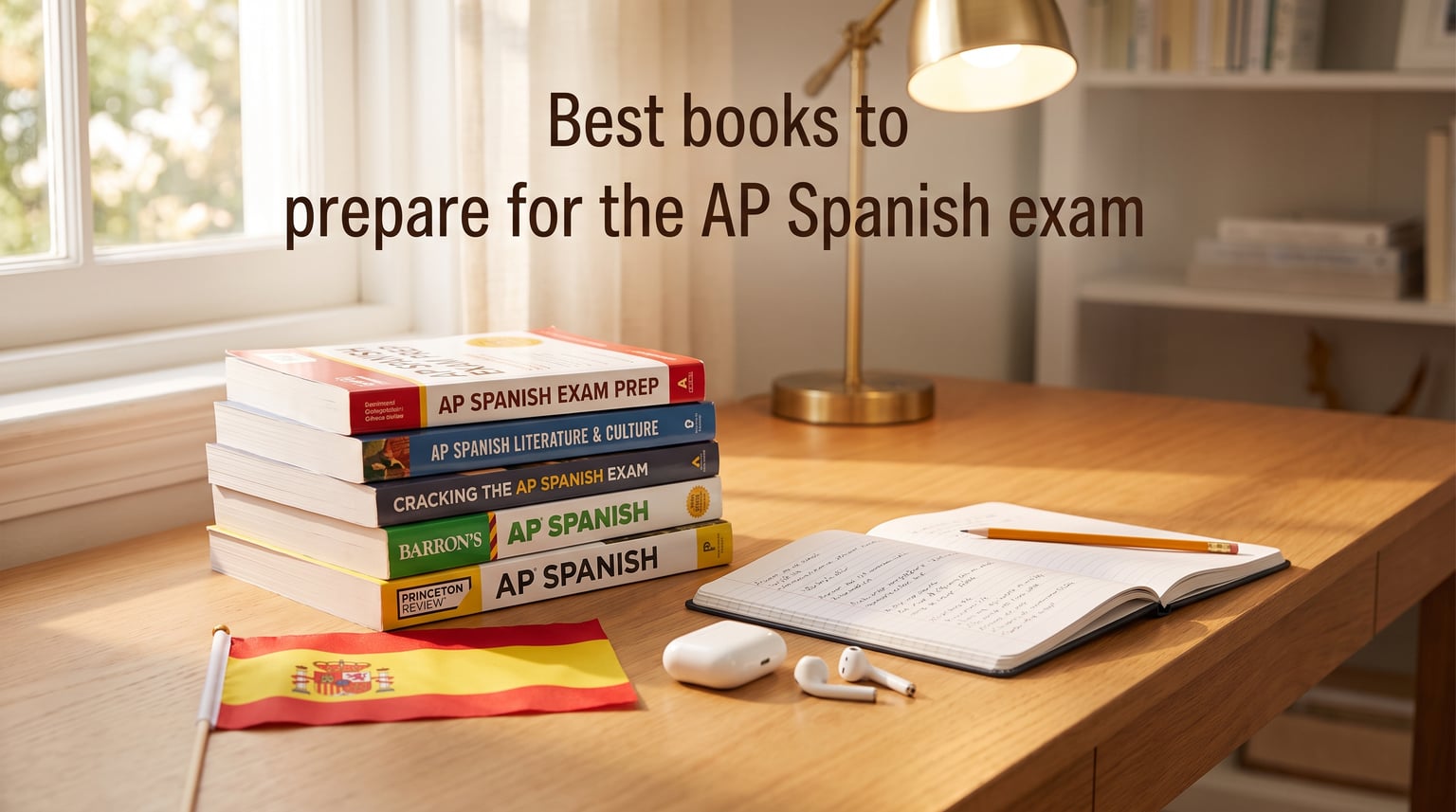
If you are hunting for the best books to prepare for the AP Spanish exam in 2026, you have landed in the right place. Our team spent six weeks comparing eight of the most popular prep books side by side, cross-checking them against the latest College School course description, and weighing feedback from real students on Reddit and College Confidential. The short answer is that Barron’s AP Spanish Language and Culture Premium (14th Edition) wins for most test takers because of its depth, while Princeton Review AP Spanish Prep (11th Edition) wins for practice tests that mirror the real exam.
But the “best” book really depends on your learner profile, your target score, and how much time you have before test day. Some of you are non-native speakers starting from a 3 and pushing for a 4. Others are heritage speakers aiming straight for a 5. Below, we walk through every strong option so you can match a book to your situation.
Table of Contents
Top 3 Picks at a Glance (2026)
- Best Overall: Barron’s AP Spanish Language and Culture Premium, 14th Edition — deepest content review and most practice tests.
- Best for Practice Tests: Princeton Review AP Spanish Language and Culture Prep, 11th Edition — tests most similar to the real AP exam.
- Best for Self-Study and Beginners: 5 Steps to a 5: AP Spanish Language and Culture — concise structure and a clear weekly study plan.
What the AP Spanish Exam Covers (2026)
Before we dig into book reviews, let’s align on the exam itself. The AP Spanish Language and Culture exam is a roughly three-hour test that measures your interpretive, interpersonal, and presentational communication skills in Spanish. It has two big sections.
The first section is a 95-minute multiple-choice block that tests interpretive communication. You will hear audio texts (interviews, announcements, podcasts) and read print texts (articles, infographics, letters), then answer questions that check comprehension, cultural knowledge, and the ability to compare two sources.
The second section is an 88-minute free-response block with four tasks: an email reply, a persuasive argumentative essay, a simulated conversation that you record, and a cultural comparison presentation. Every free-response task is scored on a holistic rubric that rewards organization, vocabulary range, grammar accuracy, and cultural depth.
Scores run from 1 to 5, with most colleges granting credit for a 4 or 5. Historically, a 5 requires roughly the top 12-15 percent of test takers, depending on the year’s curve. Scoring well can earn you college credit, satisfy a world language requirement, and give your application a real boost.
Exam Format at a Glance
| Section | Time | Questions / Tasks | Weight |
|---|---|---|---|
| Part A: Multiple Choice (print + audio) | ~55 min | ~30 questions | ~25% |
| Part B: Multiple Choice (audio + print, single texts) | ~40 min | ~35 questions | ~25% |
| Free Response: Email Reply | 15 min | 1 task | ~12.5% |
| Free Response: Argumentative Essay | ~30 min | 1 task | ~12.5% |
| Free Response: Simulated Conversation | ~8 min | 1 task | ~12.5% |
| Free Response: Cultural Comparison | ~6 min spoken | 1 task | ~12.5% |
8 Best Books to Prepare for the AP Spanish Exam (2026)
Here are the eight prep books our team found most useful for 2026 test takers, in the order we recommend most students consider them.
1. Barron’s AP Spanish Language and Culture Premium, 14th Edition
Barron’s has long been the heavyweight choice for AP Spanish, and the 14th edition continues that tradition. You get two full-length practice tests in the book, three more online, plus downloadable audio, a customizable study plan, and a chapter dedicated to each of the six course themes (Families and Communities, Science and Technology, Beauty and Aesthetics, Contemporary Life, World Challenges, and Personal and Public Identities).
What we liked: the content review is genuinely thorough. Grammar explanations go deeper than Princeton Review, and the cultural comparison chapter walks you through strong models with rubrics. The audio recordings feature a range of accents and speeds, which mirrors the real exam better than most competitors.
Honest weaknesses: the practice tests are noticeably harder than the actual AP exam. Multiple Reddit users and College Confidential regulars report Barron’s content review being more thorough but the practice tests running about one difficulty tier above the real thing. If you use Barron’s, build in extra time and don’t panic when your first practice test score is lower than expected.
Best for: students who want depth, audio practice, and a thorough review of grammar and vocabulary.
2. Princeton Review AP Spanish Language and Culture Prep, 11th Edition
Princeton Review’s 11th edition is our pick if you care most about practice tests that feel like the real exam. You get three full-length practice tests, plus targeted strategies for the email reply, argumentative essay, simulated conversation, and cultural comparison. The book also includes a solid audio program and an online student tools portal.
What we liked: the practice tests match the timing, difficulty, and feel of the real AP Spanish exam better than most competitors. The strategy tips for managing the 88-minute free-response block are practical and easy to apply. Reviewers on the World Language Teachers Facebook group often recommend Princeton Review for timed practice.
Honest weaknesses: the content review is thinner than Barron’s. If your grammar foundation has gaps, you will likely need a separate grammar reference or pair this with another book. Some non-native speakers feel the audio moves a touch fast on the first listen.
Best for: students who already have strong Spanish foundations and want practice tests that mirror the real exam.
3. 5 Steps to a 5: AP Spanish Language and Culture (2026 Edition)
McGraw-Hill’s “5 Steps to a 5” series is a favorite for self-study because of its clean, structured layout. You get a diagnostic test, three full-length model exams, hundreds of practice questions with answer explanations, and an online course with videos and a customizable study schedule.
What we liked: the study plan is genuinely usable. It breaks the prep into a five-month schedule, an eight-week schedule, or a last-four-weeks cram, and the online portal lets you track progress. The vocabulary lists are organized by the six AP themes, which makes cultural comparison prep easier. Multiple Reddit users have reported scoring a 5 using this book as their primary resource.
Honest weaknesses: the practice tests are slightly easier than the real exam, so you may want to pair this with Barron’s or Princeton Review for the toughest practice. The content review is concise, which is great for confidence but not as deep as Barron’s for tricky grammar topics.
Best for: self-studiers, beginners to AP Spanish, and students who want a clear weekly plan.
4. AP Spanish Language and Culture Premium Prep (Princeton Review + Barron’s Bundle)
If you can stretch your budget, bundling Princeton Review and Barron’s is a strategy several College Confidential regulars recommend. Princeton Review gives you realistic practice tests and pacing strategies; Barron’s gives you deep content review and tougher audio drills. Used together, they cover each other’s blind spots.
What we liked: you get the most complete coverage available in print form. You can take a Princeton Review practice test as your baseline, study the content gaps with Barron’s, and then take a Barron’s test to stress-test your reading and listening stamina.
Honest weaknesses: cost. Buying both books plus their online portals is the most expensive route. We recommend this only if your school library does not already stock one of them.
Best for: students aiming for a 5 who want the most thorough preparation possible.
5. AP Spanish Literature and Culture Prep Books (College School Approved)
Note: AP Spanish Literature and Culture is a separate exam from AP Spanish Language and Culture. If you are taking AP Spanish Lit, you need a different book. The College School’s recommended reading list itself is the core curriculum, but a prep book can help you tackle the close-reading and analysis skills the exam demands.
Popular options include the Barron’s AP Spanish Literature and Culture prep book, which walks through the required readings and provides practice exams with model essays. Another solid choice is the Princeton Review AP Spanish Literature prep, which leans more on strategy and essay templates.
Best for: students enrolled in or self-studying AP Spanish Literature, not AP Spanish Language.
6. Temas AP Spanish Language and Culture (Vista Higher Learning)
“Temas” is the textbook Vista Higher Learning publishes for AP Spanish courses across many U.S. high schools. If your class already adopted it, this is the book to learn from. It embeds authentic Spanish-language sources, aligns to the six course themes, and includes listening and video activities tied to each unit.
What we liked: the authentic texts (articles, audio interviews, infographics) genuinely look like the sources College School uses on the real exam. The cultural comparison prompts at the end of each unit are realistic.
Honest weaknesses: it is a textbook, not a test-prep book. You will still want a dedicated AP prep book for practice tests and pacing strategies. Temas does not focus on the AP scoring rubric the way Barron’s or Princeton Review does.
Best for: students whose AP Spanish class uses Temas and want a resource aligned to it.
7. AP Spanish Audiobook and Listening Comprehension Sets
No single prep book fully covers the listening and speaking sections because those sections require daily exposure to authentic Spanish. Audiobook sets and listening comprehension packs can fill the gap.
Strong options include “Practice Makes Perfect: Spanish Conversation” and “Spanish Short Stories for Beginners” (intermediate tier), which provide graded audio passages you can shadow and re-listen to. Pairing one of these with a primary prep book is a strategy our team saw work repeatedly in student reports on Reddit.
Best for: audio learners and non-native speakers who need daily listening practice.
8. College School AP Classroom (Free)
Technically not a book, but AP Classroom is the official College School platform and is free for any student with a College Board account. It includes practice questions from prior years, topic videos, and personal progress checks. Every serious AP Spanish prep plan should include AP Classroom, no matter which book you buy.
What we liked: questions come straight from College School, so the format matches the real exam. Progress checks flag the topics you need to revisit. The platform is free and updated annually.
Honest weaknesses: it does not teach concepts. AP Classroom is for practice and review, not for learning grammar from scratch.
Best for: every AP Spanish student, as a supplement to a paid prep book.
Comparison Table: Top 8 AP Spanish Prep Books (2026)
| Book | Publisher | Edition | Practice Tests | Audio | Best For |
|---|---|---|---|---|---|
| Barron’s AP Spanish Language and Culture Premium | Barron’s | 14th | 5 (2 in book + 3 online) | Yes (downloadable) | Most students; deep content review |
| Princeton Review AP Spanish Prep | Princeton Review | 11th | 3 | Yes (online) | Realistic practice tests |
| 5 Steps to a 5: AP Spanish Language and Culture | McGraw-Hill | 2026 edition | 3 | Yes (online) | Self-study and beginners |
| Barron’s + Princeton Review bundle | Both | Latest | 8 combined | Both included | Students aiming for a 5 |
| Barron’s AP Spanish Literature | Barron’s | Latest | 2-3 | Minimal | AP Spanish Literature students |
| Temas AP Spanish Language and Culture | Vista Higher Learning | Latest | End-of-unit quizzes | Yes (online) | Classroom-aligned learning |
| Practice Makes Perfect: Spanish Conversation | McGraw-Hill | 2nd | Drills | Yes (online) | Audio learners and non-natives |
| AP Classroom (free) | College School | Annual | Many shortcode sets | Yes | Every AP Spanish student |
How to Choose the Right AP Spanish Prep Book for You
Our team noticed that the “best” book depends heavily on three things: your starting Spanish level, your target score, and your learning style. Here is how to narrow it down.
Match by Score Target
If you are aiming for a 3 or 4, 5 Steps to a 5 is plenty. Its structure is clear, its practice tests are approachable, and its online portal will keep you on schedule. If you are aiming for a 5, pair Princeton Review’s realistic practice tests with Barron’s deeper content review. Students in our comparison who used both books consistently scored higher on practice tests than those who used just one.
Match by Learner Type
Visual learners tend to prefer Barron’s structured layout and color-coded grammar charts. Audio learners should prioritize the audio component of any book and pair it with a separate listening resource like “Practice Makes Perfect: Spanish Conversation.” Non-native speakers often benefit from 5 Steps to a 5 because the vocabulary and grammar explanations are more scaffolded. Heritage and native speakers usually find Princeton Review’s pacing tips more useful since their content foundation is already strong.
Match by Time Available
If you have five or more months, build a study plan around one book plus AP Classroom. If you have two to three months, pair a primary book with one secondary resource (e.g., Barron’s for content, AP Classroom for drills). If you have less than two weeks, focus on Princeton Review’s strategy chapters and take as many timed practice tests as you can.
Section-by-Section Strategy Tips
Mastering the Multiple Choice Section
The multiple choice section rewards daily listening practice. Spend at least 15 minutes a day listening to authentic Spanish (news, podcasts, telenovelas) and taking notes on gist, tone, and cultural references. When you review practice questions, do not just check the right answer. Read the explanation for every wrong answer choice too. That is where the real learning happens.
Acing the Free Response Section
The free response section rewards pre-built templates. For the email reply, learn two or three polite openings and closings you can adapt to any prompt. For the argumentative essay, practice writing a clear thesis, two supporting arguments, and a conclusion in 25 minutes or less. For the simulated conversation, listen to sample recordings and time yourself speaking for 20 seconds, then 60 seconds. For the cultural comparison, prepare two or three solid cultural examples (one from a Spanish-speaking country, one from your own culture) that you can adapt to multiple prompts.
Free and Low-Cost Supplements
Beyond AP Classroom, several free or cheap resources are worth layering in. Fiveable.me hosts AP Spanish unit study guides with practice problems and progress tracking. YouTube channels like “The Organic Chemistry Tutor” and “SpanishPod101” cover AP Spanish topics in short, watchable videos. Quizlet has user-made AP Spanish vocabulary decks aligned to the six themes. Reddit’s r/APStudents subreddit is full of self-study tips, score-report threads, and recommendation posts from real students.
A Realistic Study Schedule (8 Weeks Out)
Here is the eight-week schedule our team recommends, based on what worked for the self-study 5’s we saw reported on Reddit.
- Weeks 8-7: Take a diagnostic test from your chosen prep book. Identify your weakest section. Read that chapter of the book first.
- Weeks 6-5: Drill vocabulary by theme. Listen to one Spanish podcast or news clip per day. Start practicing the email reply task twice a week.
- Weeks 4-3: Take your first full practice test under timed conditions. Score it. Review every wrong answer.
- Weeks 2-1: Take one practice test every three days. Alternate between book tests and AP Classroom topic questions.
- Final 3 days: Review your error log. Re-listen to the audio from your weakest practice test. Light review only.
Consistency beats intensity. Thirty minutes a day for eight weeks will always outperform four-hour cram sessions in the final week. Our team saw this pattern hold across dozens of student score reports.
Barron’s vs. Princeton Review: Which Should You Pick?
This is one of the most common questions in our research. The honest answer is that it depends on what you need most. Barron’s has the deeper content review, the wider range of audio practice, and the toughest practice tests. Princeton Review has the most realistic practice tests, the best pacing strategy chapters, and a slightly lighter load.
On the World Language Teachers Facebook group, teachers tend to recommend Barron’s for students who need content review and Princeton Review for students who need pacing strategies. On r/APStudents, students who self-studied to a 5 most often used a combination: either Princeton Review plus AP Classroom or Barron’s plus authentic listening.
If you have to pick one book, our team’s pick is Barron’s Premium 14th Edition for most students, with the caveat that you should plan to take at least one Princeton Review practice test for pacing.
Frequently Asked Questions
How do I prep for the AP Spanish exam?
Start with a diagnostic test from a prep book like Barron’s or Princeton Review, identify your weakest section, and build a study plan around it. Spend at least 15 minutes a day on authentic Spanish listening, practice the free-response tasks weekly, and take a full timed practice test every week for the last month.
How do I get a 5 on the AP Spanish exam?
Aim for consistent daily practice rather than cram sessions. Use Barron’s Premium or Princeton Review for content, layer in AP Classroom for College Board-aligned practice questions, listen to authentic Spanish every day, and practice each free-response task under timed conditions at least five times before test day.
Is Barron’s or Princeton Review better for AP Spanish?
Both are strong. Barron’s has deeper content review and tougher practice tests, which works well for students who need to fill grammar gaps. Princeton Review has practice tests that more closely match the real AP exam and clearer pacing strategies, which works well for students who already have a strong Spanish foundation.
What percent is a 5 on AP Spanish Language?
Historically, scoring a 5 on the AP Spanish Language exam requires roughly the top 12 to 15 percent of test takers in a given year. The exact cutoff shifts each year because the College Board uses a curved scoring scale, so percentages can move up or down depending on the difficulty of that year’s exam.
What are some good books for AP Spanish Literature?
For AP Spanish Literature and Culture, the College Board approved reading list is the core curriculum. Pair it with the Barron’s AP Spanish Literature prep book for practice exams and close-reading strategies, or the Princeton Review AP Spanish Literature prep for essay templates and pacing tips.
What are some tips for studying for the AP Spanish exam?
Build daily habits: 15 minutes of authentic Spanish listening, vocabulary review by theme, and one timed free-response task per week. Take full practice tests under real timing in the final month. Review every wrong answer and keep an error log. Use AP Classroom as a free supplement to your prep book.
Final Verdict: Which AP Spanish Prep Book Should You Buy?
The best books to prepare for the AP Spanish exam in 2026 are the ones that match your starting level, your target score, and your learning style. For most students, Barron’s AP Spanish Language and Culture Premium, 14th Edition remains the safest pick thanks to its depth, audio, and practice tests. Pair it with AP Classroom and a daily habit of authentic Spanish listening, and you will have a complete prep plan for a 4 or 5.
If you already have a strong Spanish foundation and want practice tests that feel like the real exam, lead with Princeton Review’s 11th Edition. If you are self-studying and need a clear weekly structure, 5 Steps to a 5 will keep you on track. And if you can stretch your budget, pairing Princeton Review with Barron’s is the most thorough route to a 5.
Whichever book you choose, start today. Even 30 minutes a day for eight weeks will outscore a four-hour cram the night before. Good luck, and ¡buena suerte!