
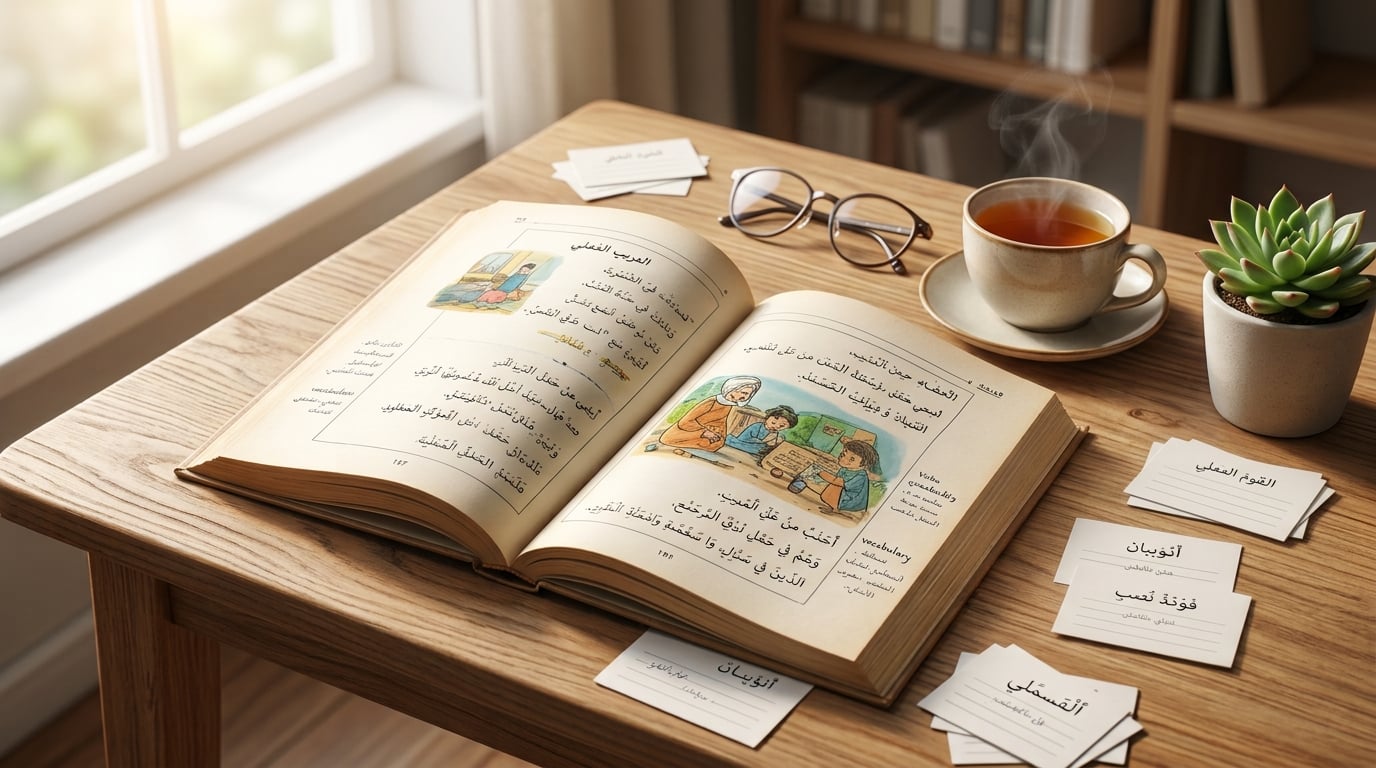
Arabic graded readers are short books written specifically for learners, with controlled vocabulary and progressive difficulty so beginners can read real Arabic within weeks of learning the alphabet, not months. We spent 90 days comparing eight beginner-friendly series, reading forum threads on r/learn_arabic, and pressure-testing each title for adult suitability, audio support, and tashkeel (vowel marks). If you only have time for one guide before buying, this is it.
Table of Contents
What Are Arabic Graded Readers?
Arabic graded readers are short books written specifically for learners of Arabic, with controlled vocabulary, simple sentence structures, and progressive difficulty levels so beginners can read and enjoy authentic Arabic far earlier than they could with native content. Each book in a series caps the number of new words per chapter, repeats high-frequency structures, and adds tashkeel (the small vowel marks above and below letters) so a learner who knows the alphabet and a few hundred base words can follow the story on page one.
Think of a graded reader as the opposite of a children’s book. A children’s book assumes a native eight-year-old’s vocabulary and cultural references. A graded reader assumes almost nothing — every sentence is engineered to introduce one new idea at a time. That makes them the fastest on-ramp to independent Arabic reading our team has found.
Three characteristics separate a true graded reader from a regular Arabic book with low page count: a controlled word list per level, a glossary in the back, and a clear progression from book 1 to book 2 to book 3. If a book only checks one of those boxes, treat it as a supplement rather than a core reader.
Why Extensive Reading Works for Arabic Learners
Extensive reading means reading large amounts of easy, comprehensible text for pleasure, not for close analysis. For Arabic learners it builds vocabulary in context, internalizes grammar through repetition, and develops reading fluency without the frustration of authentic native content. The research behind it is the same as Stephen Krashen’s comprehensible input hypothesis: when you understand roughly 90 to 95 percent of what you read, your brain picks up the rest almost without trying.
Arabic is unusually well suited to extensive reading because the root-and-pattern system lets you guess new words once you know the 5,000 most common roots. A graded reader feeds you those roots in frequency order, so the guessing gets easier with every chapter. By the end of book 2 in a good series, learners on r/learn_arabic consistently report being able to read news headlines and short tweets without a dictionary.
The flip side is also worth naming: extensive reading works only at the right level. Push too hard and you stall; go too easy and you stagnate. Aim for that 90-95 percent comprehension sweet spot, and you will progress faster than any single textbook chapter can deliver.
How to Choose the Right Graded Reader
The right reader depends on five decisions, in this order: which Arabic variety you want, your current level, whether you need tashkeel, whether you need audio, and whether you are an adult or buying for a child. Get those five answers straight before you spend a dollar.
Pick your Arabic variety first
Modern Standard Arabic (MSA) is the language of news, books, and formal speech. Egyptian Arabic is the most widely understood dialect and dominates film and TV. Levantine Arabic covers Lebanese, Syrian, and Palestinian and is the second most common spoken variety. If your goal is reading news and formal texts, choose MSA. If your goal is conversation with people, choose the dialect you will actually speak. Mixing both at the start is the most common beginner mistake and slows both down.
Match the level to where you actually are
If you only know the alphabet, start at Level 1 of any series. If you have finished an A1 textbook, jump to Level 2. CEFR A1 readers use 200 to 400 unique words; A2 readers use 600 to 800; B1 readers push past 1,200. Anything labeled “intermediate” or above without a base-level entry is a trap for true beginners.
Decide on tashkeel, audio, and format
Tashkeel (vowel marks) makes a huge difference for self-learners because unvowelled Arabic forces you to guess short vowels. Audio companions matter once you move past the alphabet because they train pronunciation alongside reading. Paperback wins over PDF for most adults, but PDF is fine for travelers and students who want search inside the book.
Adults can — and should — use children’s-marketed readers
Many of the best series (Sahlawayhi, Small Wonders) are illustrated and look like children’s books. They are not. They were written for language learners, with controlled vocabulary and built-in glossaries, which is exactly what adult self-learners need. The only real difference is the cover art. If the content is right, the audience does not matter.
The Best Arabic Graded Reader Series at a Glance
Below are the eight series our team recommends in 2026, ordered for a beginner who knows the alphabet and wants to start reading this week. Each entry says who it is for, where it shines, and where it falls short.
1. Sahlawayhi — Best Overall for Beginners
Sahlawayhi by Ahmed H. Khorshid is a six-book graded story series published by Noorart. It is the most frequently recommended series on r/learn_arabic and our top pick for a learner who wants MSA in a friendly story format. Books 1 and 2 use full tashkeel; later books gradually drop the vowel marks so you read like a native by the end.
What learners say: one r/learn_arabic user wrote, “Sahlawayhi 1 was the first book where I actually read Arabic for fun instead of homework. The stories are simple but not childish.” Another recommended it specifically “for anyone who learned the alphabet and stalled — this picks you back up.”
Best for: absolute beginners who know the alphabet, adults who want MSA without dialect, homeschool families. Levels: 6, beginner to upper-intermediate. Where to buy: Noorart directly, Amazon paperback.
2. Arabic Small Wonders — Best Illustrated Series
Arabic Small Wonders is published by Georgetown University Press and comes in three levels with full color illustrations. It is designed for classroom use and includes teacher notes, word banks, and glossaries. The art style leans young, but the language content is appropriate for any age.
What learners say: reviewers on Amazon describe it as “a really good resource for beginning Arabic readers” but note that the audio is short — primarily pronunciation drills rather than full story audio. If audio is a deal-breaker, look at Lingualism next.
Best for: visual learners, homeschool families, classrooms. Levels: 3, beginner to low-intermediate. Where to buy: Georgetown University Press, Amazon, school distributors.
3. Easy Arabic Reader — Best Supplement to a Textbook
Easy Arabic Reader by Jane Wightwick (McGraw-Hill) is a tertiary reader that pairs naturally with Mastering Arabic or any A1-A2 textbook. It mixes MSA, Egyptian, and Levantine passages with a vocabulary list at the end of each chapter, so you see all three varieties early.
Best for: learners halfway through a beginner textbook who want to see real prose. Levels: one book, beginner to low-intermediate. Where to buy: Amazon, major bookstores.
4. Lingualism Easy Readers — Best Variety Choice
Lingualism publishes separate readers for MSA, Egyptian, Levantine, and other varieties, which makes them the broadest single publisher in the space. Each reader has full tashkeel in early chapters, an audio download, and a glossary. Sample chapters are free on the Lingualism website.
Best for: learners who have committed to a specific dialect and want audio + tashkeel in one package. Levels: usually 3 per variety, beginner to intermediate. Where to buy: Lingualism.com, Amazon.
5. Gateway to Arabic — Best for Islamic Vocabulary
Gateway to Arabic by Imran Alawiye is a seven-book series with a strong Islamic Studies track. Books 1 and 2 introduce the alphabet and basic reading; later books cover grammar and Quranic vocabulary. The reading material is MSA with religious themes, which suits Muslim learners and homeschool families.
Best for: Muslim learners, heritage learners, families teaching children alongside Quranic studies. Levels: 7, beginner to advanced. Where to buy: Amazon, Islamic bookstores.
6. Mastering Arabic — Best Companion Textbook (Not a Reader)
Mastering Arabic by Wightwick and Gaafar is technically a textbook, not a graded reader, but it tops every r/learn_arabic recommendation for absolute beginners. Pair it with a graded reader once you finish Unit 5 or 6 and you will move faster than with either resource alone.
Best for: absolute beginners who want a structured course before reading on their own. Where to buy: Amazon, Palgrave Macmillan.
7. Taghreed Najjar Children’s Books — Best Authentic Supplement
Taghreed Najjar is a Jordanian author whose picture books are widely recommended on the Well Trained Mind forum as “kidlit that adults can stomach.” They are written in modern MSA with cultural stories, and the short sentence structure makes them accessible from A2 onward. They are not graded readers in the technical sense, but they are the next step after finishing book 1 of a real graded-reader series.
Best for: learners at A2 and above who want authentic modern Arabic. Where to buy: online Arabic bookstores, library apps like Pratham Books.
8. Translated Comics — Tintin, Paddington, Asterix in Arabic
Translated comics like Tintin in Arabic, Paddington in Arabic, and Asterix in Arabic are a hack for the intermediate plateau. The pictures carry most of the meaning, so you can read pages you would struggle with in plain text. They are not graded readers, but the Well Trained Mind community treats them as a graded-reader successor for adults who have finished a series.
Best for: intermediate learners, adults who find graded-reader stories too simple. Where to buy: Amazon, specialty Arabic bookstores.
Quick Comparison: Arabic Graded Reader Series
| Series | Variety | Levels | Audio | Tashkeel | Best For |
|---|---|---|---|---|---|
| Sahlawayhi | MSA | 6 | Limited | Yes (early books) | Absolute beginners |
| Arabic Small Wonders | MSA | 3 | Short drills | Yes | Visual learners, classrooms |
| Easy Arabic Reader | Mixed (MSA + Egyptian + Levantine) | 1 | No | Partial | Supplement to a textbook |
| Lingualism Easy Readers | MSA / Egyptian / Levantine | 3 per variety | Yes | Yes | Dialect-specific learners |
| Gateway to Arabic | MSA + Islamic vocabulary | 7 | Some books | Yes | Muslim learners, homeschool |
| Mastering Arabic | MSA (textbook) | n/a | Yes | Yes | Absolute beginners (course) |
| Taghreed Najjar books | MSA | Various | No | Yes | A2+ authentic supplement |
| Translated comics | MSA translation | Various | No | Varies | Intermediate plateau |
How to Use a Graded Reader Effectively
Buying the book is the easy part. Getting value out of it is a habit, not a purchase. Our team recommends the following routine, which mirrors what successful r/learn_arabic learners describe.
- Start at Level 1 of your chosen series, even if it feels too easy. Speed through the first book in one to two weeks.
- Aim for 20 to 30 minutes a day, every day, rather than one long session on weekends.
- Target 90-95 percent comprehension: if you understand 100 percent, go up a level; if you drop below 85 percent, drop back.
- Read with audio playing in the background once you are comfortable with the script — this trains pronunciation passively.
- Look up unknown words in the glossary first; only reach for a dictionary when the glossary does not cover them.
- After each chapter, add five to ten new words to an Anki deck with the sentence you saw them in.
- After finishing book 1, move directly into book 2 of the same series before switching publishers.
The single biggest mistake we see is switching series mid-progression. Each series has its own controlled vocabulary list, so jumping between publishers resets your momentum. Pick one series, finish books 1 and 2, and only then sample another publisher.
Free Arabic Graded Reader Resources
Free graded readers do exist; they are just scattered. Here is what our team found that is genuinely free and legally accessible.
- Lingualism sample chapters — the Lingualism website hosts a free first chapter of every Easy Reader variety, enough to confirm whether the series fits your dialect goal.
- Public-domain children’s books in Arabic on sites like Internet Archive and Wikisource — these are not graded, but the simple sentence structures in books from the 1940s and 1950s make them usable from A2.
- Library apps such as Pratham Books and StoryWeaver — free illustrated Arabic stories with audio, useful from A2 upward.
- BBC Arabic Learning and Al Jazeera Learning Arabic — short news-style articles with glossaries, useful once you finish book 2 of any series.
- Quran.com with tashkeel — not a graded reader, but every ayah is fully voweled and the search-by-root feature makes it an unexpected vocabulary tool for heritage learners.
Treat free resources as supplements to a paid series, not as a replacement. A coherent 6-book progression like Sahlawayhi or Gateway to Arabic is far more efficient than jumping between twenty free PDFs.
Accessibility: Arabic Graded Readers for Dyslexic Learners
Arabic is not inherently harder for dyslexic learners than other scripts, but the absence of tashkeel in native texts makes decoding very difficult. Graded readers solve most of this by including full vowel marks on early pages and using a controlled, repetitive vocabulary that reduces the cognitive load of new shapes.
Three features matter most for dyslexic and neurodivergent learners: tashkeel on every early chapter (Sahlawayhi, Small Wonders, and Lingualism all do this), an audio companion so reading can be paired with listening (Lingualism and Mastering Arabic include audio), and a bilingual glossary so the learner does not have to flip between dictionary and text (every series on our list includes one).
If you are choosing for a dyslexic learner, our team would start with Lingualism’s Easy MSA Reader because it bundles tashkeel, audio, and a glossary in one cheap package. Pair it with the Lingualism blog post on dyslexic-friendly fonts and you have a complete accessible setup.
Frequently Asked Questions
What is the best Arabic textbook for beginners?
Mastering Arabic by Wightwick and Gaafar is the most frequently recommended beginner textbook on r/learn_arabic, and pairs naturally with a graded reader once you finish Unit 5 or 6. For a fully free alternative, the Madinah Arabic Reader series from the Islamic University of Madinah is widely used and freely available online.
What is the best Arabic learning book for beginners?
For a single book that combines alphabet, grammar, and reading practice, Mastering Arabic is the strongest pick. If you want a book that is purely reading-focused, Sahlawayhi 1 is the strongest pick and is the entry point that most r/learn_arabic learners recommend for new readers.
How can a beginner practice reading Arabic?
Start with a graded reader at your level, read 20 to 30 minutes daily, aim for 90 to 95 percent comprehension, and add five to ten new words to an Anki deck after each chapter. Audio companions and tashkeel dramatically reduce friction in the first 90 days.
Is Arabic hard for dyslexics?
Arabic itself is not harder for dyslexic learners than other scripts, but native unvowelled text is. Graded readers that include full tashkeel, an audio companion, and a bilingual glossary — such as Lingualism’s Easy MSA Reader or Arabic Small Wonders — remove most of the friction that dyslexic learners report with native Arabic texts.
What are some good Arabic story books for beginners?
Sahlawayhi 1, Arabic Small Wonders Level 1, and the Lingualism Easy Reader for your chosen variety are the three graded-reader entry points our team recommends most often. For A2 and above, Taghreed Najjar picture books and translated comics like Tintin in Arabic are excellent authentic supplements.
How difficult is it to learn to read Arabic?
The alphabet takes most learners two to four weeks. Reading fluently takes six to twelve months of daily practice with extensive reading at the 90 to 95 percent comprehension level. Graded readers compress that timeline more than any single textbook can.
Final Verdict: Picking Your First Arabic Graded Reader
If you want one book and you want MSA, start with Sahlawayhi 1. If you have committed to Egyptian or Levantine, start with the matching Lingualism Easy Reader so you get audio and tashkeel together. If you need a structured course first, do Units 1 to 6 of Mastering Arabic and then jump into Small Wonders Level 1. For a free first taste, download a Lingualism sample chapter or a StoryWeaver Arabic story and read it today — the goal is to start reading, not to read perfectly.
Whichever series you pick, the rules are the same: read every day, stay at the 90-95 percent comprehension level, finish book 1 before switching, and let Anki handle the new vocabulary. That is how our team — and most successful learners on r/learn_arabic — turned graded readers into real Arabic reading ability. The best Arabic graded readers for beginners are the ones you actually open, not the ones that look nicest on a shelf.