
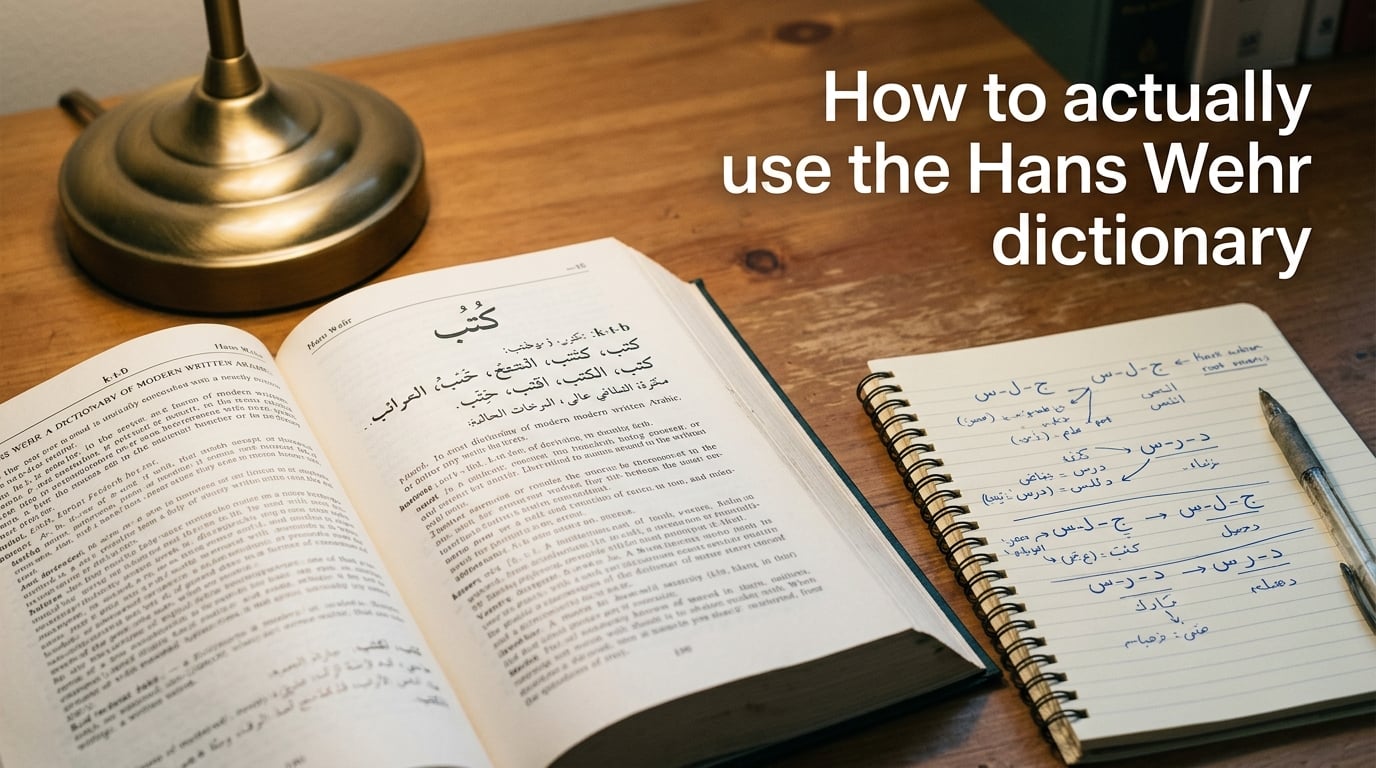
If you have ever opened the Hans Wehr dictionary, stared at a wall of three-letter roots, and wondered where to begin, this guide is for you. I have spent years teaching Arabic learners how to actually use this book, and the honest answer is that Hans Wehr is not hard; it is just organized differently from the dictionaries you grew up with. Once you understand that Arabic words are built from roots, and that Hans Wehr lists those roots first, the whole dictionary clicks into place.
By the end of this article, you will know exactly how to look up any Arabic word, how to read the Roman numerals that label each verb form, and how to use Hans Wehr alongside modern tools like Almaany and Google Translate. Let me walk you through it the same way I walk my own students through it on day one.
Table of Contents
What is the Hans Wehr Dictionary?
The Hans Wehr Dictionary of Modern Written Arabic is a root-based Arabic-to-English dictionary compiled by the German Arabist Hans Wehr and later revised by J. Milton Cowan. It is widely considered the standard scholarly reference for English-speaking learners of Arabic, and most university Arabic programs will not let you past the first semester without one.
The current edition, often called the Cowan-Wehr or the fourth edition, is a 1,301-page hardback published by Spoken Language Services and distributed through Otto Harrassowitz. Earlier editions appeared in 1961 and 1971, and the modern fourth edition added thousands of new entries covering contemporary vocabulary, especially from media and the sciences.
The dictionary’s defining feature is its root-based organization. Every Arabic word is filed under a three-letter root that carries the core meaning, so when you look up the root ك-ت-ب (k-t-b, related to writing), you find kātib (writer), kitāb (book), maktaba (library), and maktūb (written) all in one place. This forces you to learn vocabulary as families rather than as isolated words, which is exactly how Arabic builds meaning.
Why learners trust it
Hans Wehr has been the de facto standard for over sixty years because its definitions are precise, its coverage of Modern Standard Arabic is unmatched, and its root system reflects how Arabic itself works. The free web version at hanswehr.app and the dedicated iOS and Android apps (both rated around 4.8 stars with thousands of reviews) make the same content available without owning the hardback.
Why Hans Wehr uses root letters (and how to find them)
Arabic is a Semitic language, which means most of its vocabulary is built from a small stock of three-letter roots (called جذر, jidr). Each root carries a core concept, and the language adds vowels, prefixes, suffixes, and patterns to create related meanings. For example, the root ق-ر-أ (q-r-ʾ) gives us qaraʾa (he read), yaqraʾu (he reads), qurʾān (reading or recitation), maqraʾ (reading place), and iqraʾ (read!, the opening command of the Quran).
Hans Wehr organizes the entire dictionary around these roots. When you open the book, the first thing you see is a section for each root letter: alif (ا), then bāʾ (ب), then tāʾ (ت), and so on. Inside each section, the three-letter roots are alphabetized by their second and third letters.
How to identify a three-letter root
Stripping a word back to its root is the single most important skill for using this dictionary. Here is a reliable method that works for most verbs and many nouns:
- Remove any prefixes such as و (wa-), ف (fa-), ل (li-), ب (bi-), or ال (al-).
- Remove any suffixes such as ـه (-hu), ـها (-hā), ـنا (-nā), or the plural endings ـون (-ūn) and ـين (-īn).
- Look at the remaining core consonants. In a Form I verb, those are almost always three letters.
- For nouns, the three core consonants are usually present, though one or two may have dropped out (especially in common patterns).
For example, the word مكتبة (maktaba, library) loses its م and ـة, leaving you with the root ك-ت-ب (k-t-b). The word يكتبون (yaktubūn, they write) loses the prefix يـ, the infix ت, and the suffix ـون, leaving the same root.
How to read verb forms (Roman numerals I through X)
Once you find the right root, the next challenge is the Roman numerals. Every Arabic verb belongs to one of ten standard forms, and Hans Wehr labels each one with a numeral: I, II, III, IV, V, VI, VII, VIII, IX, or X. Each form follows a predictable pattern of added letters and doubled consonants.
Form I is the basic, unmodified form. Form II doubles the middle consonant (fa”ala). Form III lengthens the first vowel with a long alif (fāʿala). Form IV adds a hamza prefix (af’ala). Forms V and VI are reflexive versions of II and III. Forms VII through X add prefixes or internal alif to mark passive, reflexive, or causative meanings.
The Roman numeral tells you which verb form you are looking at, but it does not tell you the meaning. You still need to read the definition. A common beginner mistake is to assume that Form II always means “make someone do” and Form IV always means “cause to do”. Those are good starting guesses, but real meaning comes from the definition.
How to look up a word in Hans Wehr (step-by-step)
This is the walkthrough I give every new student. Pick a word you do not know, follow these six steps, and you will find it every time.
- Write down the Arabic word exactly as you see it, including all diacritics if they are present.
- Strip prefixes and suffixes until you are left with what looks like three core consonants.
- Open Hans Wehr at the section for the first of those three root letters.
- Search the entries alphabetically by the second root letter, then the third.
- Once you find the root, locate the Roman numeral that matches the form of the verb in front of you.
- Read the definition, check for any prepositions listed in italics (they often change the meaning), and pick the sense that fits your context.
If you cannot tell which form the verb belongs to, start with Form I; it is by far the most common. If the dictionary gives you several definitions for the same form, look at the example phrases in italics. They will show you which preposition the verb takes and which sense fits your sentence.
Understanding Form I: fa’ala, yaf’alu, and the masdar
Form I is the only form that does not follow a single predictable vowel pattern. Every other form has a fixed template, but Form I verbs split into several subtypes depending on the root. Hans Wehr handles this by listing the pattern right after the Roman numeral I.
You will see entries like “I fa’ala yaq’ulu” or “I fa’ala yaf’alu”. The first word is the perfect tense (he did), the second is the imperfect tense (he does). After both, you will see the masdar, also called the verbal noun. The masdar turns the action into a noun: from kataba (he wrote) comes kitāb (writing or book); from qaraʾa (he read) comes qirāʾa (reading); from ʾakala (he ate) comes ʾakl (eating or food).
When you see the masdar listed right after the perfect and imperfect forms, that is your first signal that the dictionary entry is a Form I verb. The masdar is often the most useful word in the entry because it gives you a noun you can actually use in your own sentences.
Active and passive participles (اسم فاعل and اسم مفعول)
Two derivative forms show up across many entries and are worth knowing by name. The active participle (اسم فاعل, ism al-fāʿil) describes the doer of an action, and the passive participle (اسم مفعول, ism al-mafʿūl) describes the receiver of an action.
For Form I verbs, the active participle is built by adding the pattern fāʿil (فاعل) to the root. From the root ك-ت-ب you get kātib (writer, someone who writes). The passive participle is built with mafʿūl (مفعول), giving maktūb (written, or something that has been written). Hans Wehr often lists these alongside the verb forms, and once you recognize the patterns, you can generate them yourself for any root.
For higher verb forms, the participles shift their vowels to match the form’s pattern. Form II’s active participle is mufaʿʿil, Form III’s is mufāʿil, and Form IV’s is mufʾil. The dictionary always shows the actual participle, so you do not need to memorize the rules; you just need to spot the pattern when you see it.
Where to access the Hans Wehr (print, app, and web)
You have three reliable ways to use the Hans Wehr dictionary today. The first is the print edition, which is still the gold standard if you can carry it. The 1,301-page hardback is heavy but indestructible, and a single charge gives you a lifetime of use. Most Arabic programs sell it through their campus bookstore.
The second option is the official apps. There are dedicated iOS and Android apps with the full content of the dictionary, offline search, and the ability to type either Arabic or Latin transliteration. Both apps hold a 4.8-star rating across thousands of reviews, which is unusual for a niche reference tool and tells you how much learners depend on them.
The third option is the free web version at hanswehr.app. It is a single-page search interface that lets you type in Arabic or Latin letters and instantly returns the matching root and its derivatives. It is the fastest way to look up a single word, and many learners keep it open in a browser tab while they read.
Hans Wehr vs Almaany vs Google Translate
Each tool has a sweet spot, and knowing which one to reach for will save you time. Here is a quick comparison based on how I use them every day.
- Hans Wehr is best for accurate, scholarly definitions of Modern Standard Arabic, especially when you need to understand the root, all its forms, and the precise sense of a word.
- Almaany is best for quick lookups of contemporary vocabulary, dialect words, and example sentences from real Arabic websites. It pulls from multiple online sources and often gives you context that Hans Wehr does not.
- Google Translate is best for fast first-pass translation of a full sentence, especially if you are working with a text you need to understand roughly rather than precisely. It is unreliable for root analysis or verb form identification.
For serious study, I open Hans Wehr first to understand the word at the root level, then I check Almaany for example sentences, and I use Google Translate only as a sanity check on whole passages. Mixing the three gives you both depth and speed.
Common beginner mistakes to avoid
After watching hundreds of students use this dictionary, I have seen the same handful of mistakes over and over. Avoiding them will save you months of frustration.
- Guessing the wrong root. If you cannot find a word, the root you stripped back is probably wrong. Try removing different prefixes or check if one of the letters is actually a long vowel in disguise.
- Ignoring the Roman numeral. A single root often has ten separate verb entries. If you read Form II’s definition while looking at a Form I verb, your translation will be off.
- Skipping the prepositions. Many Arabic verbs change meaning completely based on the preposition that follows them. The dictionary prints these in italics. Always check them.
- Picking the first definition you see. Hans Wehr lists senses from literal to figurative. Read at least two or three definitions before choosing one.
- Treating the dictionary as a translator. Hans Wehr is a reference, not a translator. You still need to understand the grammar around the word to pick the right sense.
Reddit threads in r/learn_arabic still surface the same confusion that has plagued beginners for years: “Can someone explain how the Hans Wehr works in this image, I’m so confused.” If that is you, you are not alone, and the dictionary is not broken. It is just asking you to think in roots.
A practical 5-step study workflow
When you sit down to read an Arabic text with Hans Wehr open, here is the routine that turns dictionary lookups into real learning.
- Read one full sentence before you touch the dictionary. Guess the meaning from context first.
- Mark only the words you genuinely cannot infer. Do not look up every unknown word, or you will never finish.
- For each marked word, run the six-step lookup process from earlier in this article.
- Write the root, the form, and one masdar or participle for each word in a small notebook beside the dictionary.
- After every page, review the roots you just collected. Patterns will start to jump out within a week.
This workflow turns Hans Wehr from a lookup tool into a learning tool. You will start recognizing roots you have already seen, and eventually you will be able to guess the meaning of an unfamiliar word before you even open the dictionary.
Frequently Asked Questions
What are the key features of Hans Wehr’s dictionary?
Hans Wehr is a root-based Arabic-English dictionary organized by three-letter roots, with verbs grouped by Roman numerals I through X. It covers Modern Written Arabic comprehensively, fits in a 1,301-page hardback, and is available in print, on iOS and Android apps, and as a free web version at hanswehr.app.
How many editions of Hans Wehr’s dictionary exist?
The dictionary has gone through four major editions, with the first published in 1961 and the current fourth edition revised by J. Milton Cowan and expanded with contemporary vocabulary. Modern reprints are widely available through university bookstores and online retailers.
What is Hans Wehr?
Hans Wehr was a German Arabist whose Arabic-English dictionary, first published in 1961, became the standard scholarly reference for English-speaking learners of Arabic. The dictionary is still named after him and is in active use in university programs worldwide.
How do I look up an Arabic word in Hans Wehr?
Strip the word down to its three core consonants, open the dictionary at the section for the first root letter, find the root alphabetically, locate the Roman numeral that matches the verb form, and read the definition along with any italicized prepositions to pick the right sense for your context.
How do I identify the root of an Arabic word?
Remove prefixes such as wa-, fa-, li-, bi-, and al-, then remove suffixes such as -hu, -hā, and plural endings. The three remaining core consonants are almost always the root, especially for Form I verbs.
How many root words does Arabic have?
Most estimates put the number of productive three-letter roots in Arabic somewhere between 1,000 and 1,500, though historical and classical dictionaries list several thousand including rarer patterns. Mastering even the first 500 most common roots will give you access to the majority of everyday vocabulary.
Final thoughts on using the Hans Wehr dictionary
The Hans Wehr dictionary is one of the best learning tools you will ever own, and learning to actually use it well is a skill that pays off for the rest of your Arabic journey. Start with one page, one root, one verb form. Run through the six-step lookup, write the root in your notebook, and review it the next day.
If you commit to this workflow for a single month, you will look back and wonder how you ever read without the dictionary open beside you. That is when you will know you have actually learned how to use the Hans Wehr dictionary.