
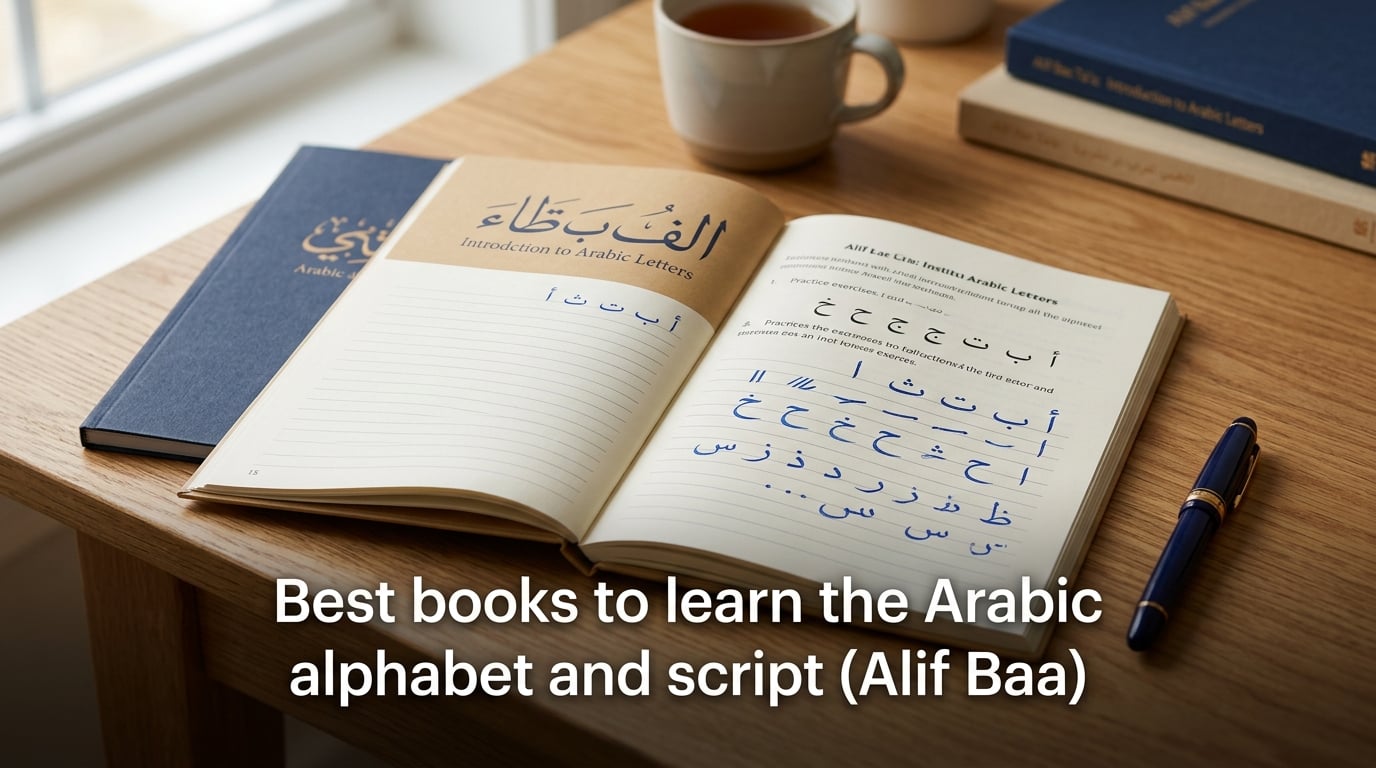
Picking the best books to learn the Arabic alphabet and script is the single highest-leverage decision you will make in your first month of study. Most adult learners who abandon Arabic do so in the first two weeks – not because the script is impossibly hard, but because they tried to memorize vocabulary before they could actually read the letters on the page.
I have spent the past year working through these textbooks alongside heritage speakers, university students, and self-taught beginners. This guide collects the strongest books to learn the Arabic alphabet, breaks down the methodology behind each, and matches them to specific learner goals so you can stop researching and start reading.
If you have typed “Alif Baa” into a search bar, you are already on the right track. Alif Baa is the introductory volume of the Al-Kitaab Arabic Language Program by Kristen Brustad, Mahmoud Al-Batal, and Abbas Al-Tonsi, published by Georgetown University Press. It is the most widely recommended textbook for English-speaking adults learning the 28 Arabic letters, their four positional forms, and the core sounds of Modern Standard Arabic. In this guide I will explain exactly what is inside, how it compares to alternatives like Mastering Arabic 1, and which book fits which kind of learner.
Table of Contents
Quick Picks: Best Books by Use Case
Skim this if you are short on time. Each pick links to a deeper review lower in the article.
Best overall for absolute beginners: Alif Baa, Third Edition (Brustad, Al-Batal, Al-Tonsi). University-tested, audio-supported, and structured around sound-before-grammar.
Best for self-study with audio: Mastering Arabic 1 by Jane Wightwick and Mahmoud Gaafar. Designed for solo learners, with native-speaker audio and an answer key.
Best for Quranic Arabic: Madinah Arabic Course by Dr. V. Abdur Rahim. Three volumes used in Islamic schools worldwide, heavy on Classical Arabic and Quranic vocabulary.
Best for heritage speakers: Alif Baa + supplementary conversation with a fluent family member. Most heritage learners I have worked with need the script taught cleanly, not a children’s book.
Best reference companion: Hans Wehr Dictionary of Modern Written Arabic. Not a textbook – a tool you will use for years.
What Makes a Good Arabic Alphabet Book?
Not every Arabic textbook deserves shelf space. After comparing more than a dozen programs, I look for five non-negotiable features before recommending a book.
1. Native-speaker audio support. Four Arabic consonants – ع (‘ayn), خ (khā’), ح (ḥā’), and غ (ghayn) – are nearly impossible to self-teach from text alone. Any book without audio will leave you guessing on these letters. The best books bundle MP3 downloads or a companion website with every chapter.
2. All four positional forms taught together. Every Arabic letter changes shape depending on where it sits in a word. The letter ع looks like a small eye in isolation, ties to the next letter in the middle, and breaks off at the end. Books that introduce only the isolated form force you to relearn the alphabet later. The strongest textbooks teach isolated, initial, medial, and final forms side by side from lesson one.
3. Tashkeel made visible from the start. Tashkeel – the short vowel marks and other diacritics placed above and below letters – is omitted in most everyday Arabic text. Beginners who start with unvoweled text struggle to know whether a word means “he wrote” or “I wrote.” A good beginner book keeps tashkeel on every word in the first 80% of the content, then weans you off it gradually.
4. Writing practice with stroke order. Arabic letters connect in ways that look unintuitive at first. Without guided stroke order you will develop muscle memory that is hard to break. Look for books with explicit arrow diagrams or numbered stroke sequences.
5. Self-study friendliness. Answer keys, glossaries, and a clear companion website matter more than people expect. Many respected programs stall at Book 2 because they were written for a classroom and assume a teacher is on hand to explain gaps.
Alif Baa (Al-Kitaab Part 1) by Brustad, Al-Batal, and Al-Tonsi
Alif Baa is the textbook most Arabic instructors will hand you on day one of a university program – and for good reason. The Third Edition, published by Georgetown University Press, introduces all 28 letters, their positional forms, and the basic sounds of Modern Standard Arabic across 11 chapters, with integrated Egyptian and Levantine audio from the first page.
What sets Alif Baa apart from the rest of the field is its teaching philosophy. The authors explicitly delay grammar rules until you can already hear and produce the sounds. By chapter 3 you are reading short dialogues in Arabic script with tashkeel marked. By chapter 6 you are writing simple sentences by hand. Grammar terminology (Nahw for syntax, Sarf for morphology) shows up later, when you have a foundation to attach it to.
The Third Edition ships with a companion website at alkitaabtextbook.com that hosts all audio files, video dialogues, and additional drills. This was the gap I saw most clearly when comparing editions – the 2nd Edition required a separate CD purchase, while the 3rd Edition puts everything online. If you are buying used, confirm the access code is unused.
Alif Baa works best for English-speaking absolute beginners with no prior Arabic exposure. University students starting an MSA program will find it maps directly onto their coursework. Heritage speakers – adults who grew up speaking Arabic at home but never learned to read it – often find it slightly slow at the start but appreciate that it does not assume conversational fluency. Children under 12 generally need a different resource (see the workbook section below).
How long does Alif Baa actually take? Working through it at 30-45 minutes a day, five days a week, most adult learners I have spoken with finish the book in 10-14 weeks. Heritage speakers often finish faster because their ear is already trained – 6-8 weeks is common. Going slower is fine; the point is consistency, not speed.
A note on terminology: Alif Baa is not the Arabic alphabet. “Alif Baa” (ألف باء) refers to the first two letters of the Arabic script – alif and baa – and is also the title of this introductory textbook. The Arabic alphabet has 28 letters. Alif Baa is the book that teaches them.
Mastering Arabic 1 by Jane Wightwick and Mahmoud Gaafar
Mastering Arabic 1 is the textbook I recommend most often to self-taught adult learners. Wightwick and Gaafar have been writing Arabic self-study books together for over two decades, and Mastering Arabic 1 reflects that experience. Every chapter is structured for solo use: clear grammar explanations, abundant vocabulary, native-speaker audio, and a full answer key in the back.
The book leans toward Modern Standard Arabic with vocabulary themes drawn from everyday life – family, food, travel, weather, professions. If your goal is to read Arabic signs, follow news headlines, or chat in MSA during a trip, Mastering Arabic 1 will get you there faster than Alif Baa. If your goal is academic study or continued progression into the Al-Kitaab series, Alif Baa remains the better starting point.
Two practical strengths make Mastering Arabic 1 a standout. First, the audio files are downloadable and organized by chapter, so you can load them onto a phone and study without internet. Second, the writing practice sections include stroke-order diagrams for every letter and many common letter combinations – critical for building muscle memory.
The book has appeared repeatedly on Goodreads reader lists and Reddit r/learn_arabic threads as a trusted self-study option. The main limitation reviewers mention is that it does not dig as deeply into Arab culture or dialect variation as Alif Baa does. For pure alphabet and foundational grammar, that is a strength, not a weakness.
Al-Kitaab fii Ta’allum al-‘Arabiyya (Part One)
Al-Kitaab Part One is the second volume of the same Al-Kitaab program that starts with Alif Baa. The two books are often discussed together, which causes confusion for first-time buyers. Here is the clear breakdown.
Alif Baa teaches the alphabet, sounds, and writing system. Al-Kitaab Part One picks up from there with longer readings, grammar instruction, and cultural capsules. It is the volume most university first-year Arabic courses actually use as their main textbook, with Alif Baa serving as the precursor.
Al-Kitaab Part One is more grammar-heavy than Alif Baa or Mastering Arabic 1. Each chapter introduces a new grammatical structure (verb conjugations, nominal sentences, idafa constructions) and asks you to apply it in reading, writing, listening, and speaking exercises. This is what makes Al-Kitaab an academic standard – it is rigorous, but it assumes you have completed Alif Baa first or have equivalent alphabet fluency.
Self-study learners often stall in Book 2 of Al-Kitaab because the grammatical density ramps up sharply. If you plan to use this book without an instructor, budget extra time for the exercises and consider pairing it with a tutor for the trickier chapters.
Madinah Arabic Course by Dr. V. Abdur Rahim
The Madinah Arabic Course is a three-volume program originally developed for the Islamic University of Madinah. It is the most widely used textbook for learners whose primary goal is reading the Quran and understanding Classical Arabic. Dr. V. Abdur Rahim’s approach emphasizes grammatical analysis of Arabic sentences from the start, which mirrors how Arabic is taught in traditional Islamic seminaries.
Volume 1 covers the Arabic alphabet, pronunciation, and basic sentence structure. It uses Quranic words and phrases as primary examples, so from lesson one you are reading vocabulary drawn directly from the Quran. For Muslim learners, this is a major advantage – the words you memorize are the ones you will encounter in prayer and recitation.
The trade-off is that Madinah Arabic is less flexible than Alif Baa for learners whose goal is conversational Modern Standard Arabic. The grammatical terminology (I’rab – case marking, for example) is presented in a way that assumes familiarity with traditional Arabic grammar instruction. Beginners with no Islamic studies background sometimes find the approach dense.
If your goal is the Quran, start here. If your goal is broader Arabic fluency, start with Alif Baa or Mastering Arabic 1 instead.
Other Strong Picks: Workbooks, Heritage Speakers, and Reference Companions
Beyond the four flagship textbooks above, several niche books deserve mention. Each fills a gap that the main programs leave open.
The Arabic Alphabet: How to Read and Write It by Nicholas Awde. A slim, dedicated alphabet primer. Useful as a one-week primer before you dive into a longer program. Worth the small investment if you want to nail the letter shapes and stroke order before tackling dialogues.
Beginner’s Arabic Script by John Mace. A self-teaching workbook that walks through the alphabet with writing drills and reading exercises. Less comprehensive than Alif Baa but more focused on the script itself – useful as a supplement.
Alif Baa Taa: Learning My Arabic Alphabet by Elise Bellin. A picture-book format designed for younger learners. The Islamic Resource Center librarian review in the Wisconsin Muslim Journal recommends this for children and family learning, while adult learners will find Alif Baa more appropriate.
Arabic for Dummies. Don’t let the title put you off. It is a low-pressure, low-density entry point for adults who feel intimidated by academic textbooks. Pair it with a free alphabet chart and you have a serviceable starter kit, though you will outgrow it within a few weeks.
Hans Wehr Dictionary of Modern Written Arabic. Not a textbook – a reference dictionary. Every serious Arabic learner eventually buys one. The pocket edition is fine for beginners; the larger edited version is better once you start reading unvoweled text.
Best Books for Heritage Speakers Learning to Read Arabic
Heritage speakers – adults who grew up hearing Arabic at home but never learned to read or write it – are an underserved niche. A Reddit thread on r/learn_arabic surfaced this gap clearly: one learner described an Iraqi-American friend who moved to the US at age five, speaks Arabic fluently, and has never been able to read a single Arabic word. That pattern is common across Iraqi, Lebanese, Palestinian, Egyptian, and Yemeni-American communities.
The challenge is that standard beginner textbooks assume zero Arabic knowledge, including conversational. For an oral-fluent learner, wading through “Hello, my name is…” feels patronizing and slow. Yet skipping the alphabet fundamentals is not an option – the script is the actual goal.
My recommendation for heritage speakers: use Alif Baa for the alphabet and writing system, then jump quickly into reading material at your speaking level. Pair the textbook with regular conversation in Arabic with a family member or tutor so the language stays fresh on both sides – oral and written. Plan to finish the alphabet portion in 6-8 weeks rather than the standard 12-14.
Two supplementary resources help: short-story readers at the A2-B1 level (such as those published by the Librairie du Liban or the AUC Press) and graded-reader apps that pair Arabic text with audio. These let heritage speakers practice reading without going back to toddler vocabulary.
Which Book Should You Pick? Quick Comparison Table
Match your primary goal to the book that fits it. Most learners have one clear use case – pick the column that matches yours.
| Book | Best For | Audio Included | Self-Study Level | Edition Status |
|---|---|---|---|---|
| Alif Baa | Absolute beginners, university prep, heritage speakers | Yes (companion website) | Moderate | 3rd Edition |
| Mastering Arabic 1 | Independent learners, travelers, conversational MSA | Yes (downloadable MP3) | High | Current |
| Al-Kitaab Part One | University students continuing after Alif Baa | Yes (companion website) | Moderate to low | 3rd Edition |
| Madinah Arabic Course | Quranic Arabic, Islamic studies | Limited (older audio quality) | Moderate | Revised editions |
| Nicholas Awde Alphabet Primer | One-week alphabet crash course | No | High | Current |
| Beginner’s Arabic Script (Mace) | Writing practice supplement | No | High | Current |
| Alif Baa Taa | Children and family learning | No | High | Current |
| Hans Wehr Dictionary | Long-term reference for every learner | N/A | High | Current |
Free PDFs and Online Companion Resources
One high-volume question from related searches is whether Alif Baa or equivalent textbooks are available as free PDFs. The honest answer: legitimate free PDFs of current editions are rare, but several companion resources make the books you already own much more useful.
Alif Baa companion website. Georgetown University Press hosts audio files, video dialogues, and additional exercises at alkitaabtextbook.com. Access typically requires the code printed inside new copies of the Third Edition. Used copies without an active code will not unlock the website.
Open alphabet charts. Several university Arabic programs publish free alphabet charts with positional forms and pronunciation guides. Search for “Arabic alphabet chart PDF” along with your university of choice – most are open-access.
Library and archive access. Many public libraries carry Alif Baa, Mastering Arabic 1, and the Madinah Arabic Course. University libraries often have older editions available through interlibrary loan. If you want to test-drive a book before buying, this is the lowest-risk path.
OpenCourseWare. Universities including MIT and Yale have published free Arabic language course materials that complement any of the textbooks above. Pair these with your book and you effectively get a free semester of structured instruction.
Last updated: October 2026. Based on the Alif Baa Third Edition published by Georgetown University Press. Companion website access details reflect current publisher policies.
Frequently Asked Questions
What is the best book for a beginner learning Arabic?
Alif Baa, Third Edition by Brustad, Al-Batal, and Al-Tonsi is the most widely recommended book for absolute beginners. It teaches all 28 Arabic letters, their four positional forms, and the basic sounds of Modern Standard Arabic with integrated audio on the companion website. For self-study learners who want a faster path to conversational MSA, Mastering Arabic 1 by Wightwick and Gaafar is the strongest alternative.
Is Alif Baa the same as the Arabic alphabet?
No. Alif Baa is the title of an introductory textbook that teaches the Arabic alphabet – it is not the alphabet itself. The book takes its name from the first two letters of the Arabic script: alif and baa. The Arabic alphabet has 28 letters total. Alif Baa is the most popular textbook for learning those 28 letters and their positional forms.
How long does it take to learn Alif Baa?
Most adult learners working at 30 to 45 minutes a day, five days a week, finish Alif Baa in 10 to 14 weeks. Heritage speakers who already speak Arabic orally typically finish faster, in 6 to 8 weeks. The exact timeline depends on your prior exposure to the script, your daily consistency, and whether you are pairing the book with audio practice and writing drills.
What is the best way to learn the Arabic alphabet?
Pair a structured textbook like Alif Baa or Mastering Arabic 1 with three habits: daily audio practice to train your ear on difficult consonants like ع, خ, ح, and غ; writing drills with stroke order to build muscle memory; and short reading sessions with tashkeel marked before moving to unvoweled text. Apps and flashcards are useful supplements but cannot replace a good textbook for building the foundational reading and writing skills the Arabic script requires.
Final Thoughts
If you take one book away from this guide, make it Alif Baa. It is the safest starting point for English-speaking adults learning the Arabic alphabet and script in 2026, and it pairs naturally with whichever direction you go next – university study, Quranic Arabic, or self-taught conversational MSA.
Match the book to your learner goal, not to the loudest marketing. Use audio from day one. Practice writing with stroke order. Stay consistent for 30 minutes a day. That combination beats any single textbook, no matter how highly recommended.