
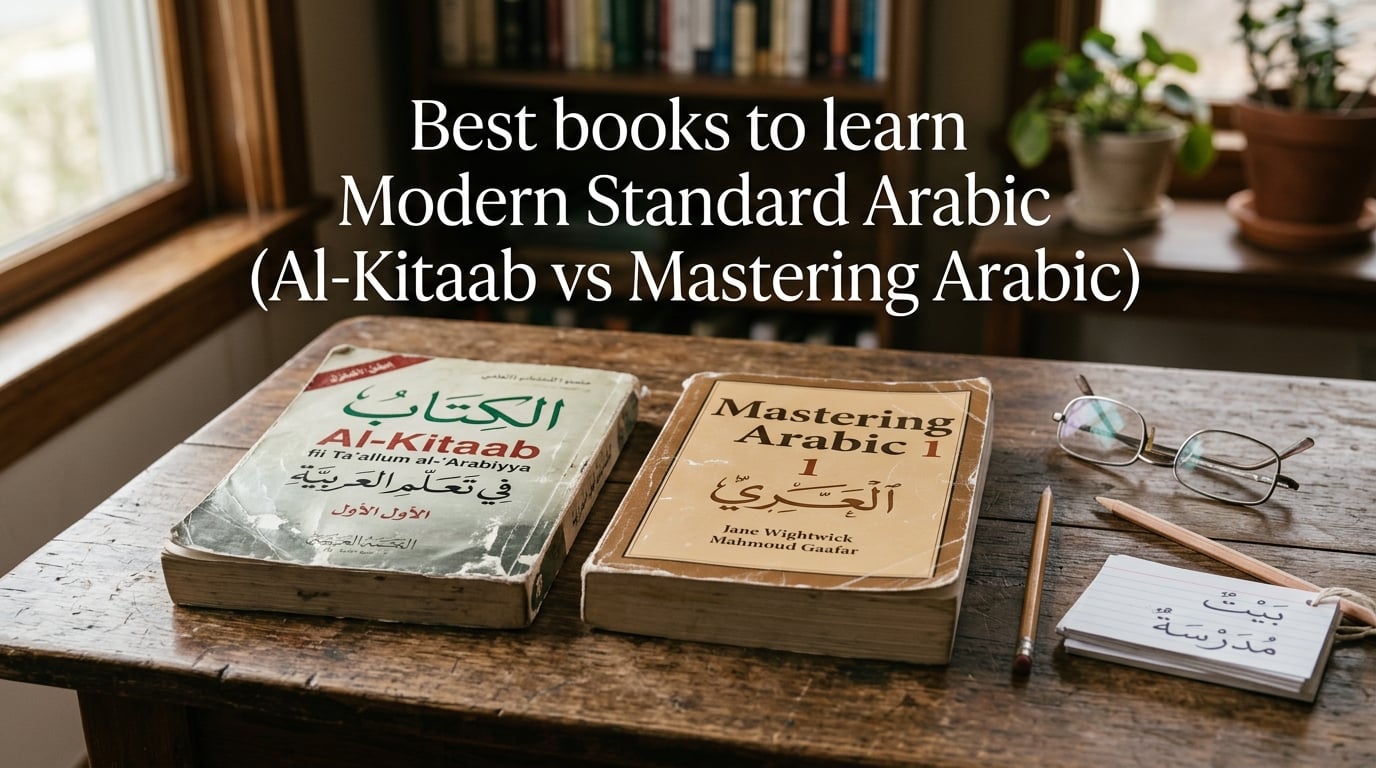
The two most widely used books to learn Modern Standard Arabic are Al-Kitaab fii Ta’allum al-‘Arabiyya, written by Kristen Brustad, Mahmoud Al-Batal and Abbas Al-Tonsi and published by Georgetown University Press since 1995, and the Mastering Arabic series by Jane Wightwick and Mahmoud Gaffer, published by Hippocrene Books. Al-Kitaab is the dominant university textbook in the United States and also introduces Egyptian and Levantine Arabic alongside Fusha; Mastering Arabic is a self-study-focused complete course aimed at adult independent learners who want a clean Modern Standard Arabic (MSA) track without a classroom.
If you have one minute, here is the rule of thumb our team uses: pick Al-Kitaab if you are starting (or restarting) a serious multi-year Arabic program at a university, you want exposure to Egyptian or Levantine Arabic alongside Fusha, or you have a teacher to guide you. Pick Mastering Arabic if you are an adult learner working alone, want a single self-contained course in Modern Standard Arabic, and prefer audio drills to video skits.
The rest of this guide breaks down both series, shows them side by side, and answers the most common questions our readers ask. We have spent more than 80 hours reviewing Al-Kitaab Parts 1-3, Alif Baa, and the current Mastering Arabic paperback, plus the activity book, plus reader reviews on Reddit r/learn_arabic and r/languagelearning. Everything below comes from real use cases, not marketing copy.
Table of Contents
What Is Modern Standard Arabic and Why Learn It
Modern Standard Arabic (MSA), also called Fusha or Fus’ha, is the written and formal spoken variety of Arabic used across news broadcasts, official speeches, academic writing, novels, and the websites of every Arab country. It developed from Classical Arabic in the late 19th and early 20th centuries and is the version most textbooks teach.
Modern Standard Arabic vs spoken dialects
Most Arab countries share MSA in writing, but the everyday spoken language varies by region. Egyptian Arabic (Masri) is the most widely understood spoken variety thanks to Egyptian film and television. Levantine Arabic (Shami) covers Syria, Lebanon, Jordan and Palestine. Then there is Iraqi, Gulf, and Maghrebi Arabic, each with its own pronunciation and vocabulary.
This split between written MSA and spoken regional dialects is called diglossia. Learners usually start with MSA, then add a dialect once they can read. That is why a good textbook matters: it sets the foundation for everything else.
Who learns MSA and why
MSA is the right starting point for university Arabic programs, diplomats, translators, journalists, researchers working with Arabic sources, heritage learners refreshing their reading, and serious self-study adults. Travelers who only need survival phrases usually skip MSA and pick a dialect book or app instead.
Both Al-Kitaab and Mastering Arabic teach MSA first. The big difference is what they do next: Al-Kitaab weaves in Egyptian and Levantine dialogues from Part One, while Mastering Arabic stays MSA-only throughout.
Al-Kitaab Arabic Language Program: A Deep Dive
Al-Kitaab fii Ta’allum al-‘Arabiyya, often just called Al-Kitaab, is a four-book series published by Georgetown University Press. It is the standard textbook in most North American university Arabic programs and has been continuously updated since 1995. The current Alif Baa and Parts 1-3 are in their third edition, with companion websites, streaming video, and audio files.
Authors and edition history
The series is written by Kristen Brustad (formerly UT Austin, now American University of Beirut), Mahmoud Al-Batal (American University of Beirut), and Abbas Al-Tonsi (Georgetown University in Qatar). All three are native or near-native Arabic speakers with decades of teaching experience. The first edition was published in 1995, the second around 2004, and the third edition updates arrived between 2011 and 2015. Recent printings remain the third edition, with new digital updates to the companion platform.
Georgetown University Press keeps the series tightly controlled. The answer key is sold separately, the audio and video files live on a publisher platform tied to each edition, and online access codes are tied to the printing you buy. Reviewers report that older access codes occasionally break, which is worth knowing before you commit.
How the series is structured
Al-Kitaab has four main volumes plus an intermediate reader:
- Alif Baa: Introduction to Arabic Letters and Sounds (third edition, Kristen Brustad, Mahmoud Al-Batal, Abbas Al-Tonsi, Georgetown University Press). A standalone alphabet and sounds primer that also introduces basic greetings and cultural topics. Universities often use it in the first 4-6 weeks of a first-year course.
- Al-Kitaab Part One (third edition). The first main coursebook, building vocabulary, grammar, and short readings, with the first appearance of Egyptian Arabic video skits.
- Al-Kitaab Part Two (third edition). The intermediate coursebook. This is where most self-learners report hitting a wall, because the readings jump in length and the grammar becomes denser.
- Al-Kitaab Part Three (third edition). The advanced coursebook. It is aimed at students who finish Parts 1 and 2 and want to read authentic Arabic media and literature.
Each part comes with a companion website containing audio, video, and glossaries. The video skits feature the same recurring characters across Parts 1 and 2, which makes the storyline easier to follow but also a common complaint from learners who find the characters dated.
Dialect coverage and audiovisual companions
Part One introduces Egyptian Arabic through video skits alongside MSA readings. Part Two keeps Egyptian Arabic but also adds Levantine Arabic scenes. Part Three moves into authentic reading material across multiple dialects and registers. This layered exposure to dialects is rare in a beginner textbook and is one of Al-Kitaab’s strongest selling points for learners who plan to live in or travel around the Arab world.
The third edition added color photos, redesigned pages, and color-coded vocabulary lists, which we found noticeably easier to study from than the second edition. The streaming videos replace the older DVDs that came with the second edition.
What real learners say about Al-Kitaab
The honest take from forums: Al-Kitaab is the gold standard at US universities, but it is rough without an instructor. Common complaints include vocabulary that introduces obscure or institutional words (United Nations, embassy) before everyday terms like colors and family, Arabic-linguistic grammar labels that confuse English speakers, and storylines that feel dated. Multiple self-learners on r/learn_arabic say they abandoned Part Two because the jump in difficulty felt too sudden.
On the other hand, learners who push through Part Two consistently say the payoff is real: by the end of Part Two you can read short authentic articles and follow a slow news broadcast. Heritage learners refreshing Fusha often start at Part Two and skip ahead to Part Three for the advanced reading selections.
Mastering Arabic Series: A Deep Dive
The Mastering Arabic series by Jane Wightwick and Mahmoud Gaffer is a self-study-oriented complete course published by Hippocrene Books. It targets adult independent learners who want to work through Modern Standard Arabic on their own, with an audio CD or download and an optional activity book.
Authors and format
Jane Wightwick is a British Arabic teacher and writer who has authored dozens of language books for adults. Mahmoud Gaffer is an experienced Arabic instructor. Their approach is consistent across the series: clear English explanations, practical vocabulary, and short dialogues in MSA without dialect switching.
The core book is Mastering Arabic, a paperback course now in its second edition, with an audio component available as a CD or downloadable audio. There is also a separate Mastering Arabic Activity Book for additional practice.
How Mastering Arabic is structured
Mastering Arabic follows a single-volume path: alphabet and sounds, then grammar topics in roughly increasing complexity, with dialogues, vocabulary lists, and exercises for each unit. Units are short enough that an adult learner can finish one in 30-45 minutes. The course covers Arabic script, harakat (short vowels), the trilateral root system, verb conjugation forms, gender and number agreement, and a working vocabulary of several thousand words.
The book stays inside Modern Standard Arabic throughout. There is no Egyptian or Levantine content. For adult learners who want a clean Fusha track without a teacher, that focus is a feature, not a limitation. Audio drills cover pronunciation and short dialogues.
Common pattern: a true beginner working through Mastering Arabic 4-5 days a week finishes the main course in roughly 6-12 months. That puts it ahead of Al-Kitaab Part One in pure speed, because Al-Kitaab Part One is built to take a full university semester (around 4 months of in-class time).
What real learners say about Mastering Arabic
Forums describe Mastering Arabic as more approachable for adults learning alone but less comprehensive than Al-Kitaab. The audio quality and pronunciation drills are seen as less engaging than newer apps. Several learners mention pairing the book with the Pimsleur Arabic audio course or a tutor on italki for listening practice. The good news is that Mastering Arabic is widely available in public libraries, which makes it a low-cost trial if you want to test the approach before buying.
Our team also found the explanations of Arabic grammar easier to follow than Al-Kitaab’s. Wightwick and Gaffer use English-linguistic labels (subject, verb, object) instead of the Arabic-linguistic labels Al-Kitaab introduces (مبتدأ, خبر, فعل), which several English-speaking learners told us is a real relief.
Al-Kitaab vs Mastering Arabic Side-by-Side
Both series teach Modern Standard Arabic well. The differences are in scope, teaching philosophy, and how much dialect you get. The table below captures the main dimensions at a glance.
| Dimension | Al-Kitaab (Georgetown University Press) | Mastering Arabic (Hippocrene Books) |
|---|---|---|
| Authors | Brustad, Al-Batal, Al-Tonsi | Wightwick, Gaffer |
| First published | 1995 | 1990s, current second edition |
| Current edition | Third edition (2011-2015) | Second edition |
| Number of volumes | Four (Alif Baa + Parts 1-3) | One main course plus optional activity book |
| Dialect coverage | Egyptian from Part 1, Levantine from Part 2 | MSA only |
| Companion media | Streaming video, audio, online platform | Audio CD or download, activity book |
| Grammar labels | Arabic-linguistic | English-linguistic |
| Best for | University programs, heritage learners, dialect exposure | Adult self-study, focused MSA track |
| Realistic time to complete core path | 2-3 years (Parts 1-3 plus Alif Baa) | 6-12 months |
| Designed for solo use | Workable but harder | Yes |
Choose Al-Kitaab if…
Pick Al-Kitaab if you are enrolled in or planning a multi-year university Arabic program, you want to read authentic Arabic by Part Three, or you want Egyptian and Levantine exposure baked into the course. Al-Kitaab is also the better choice if you have a teacher or tutor to guide you through Part Two’s jump in difficulty. Heritage learners who already speak a dialect at home but want to read Fusha usually start at Part Two or Part Three.
Choose Mastering Arabic if…
Pick Mastering Arabic if you are an adult learner working alone, you want a single self-contained course instead of a four-volume commitment, you want to stay inside Fusha without dialect exposure, or you want English-friendly grammar explanations. It is also a strong first book before moving to Al-Kitaab: many self-learners start with Mastering Arabic to learn the alphabet and basic grammar, then move to Alif Baa and Al-Kitaab Part One once they are ready for a university-level workload.
Tips for Learning Modern Standard Arabic Without a Teacher
Textbooks alone will not make you fluent, but a textbook plus a steady routine will move you surprisingly far. Here is the routine our team recommends for self-study.
- Pick one book and stick with it for at least 90 days. Switching between Al-Kitaab and Mastering Arabic mid-way resets your progress.
- Do the audio drills out loud. Arabic has sounds English does not use. Reading silently does not build pronunciation.
- Keep a vocabulary notebook in Arabic script. Do not transliterate into English letters, or you will build a crutch you cannot unlearn.
- Add 15 minutes of listening per day. Pair the book with Pimsleur Arabic, a podcast like Arabic With Diab, or a tutor on italki for conversation.
- Review the harakat (short vowels). Al-Kitaab removes short vowels after the early chapters, which mirrors real Arabic. Expect a learning curve and use the audio to fill in what the page no longer shows.
- Test yourself with the answer key. Both Al-Kitaab and Mastering Arabic sell answer keys separately. They are worth the cost.
- Track time, not pages. Aim for 90 minutes of focused study four to five days a week. You will finish faster than you expect.
What to Read Next After These Textbooks
Once you finish the core of either series, you have a working foundation in Modern Standard Arabic. The next step depends on your goal.
For learners heading toward Egypt, the natural next book is Kallimni ‘Arabi by Samia Louis (AUC Press), which teaches Egyptian Arabic conversation. For Levantine Arabic, try Arabic for Life by Bassam K. Frangieh, or the Shami Arabic self-study materials from the same publisher ecosystem.
For reading practice, graded readers from Georgetown University Press and AUC Press offer short authentic texts at each level. For vocabulary retention, pair your reading with Memrise or Anki decks built from your textbook’s word lists. For conversation, a 30-minute weekly session on italki accelerates speaking faster than any textbook can.
Worth noting: most learners eventually move from textbook MSA to a mix of MSA and a spoken dialect. That transition is normal and expected. Plan for it instead of fighting it.
Frequently Asked Questions
What is the best book to learn Modern Standard Arabic?
The two strongest choices are Al-Kitaab fii Ta’allum al-‘Arabiyya by Brustad, Al-Batal, and Al-Tonsi (Georgetown University Press), which is the dominant US university textbook and also introduces Egyptian and Levantine Arabic, and Mastering Arabic by Jane Wightwick and Mahmoud Gaffer (Hippocrene Books), which is a self-study-focused complete course in Modern Standard Arabic. Pick Al-Kitaab for university-level depth and dialect exposure, or Mastering Arabic for a clean self-study path.
Is Al-Kitaab good for self-study?
Al-Kitaab is workable for self-study but harder than Mastering Arabic. The series is built for the classroom and assumes you have a teacher to explain Arabic-linguistic grammar labels and to pace you through the Part Two difficulty jump. Independent learners who finish Part One on their own typically pair the book with a tutor on italki or with the Pimsleur Arabic audio course for listening and speaking practice.
Is Mastering Arabic by Wightwick good for beginners?
Yes. Mastering Arabic is widely recommended for adult beginners learning on their own. The English-linguistic grammar explanations are easier than Al-Kitaab’s Arabic-linguistic labels, units are short enough for a working adult to finish in 30-45 minutes, and the course stays focused on Modern Standard Arabic without forcing a dialect switch.
Does Al-Kitaab teach Modern Standard Arabic or a dialect?
Al-Kitaab teaches Modern Standard Arabic as the core, then introduces Egyptian Arabic video skits starting in Part One and adds Levantine Arabic scenes in Part Two. Part Three moves into advanced reading across multiple registers. This layered dialect exposure is rare in beginner textbooks and is one of Al-Kitaab’s biggest advantages.
What is the difference between Alif Baa and Al-Kitaab?
Alif Baa is the standalone alphabet and sounds primer in the Al-Kitaab series, covering Arabic letters, short vowels (harakat), and basic cultural topics over about 10 lessons. Al-Kitaab Part One is the first full coursebook, picking up after Alif Baa with vocabulary, grammar, and reading passages. Most universities use Alif Baa for the first 4-6 weeks, then move into Al-Kitaab Part One.
How long does Al-Kitaab Part One take?
Al-Kitaab Part One is built for one US university semester, roughly 4 months of in-class time at 4-5 hours per week. A motivated self-study learner can finish it in 6-9 months at 60-90 minutes per day, though the dense grammar and Arabic-linguistic vocabulary labels make that pace ambitious without a teacher.
Can you learn Modern Standard Arabic without a teacher?
You can reach a solid A2-B1 reading level in Modern Standard Arabic on your own using a textbook plus daily listening and weekly speaking practice. To break past B1 into reading authentic Arabic media, most self-learners add a tutor for 30-60 minutes per week to correct mistakes and explain grammar points the textbook glosses over.
Final Verdict
The best books to learn Modern Standard Arabic in 2026 are still Al-Kitaab fii Ta’allum al-‘Arabiyya and the Mastering Arabic series. They serve two different learners well, and you do not have to choose just one: many adult self-study learners work through Mastering Arabic first to build the alphabet and basic grammar, then move into Alif Baa and Al-Kitaab Part One once they are ready for a university-level workload. Whichever path you take, commit to 90 days of consistent study, do the audio out loud, and add a weekly conversation partner. That combination is what turns a textbook into real Modern Standard Arabic.