
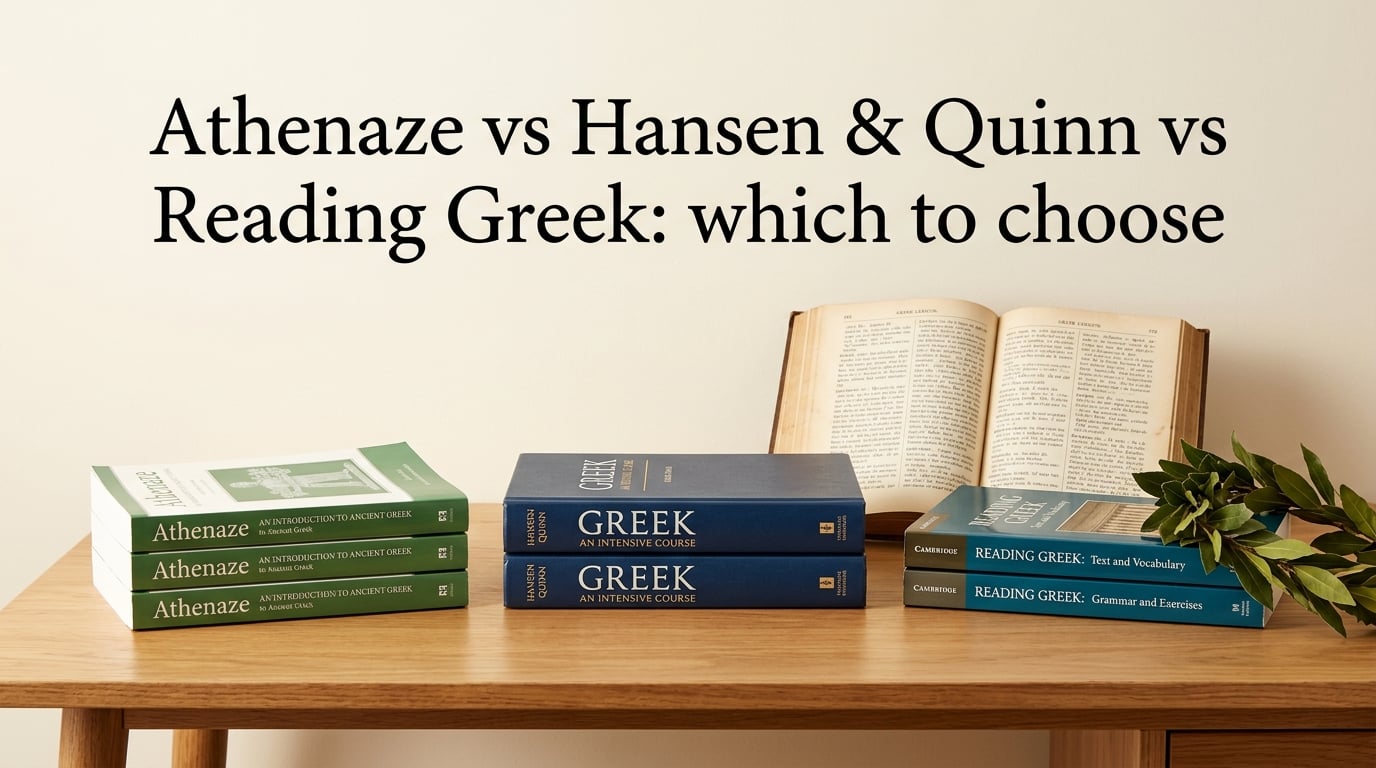
Choosing between Athenaze, Hansen & Quinn, and Reading Greek (JACT) is the first real decision every Ancient Greek learner makes – and the forums are full of people who picked wrong and burned out before they ever read a line of Plato. I have spent the past several months working through all three, comparing forum threads on r/AncientGreek, Textkit, and Quora, and talking to autodidact learners who finished (or abandoned) each book.
This guide gives you a structured comparison so you can stop searching and start reading. You will get a side-by-side table, a methodology primer, a deep dive on each textbook, a decision framework by learner profile, dialect coverage notes, pairing recommendations, and a FAQ block answering the eight most-asked questions about the Athenaze vs Hansen & Quinn vs Reading Greek debate. Everything below is based on real forum reports, published reviews, and the books themselves – not on speculation.
Table of Contents
Quick Summary: Which Textbook Should You Pick?
If you only have a minute, here is the short answer. Pick Athenaze if you are a true beginner who wants a gentle, story-based on-ramp and you do not mind supplementing with a grammar reference on the side. Pick Hansen & Quinn if you are enrolled in (or emulating) an intensive university course and want the most rigorous, drill-heavy path to reading Plato and Aristotle. Pick Reading Greek (JACT) if you are a serious self-learner who wants the closest thing to an Oxford-style course and you can stay disciplined without a teacher.
For most autodidacts, my honest recommendation in 2026 is Athenaze Book I paired with a companion grammar – it gives you the smoothest start and the largest pool of online help. For classroom learners, Hansen & Quinn remains the default and is hard to beat. Reading Greek is the strongest choice if your goal is to read classical philosophy quickly and you are willing to put in the hours.
Athenaze vs Hansen and Quinn vs Reading Greek: Side-by-Side Comparison
This table gives you the headline facts at a glance. Method, primary dialect, volume structure, target learner, supplementary resources, and publisher are all there so you can scan in under a minute.
| Feature | Athenaze | Hansen & Quinn | Reading Greek (JACT) |
|---|---|---|---|
| Full title | Athenaze: An Introduction to Ancient Greek | Greek: An Intensive Course | Reading Greek: Text and Vocabulary |
| Authors | Balme, Lawall, Morwood | Hardie Debold Hansen, Gerald M. Quinn | Joint Association of Classical Teachers (JACT) |
| Publisher | Oxford University Press | University of California Press | Cambridge University Press |
| Method | Inductive, reading-based with pedagogical modified Greek | Grammar-translation, drill-heavy | Reading-based with explicit grammar |
| Primary dialect | Attic | Attic | Attic with Koine leanings in later chapters |
| Structure | Two volumes (Book I, Book II) | One volume, 20+ units | Two volumes plus a Grammar, Vocabulary, and Exercises volume |
| Ideal learner | True beginners, autodidacts, high schoolers | University first-year courses, intensive programs | Serious self-learners, returning adults, Oxbridge-track |
| Reading approach | Adapted stories that slowly approach real Attic | Real Greek sentences from the start, heavy paradigm drills | Adapted Greek moving into continuous prose by mid-Book I |
| Published answer key | No published answer key for students | Limited teacher edition; partial keys in some reprints | Separate Text and Vocabulary volume plus Grammar volume |
| Audio resources | Luke Ranieri / Legentibus recordings available | Same community audio exists | Same community audio exists |
| Pace | Moderate, friendly to beginners | Fast, demanding | Steady, intermediate |
Methodology Primer: Grammar-Translation vs Inductive Reading Methods
Before you pick a textbook, you need to understand the pedagogical divide that runs through all three choices. The three books fall along a spectrum from explicit grammar instruction to implicit learning through reading.
Grammar-Translation Method
Grammar-translation is the oldest and most explicit method. You memorize paradigms (the patterns of how nouns and verbs change form), drill forms until they stick, and only later apply them to connected passages. Hansen & Quinn is the strongest representative in the Greek world – every chapter introduces a grammar point, drills it relentlessly, and only then gives you real Greek to translate. The advantage is speed: if you finish the book, you actually know your morphology. The disadvantage is boredom and the risk of burnout – forum users on Textkit regularly describe grinding through H&Q as “living life on the edge.”
Inductive / Reading-Based Method
The inductive method works in the opposite direction. You read adapted Greek from the start, encounter forms in context, and only later formalize the grammar rules. Athenaze is the purest version of this in English – the first chapters are short stories in pedagogical modified Greek (Greek that has been deliberately simplified for learners) where you pick up vocabulary and patterns before any explicit rule is named. Reading Greek (JACT) sits between the two: it moves from adapted Greek into real Greek faster than Athenaze but stops to call out grammar rules along the way.
Where the Methods Come From
This split mirrors a long-running debate in language teaching. Stephen Krashen’s comprehensible input hypothesis argues that learners acquire language by understanding messages slightly above their current level – which is what Athenaze and JACT try to do with adapted stories. The grammar-translation camp counters that without explicit drilling, learners develop fragile intuitions that collapse when they meet a real text. You can see the same divide in Latin: Wheelock is grammar-translation, while LLPSI (Lingua Latina per Se Illustrata) is reading-based. Both approaches work; they just suit different temperaments.
Athenaze Deep Dive: Method, Structure, Strengths and Weaknesses
Athenaze is published by Oxford University Press and was written by Maurice Balme, John Lawall, and Gilbert Morwood. It comes in two volumes – Book I for the first year and Book II for the second – and uses a story-driven, inductive method that has made it a favorite in high school and gentle introductory college programs.
Structure of Athenaze
Book I runs through roughly twenty chapters that move from very short adapted dialogues about a fictional Greek family in Croton (a Greek colony in southern Italy) to genuine Attic prose by the end. Each chapter opens with a running vocabulary list, presents a story, then asks comprehension and grammar questions. Cultural notes about daily life in the ancient Greek world – food, family, religion – are woven into the readings, which is one of Athenaze’s signature features.
Strengths of Athenaze
The on-ramp is exceptionally gentle. Beginners who bounce off Hansen & Quinn in week two often settle into Athenaze and stay with it for months. The cultural notes make the readings feel alive rather than mechanical. Because the textbook has been around since the 1970s and is in its third edition (with Italian and other European variants also in print), there is a huge ecosystem of free help online – flashcards, vocabulary lists, audio recordings, and forum threads. Luke Ranieri has recorded the entire Athenaze reading series, which is invaluable if you are self-studying without a teacher.
Weaknesses of Athenaze
The biggest complaint on forums is retention. A Textkit user named Loiesun wrote that Athenaze “was insufficient on its own. I was half-learning many things” – the stories are so lighthearted that you can read chapter after chapter without internalizing the grammar. Because Athenaze uses pedagogical modified Greek before real Attic, you also reach real Greek later than you would with Hansen & Quinn. Finally, there is no published answer key, which makes the book awkward to use without a teacher or a study partner.
Who Athenaze Suits Best
True beginners, self-learners who want a humane pace, high school students in classical programs, and anyone who already knows they prefer story-based learning. Pair it with a grammar reference like Smyth or the Athenaze Workbook for best results.
Hansen and Quinn Deep Dive: Method, Structure, Strengths and Weaknesses
Hansen and Quinn’s full title is “Greek: An Intensive Course,” and the name tells you the philosophy. It was written by Hardie Debold Hansen and Gerald M. Quinn, published by the University of California Press, and is the workhorse textbook of intensive first-year Greek programs across North America.
Structure of Hansen and Quinn
The book is a single large volume divided into roughly twenty units. Each unit opens with a passage of real Attic Greek (adapted from classical authors), then dives into the grammar and vocabulary introduced in that passage. The second half of each unit is dense with paradigms, drills, and translation exercises. By the end of the book, you have worked through most of Attic morphology – including participles, contract verbs, and the optative mood – and you have read hundreds of sentences of real Greek.
Strengths of Hansen and Quinn
It is the most rigorous of the three books. Learners who finish H&Q can genuinely read Plato and Aristotle without backtracking for grammar. The drill density is unmatched – if you do even half the exercises, you will know your paradigms cold. It is also the textbook most universities actually use, which makes it easy to find a study group, a tutor, or a syllabus online if you are self-studying. A Reddit user on r/classics wrote that they “really learned Hansen and Quinn better than I had Greek” – meaning the textbook itself, not just the language.
Weaknesses of Hansen and Quinn
The pace is brutal. It was designed for intensive programs that meet four to five days a week, and autodidacts regularly report burnout in unit five or six. The readings are dense and unvarnished Attic, with no pedagogical easing – which is great for fluency but punishing for beginners. The famous answer key problem: while there is a teacher’s edition, it is not widely available to students, so self-learners cannot fully check their work. Long vowels are not marked in earlier printings, which breaks pronunciation practice.
Who Hansen and Quinn Suits Best
University first-year Greek courses, intensive summer programs (the kind that meet six contact hours a week), and disciplined self-learners who want a rigorous, grammar-first path. If you thrive on drills and can keep a steady pace, H&Q is hard to beat.
Reading Greek (JACT) Deep Dive: Method, Structure, Strengths and Weaknesses
Reading Greek is published by Cambridge University Press and authored by the Joint Association of Classical Teachers, a consortium of UK Classics professors. It comes in two main volumes – a Text and Vocabulary volume and a separate Grammar, Vocabulary, and Exercises volume – and is the standard textbook for first-year Greek at Oxford and many UK universities.
Structure of Reading Greek
Book I starts with very simple adapted Greek and gradually introduces real Attic prose from authors like Xenophon and Plato’s dialogues. By the middle of Book I you are reading continuous prose. Book II carries you through Herodotus, Thucydides, and into New Testament Koine. The vocabulary lists are running glossaries at the back of each chapter, and the grammar volume sits beside the text volume as a reference. There are unseens (unseen translation passages) drawn from classical authors throughout, which is excellent practice for the kind of translation you will face in exams.
Strengths of Reading Greek
Reading Greek sits in a sweet spot between Athenaze and Hansen & Quinn. It moves into real Greek faster than Athenaze but with more guidance than H&Q. The continuous reading approach builds reading stamina early. A Quora respondent who learned Greek at Oxford wrote that they would “definitely recommend RG – best suited to someone who wants to take their study seriously from the start.” Because it is a Cambridge publication, the editing and typography are clean, and the separate grammar volume is well-organized for reference.
Weaknesses of Reading Greek
It is harder to use without a teacher than Athenaze. The running vocabulary and chapter-end unseens are easier to navigate in a classroom where someone can explain the structure. Self-learners on Textkit sometimes describe it as “more annoying to navigate” than Athenaze because you constantly flip between the text volume and the grammar volume. The Koine leanings in Book II can be a surprise to learners who thought they were signing up for classical Attic only.
Who Reading Greek Suits Best
Serious self-learners, returning adult learners, students aiming for UK-style courses, and anyone targeting Plato or Aristotle who wants a Cambridge-curated path. If you want one book that gets you from zero to reading real classical prose with confidence, Reading Greek is the most balanced choice.
Comparison by Learner Profile: Self-Study, Classroom, Intensive, Dialect Goal
The textbook you should pick depends heavily on how you are studying and what you ultimately want to read. Here is the decision framework by profile.
Self-Study / Autodidact Learner
For solo learners without a teacher, Athenaze is the safest starting point because of its gentleness and the volume of free online help. Reading Greek is the next best choice if you have the discipline to push through. Hansen & Quinn is the riskiest choice without a teacher because of its drill volume and answer-key gap. If you are self-studying, plan to pair whichever book you choose with a grammar reference (Smyth’s Greek Grammar is free online) and one of the free Luke Ranieri audio recordings.
University First-Year Course
If your university has assigned a textbook, use it. If you have a choice, ask your professor. Hansen & Quinn is the most common pick in North American departments. Reading Greek is the default in many UK programs. Athenaze is more common in high school and gentle college survey courses.
Intensive Summer Program
Intensive programs (six to eight contact hours per week over eight to twelve weeks) almost universally use Hansen & Quinn because the pace matches the method. If you are emulating an intensive at home, H&Q is still the right call – just budget fifteen to twenty hours per week and stick to the syllabus.
Homer / Iliad Goal
If your long-term goal is reading Homer, none of the three books is sufficient on its own. All three teach Attic, and Homeric Greek is a different dialect with its own forms. Plan to finish Book I of any primer, then transition to Pharr’s “Homeric Greek” or a similar Homeric primer. Athenaze Book II includes a short Homeric transition chapter that eases the jump.
Koine / New Testament Goal
If you want to read the New Testament or Church Fathers, Reading Greek has a slight edge because Book II already moves into continuous Koine prose. Athenaze and H&Q both teach Attic, which is close enough to Koine to get you reading with a small amount of extra work on Hellenistic forms.
Dialect Coverage Guide: Attic, Koine, and Homeric Greek
Ancient Greek was not one language. The three textbooks all teach Attic, but the dialect landscape is broader, and your textbook choice interacts with your reading goal.
Attic Greek
Attic is the dialect of classical Athens in the fifth and fourth centuries BCE – the language of Plato, Aristotle, Thucydides, and the Athenian playwrights. All three textbooks teach Attic as their primary focus, and Attic is the standard dialect for university Greek programs worldwide.
Koine Greek
Koine (literally “common”) Greek is the simplified dialect that emerged after Alexander’s conquests and is the language of the New Testament, the Church Fathers, and most post-classical Greek literature. Koine is far closer to Attic than most beginners expect – the morphology is largely the same, with differences in vocabulary, some verb forms, and syntax. Reading Greek’s Book II gives you a head start on Koine because it includes continuous prose passages.
Homeric Greek
Homeric Greek is the literary dialect of the Iliad and Odyssey – a mix of Ionic, Aeolic, and other historical forms frozen by epic tradition. Homeric Greek has different noun forms, a different verb system, and uses many forms that never appear in Attic. You will need a separate Homeric primer after finishing Book I of any of the three books. Pharr’s “Homeric Greek” is the classic choice.
Dialects Beyond Attic, Koine, and Homeric
Doric, Aeolic, and Ionic appear in lyric poetry, some Hellenistic writers, and inscriptions. None of the three textbooks covers these dialects, and you will need specialized reference grammars if you want to read them. For most learners, Attic plus optional Homeric plus optional Koine is more than enough.
Pairing Recommendations: Using Two Textbooks Together
You do not have to pick exactly one book. Many experienced learners use two textbooks side by side to get the best of both methods. Here are the pairings that work.
Athenaze Plus a Companion Grammar
Athenaze + Mastronarde’s “Introduction to Attic Greek” is the classic pairing for autodidacts. Athenaze provides the gentle reading practice and cultural notes, while Mastronarde provides explicit grammar explanations and paradigm tables. The two books complement each other almost perfectly.
Athenaze Book I Plus Reading Greek Book II
Use Athenaze Book I for your first year, then transition to Reading Greek Book II for your second year. You get Athenaze’s smooth on-ramp and Reading Greek’s faster exposure to real Greek prose. This is the pairing I recommend most often to serious self-learners.
Hansen and Quinn Plus Athenaze Readings
If you want the rigor of H&Q but find the readings dry, supplement with the Athenaze stories on weekends. The cultural context in Athenaze reinforces the grammar you drill in H&Q, and the variety keeps motivation up.
Any Primer Plus Pharr for Homer
Once you finish Book I of any of the three, add Pharr’s “Homeric Greek” to start the transition to Homer. This is the most common transition path for learners whose ultimate goal is the Iliad or Odyssey.
Supplementary Resources and Answer Keys for Self-Study
Whichever textbook you pick, you will need supplementary resources – especially if you are self-studying. Here is what is available in 2026.
Answer Key Availability
Hansen & Quinn has a teacher’s edition that contains most answers, but it is not sold to students. Athenaze has no published answer key at all. Reading Greek’s separate Grammar, Vocabulary, and Exercises volume functions as a partial key for the exercises in Book I. For full answer checking, your best resource is the active communities on r/AncientGreek and Textkit, where experienced learners will correct your work if you post it.
Audio Recordings
Luke Ranieri of Legentibus has recorded the readings from all three textbooks. His website and YouTube channel are free and are the de facto audio resource for English-speaking autodidacts. For pronunciation, his reconstructed classical pronunciation is the standard in most North American programs.
Online Communities
The r/AncientGreek subreddit is active and welcoming. The Textkit Greek and Latin forum has been around for over a decade and contains hundreds of threads on each textbook. The welltrainedmind.com forums also have a Classics section. If you join one community and post regularly, you will find study partners.
Free Grammar References
Smyth’s “Greek Grammar” is freely available online and is the standard reference. The Cambridge “Greek Grammar” included with Reading Greek is also excellent. For morphology tables, the running vocabulary lists in each textbook plus a flashcard app like Anki will carry you through your first year.
Frequently Asked Questions
Which is better, Reading Greek or Athenaze?
It depends on your learner profile. Athenaze is better for true beginners and self-learners who want a gentle, story-based on-ramp and are willing to supplement with a grammar reference. Reading Greek is better for serious learners who want to reach real Attic prose faster and do not mind the slightly steeper pace. Many experienced learners use Athenaze Book I and then transition into Reading Greek Book II for the second year.
What is the best textbook for learning Greek?
There is no universally best textbook. Hansen and Quinn is the most rigorous and is the default in intensive university programs. Reading Greek (JACT) is the most balanced and is the standard in UK-style programs. Athenaze is the most beginner-friendly and is widely used in high school and gentle college programs. Pick the one that matches your learning style and study context rather than chasing a universal winner.
What are some good textbooks for learning Greek language?
Beyond Athenaze, Hansen and Quinn, and Reading Greek, consider Mastronarde’s Introduction to Attic Greek, Shelmerdine’s Introduction to Greek, and Pharr’s Homeric Greek (for Homer specifically). For Latin-to-Greek crossover learners, Luschnig’s An Introduction to Ancient Greek is another gentle option. Each of these is best paired with Smyth’s Greek Grammar as a reference.
Which Ancient Greek textbook is best for self-study?
For self-study, Athenaze is the safest pick because of its gentleness and the huge ecosystem of free online help, including Luke Ranieri’s audio recordings. Reading Greek (JACT) is the next best choice if you are disciplined and willing to flip between two volumes. Hansen and Quinn is harder for self-study because of its demanding pace and limited answer-key availability, though serious autodidacts do finish it.
Overview of Quinn’s Greek textbook
Gerald M. Quinn co-authored Greek: An Intensive Course with Hardie Debold Hansen, published by the University of California Press. The book is a single-volume, grammar-translation textbook designed for intensive first-year university Greek programs. It is drill-heavy, exposes students to real Attic from the start, and remains one of the most widely used Greek textbooks in North American college classrooms.
Does Hansen and Quinn have an answer key?
Hansen and Quinn has a teacher’s edition that contains most answers, but it is not sold to students and there is no published student answer key. Self-learners must rely on online communities like r/AncientGreek and Textkit to check their work. This is one of the most common complaints about the book among autodidacts.
What Ancient Greek dialects exist beyond Attic and Koine?
Beyond Attic and Koine, the major dialects are Homeric (a literary mix of Ionic, Aeolic, and other forms used in the Iliad and Odyssey), Doric (used in some lyric poetry and Hellenistic writers), Aeolic (Sappho, early lyric), and Ionic (Herodotus, Hippocrates). None of the three textbooks covers these dialects in depth; for Homer you need a separate primer like Pharr’s Homeric Greek, and for the others you need specialized reference grammars.
How long does it take to finish Athenaze, Hansen and Quinn, or Reading Greek?
For a typical self-learner spending 6-10 hours per week, Athenaze Book I takes roughly 9-12 months, Hansen and Quinn takes roughly 12-18 months, and Reading Greek Book I takes roughly 9-12 months. In an intensive university course (4-5 contact hours per week plus homework), the same material is covered in one academic year. These estimates assume you do most of the exercises and read fluently rather than skimming.
Conclusion: Making the Right Choice for Your Greek Journey
The Athenaze vs Hansen & Quinn vs Reading Greek question does not have a single right answer. Pick the textbook that matches your learning style, your study context, and your ultimate reading goal – and do not be afraid to combine two books if your budget and discipline allow. Athenaze + Mastronarde is the classic autodidact pairing. Reading Greek Book I and II is the most balanced solo path. Hansen & Quinn is the rigorous choice for intensive programs and learners who thrive on drills.
Whatever you choose, commit to it for at least six months before switching. Greek pays off over years, not weeks – and the textbook you actually finish is far better than the perfect textbook you abandoned in chapter four.