
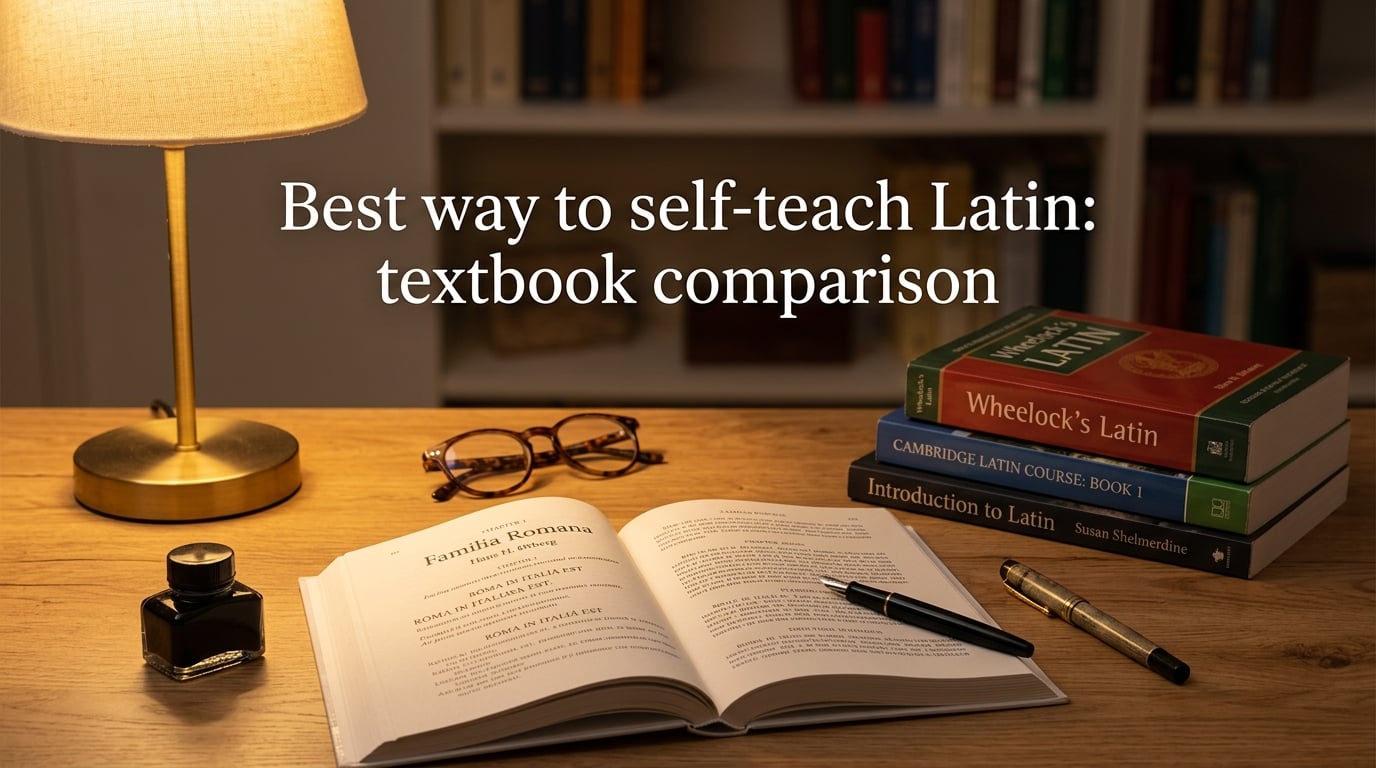
I learned my first declension from a battered copy of Wheelock’s in a college library. Twelve years later I have worked through Familia Romana twice, taught from Cambridge, and watched dozens of adult learners stall out on the wrong book by week three. The best way to self-teach Latin is not one book. It is a stack that matches how your brain actually learns grammar, plus a plan for the long, unglamorous middle.
This guide compares the eight Latin textbooks self-learners ask about most, lays out the grammar-based versus reading-based debate in plain terms, and gives you a realistic timeline and decision framework. By the end you will know exactly which book to start with, what to read alongside it, and how long it takes to crack open Caesar without a teacher.
Table of Contents
Quick Answer: The 3 Best Latin Textbooks for Self-Learners
For most adult self-learners in 2026, the three best Latin textbooks are Familia Romana, Wheelock’s Latin, and the Cambridge Latin Course. Each serves a different learner, and you can combine them.
- Familia Romana (Lingua Latina per se Illustrata) – the best single textbook for self-learners who want to read Latin the way you read a novel. Immersive, all-Latin, no translation crutch.
- Wheelock’s Latin – the classic grammar-based choice for self-learners who want a clear, deductive path from morphology to original authors. Dense, but every chapter has an answer key.
- Cambridge Latin Course – the best option if you learn through stories and want a gentle on-ramp, though you will need to supplement its grammar for true independence.
If you only have time to pick one book and want to start reading Latin, not just studying it, start with Familia Romana. If you are an analytical learner who likes rule-then-example, start with Wheelock’s. If you have a high school student at home and want a low-stress entry point, start with Cambridge.
Latin Textbook Comparison Table (At a Glance)
Before the deep reviews, here is the at-a-glance comparison. None of the four top competitors for this keyword publish a single table like this – it is the gap this article fills.
| Textbook | Approach | Best For | Level | Answer Key | Editions to Get |
|---|---|---|---|---|---|
| Familia Romana (LLPSI) | Reading-based / natural method | Adult self-learners, immersive readers | Beginner to upper-intermediate | Companion Exercitia Latina I has key | Hans Ørberg 2nd edition (Focus Publishing) |
| Wheelock’s Latin | Grammar-based, deductive | Analytical learners, future classicists | Beginner to advanced | Yes – in the back of each edition | 7th edition (Collins / Wheelock’s Latin Reader required companion) |
| Cambridge Latin Course | Reading-based with grammar notes | Homeschool, younger students, story-led learners | Beginner to intermediate (Book 4 = GCSE) | Yes – separate Teacher’s Manuals, but answers usable by self-learners | 5th edition (Units 1-4, then Anthology) |
| Oxford Latin Course | Reading-based with grammar integrated | College students, story-led adults | Beginner to intermediate (Part III ends at GCSE) | Yes – separate volumes | 2nd edition (Parts I-III + Reader) |
| Ecce Romani | Reading-based, narrative-driven | High school programs, motivated self-learners | Beginner to advanced placement | Yes – Teacher’s Edition and online resources | Latest 3rd edition |
| Latin for the New Millennium | Hybrid (grammar + reading) | Homeschool, college bridge courses | Beginner to intermediate (Levels 1-2) | Yes – teacher’s edition available | Levels 1 and 2 (Bolchazy-Carducci) |
| So You Really Want to Learn Latin (Oulton) | Grammar-based, British | Independent UK learners, GCSE/A-level prep | Beginner to GCSE | Yes – separate answer book | 3rd edition (Galore Park) |
| Kennedy’s Revised Latin Primer | Grammar-based, traditional | Mature self-learners, reference grammar | Beginner to advanced reference | Partial – online keys available | Bennett’s revised edition (Longman) |
Grammar-Based vs Reading-Based: Which Method Suits You?
The first decision every self-learner makes is methodological, not which book to buy. Latin pedagogy splits into two camps: grammar-based and reading-based. Your choice shapes which textbook you should pick, how you study, and when you feel progress.
Grammar-Based Approach: Rules First, Then Reading
The grammar-based approach teaches morphology and syntax explicitly before showing you real Latin. You memorize the first three declensions, drill the indicative active, and only later read continuous prose. Wheelock’s, Oulton, Kennedy’s, and Jenney’s First Year Latin sit in this camp.
This method suits learners who like clarity, want a map before they walk, and plan to read Caesar, Cicero, or Virgil in the original. The trade-off is the long dry middle: chapters 5 through 20 in Wheelock’s feel like conjugation drills, and you may lose motivation before you read anything beautiful.
Reading-Based Approach: Stories First, Grammar Picked Up in Context
The reading-based approach, sometimes called the natural method or induction, drops you into Latin from page one. Familia Romana is written entirely in Latin with marginal grammar notes. Cambridge and Oxford present a story first and let you infer grammar from context, then formalize the rules later.
This method suits learners who learn by pattern recognition and who want to feel like they are reading Latin, not just studying it. The trade-off is shallow grammar: you can finish Familia Romana and still stumble on indirect statement or the subjunctive because Ørberg waits until late to formalize them.
How to Pick a Method
Ask yourself two questions. Did you enjoy diagramming sentences in English class? If yes, grammar-based will feel familiar. Did you learn French by reading French subtitles before you knew the grammar? If yes, reading-based will click faster.
Reddit users in r/latin consistently report success with a hybrid stack: Familia Romana for reading stamina, Wheelock’s for grammar depth. That is the approach I now recommend to most adult beginners.
Best Latin Textbooks for Self-Learners: In-Depth Reviews
These eight textbooks cover roughly 90 percent of the recommendations you will see from Latin tutors, self-learners, and Reddit threads. I have worked through portions of each and reviewed what experienced teachers say about them.
Familia Romana (Lingua Latina per se Illustrata)
Hans Ørberg’s Familia Romana is the closest thing to a one-book self-study curriculum for Latin. The entire 35-chapter textbook is written in Latin, with new vocabulary and grammar introduced through a story about a Roman family in the time of Augustus. There is no translation, no glossary dump, no formal grammar table until much later.
For self-learners this is the single biggest advantage: you cannot peek at a translation because there is no English to peek at. You learn to read Latin the way you learned to read English, by pattern. The companion volume Exercitia Latina I gives you drills with an answer key, and Colloquia Personarum provides spoken practice.
I worked through chapters 1 through 10 over six weeks and could read simple Latin sentences by week four. The downside is the slow grammar formalization – the perfect passive and subjunctive arrive late. For a self-learner without a teacher to fill gaps, plan to keep a grammar reference (Allen and Greenough is free online) beside you.
Best for: independent adult learners, anyone who learns by reading, people who want to read original Latin eventually.
Avoid if: you are an absolute beginner with zero language-learning experience and get anxious without explicit rules.
Wheelock’s Latin
Wheelock’s Latin is the standard textbook for college introductory Latin in the United States. Frederic Wheelock designed it as a grammar-first course: each chapter introduces a grammar concept, provides example sentences, then drills. The 7th edition (revised by Richard LaFleur) includes cultural essays, more readings, and the famous self-tutorial exercises with answers in the back.
For self-learners the answer key is the deciding factor. You can work through every chapter alone, check your work, and keep moving. The book has 40 chapters that take most adult learners 9 to 14 months at five hours a week.
I taught from Wheelock’s for two years and saw two consistent failure modes: students stop after chapter 10 because the conjugation tables feel endless, and students finish the book and still cannot read Caesar because they never practiced reading. Pair Wheelock’s with the Wheelock’s Latin Reader from chapter 15 onward.
Best for: analytical learners, future classicists, anyone planning college-level Latin.
Avoid if: you hate conjugation drills or you need to feel like you are reading Latin before chapter 20.
Cambridge Latin Course
The Cambridge Latin Course (CLC) is the dominant textbook in UK schools and a popular homeschool choice in North America. Five units tell the story of a Roman family in Pompeii, Roman Britain, and Roman Alexandria. Grammar is taught inductively – you encounter a construction, infer the pattern, then see the rule formalized in the back.
For self-learners the appeal is the story. Cambridge reads like a graphic novel in textbook form, with illustrations, relatable characters, and a continuous narrative across all five units. Most learners stick with it longer than they would with a pure grammar book.
The weakness, called out repeatedly by experienced tutors like Emma Williams, is shallow grammar coverage. Students who finish Book 3 and try to read unadapted Latin are surprised by the syntax. Self-learners using Cambridge should plan to add a grammar reference (or pair it with a grammar-based text after Book 2).
Best for: high school students, homeschool families, story-led learners, anyone who has quit a denser textbook before.
Avoid if: you are an analytical adult who finds story-led learning too slow.
Oxford Latin Course
The Oxford Latin Course (OLC) is Cambridge’s main competitor and the standard introductory textbook in many US colleges. Like Cambridge it tells a continuous story (the fictional Horace and his household) and integrates grammar into the narrative, but it covers grammar more thoroughly and at a faster pace.
For self-learners the Oxford course sits in a middle ground. It is reading-based enough to feel like you are progressing through a story, but grammar-heavy enough that you finish Part III with real reading skills. College Press Reviews and r/latin both note that OLC graduates find the jump to Caesar smoother than CLC graduates.
Parts I, II, and III cover roughly two years of college Latin. Most self-learners should plan to use all three plus the Oxford Latin Reader.
Best for: college-bound adults, self-learners who want a balance of story and grammar.
Avoid if: you want a single-volume completion or you need a British-aligned GCSE track.
Ecce Romani
Ecce Romani is a four-volume reading-based series that dominated US high school Latin programs for two decades. Like Cambridge and Oxford, it tells a story (a Roman family in the late Republic) and introduces grammar inductively. The cultural notes are richer than Cambridge’s and the reading passages get longer faster.
For self-learners, Ecce Romani has solid answer keys in the Teacher’s Edition, and the grammar is rigorous enough to stand alone – though it is not as thorough as Wheelock’s. The main drawback is availability: it is harder to find outside the US school market.
Best for: high school students, motivated adult learners who like cultural context, anyone using a structured homeschool curriculum.
Avoid if: you live outside North America and struggle to source used copies.
Latin for the New Millennium (LNM)
Latin for the New Millennium is a two-level textbook published by Bolchazy-Carducci and widely used in college bridge courses and homeschool co-ops. It uses a hybrid approach: each chapter opens with a short reading, then teaches the grammar that unlocks it, then drills.
For self-learners, LNM has clear answer keys, good audio recordings, and a gentler ramp than Wheelock’s. Reviewers on r/latin call it a strong choice for adults who want more grammar than Cambridge but more story than Wheelock’s.
Best for: adult beginners, homeschool families, college students refreshing Latin.
Avoid if: you prefer a single deep textbook (LNM tops out at the end of the second-year curriculum).
So You Really Want to Learn Latin (Oulton)
Lawrie Oulton’s three-volume series is the standard grammar-based option for UK independent learners, especially those preparing for Common Entrance, GCSE, or A-level Latin. The grammar is rigorous, the exercises are extensive, and a separate answer book is available for self-learners.
For self-learners in the UK, Oulton is what Wheelock’s is in the US: the default serious choice. Outside the UK it is less common and harder to find, but tutor Daniel Pettersson recommends it for adult learners who prefer British grammar traditions.
Best for: UK self-learners, GCSE/A-level candidates, adults who prefer grammar-first.
Avoid if: you live in North America and cannot easily source the Galore Park editions.
Kennedy’s Revised Latin Primer
Kennedy’s Latin Primer, originally published in 1888 and revised by Ben N. Smith and now by T.A. Bennett, is the grandfather of Latin textbooks. It is a dense, comprehensive reference grammar with progressive exercises and is still used in some British schools and by classicists who want one book that takes them from beginner to advanced.
For self-learners Kennedy’s works best as a reference grammar, not a primary textbook. Pair it with a more guided course (Wheelock’s, Oulton) and use it to look up forms and syntax when you get stuck.
Best for: serious self-learners who want a reference grammar, classicists building a long-term library.
Avoid if: you want a friendly first textbook.
How to Choose the Right Latin Textbook (Decision Framework)
If you are still undecided after the reviews, walk through this short framework.
Pick Familia Romana if: you learn by reading, you can tolerate not knowing a rule explicitly for weeks, and you want to read Latin by month four.
Pick Wheelock’s if: you like rule-then-example, you have a study block of at least five hours a week, and you are willing to grind through conjugation drills for the first two months.
Pick Cambridge if: you are a story-led learner, you have a younger student at home, or you have failed to stick with a grammar-heavy textbook before.
Pick a stack instead of a single book if: you read the descriptions above and felt torn. Most successful adult self-learners on Reddit use two: a reading-based primary text (Familia Romana or Cambridge) plus a grammar reference (Wheelock’s, Allen and Greenough, or Kennedy’s).
Switch if: you are six weeks in and dread every study session. The textbook is wrong, not Latin.
Companion Resources: Readers, Dictionaries, and Audio
A core textbook alone will not get you to fluency. Self-learners who succeed add three kinds of companions: graded readers, a good dictionary, and audio.
Graded Readers in Recommended Order
Once you finish Familia Romana chapters 1 through 15 or Wheelock’s chapters 1 through 20, start a graded reader. Fabulae Syrae (Collar and Eves) is the standard next step for Familia Romana graduates. Ritchie’s Fabulae Faciles is similar in difficulty and works for either path.
After that, move to Pugio Bruti (RSIB) for a beginner-friendly detective story, then Roma Aeterna (the LLPSI sequel) or the Oxford Latin Reader. For medieval and Church Latin, Ad Alpes and Fabulae Gallicae fill the gap that classical-focused readers leave.
Dictionaries: Pick One and Use It
Three Latin dictionaries cover 95 percent of self-learner needs. For most adult beginners the Bantam New College Latin and English Dictionary is the right choice – portable, affordable, and clear.
For serious reading, Lewis and Short (A Latin Dictionary, 1879) is the gold standard and is free online through the Perseus Digital Library. Cassell’s Latin Dictionary is the better choice if you are reading medieval Latin or post-classical authors. Avoid Oxford Latin Dictionary as a beginner – it is huge and its definitions assume you already know Latin.
Audio and Modern Resources
The two audio resources worth your time are Legentibus (a paid subscription with recordings of original Latin texts read aloud) and the Latinitium podcast (free). For YouTube, ScorpioMartianus and Latinum have hours of beginner-friendly spoken Latin practice.
Apps are thin on the ground for Latin, but the Lingua Latina per se Illustrata companion app and Quizlet decks built from Wheelock’s vocabulary lists fill the spaced-repetition gap.
A Realistic Self-Study Timeline (and How to Stick to It)
Most adult self-learners want to know one thing: how long until I can read Caesar in the original? The honest answer is 12 to 18 months of consistent study, with milestones you can hit along the way.
- Month 1 to 3: First three declensions, present indicative active, basic vocabulary (around 300 words). You can read simple sentences like “Puer puellam amat.”
- Month 4 to 6: All five declensions, all indicative tenses, the relative pronoun, basic subordinate clauses. You can read adapted passages from a graded reader.
- Month 7 to 9: Passive voice, participles, the subjunctive mood. You start to feel overwhelmed – this is normal and where most self-learners quit.
- Month 10 to 12: Indirect statement, result clauses, cum clauses. You can read simplified Caesar (the North and Hillard graded selections) with a dictionary.
- Month 12 to 18: Original Caesar, simple Cicero, Eutropius. You are reading.
Realistic time commitment: 5 hours a week gets you through Wheelock’s chapters 1 through 20 in about nine months. Three hours a week doubles that. One hour a week turns this into a multi-year project.
Three habits separate learners who finish from learners who quit. First, do the drills. Second, read aloud every day, even five minutes. Third, keep a vocabulary notebook and review it weekly with spaced repetition.
Common Beginner Mistakes (and How to Avoid Them)
After watching dozens of self-learners start, I see the same five mistakes in the first three months.
Mistake 1: Switching textbooks. The grass is not greener. Pick Familia Romana or Wheelock’s and finish at least the first ten chapters before you switch.
Mistake 2: Skipping exercises. Reading about grammar is not the same as doing grammar. The exercise sections are where the learning happens.
Mistake 3: Translating everything to English first. This slows you down. Train yourself to read Latin as Latin, with English as the fallback.
Mistake 4: Avoiding the dictionary. Lookups feel like failure. They are the curriculum. Every Latin learner you admire spent years looking up words.
Mistake 5: Studying alone with no community. Join r/latin or the Textkit forum. When you stall, the people who answer your questions are the difference between quitting month nine and finishing month eighteen.
If you already made one of these mistakes, the recovery is simple: pick the book back up, do the chapters you skipped, and add a community.
Free vs Paid: Latin Resources on Any Budget
You can self-teach Latin for the cost of one textbook, or for free, depending on what you already have access to.
Free resources: Allen and Greenough’s New Latin Grammar is fully online at Tufts’ Perseus Digital Library. William Linney’s Getting Started with Latin is a free PDF beginner textbook. The r/latin community maintains a wiki with public-domain links to Ørberg, Ritchie, and Kennedy.
Library-first approach: Most public libraries carry Wheelock’s, the Bantam dictionary, and at least one Cambridge unit through interlibrary loan. College town libraries often have full Latin reference sections.
Where to spend if you can: Familia Romana is the single best textbook purchase for most self-learners. Add Exercitia Latina I for the answer key. A used Bantam dictionary costs less than a movie ticket. Skip the audio subscriptions until you finish chapter 15.
Frequently Asked Questions
What is the best book for self-studying Latin?
For most adult self-learners, Familia Romana (Lingua Latina per se Illustrata) is the best single book. It is written entirely in Latin, teaches through story, and gives self-learners enough immersion to read original Latin after 9 to 12 months. Wheelock’s Latin is the best choice if you prefer a grammar-first method, and the Cambridge Latin Course is the best choice for story-led learners or younger students.
Is it possible to self-teach Latin?
Yes. Thousands of adult learners and homeschool students have taught themselves Latin to the point of reading Caesar, Cicero, and Virgil in the original. The two requirements are a structured textbook with an answer key and at least three to five hours a week of consistent study for twelve to eighteen months.
How long does it take to self-teach Latin?
At five hours a week, most self-learners can read simplified Caesar in twelve months and original Caesar in eighteen months. At three hours a week, expect twenty-four to thirty months. At one hour a week, plan for a multi-year journey of three to five years to reach the same milestone.
What is the most effective way to learn Latin?
The most effective way combines three practices: a structured core textbook with answers, daily reading aloud to internalize the sound of Latin, and graded readers once you finish the first fifteen chapters. Self-learners who follow this pattern finish their textbook; self-learners who only read grammar summaries almost never do.
Which is harder, Greek or Latin?
Latin is generally considered easier than Ancient Greek for English speakers. Latin has fewer noun cases in common use, simpler verb morphology in the indicative, and a much larger library of self-study resources. Greek has a richer verb system and an alphabet English speakers must learn first. Both take about the same total study hours to reach reading fluency.
Why is Latin no longer taught as a spoken language?
Latin stopped being a native spoken language around the sixth or seventh century as the Romance languages diverged from spoken Latin across the former Roman Empire. By the Renaissance it was used as a learned lingua franca for scholarship, diplomacy, and the Church, and by the twentieth century it had been replaced by national languages and English in almost every domain except the Catholic Church and classical scholarship.
Final Verdict: Building Your Self-Teaching Latin Stack
After comparing eight Latin textbooks against the experiences of self-learners and the recommendations of tutors, my stack recommendation is simple. Start with Familia Romana for reading stamina. Add Wheelock’s chapters 1 through 20 as your grammar backbone, working through one chapter a week alongside your Familia Romana reading. Pick up Exercitia Latina I for answer-key drills. After month six, begin Fabulae Syrae.
If that stack feels too heavy, cut to one book: Familia Romana alone, with Allen and Greenough as your grammar reference. If that feels too light, replace Cambridge with Wheelock’s and commit to the full forty chapters plus the Wheelock’s Latin Reader.
The best way to self-teach Latin in 2026 is the same as it has been for a generation of independent learners: one serious textbook, one answer key, one hour a day minimum, and a community when the grammar gets hard. Pick the book that matches how you already learn. Open it today. Latin is waiting.