
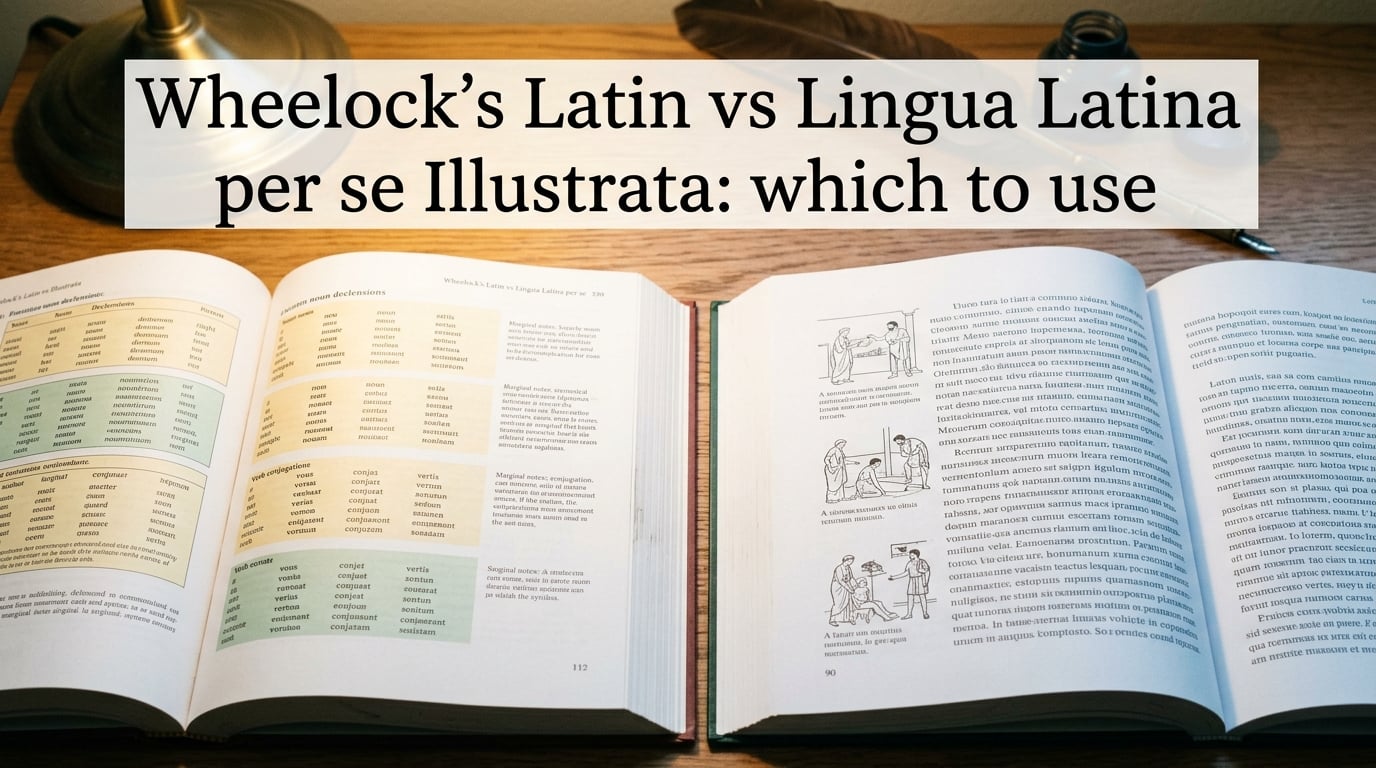
Choosing between Wheelock’s Latin and Lingua Latina per se Illustrata (LLPSI) is one of the most common decisions new Latin learners face. I have spent the last year working through both books side by side, and I want to share what I have learned so you can pick the right path for your own goals.
These two textbooks teach the same language but in opposite ways. Wheelock’s uses the traditional grammar-translation method: it explains Latin rules in English, then drills you on them. LLPSI, written by Hans Ørberg, drops you into a Latin-only story and lets grammar emerge from context. The right pick depends on how you learn, whether you have a teacher, and what kind of Latin you want to read.
In this guide, I will walk you through what each book is, how their methods differ, where each one shines, and how to combine them. By the end, you will know which to use for your situation.
Table of Contents
Quick Answer: Which Latin Textbook Should You Use?
Use Wheelock’s Latin if you are an analytical self-study adult, a college undergrad in a classics program, or a homeschool family who wants clear grammar explanations and a structured syllabus. Use LLPSI (Familia Romana) if you want to read Latin fluently, prefer learning by immersion, and can commit to working through a longer narrative arc. Many serious learners use both together: Wheelock’s for grammar reference, LLPSI for reading practice.
If you want a single-decision rule: pick LLPSI if reading fluency matters most, and pick Wheelock’s if understanding grammar rules matters most. Both books are excellent. Neither is a mistake.
What Is Wheelock’s Latin?
Wheelock’s Latin is the standard introductory textbook in most American undergraduate Latin programs. The original was written by Frederic Wheelock in 1956, and the current 7th edition was revised by Richard LaFleur. An 8th edition exists for newer courses, and many self-learners still successfully use the 7th.
The book is organized into 40 chapters, each one focused on a slice of grammar: declensions, conjugations, cases, tenses, and syntax. You read a short grammar explanation in English, study example sentences, then work through translation exercises. Vocabulary is listed per chapter, and there is a separate Workbook with an answer key for self-learners.
The pedagogy is called grammar-translation: rules first, application second. It is the same approach used in most European language classrooms until the 1960s, and it remains popular because it gives you a clear mental map of how Latin works. Wheelock’s is dense. A single chapter might introduce six new forms and thirty new words. That density is its strength for analytical learners and its weakness for everyone else.
What Is Lingua Latina per se Illustrata (LLPSI)?
Lingua Latina per se Illustrata was created by Hans Ørberg, a Danish linguist who believed languages should be learned the way children learn their first language: through comprehensible input, not rules. The series is built around two main texts. Familia Romana (Pars I) carries the learner through a Latin story about a Roman family across 35 chapters. Roma Aeterna (Pars II) continues into Roman history and literature.
From the first sentence, LLPSI is written entirely in Latin. There are no English grammar explanations. Instead, each chapter introduces vocabulary and grammar through the story itself, with marginal notes in Latin to help you decode new forms as you go. The illustrations are simple line drawings that anchor the meaning of unfamiliar words.
This method is called the natural approach or comprehensible input. The grammar is implicit: you absorb how the ablative works by seeing it used hundreds of times before anyone names it for you. For learners who trust context over rules, it is a more intuitive path to reading Latin as a language rather than as a translation puzzle.
How Do Their Teaching Methods Differ?
The biggest difference between Wheelock’s Latin and LLPSI is when and how grammar enters the picture. Wheelock’s is deductive: it tells you the rule first, then shows you examples. By chapter 5, you have already memorized the present, imperfect, and future tenses of the first conjugation. By chapter 15, you have learned all five declensions.
LLPSI is inductive: it shows you examples first, and the rules crystallize later. The first several chapters of Familia Romana focus on nouns and present-tense verbs. The perfect system and subjunctive mood do not appear until much later, and when they do, they are introduced through narrative context. You will not see a paradigm table for the third declension until you have already read dozens of third-declension nouns in the story.
This pacing difference has real consequences. Wheelock’s students often know more grammar earlier but struggle to read continuous Latin. LLPSI students read Latin more naturally but may feel fuzzy on the formal grammar until they finish the book and circle back to review.
Both approaches work. The choice depends on whether you prefer explicit structure or implicit absorption.
Side-by-Side Comparison: Wheelock’s Latin vs LLPSI
Here is a quick-reference table covering the dimensions most readers ask about.
| Dimension | Wheelock’s Latin (7th ed.) | LLPSI (Familia Romana) |
|---|---|---|
| Author | Frederic Wheelock, rev. Richard LaFleur | Hans Ørberg |
| Method | Grammar-translation (deductive) | Natural approach (inductive) |
| Language of instruction | English explanations with Latin examples | Latin only, with Latin marginal notes |
| Chapters | 40 chapters | 35 chapters in Familia Romana |
| Grammar sequencing | All five declensions by chapter 15 | Nouns before verbs; perfect tense arrives late |
| Vocabulary pacing | 20 to 40 new words per chapter, listed explicitly | Gradual, woven into the running story |
| Reading passages | Adapted sentences and short extracts | Continuous narrative about a Roman family |
| Self-study friendly | Good with the Workbook and answer key | Requires the Companion to Familia Romana |
| Time to finish | One college semester to one year | Six months to one year for most self-learners |
| Best for | Analytical adults, classroom students, reference use | Immersion lovers, reading-focused learners, motivated teens |
Wheelock’s Latin: Strengths and Weaknesses
Wheelock’s biggest strength is clarity. Every chapter opens with a tight grammar explanation, complete with paradigm tables you can memorize. If you have ever taken a foreign language class, the format will feel familiar. The vocabulary lists are explicit, the exercises are well-structured, and the answer key (sold separately as the Workbook) lets you verify your work without a teacher.
Wheelock’s is also the standard in most American classics departments, which means many Latin resources assume you have used it. Wheelock’s Latin Reader, the Workbook, and the answer key are all designed to plug in alongside the main text. If you ever join a Latin study group or post questions on Latin Stack Exchange, chances are people will recognize your chapter references.
The weaknesses are real. The chapters are dense. Pages 5 through 10 of a typical Wheelock’s chapter can overwhelm a beginner who has no one to ask questions to. Many self-learners abandon the book around chapter 7 or 8 because the pace picks up faster than their confidence does.
Wheelock’s also leans heavily on translation rather than reading comprehension. You will learn to convert Latin into English, but you will not necessarily learn to read Latin sentences the way you read English sentences. That gap is exactly what LLPSI was designed to close.
LLPSI (Familia Romana): Strengths and Weaknesses
LLPSI’s biggest strength is reading fluency. By the time you finish Familia Romana, you have read a continuous Latin story cover to cover. You have seen hundreds of subordinate clauses, ablative absolutes, and relative pronouns in context. This is something Wheelock’s cannot offer, because Wheelock’s chapters are short and disconnected.
Hans Ørberg’s natural method also produces a kind of intuitive Latin that translation drills cannot. You start to feel the language’s rhythm, its patterns, and its case usage. For learners who want to read Caesar, Vergil, or medieval Latin for pleasure rather than for credit, this is the more rewarding path.
The weaknesses are also real. Familia Romana has no English, no formal grammar index, and no answer key. Self-learners routinely get stuck around chapter 10 or 15 because Ørberg introduces forms before he explicitly names them. Without the Companion to Familia Romana by Jeanne Neumann, many readers give up.
LLPSI also assumes more grammatical intuition than most beginners have. As one reviewer on Booksnbackpacks noted, LLPSI paradoxically assumes more grammatical competency than a traditional textbook like Wheelock’s. If your Latin grammar background is shaky, you will need a reference book (Wheelock’s is a popular choice) to get unstuck.
Finally, the repetition that makes LLPSI effective can also feel tedious. Some learners find the slow pacing comforting. Others find chapter 12 indistinguishable from chapter 13 and lose momentum.
Using Wheelock’s and LLPSI Together: A Hybrid Approach
Many serious Latin learners, myself included, end up using both books. The hybrid approach is straightforward in principle: you let one book teach you the rules and the other teach you the reading. In practice, you have two reasonable paths.
The first path is Wheelock’s first, then LLPSI. You work through Wheelock’s chapters 1 through 20 in about four to six months, absorbing grammar and building vocabulary. Then you switch to Familia Romana to apply what you learned in continuous reading. This works well for analytical adults who want the grammar framework before they attempt unadapted narrative.
The second path is LLPSI first, then Wheelock’s as reference. You read Familia Romana straight through, keeping the Companion to Familia Romana close at hand for grammatical explanations. When you encounter a form that confuses you, you flip to the matching chapter in Wheelock’s for a clear paradigm table. This path suits language enthusiasts who want to experience Latin as Latin before dissecting it.
Either way, the Companion to Familia Romana by Jeanne Neumann is the most important supplementary book you can buy. It provides the explicit grammar explanations that LLPSI deliberately omits, plus translation help for the Pensa (chapter exercises) and the more difficult Sententiae Antiquae. Without it, self-study with LLPSI is genuinely difficult.
Other useful supplements include Exercitia Latina (additional drills), the Lingua Latina Vocabulary, and the Fabulae Syrae reader for short adapted stories. For Wheelock’s, the Workbook with answer key and the Wheelock’s Latin Reader are the standard add-ons.
Which Should You Use? A Decision Guide by Learner Type
Different learners thrive with different books. Here is how I would guide each profile I hear about most often.
If you are a self-teaching adult with no Latin background, start with Wheelock’s 7th edition and the Workbook. The clear grammar explanations and answer key give you a self-study path that LLPSI alone cannot. Plan on four to six months for chapters 1 through 20, then add Familia Romana for reading practice.
If you are a motivated high-schooler in a homeschool or co-op setting, LLPSI often works beautifully, especially if you already understand English grammar well. Pair it with the Companion to Familia Romana. You will likely finish Familia Romana in a full school year, which is roughly the pace Claire Mieher describes in her teaching diary.
If you are a college undergraduate in a classics program, use whichever book your course assigns. Wheelock’s is most common, but programs that favor comprehensible input are increasingly assigning LLPSI. Either is fine; the program context matters more than the book.
If you are a younger or less analytical learner, LLPSI is often the better first exposure. Wheelock’s dense chapters can crush confidence in a 12-year-old who does not yet know what a “nominative” is. Familia Romana’s story-based immersion is gentler.
If you already speak a Romance language or have studied Latin before, LLPSI will move faster than you expect. You can realistically finish Familia Romana in three to four months.
And if you want to read Latin for pleasure rather than for credit, the natural method wins. Most serious Latin readers end up gravitating toward LLPSI-style immersion even if they started with Wheelock’s.
Frequently Asked Questions
Is Wheelock’s Latin good?
Yes. Wheelock’s Latin is a strong, well-organized textbook and the standard in many American undergraduate programs. It works best for analytical adults, classroom students, and self-learners who want clear grammar explanations and a structured pace. Its main weaknesses are dense chapters and a translation-heavy approach that can leave readers less able to read continuous Latin without supplementing.
How long does it take to finish Lingua Latina?
Most self-learners finish Familia Romana in six months to one year, working at roughly one chapter per week. College students in a semester-paced course typically cover 18 to 20 chapters in 15 weeks. Adding the Companion to Familia Romana shortens the learning curve considerably, especially around chapters 10 to 20 where grammar accelerates.
Should I learn Latin with Lingua Latina or Wheelock’s Latin?
Choose Wheelock’s if you want explicit grammar explanations, an answer key, and a structured syllabus you can follow alone. Choose LLPSI if you want to read Latin fluently and prefer learning through immersion rather than rules. Many learners combine both: Wheelock’s as a grammar reference and LLPSI as the main reading text.
Is Wheelock’s Latin good for beginners?
Wheelock’s is good for beginners who are analytical, motivated, and comfortable with dense information. It is less ideal for beginners without a teacher, younger students, or learners who get discouraged by long grammar explanations. Pairing the main text with the Workbook and answer key makes it far more beginner-friendly.
Do I need the Companion to Familia Romana?
Yes, if you are self-studying without a teacher. The Companion to Familia Romana by Jeanne Neumann provides the explicit grammar explanations that LLPSI deliberately omits, plus translation help for the chapter exercises. Without it, many self-learners get stuck around chapter 10 and abandon the book. With it, Familia Romana becomes a complete self-study curriculum.
Final Thoughts on Choosing Between Wheelock’s Latin and LLPSI
The Wheelock’s Latin vs Lingua Latina per se Illustrata decision is less about which book is better and more about which book matches how you learn. Wheelock’s gives you a grammar framework you can rely on for the rest of your Latin life. LLPSI gives you the reading fluency that makes Latin feel like a language rather than a puzzle.
My honest recommendation for most self-learners is to start with Wheelock’s first edition you can find (the 7th edition is widely available and well-supported), work through chapters 1 through 20 with the Workbook, and then add Familia Romana with the Companion to Familia Romana as your reading practice. That combination has produced more confident Latin readers than either book alone.
Whichever path you choose, the most important step is the one you take today. Both books work when you actually use them.