
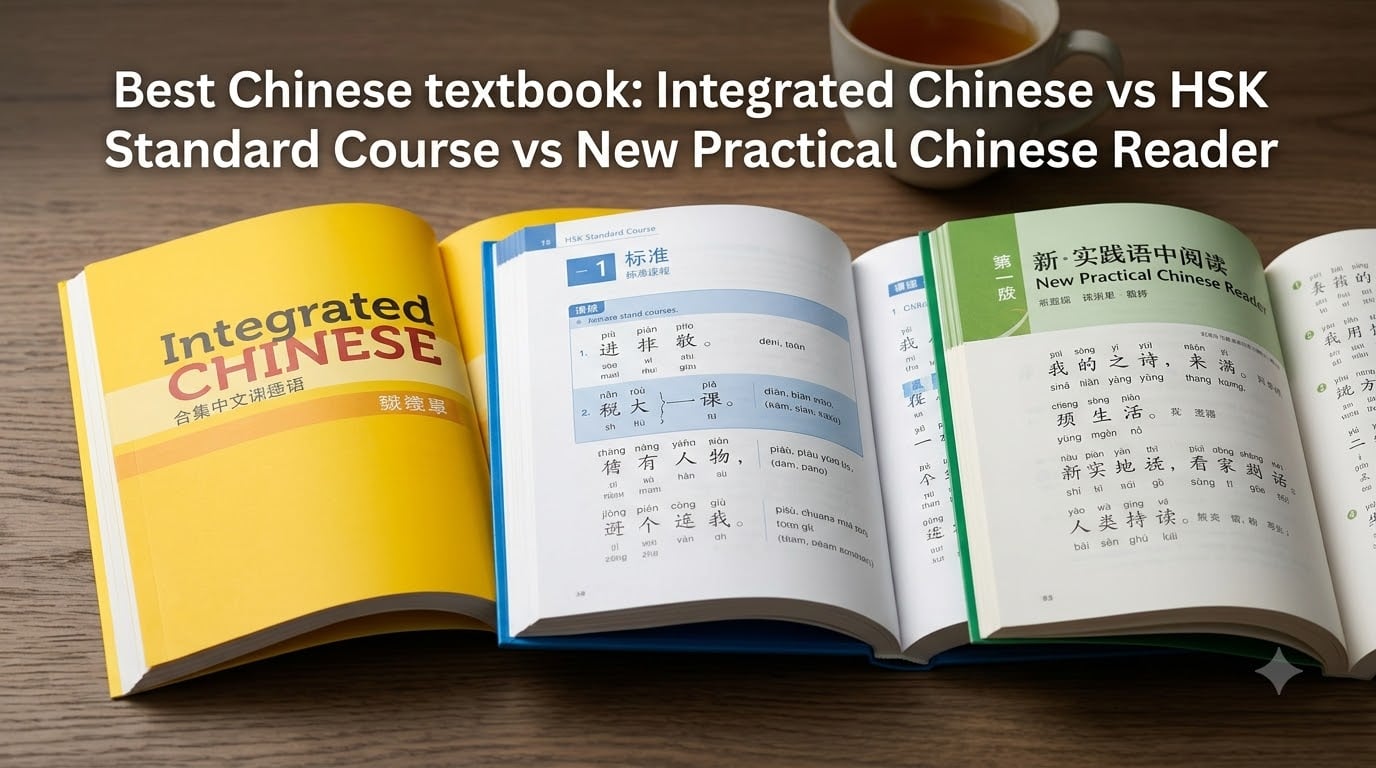
If you are choosing between Integrated Chinese, HSK Standard Course, and New Practical Chinese Reader, here is the short answer: Integrated Chinese is the safest pick for university-style structured study, HSK Standard Course is the best match if you are aiming at the HSK exam, and New Practical Chinese Reader is the right call if your priority is character recognition and reading practice.
All three are credible, widely adopted series. They differ in teaching philosophy, character set coverage, audio quality, and how well they prepare you for real Chinese content outside the classroom. In this guide I walk through each series in depth, put them side by side on the same axes, and give you a clear decision rule based on the kind of learner you are.
Table of Contents
Quick Overview: Which Chinese Textbook Should You Use?
If you only have sixty seconds, this table points you to the right book. It is the same comparison I use when friends ask me which series to buy.
| Pick this series | If you are… | Levels covered | Character set |
|---|---|---|---|
| Integrated Chinese (4th edition) | A beginner who wants university-grade structure with both simplified and traditional options | IC 1 to IC 4 (roughly HSK 1-5) | Both simplified and traditional editions |
| HSK Standard Course | A learner aiming at a specific HSK band on the Chinese proficiency test | 6 volumes mapped to HSK 1-6 (plus HSK 3.0 updates) | Simplified only |
| New Practical Chinese Reader (2nd edition) | A self-study learner who wants the strongest character and reading focus | 6 volumes, beginner to advanced | Simplified primary; traditional companion |
None of these is the best textbook in absolute terms. The right answer depends on whether you are cramming for HSK, sitting in a semester-long class, or learning on your own at home. The rest of this article breaks down why.
Integrated Chinese: The University Standard
Integrated Chinese is the most widely adopted textbook in North American university Chinese programs, and for good reason: it is structured, rigorous, and balanced between speaking, reading, and writing.
Published by Cheng & Tsui and now in its 4th edition (released 2017-2018), the series comes in two parallel tracks. Level 1 Part 1 starts every learner at zero, teaching pinyin, tones, and the first 200 or so characters through short situational dialogues. By the time you finish Integrated Chinese Level 4, you have covered roughly the vocabulary and grammar of HSK 5.
Each main textbook is paired with a workbook that drills characters, grammar, and translation. Audio is sold separately and is decent but not spectacular. A character workbook is also available for learners who want extra writing practice.
Strengths. The progression is logical, the grammar explanations are clear, and the cultural notes are genuinely useful. The 4th edition refreshed the dialogues so they sound less stiff than the 3rd edition did. Both simplified and traditional character editions exist, so learners in Taiwan or Hong Kong are not forced to switch sets partway through.
Weaknesses. Integrated Chinese was designed for the classroom, and it shows. Dialogues are clean but feel scripted. Self-study learners often struggle with grammar points the textbook glosses over, because a teacher would normally unpack them in lecture. Audio quality has improved in the 4th edition but is still the weakest link compared to dedicated apps.
Best for. University students earning Chinese credit, AP Chinese candidates, and disciplined self-study learners who want a complete, teacher-approved curriculum from beginner through upper-intermediate. If you want one series that takes you from “ni hao” to reading Chinese news articles, Integrated Chinese is the most reliable pick.
HSK Standard Course: The Exam-Focused Choice
HSK Standard Course is the official textbook series published by Beijing Language and Culture University Press, and it is built around the HSK (Hanyu Shuiping Kaoshi) Chinese proficiency test.
The series has six volumes, each mapped to one HSK level from HSK 1 to HSK 6. A textbook and workbook are bundled together for most volumes. The structure is simple: warm-up, two to three short texts per lesson, vocabulary list, grammar notes, and exercises modeled on the actual HSK question types.
The newer HSK 3.0 framework, which rolled out in stages over 2026, reshuffled the level mapping, and updated volumes are now arriving that reflect the new vocabulary bands. If you are starting fresh, look for the latest printing.
Strengths. Nothing beats HSK Standard Course for exam alignment. If your goal is a specific HSK band, this is the series that was written for that exact purpose. Vocabulary lists are tight, and grammar points are limited to what each HSK level actually tests. The workbooks include listening scripts and full answer keys, which makes self-study far more workable than older editions did.
Weaknesses. Learners on Reddit and Chinese-Forums consistently call the dialogues “boring” and “mechanical.” Vocabulary is ordered by HSK band rather than real-world usefulness, so you learn “postage stamp” before “actually.” It comes in simplified characters only, so traditional-character learners need a supplement. Because it is exam-driven, it does not push you toward reading Chinese outside the textbook.
Best for. HSK candidates who want to pass a specific band on a deadline, learners working with a tutor who needs a structured syllabus, and anyone who values a clear finish line over engaging stories. If your study window is six months and you need HSK 4 on your transcript, HSK Standard Course is the textbook.
New Practical Chinese Reader: The Character-Focused Classic
New Practical Chinese Reader (NPCR) is the oldest of the three series in continuous print, originally published by Beijing Language and Culture University Press in the early 2000s and now in its 2nd edition. It remains a favorite of learners who care deeply about reading Chinese characters.
Six volumes take you from absolute beginner to advanced. Each lesson centers on a longer narrative passage with rich vocabulary and detailed cultural footnotes. The character writing sequence is more deliberate than the other two series, and the 2nd edition added pinyin-only early chapters so beginners can ramp up before characters flood in.
Strengths. The reading passages are the strongest of the three series. Vocabulary is introduced in context, and the cultural notes are genuinely interesting. Learners on Reddit often praise NPCR for being “more interesting and less boring” than HSK Standard Course. It does the best job of any major series at building reading stamina for native Chinese content.
Weaknesses. The 1st edition is dated, and some learners hesitate because of that. The 2nd edition fixed most of the worst examples, but cultural references still feel a decade or more behind real Chinese life. It is a teacher-driven series: the textbook assumes someone will explain the grammar. Solo learners regularly report getting stuck without outside help. Audio quality is acceptable but not great.
Best for. Learners whose main goal is to read Chinese novels, articles, or web pages. University programs that want a reading-heavy curriculum. Anyone who has tried Integrated Chinese or HSK Standard Course and bounced off the dry dialogues. If you are the kind of person who finishes a chapter and wants a story, not a vocabulary list, NPCR is the one to pick.
Side-by-Side Comparison: Integrated Chinese vs HSK Standard Course vs New Practical Chinese Reader
Here is the same comparison table on a deeper set of axes, so you can see exactly where each series wins and where it loses.
| Feature | Integrated Chinese (4th ed.) | HSK Standard Course | New Practical Chinese Reader (2nd ed.) |
|---|---|---|---|
| Publisher | Cheng & Tsui (USA) | Beijing Language and Culture University Press | Beijing Language and Culture University Press |
| Volumes | 4 levels (split into Part 1 and Part 2) | 6 volumes (HSK 1-6) | 6 volumes |
| Approximate HSK coverage | HSK 1 through HSK 5 | HSK 1 through HSK 6 (with HSK 3.0 updates) | HSK 1 through HSK 5+ |
| Teaching approach | Dialogue-led with explicit grammar | HSK-aligned drills and exam-format exercises | Narrative passages with cultural notes |
| Character set | Simplified and traditional editions | Simplified only | Simplified primary, traditional available |
| Workbook included | Sold separately | Bundled with most volumes | Sold separately |
| Audio | Decent, sold separately | Included, basic quality | Included, acceptable |
| Self-study friendly | Medium | High | Low to medium |
| Best for | University and AP Chinese | HSK exam prep | Reading and character focus |
Which Chinese Textbook Should You Pick?
Here is the decision logic I wish someone had handed me when I started. Match your situation to the series below.
Pick Integrated Chinese if you are…
- A university student earning Chinese credit or an AP Chinese candidate
- A self-study beginner who wants a complete, teacher-approved curriculum
- Someone who wants both simplified and traditional options in one series
Pick HSK Standard Course if you are…
- Working toward a specific HSK band on a deadline
- Studying with a tutor who wants exam-aligned material
- Already in mainland China and need a textbook that matches what local schools use
Pick New Practical Chinese Reader if you are…
- A reading-focused learner who wants richer passages than the other two series offer
- Someone preparing to read Chinese novels, news, or web content
- A learner who found the other two series dry and wants stories instead of drills
If you are not sure which camp you fall into, Integrated Chinese is the safest default. It is the most balanced of the three, has the broadest adoption, and will not lock you into a single goal.
Why One Textbook Is Not Enough
Here is the honest caveat: finishing any one of these series will not, on its own, make you fluent. Forum threads on Reddit’s r/ChineseLanguage and Hacking Chinese’s comment section keep landing on the same insight: a single textbook covers only a slice of what you need.
The strongest learners I have seen use one of these three series as a spine, then layer other resources on top. Graded readers like Mandarin Companion or the Pleco add-on graded reader library give you stories you can actually finish. Apps like Du Chinese, The Chairman’s Bao, or Pleco’s reader feed give you daily comprehensible input. Anki or Pleco’s flashcard system locks vocabulary into long-term memory through spaced repetition.
Paul Nation’s four strands framework, which Hacking Chinese often references, breaks language learning into meaning-focused input, meaning-focused output, language-focused learning, and fluency development. A textbook mostly covers the third strand. The other three strands need graded readers, conversation partners, and listening practice.
Practical Audio-Visual Chinese (PAVC) is another series worth knowing about, especially if you want stronger audio and a more communicative approach than any of the three main series offers. It is less common in Western programs but is the backbone of many intensive Chinese programs in Taiwan.
My honest recommendation: pick the series that matches your immediate goal, finish at least the first volume, and then add one graded reader or input-based app before judging whether the textbook “works.”
Frequently Asked Questions
Which is the best Chinese textbook for beginners?
Integrated Chinese is the safest pick for most beginners. Its 4th edition has clear grammar explanations, audio in both simplified and traditional character editions, and a workbook that builds the foundation you need before tackling HSK prep or reading practice.
Is Integrated Chinese good for beginners?
Yes. Integrated Chinese is one of the most widely used beginner Chinese textbooks in North American universities. The first volume assumes zero prior knowledge and builds up pinyin, tones, characters, and grammar in a logical sequence. Self-study beginners will want to supplement it with an answer key or online community.
Which HSK book is best?
HSK Standard Course is the official HSK-aligned textbook series and the best choice for exam prep. If your goal is a specific HSK band on a deadline, no other series maps vocabulary and grammar to the test as cleanly. For HSK 3.0 updates, look for the latest printing.
How many levels does HSK Standard Course have?
HSK Standard Course has six volumes, each tied to one HSK level from HSK 1 through HSK 6. Updated volumes reflecting HSK 3.0 are rolling out through 2026 and beyond.
Which Chinese textbook is best for self-study?
For self-study, HSK Standard Course is the most workable because the bundled workbook includes answer keys and exam-style exercises. Integrated Chinese is also usable for self-study if you buy the workbook and find an online community for grammar questions. New Practical Chinese Reader is the hardest of the three to use without a teacher.
What level is the New Practical Chinese Reader?
New Practical Chinese Reader covers six volumes from absolute beginner to advanced. The first two volumes roughly cover HSK 1 to HSK 3, and the later volumes push into HSK 5 and beyond. The 2nd edition is the current standard and is what you should look for.
Is New Practical Chinese Reader outdated?
The 1st edition is dated and not recommended. The 2nd edition, however, refreshed the cultural notes, modernized the dialogues, and added pinyin-only early chapters. The 2nd edition is still a credible option for learners who want a reading-focused series, though none of these textbooks alone is current enough to substitute for real Chinese input.
Which is better, traditional or simplified Chinese?
Pick based on where you plan to use the language. Simplified is the standard in mainland China and Singapore; traditional is used in Taiwan, Hong Kong, and Macau. Integrated Chinese is the only one of the three series that ships in both character sets, so it is the most flexible if you might switch regions later.
Final Verdict: Which Chinese Textbook Wins?
There is no single winner among Integrated Chinese, HSK Standard Course, and New Practical Chinese Reader, but there is a clear winner for each kind of learner. Choose Integrated Chinese for a balanced, university-style curriculum. Choose HSK Standard Course if the HSK exam is your north star. Choose New Practical Chinese Reader if you want to read Chinese and you want stories rather than drills.
Whichever series you pick, treat it as a starting point. Add a graded reader, an input-based app, and a daily listening habit within the first month. That combination is what turns a finished textbook into actual Mandarin ability.