
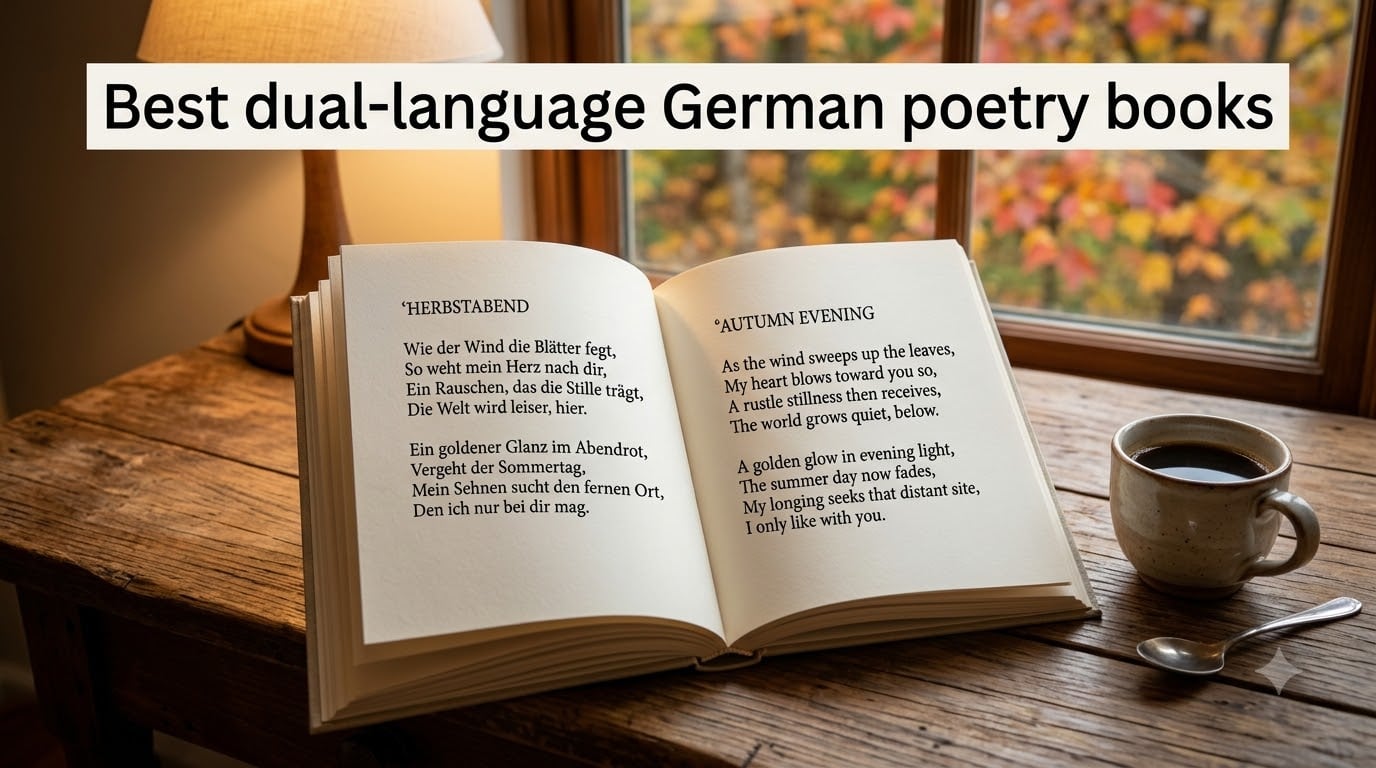
I still remember the first time I cracked open 103 Great Poems at a used-book stall in Berlin. The German sat on the left page, the English on the right, and for the first time I could actually hear Goethe’s rhythm while following the meaning. That is exactly what a good dual-language German poetry book gives you: a side-by-side window into how the original sounds and why it works.
This guide covers the best dual-language German poetry books available right now, from affordable Dover anthologies to focused single-author editions. Whether you are a B1 learner trying to memorize Heine aloud, a literature student studying Rilke’s imagery, or a translator checking how Stephen Mitchell handles the Duino Elegies, you will find a starting point here. I have leaned on forum threads, Goodreads shelves, and the Dover Publications back catalogue to curate eight quick picks, six Dover anthologies, six single-author editions, and a section on contemporary and free public-domain options.
Table of Contents
Quick Picks: Best Dual-Language German Poetry Books at a Glance
Looking for the short list? Here are the eight strongest dual-language German poetry books our team keeps coming back to. Each one pairs the German original with a credible English translation and survives close reading.
- 103 Great Poems: A Dual-Language Book – Goethe’s lyrical poems, ballads, and elegies edited by Stanley Appelbaum. The single best starting point for a German learner who wants a Romantic-classical anchor.
- Great German Poems of the Romantic Era – 23 Romantic poets, 131 poems, also edited by Appelbaum. Broader Romantic sweep than Goethe alone.
- Introduction to German Poetry: A Dual-Language Book – A general survey from Baroque through Classical, edited by Gustave Rudman and Appelbaum. Ideal first anthology.
- Twenty German Poets: A Bilingual Anthology – Walter Kaufmann’s modern anthology covering Hölderlin through Brecht. Kaufmann’s translations are famously direct.
- Twenty-Five German Poets: A Bilingual Anthology – The Kaufmann companion volume with a 20th-century emphasis, including Celan and Bachmann.
- The Selected Poetry of Rainer Maria Rilke – Stephen Mitchell’s classic bilingual Rilke. Still the most accessible entry point to a difficult Modern master.
- Songs of Love and Grief: A Bilingual Anthology of Heinrich Heine – The most important Heine collection for English readers; literal translations sit beside the German.
- Selected Poems and Prose of Paul Celan – Bilingual edition of one of the post-war era’s defining voices. For advanced readers who want to wrestle with Celan’s compressed German.
What Is a Dual-Language German Poetry Book?
A dual-language German poetry book is a bilingual edition that prints the original German poem alongside an English translation, almost always on facing pages or stacked top-and-bottom, so you can compare rhyme, rhythm, and vocabulary line by line. The format dates back to 19th-century school editions but was revived in the 1990s by Dover Publications, whose affordable Dual Language German series now defines the category.
How the format works in practice is straightforward. Each poem appears in German on one side (or at the top) with the English translation directly opposite (or below). As you read, your eye travels between the two versions, which makes it easier to spot how a translator handled a particular image, where the German verb falls in the line, or whether the rhyme survived. For pronunciation practice this is gold: you can read the German aloud, glance down to confirm the meaning, then return to the original without losing your place.
Why this matters for learners is the real point. Dual-language poetry helps you absorb authentic German verse in rhythm – memorizing lines aloud builds pronunciation, grammar intuition, and vocabulary faster than prose reading does. One Reddit user on r/German asked specifically for “German poems that are similar [to] Edgar Allan Poe, namely more classical than modern … anything with a good rhyme scheme.” That is exactly the audience these books serve: intermediate learners who want rhyme, meter, and a translation they can trust.
Best Dover Dual-Language Anthologies
Dover Publications dominates the affordable end of the bilingual German poetry shelf. The Dover Dual Language German series is the closest thing the category has to a standard library. Six anthologies cover most of what an intermediate learner or casual poetry reader needs.
103 Great Poems: A Dual-Language Book
Stanley Appelbaum’s edition of Goethe remains the canonical single-author Dover entry. It gathers lyrical poems, ballads, and elegies across Goethe’s entire career – from early Sturm und Drang pieces to the late Divan-style work. The English translations are literal rather than literary, which suits learners who want a faithful rendering. If you only buy one German poetry book, this is the safest bet.
Great German Poems of the Romantic Era
This companion volume broadens the Romantic canvas. Appelbaum includes 23 poets and 131 poems, from Hölderlin and Novalis to Mörike and Eichendorff. Each poet gets a short critical introduction that explains where they sit in the Romantic movement. Reviewers on Better World Books highlight the literal translations on facing pages and the brief evaluations of each poet as the volume’s strongest features.
Introduction to German Poetry: A Dual-Language Book
Edited by Gustave Rudman and Stanley Appelbaum, this anthology is the best on-ramp for newcomers. It moves chronologically from Baroque and Classical through Romantic and into 20th-century verse. Because the selections are shorter and the poets more varied, you can sample widely before committing to a single-author edition. Many teachers use this one as a classroom text.
Twenty German Poets: A Bilingual Anthology
Walter Kaufmann’s anthology is the modernist counterweight to the Appelbaum Romantic volumes. Kaufmann’s translations are famously direct – sometimes blunt – which some readers love and others find flat. The poet selection runs from Hölderlin and Goethe through Nietzsche, Rilke, and Brecht. If you want a single bilingual anthology that covers both classical and 20th-century German poetry, this is the strongest option outside of an academic press.
Twenty-Five German Poets: A Bilingual Anthology
This is the Kaufmann follow-up volume, with a heavier tilt toward 20th-century poets. Paul Celan, Ingeborg Bachmann, Gottfried Benn, and Nelly Sachs all appear. For advanced learners who have already worked through the Romantic canon, this is the natural next step.
Duino Elegies and The Sonnets to Orpheus
Rilke’s two great Modernist cycles are available in separate Dover editions as well as combined dual-language volumes. Stephen Mitchell’s translations remain the most accessible, though purists prefer Walter Arndt or Edward Snow. The Duino Elegies in particular reward bilingual reading: Rilke’s German is dense and the English clarifies without sanding off the edges.
Best Single-Author Bilingual Editions
Anthologies are useful, but most readers eventually gravitate toward a single poet they want to know deeply. Here are the six single-author bilingual editions I recommend, one per major voice in the German canon.
Rainer Maria Rilke
Rilke dominates the Goodreads german-poetry shelf with more than nine entries and 17,000+ ratings on his Selected Poetry alone. The Mitchell translation is still the standard. For a closer, more literal rendering, look for C.F. MacIntyre’s versions of the Duino Elegies. Newer bilingual editions from Pushkin Press (translator Martyn Crucefix, around the 2025-2026 Rilke 150th anniversary window) are worth seeking out for fresh line-by-line work.
Johann Wolfgang von Goethe
Goethe is the obvious starting poet, and 103 Great Poems covers him well. For readers who want only the lyric verse without the ballads, lean on the slim bilingual Goethe lyric selections that Penguin and Dover have published. Goethe’s most famous poem – if you need a quick answer for trivia or conversation – is Willkommen und Abschied from the 1789 Willkomm und Abschied cycle, though Erlkönig is more widely anthologized because of its ballad momentum.
Heinrich Heine
Songs of Love and Grief: A Bilingual Anthology of Heinrich Heine is the Heine volume to know. Heine’s German is clean, ironic, and musical – perfect for reading aloud. The literal translations preserve the rhyme schemes, which matters because Heine’s reputation in English depends on his songs sounding like songs.
Friedrich Hölderlin
Hölderlin is harder to render bilingually because his syntax is so compressed. Michael Hamburger’s translations remain the academic standard, though Penguin and other presses have issued newer bilingual selections. For a learner, Hölderlin is best approached after you already feel comfortable with Goethe and Schiller.
Paul Celan
Celan’s Selected Poems and Prose in a bilingual edition is the gateway text. His post-war German resists literal translation, and the bilingual format lets you see how translators like Michael Hamburger and Pierre Joris handle his compressed imagery. Expect to do more rereading than with Goethe or Heine.
Ingeborg Bachmann
Bachmann’s Darkness Spoken: Collected Poems is bilingual in several editions. Her verse is closer to Celan than to Heine – tight, ironic, post-war. For advanced learners and translators, this is where to go after Bachmann’s prose.
How to Choose the Right Edition
Picking a dual-language German poetry book comes down to four practical choices. Walk through them and the right volume usually picks itself.
Facing-page vs top-bottom vs end-notes. Facing-page translations are the gold standard for active learners because you can read the German and check the English in one motion. Top-bottom stacks work well for shorter poems. End-of-book notes are academic but slow; they suit translators who want a single readable German page, not learners practicing line by line.
Single-author vs anthology. An anthology gives you range and is the right choice if you do not yet have a favorite German poet. A single-author edition gives you depth and is the right choice once you have one. Most readers end up owning one of each.
Paperback vs eBook. Paperbacks are easier on the eyes for line-by-line bilingual reading and survive rereading better. eBooks are searchable, which helps when you want to find every poem containing a given word or image. If you can afford only one format, paperback wins for poetry.
Beginner vs advanced. Heine, Goethe, Mörike, and the lighter Romantics are beginner-friendly because their German is closer to modern usage and their rhyme schemes are forgiving. Celan, Bachmann, Sachs, and the later Rilke are advanced: the syntax is compressed, the vocabulary archaic or invented, and the imagery demands cultural context. Match the poet to your level.
How to Use These Books for Pronunciation Practice
One of the most common questions on Reddit’s r/German and r/germany threads is how to actually use a bilingual poetry book to practice pronunciation. Here is the four-step method that works for our team.
Step 1: Read the German aloud once without looking at the English. Get the rhythm in your ear first. Do not worry about meaning. Notice which syllables the poet stresses and where the line breaks fall.
Step 2: Read the English aloud. This anchors the meaning. You will start to feel which German words carry the weight of the line because they will map to the English keywords.
Step 3: Re-read the German aloud, this time glancing at the English when a phrase confuses you. This is where the bilingual format pays off. You can confirm meaning without breaking flow.
Step 4: Memorize one short poem – eight lines is enough – and recite it. Memorization forces you to internalize vowel length, umlauts, and the ch-sound in ways that casual reading never does. Pick a Heine lyric or a Goethe ballad; both rhyme well and sit at a comfortable B1-B2 reading level.
Reddit users in r/germany consistently praise side-by-side formats for this kind of work. The bilingual layout lets you keep your place on the German side without losing the page in the translation. If you only own one book for pronunciation practice, make it a facing-page edition.
Contemporary German Poetry in Bilingual Editions
The German poetry scene in 2026 is more active than the Dover back catalogue suggests. New Books in German’s 2025 essay by translator Karen Leeder maps the contemporary landscape: Uljana Wolf, Monika Rinck, Andrea Winkler, and Elke Erb on the experimental side; Nora-Eugenie Gomringer, Jan Wagner, and Thomas Kling on the lyric side. UK and US presses – Arc, Carcanet, Pushkin Press, Seagull, Fitzcarraldo, Burning Eye – publish bilingual editions of these poets regularly.
For learners, contemporary bilingual poetry is a mixed gift. The German is closer to modern spoken usage than Rilke or Celan, which helps comprehension. But the imagery is often more demanding, and translations vary widely in quality. Pushkin Press’s 2025 Rilke release (Martyn Crucefix, Change Your Life) is a useful bridge: a familiar poet in a fresh bilingual rendering that sits alongside new work by Draesner and Sandig.
Free Public-Domain Editions Worth Knowing
Not every great German poet requires buying a book. In the United States, works published before 1929 are in the public domain, which means Heine, Goethe, Schiller, Hölderlin, and much of the Romantic canon are freely available in English translation.
- Project Gutenberg hosts English translations of Goethe’s Faust (part 1 and 2), Schiller’s plays and ballads, Heine’s Deutschland. Ein Wintermärchen, and selections of Hölderlin.
- Standard Ebooks offers cleaned-up, typeset editions of public-domain German literature with English translations included.
- Internet Archive carries scanned bilingual editions from the 19th and early 20th centuries, including some of the earliest facing-page German-English poetry collections.
These editions are not as polished as a modern Dover paperback – the typography is functional, the introductions are missing – but for a budget-conscious learner or for someone testing whether they like a poet before committing to a paid edition, they are hard to beat. Most of them are also available as free Kindle or Kobo downloads.
Where to Buy These Books
Four reliable sources cover nearly every dual-language German poetry book on this list.
Dover Publications directly. Buying from doverpublications.com is the most direct route for new copies of the Dual Language German anthology series. The site lists paperback and eBook editions side by side.
Amazon. Useful for hard-to-find imports and for the newer single-author bilingual editions from Penguin, Pushkin Press, and others. Customer reviews are a reliable sanity check on translation quality.
Better World Books. A strong source for used copies of out-of-print bilingual editions. Their condition table for used copies makes it easy to compare options.
Your local library via WorldCat. For anyone who only wants to sample a poet, library access is the smartest route. WorldCat lets you search by title or ISBN across thousands of library systems, and most libraries now offer bilingual Dover editions through interlibrary loan.
Frequently Asked Questions
What is the most beautiful German poem?
Beauty in German poetry is subjective, but a few poems consistently top reader polls: Goethe’s Erlkönig and Willkommen und Abschied for narrative power and lyric intensity, Heine’s Du bist wie eine Blume for its spare tenderness, Rilke’s Du im Voraus from the Sonnets to Orpheus for meditative depth, and Hölderlin’s Hälfte des Lebens for its rhythmic balance. If you want a single starting point, Goethe’s Erlkönig is the most widely translated and the most frequently set to music.
What are some good bilingual German-English books?
Strong bilingual German-English poetry books to start with include 103 Great Poems: A Dual-Language Book (Goethe), Great German Poems of the Romantic Era (Appelbaum), Introduction to German Poetry (Rudman and Appelbaum), Twenty German Poets (Walter Kaufmann), Songs of Love and Grief (Heine), The Selected Poetry of Rainer Maria Rilke (Stephen Mitchell), and Selected Poems and Prose of Paul Celan. Most are published by Dover and widely available in paperback and eBook.
Which German language book is best?
The best German language book depends on your goal. For a complete beginner, a graded reader or textbook is more useful than poetry. For an intermediate learner (B1+) who wants poetry, the strongest single pick is 103 Great Poems: A Dual-Language Book because it pairs Goethe’s range with literal, dependable English translations. For an advanced reader or translator, Twenty-Five German Poets by Walter Kaufmann covers the modern canon including Celan and Bachmann.
What is Goethe’s most famous poem?
Goethe’s most famous poem is Erlkönig, the 1782 ballad about a father riding through the night with his sick child while a supernatural Erlking tries to lure the boy away. It has been translated more than any other Goethe poem, set to music by Schubert, and illustrated by Goethe himself. Willkommen und Abschied is the next most famous lyric, followed by the Wanderer’s Nachtlied and Ganymed.
Final Thoughts on Building Your Bilingual German Poetry Shelf
If you are starting from scratch, the cleanest path is one anthology and one single-author edition. Pair 103 Great Poems or Introduction to German Poetry with whichever poet excites you most – for most readers that ends up being Rilke, Heine, or Goethe himself. Once you have a foundation, layer in a Walter Kaufmann anthology for the 20th century and a Celan or Bachmann bilingual edition for the post-war voice. Add a free public-domain Heine from Project Gutenberg if you want rhyme-rich reading material on the side.
The best dual-language German poetry books reward rereading. Pick one short poem a week, memorize it, recite it aloud, and let the German sink in by ear. After a few months you will notice your pronunciation tightening, your vocabulary widening, and your sense of the line deepening in ways that no textbook can match.