
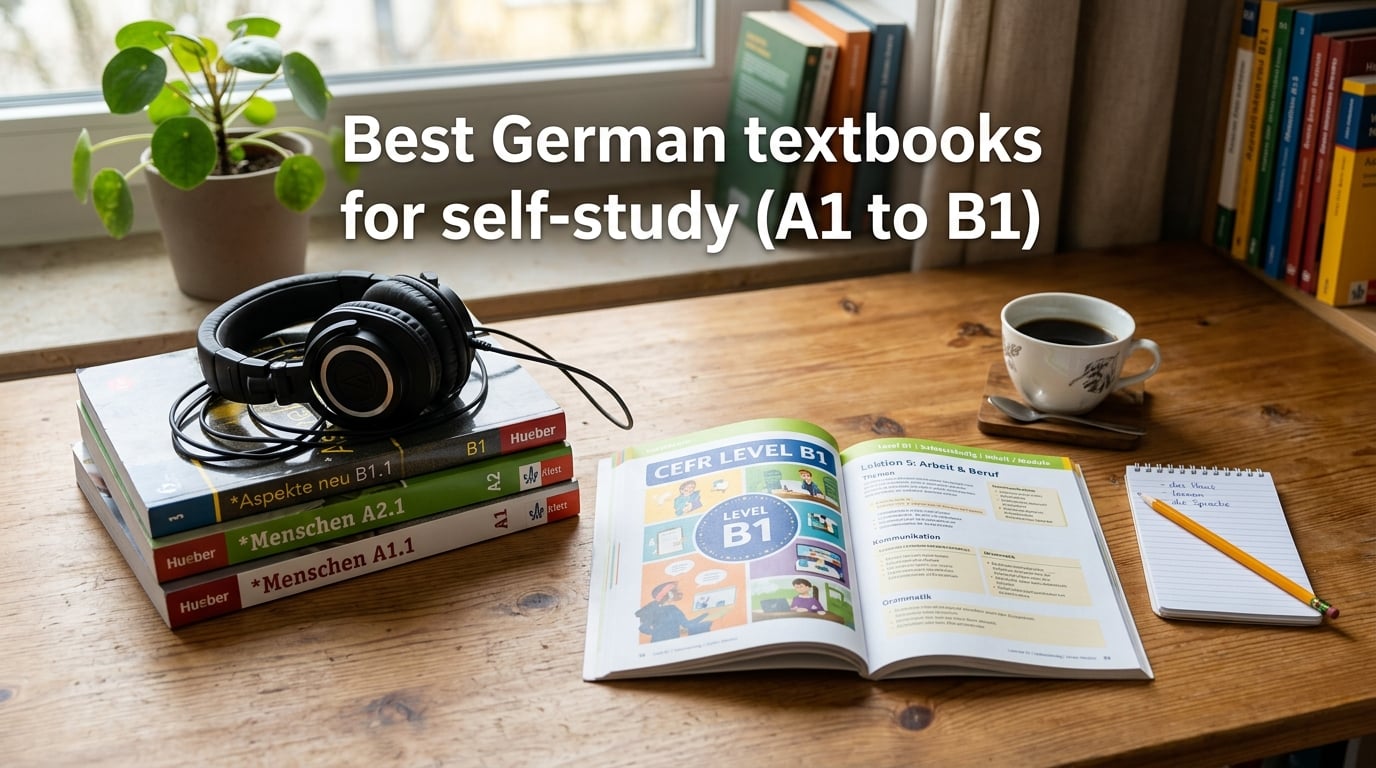
Finding the best German textbooks for self-study from A1 to B1 is the single biggest decision you will make as an independent learner. The right coursebook gives you grammar explanations, vocabulary lists, dialogues, audio recordings, and a workbook with answers, all without a teacher. The wrong book, however, wastes months and leaves you with stubborn gaps in cases, gender, and verb conjugation. I have spent years working through German coursebooks as a self-learner, and this guide distills what actually moves you from absolute beginner to confident B1.
In this article I walk you through the top textbooks at every CEFR level, give you a side-by-side comparison of the major series, share a realistic 12-month study plan, and answer the questions I hear most often on Reddit and language forums. Everything is written for English speakers learning German on their own, so you can stop second-guessing your bookshelf and start making measurable progress in 2026.
Table of Contents
Quick Picks: Best German Textbooks for Self-Study by Level and Goal
If you only have 30 seconds, here is my shortlist of the best German textbooks for self-study from A1 to B1, matched to the most common learner goals.
Best overall for A1 self-study
- Menschen A1 (Klett) — best for visual learners who want a modern, photo-driven coursebook with audio
- Assimil German with Ease — best for beginners who prefer a bilingual format and short daily lessons
Best overall for A2 self-study
- Berliner Platz A2 (Cornelsen) — best for learners who finished A1 and want a smooth, exam-aligned continuation
- Grammatik aktiv A1-B1 — best for self-learners who need a grammar workbook with answer key
Best overall for B1 self-study
- Begegnungen B1 (Schubert) — best for serious learners preparing for the Goethe-Zertifikat B1 exam
- Mittelpunkt B1 (Klett) — best for conversation practice and balanced skills development
Best for grammar focus
- Hammer’s German Grammar and Usage — the definitive reference once you cross B1
Best for travelers
- Speak German in 90 Days — short, scenario-based chapters for trip preparation
Best German Textbooks for A1 Self-Study
A1 is where everything starts, and the right A1 textbook makes or breaks your motivation. These three books are the ones I recommend most often to English speakers starting German on their own.
Menschen A1 — Best for Visual Learners
Menschen A1 from Klett is the most visually appealing A1 coursebook on the market. Full-color photo stories, clear grammar boxes, and well-paced chapters make it approachable for adult self-learners who do not have a teacher explaining every line. The audio download is free with the book, and the accompanying workbook has an answer key, which is essential when you are studying alone.
The main limitation is the multi-book setup. A full Menschen A1 kit includes the textbook, workbook, audio CDs, and sometimes a glossary. Self-learners on Reddit consistently say this feels confusing at first. My advice is simple: buy the textbook plus workbook as a bundle, ignore the extras until you finish the level, and supplement with free audio from Deutsche Welle if you need more listening practice.
Assimil German with Ease — Best Bilingual Option
Assimil German with Ease is the classic choice for self-learners who prefer a bilingual format. Each lesson pairs a German dialogue with an English translation, and the audio features native speakers recorded at a comfortable pace. The method is built around daily 20 to 30 minute lessons, which makes it easy to stay consistent.
The downside is that Assimil assumes you will figure out grammar through context, so if you are a complete beginner, you may want a separate grammar reference. The book is also mostly useful for A1 to B1; serious exam prep will require a more structured coursebook later on.
Berliner Platz A1 — Best for Exam Alignment
Berliner Platz A1 from Cornelsen is the textbook most German language schools use, which means it is tightly aligned with the Goethe-Zertifikat A1 exam format. If your goal is a recognized certificate, starting here gives you a clear advantage. The chapters are dense but well organized, and the audio is high quality.
One caveat from real learners on language forums: Berliner Platz is challenging for casual self-study because it moves quickly and assumes classroom interaction. I recommend it for disciplined learners who plan to sit an official exam, not for someone who wants a relaxed first encounter with German.
Best German Textbooks for A2 Self-Study
By A2, you should be comfortable with present tense, the nominative and accusative cases, and basic past tense. The best A2 textbooks deepen these foundations and push you toward connected sentences and everyday conversation.
Berliner Platz A2 — Best for Continuity
If you started with Berliner Platz A1, the A2 volume is the natural next step. The structure, vocabulary themes, and exam alignment carry forward, which saves you the cognitive load of switching series mid-journey. The audio and workbook continue to be reliable, and self-learners can complete it without a tutor.
Grammatik aktiv A1-B1 — Best Grammar Workbook
Grammatik aktiv A1-B1 from Cornelsen is not a coursebook, but it is the single best grammar workbook for self-study covering the entire beginner to intermediate journey. Every chapter targets one grammar topic, explains it in clear English, gives you graduated exercises, and includes a full answer key at the back. This is the book you keep next to your main coursebook.
If you only buy one grammar resource, make it Grammatik aktiv. Pair it with Menschen or Berliner Platz, and you will close most of the grammar gaps that plague self-learners.
Best German Textbooks for B1 Self-Study
B1 is the level where most self-learners stall. The grammar gets harder (subjunctive II, relative clauses, passive voice), and vocabulary jumps from everyday topics to abstract ideas. These two textbooks carry most learners through.
Begegnungen B1 — Best for Exam Preparation
Begegnungen B1 from Schubert Verlag is dense, thorough, and unforgiving, which is exactly why experienced learners love it. It mirrors the Goethe-Zertifikat B1 structure closely, and the chapters push you into longer reading passages, opinion essays, and structured arguments. If you plan to take the official B1 exam, this is the textbook I recommend.
The honest drawback is that Begegnungen is harder than its CEFR label suggests. Many reviewers on Reddit report it feels closer to B2. For self-study, that means you need to budget more time per chapter, and you will likely want to add a grammar reference like Hammer’s once you cross the halfway point.
Mittelpunkt B1 — Best for Balanced Skills
Mittelpunkt B1 from Klett is the friendlier of the two big B1 coursebooks. It balances grammar, reading, listening, and speaking practice more evenly than Begegnungen, and the chapter themes feel more contemporary. For self-learners whose goal is conversation and everyday fluency rather than a certificate, Mittelpunkt B1 is the better fit.
Major German Textbook Series Compared
Most competitors list books one by one without comparing the series. Here is the comparison table I wish I had when I started. It covers the four main coursebook families English-speaking self-learners actually choose between, plus Assimil for its unique bilingual method.
| Series | Levels Covered | Format | Audio | Workbook + Answers | Best For |
|---|---|---|---|---|---|
| Menschen (Klett) | A1 to B1 | All-German with English instructions | Free download | Yes | Visual learners, modern design |
| Berliner Platz (Cornelsen) | A1 to B2 | All-German with English glossary | Free download | Yes | Exam alignment, school-style learners |
| Begegnungen (Schubert) | A1 to B1 | All-German, dense | Free download | Yes | Serious B1 exam candidates |
| Mittelpunkt (Klett) | B1+ | All-German, balanced skills | Free download | Yes | Conversation and fluency at B1 |
| Assimil German with Ease | A1 to B1 | Bilingual (German + English) | CDs included | Light exercises | Bilingual learners, daily habit builders |
Notice that none of the Klett, Cornelsen, or Schubert series are bilingual. If you are a true beginner who is anxious about diving into all-German pages, start with Assimil for the first two months, then transition to Menschen or Berliner Platz once you have the alphabet, basic pronunciation, and a few hundred words under your belt.
How to Self-Study German Effectively With Textbooks
Owning the right textbook is only half the battle. The other half is how you use it. Here is the self-study methodology I recommend after watching hundreds of learners succeed and stall.
Follow the 80/20 Rule
The 80/20 rule in German learning means that 80 percent of your real-world communication comes from about 20 percent of the grammar and vocabulary. Focus your textbook time on the most common patterns: present tense, perfect tense, the four cases, modal verbs, and the 500 most frequent nouns. Anything beyond that is decoration until you have those patterns automatic.
Do the Workbook Exercises With the Answer Key Open
Self-learners often avoid the workbook because there is no teacher to check it. Flip that. Open the answer key, attempt each exercise, and check immediately. The point is not to grade yourself but to learn from your mistakes in real time. Write out the corrected sentences by hand; muscle memory matters more than you think.
Listen Before You Read
Every chapter has an audio track. Before you read the dialogue, listen to it twice with the text closed. Then read while listening. Then listen again with the text closed. This three-pass approach trains your ear faster than any other method and is the single biggest difference between self-learners who reach B1 and those who stay stuck at A2.
Build a Spaced Repetition Vocabulary Habit
Textbooks give you vocabulary lists, but most learners forget 70 percent of new words within a week. Fix that by copying each chapter’s vocabulary into an Anki deck the same day you meet it, and review for 10 minutes every morning. Combined with your textbook work, this is how you go from recognizing words to actually using them.
A Realistic 12-Month Study Plan From A1 to B1
Most competitors skip the schedule. Here is the 12-month plan I give to motivated self-learners who can study 5 to 7 days a week for 45 to 90 minutes per session. Adjust the pace if you have more or less time.
Months 1 to 3 — A1 Foundation
Complete Menschen A1 or Berliner Platz A1, plus the matching workbook. Add 15 minutes of Anki vocabulary review every morning and one Coffee Break German podcast episode per week. Goal: 600 active words, confident present tense, and accurate der/die/das for the 100 most common nouns.
Months 4 to 6 — A2 Consolidation
Finish Berliner Platz A2 or move into Menschen A2. Add Grammatik aktiv chapters on cases and modal verbs. Start a simple German journal (3 sentences per day) and read one Easy German YouTube transcript per week. Goal: past tense, accusative and dative cases, and the ability to talk about your daily routine for two minutes without notes.
Months 7 to 9 — B1 Bridge
Begin Mittelpunkt B1 or Begegnungen B1, depending on your goal (conversation versus exam). Add Hammer’s German Grammar as a reference for subjunctive and relative clauses. Watch Nicos Weg on Deutsche Welle for free listening input at A2 to B1. Goal: passive voice, basic subjunctive II, and comprehension of native-speed audio on familiar topics.
Months 10 to 12 — B1 Confidence
Finish your chosen B1 coursebook, complete the workbook, and take a mock Goethe-Zertifikat B1 exam. Add 15 minutes of speaking practice per week using a tutor on italki or a language exchange partner. Goal: comfortable conversation, written essays of 150 words, and readiness to sit the official exam if you want to.
Free Resources That Pair Well With Textbooks
Free resources will not replace your textbook, but they will dramatically speed up your progress when used alongside it.
- Deutsche Welle (DW) — free news, podcasts, and video courses at every CEFR level, including the famous Nicos Weg series for A1 to B1.
- Coffee Break German — a long-running podcast that walks English speakers through grammar and conversation at a comfortable pace.
- Easy German (YouTube) — street interviews with native speakers and subtitles; excellent listening practice once you hit A2.
- DW Learn German app — gamified vocabulary and grammar practice that mirrors the textbook topics.
- Anki — free spaced repetition software for memorizing vocabulary from your textbook chapters.
Pick one or two of these, not all of them. Textbooks provide the structure, and free resources provide the repetition and authentic input. That combination is what carries most self-learners across the B1 finish line.
Which Textbook Fits Your Learning Goal
Not every learner needs the same book. Here is how I match textbooks to specific goals based on what works for real self-learners.
For exam preparation (Goethe-Zertifikat)
Start with Berliner Platz A1 and A2, then move into Begegnungen B1. This path mirrors the official exam structure at every level. Add Hammer’s German Grammar for reference, and take a mock exam in month 11.
For conversation and fluency
Begin with Menschen A1 and A2, then transition to Mittelpunkt B1. Pair the textbook with the Easy German YouTube channel and a weekly conversation partner on italki. This route prioritizes speaking and listening over exam drills.
For travel preparation
Pick up Speak German in 90 Days or Assimil German with Ease for short, scenario-based lessons. Spend 30 minutes a day for two months and you will be able to handle hotels, restaurants, and directions across Germany, Austria, and Switzerland.
For grammar focus
Use Grammatik aktiv A1-B1 alongside any main coursebook. Once you cross B1, add Hammer’s German Grammar and Usage as your permanent reference. This combination closes the grammar gaps that most self-learners never fully fix.
Common Pitfalls When Self-Studying German
Even with the best German textbook for self-study, certain mistakes can stall your progress for months. Watch out for these.
Skipping speaking practice
Textbooks train reading, writing, and listening. They do not train speaking. If you only ever study alone with a book, you will freeze the moment you need to open your mouth. Add a weekly conversation partner, even 20 minutes is enough to keep your spoken German alive.
Memorizing vocabulary lists without context
Word lists without example sentences are how you end up forgetting 90 percent of new vocabulary within a month. Always learn new words inside a sentence from your textbook, and review them in Anki using example sentences, not isolated words.
Switching textbooks every few months
It is tempting to buy every German book recommended on Reddit. Resist that. Pick one main coursebook per level and finish it. Switching series every two months is one of the most common reasons self-learners never reach B1.
Underestimating how hard B1 actually is
A1 and A2 feel manageable. B1 is where most learners quit. Plan for B1 to take longer than A2, expect to revisit grammar from earlier levels, and do not measure your progress by chapter count. Measure it by what you can actually do with the language.
How Long Does It Take to Learn German From A1 to B1?
Honestly, it depends on how much time you put in. The Goethe-Institut estimates roughly 350 to 400 hours of guided study to reach B1 from zero. For a self-learner studying 45 to 90 minutes a day, that translates to about 10 to 14 months of consistent work. The 12-month plan above is achievable but assumes you study most days and review older material regularly.
There is no shortcut. The textbooks recommended here are the most efficient path I have found, and the free resources amplify them. Stick with one coursebook per level, do the workbook, review with Anki, and add speaking practice weekly. That is the entire formula.
Frequently Asked Questions
What is the best German textbook for self-study?
Menschen A1 from Klett is my top pick for most self-learners because it combines a modern visual design, clear grammar explanations, free audio downloads, and a workbook with an answer key. If you prefer a bilingual format, Assimil German with Ease is an excellent alternative that builds a daily learning habit through short lessons.
What is the best book for learning German A1?
Menschen A1 is the best all-around A1 textbook for English speakers self-studying German. For complete beginners who want extra support, Assimil German with Ease offers a bilingual format that is easier to start with. If your goal is the Goethe-Zertifikat A1 exam, Berliner Platz A1 from Cornelsen is the most exam-aligned option.
Can I self-study German A1?
Yes, you can reach A1 through self-study if you use a structured textbook like Menschen A1 or Assimil German with Ease, commit to daily review with Anki, and supplement with free resources such as Deutsche Welle and Coffee Break German. Most motivated learners reach A1 in two to three months with 45 to 60 minutes of study per day.
What are the best German books for B1 level?
Begegnungen B1 from Schubert Verlag is the best choice for learners preparing for the Goethe-Zertifikat B1 exam, while Mittelpunkt B1 from Klett is better for learners who want balanced conversation and fluency practice. Pair either book with Grammatik aktiv A1-B1 for grammar drills and Hammer’s German Grammar as a reference.
What is the 80/20 rule in German?
The 80/20 rule in German learning means that roughly 80 percent of everyday communication uses only about 20 percent of the language. That core 20 percent includes present tense, perfect tense, the four cases, modal verbs, common prepositions, and the most frequent 500 nouns. Mastering this core first gives you faster, more usable German than trying to learn everything at once.
Final Recommendations for Self-Studying German From A1 to B1
Choosing the best German textbooks for self-study from A1 to B1 comes down to your goal. If you want exam readiness, walk the Berliner Platz to Begegnungen path. If you want conversation and fluency, walk the Menschen to Mittelpunkt path. In both cases, layer Grammatik aktiv for grammar drills and a free resource like Deutsche Welle for authentic listening.
The single biggest predictor of success is not the textbook itself. It is consistency. Pick one book per level, do the workbook every day, review with Anki, speak once a week, and finish what you start. That is how self-learners cross from A1 to B1 in 2026 and earn a real command of the German language.