
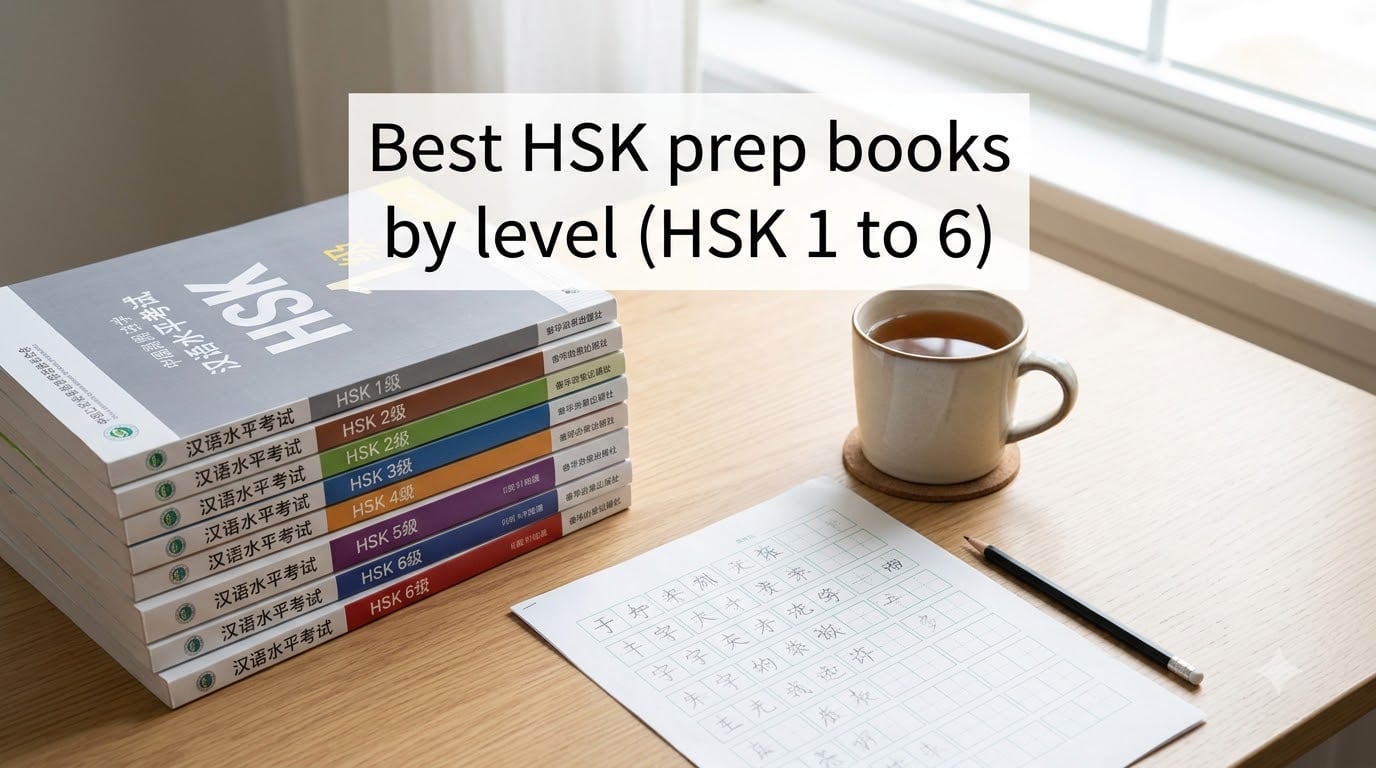
Choosing the right HSK prep books can save you months of wasted effort. The HSK (Hanyu Shuiping Kaoshi) is the standardized Chinese proficiency test for non-native speakers, with six classic levels requiring roughly 150 to 5,000 cumulative vocabulary words. Whether you are a complete beginner targeting HSK 1 or an advanced learner aiming for HSK 6, this guide walks you through the best books for every level so you can build a study stack that actually works.
We spent weeks comparing every major HSK textbook series, graded reader collection, and mock exam book currently available in 2026. The recommendations below are organized by level, with specific book stacks for each stage. You will also find a breakdown of the new HSK 3.0 framework, common buying mistakes to avoid, and a self-study routine you can start today.
Table of Contents
HSK 3.0 vs Old HSK: What You Need to Know Before Buying Books
Before you buy a single book, you need to understand which HSK framework it covers. The old HSK system has six levels. In late 2025, China introduced HSK 3.0, a three-stage, nine-level framework that adds three advanced levels (HSK 7-9) and shifts vocabulary targets upward at every stage.
This matters because some books on store shelves still target the old six-level standard, while newer publications align with HSK 3.0. The good news: for HSK 1 through 6, the core vocabulary and grammar points are largely the same between the two systems. HSK 3.0 added approximately 100 to 300 extra words at each level and introduced more integrated speaking and writing tasks.
Our recommendation: if a book is labeled “HSK Standard Course” with the current BLCUP (Beijing Language and Culture University Press) edition, it is aligned with the exam you will actually take. For HSK 1 through 6, any current-edition book from a major publisher will prepare you properly. The nine-level expansion only becomes a factor if you are studying beyond HSK 6.
Best HSK Prep Books at a Glance
Here is a quick overview of our top pick for each HSK level. Scroll down for the full breakdown, alternative options, and complete book stacks.
- HSK 1: HSK Standard Course 1 (BLCUP) — 150 words, beginner-friendly with audio and workbook
- HSK 2: HSK Standard Course 2 (BLCUP) — 300 cumulative words, continues the series seamlessly
- HSK 3: HSK Standard Course 3 (BLCUP) — 600 words, the jump-point where vocabulary roughly doubles
- HSK 4: HSK Standard Course 4 (BLCUP) — 1,200 words, last level before advanced territory
- HSK 5: HSK Standard Course 5 Upper and Lower (BLCUP) — 2,500 words, advanced grammar and reading
- HSK 6: HSK Standard Course 6 Upper and Lower (BLCUP) — 5,000 words, near-native reading practice
Each level also benefits from a workbook, a graded reader, and a mock exam book. We cover those supplementary picks in every level section below.
Best Books for HSK 1
HSK 1 requires 150 vocabulary words and tests basic listening and reading comprehension. Most learners can reach this level in approximately 50 to 80 study hours. At this stage, you need a textbook that introduces pinyin alongside characters, includes audio, and provides simple dialogues you can practice immediately.
HSK Standard Course 1 by Jiang Liping (BLCUP) is the most widely recommended HSK 1 textbook. It matches the HSK 1 syllabus exactly, includes an audio download, and has a companion workbook with answer keys. Reddit users on r/ChineseLanguage consistently endorse this series as the exam-aligned backbone for self-study.
Integrated Chinese 1 Part 1 by Cheng & Tsui is a strong alternative, especially if you prefer a more communication-focused approach. It covers more grammar than strictly needed for HSK 1, which means you will be over-prepared for the exam but better equipped for real conversation. The textbook includes audio and a character workbook.
Mandarin Companion Level 1 graded readers are excellent supplements at this stage. These are simplified-story books that use only 150 characters, letting you practice reading comprehension with actual narratives rather than textbook dialogues.
Your HSK 1 Book Stack
- Core textbook: HSK Standard Course 1
- Workbook: HSK Standard Course 1 Workbook
- Graded reader: Mandarin Companion Level 1 (Breakfast in Beijing or similar)
- Mock exam: HSK 1 Past Papers collection
Best Books for HSK 2
HSK 2 builds to 300 cumulative vocabulary words and introduces slightly more complex sentence patterns. The test still focuses on listening and reading, but passages are longer. Most learners need approximately 100 to 140 total study hours to pass HSK 2.
HSK Standard Course 2 continues directly from Book 1 with the same teaching methodology. The vocabulary is cumulative, so starting with Book 1 is strongly recommended even if you have some Chinese background. The audio files and workbook answer keys make this a solid self-study option.
Integrated Chinese 1 Part 2 picks up where Part 1 left off and covers vocabulary and grammar that overlap significantly with HSK 2 requirements. If you started with Integrated Chinese for HSK 1, continuing with the same series keeps your learning consistent.
Self-study learners report that buying a workbook from the very beginning is essential. As one Reddit user put it: “Text alone leaves gaps — the workbook forces you to produce, not just recognize.” This is especially true at HSK 2, where you start forming your own sentences.
Your HSK 2 Book Stack
- Core textbook: HSK Standard Course 2
- Workbook: HSK Standard Course 2 Workbook
- Graded reader: Mandarin Companion Level 1 (remaining titles) or Chinese Breeze Level 1
- Mock exam: HSK 2 Past Papers collection
Best Books for HSK 3
HSK 3 is where the difficulty curve steepens. The vocabulary requirement jumps to 600 cumulative words, and the exam now includes a writing section where you must construct sentences from given words. Learners typically need 200 to 300 total study hours to prepare. This is the level where many self-study learners plateau without the right materials.
HSK Standard Course 3 handles the vocabulary expansion methodically, introducing new characters with clear stroke-order guidance and grammar explanations. The writing section preparation is built into the textbook exercises, which is critical since this is the first level that tests writing.
New Practical Chinese Reader (NPCR) Volumes 2 and 3 by Beijing Language and Culture University Press is another excellent option. NPCR has a stronger focus on grammar explanations and cultural context than HSK Standard Course, making it better suited for learners who want deeper understanding rather than pure exam preparation.
Chinese Breeze graded readers become genuinely useful at HSK 3. The Level 2 books use approximately 500 characters and offer engaging stories that build reading speed — a skill the HSK 3 reading section demands.
Your HSK 3 Book Stack
- Core textbook: HSK Standard Course 3
- Workbook: HSK Standard Course 3 Workbook
- Graded reader: Chinese Breeze Level 2 (500-character level)
- Mock exam: HSK 3 Past Papers and Mock Exams
- Grammar supplement: Basic Patterns of Chinese Grammar by Qin Xue Herzberg
Best Books for HSK 4
HSK 4 is the last level before you enter advanced territory. The vocabulary requirement reaches 1,200 cumulative words, and the exam tests all four skills: listening, reading, writing, and speaking (the oral test is optional but recommended). Most learners need 350 to 500 study hours to reach this level. The grammar becomes noticeably more complex, with conditionals, passive constructions, and formal registers appearing regularly.
HSK Standard Course 4 Upper and Lower (two volumes) covers the full HSK 4 syllabus. The reading passages are significantly longer than HSK 3, and the writing section now requires short essay responses rather than just sentence construction. The workbook at this level is particularly important for building writing fluency.
Developing Chinese (also published by BLCUP) is a solid alternative series that some learners prefer for its more natural dialogue style. It covers similar content to HSK Standard Course but with more emphasis on practical communication scenarios.
At HSK 4, experienced learners recommend starting to reduce pinyin dependency. Look for books that start presenting new vocabulary in characters only, with pinyin in the vocabulary list but not over every character in the text. This forces you to recognize characters by sight, which is essential for the reading section’s time pressure.
Your HSK 4 Book Stack
- Core textbook: HSK Standard Course 4 (Upper and Lower)
- Workbook: HSK Standard Course 4 Workbook
- Graded reader: Chinese Breeze Level 3 or Mandarin Companion Level 2
- Mock exam: HSK 4 Past Papers and Mock Exams
- Vocabulary supplement: HSK Vocabulary Guide (organized by frequency)
Best Books for HSK 5
HSK 5 requires 2,500 cumulative vocabulary words and is widely considered the point where textbooks give diminishing returns. The exam tests your ability to read newspaper-length passages, write 800-character essays, and follow extended spoken narratives. Learners typically need 500 to 800 study hours, spread across 12 to 24 months of consistent practice.
HSK Standard Course 5 Upper and Lower remains the most exam-aligned option. The reading passages mirror the actual test format, and the grammar explanations cover advanced constructions like rhetorical questions, literary idioms, and formal written Chinese.
However, experienced learners on r/ChineseLanguage consistently recommend supplementing (or replacing) textbooks with modern graded readers and authentic content at this level. Dense textbooks feel tedious when your comprehension is already intermediate. Mandarin Companion Level 2 and 3 stories, Chinese novels with annotations, and Chinese news sites with dictionary pop-ups become more effective study tools.
Reading and Writing Chinese by William McNaughton is a valuable reference at HSK 5 for reviewing character writing and understanding the component parts (radicals) that make complex characters more memorable.
Your HSK 5 Book Stack
- Core textbook: HSK Standard Course 5 (Upper and Lower)
- Workbook: HSK Standard Course 5 Workbook
- Extensive reading: Mandarin Companion Level 2-3 + annotated Chinese novels
- Mock exam: HSK 5 Past Papers and Mock Exams
- Character reference: Reading and Writing Chinese by McNaughton
Best Books for HSK 6
HSK 6 demands 5,000 cumulative vocabulary words and tests near-native reading comprehension, extended essay writing, and the ability to follow rapid spoken Chinese on abstract topics. This is the highest level in the classic HSK framework (the new HSK 3.0 adds levels 7-9 for near-native mastery). Most learners need 800 to 1,200 total study hours to prepare, often spanning two or more years of dedicated study.
HSK Standard Course 6 Upper and Lower covers the exam syllabus with passages drawn from newspaper editorials, academic essays, and literary excerpts. The writing section requires structured argumentative essays, and the listening section uses natural-speed broadcasts.
At this level, the most effective learners shift heavily toward authentic materials: Chinese newspapers (People’s Daily, China Daily), Chinese fiction in the original, Chinese podcasts, and Chinese TV dramas with subtitles. Textbooks serve primarily as a review framework and source of practice tests.
Mock exam books become critical at HSK 6. The test format is demanding, and time pressure is intense. Taking full-length timed practice tests in the final month before your exam date is the single most impactful preparation strategy, according to both forum discussions and experienced teachers.
Your HSK 6 Book Stack
- Core textbook: HSK Standard Course 6 (Upper and Lower)
- Workbook: HSK Standard Course 6 Workbook
- Extensive reading: Authentic Chinese novels, news editorials, academic essays
- Mock exam: HSK 6 Past Papers, Mock Exams, and timed practice tests
- Vocabulary reference: HSK 6 Complete Vocabulary List with example sentences
Supplementary Books Every HSK Learner Should Consider
Regardless of your target level, certain supplementary books fill gaps that core textbooks leave open. Here are the four categories worth evaluating.
Character Learning Books
If you struggle with memorizing Chinese characters — and most learners do — a dedicated character book can accelerate your progress dramatically. These books teach characters through mnemonics, radical breakdowns, or etymological stories rather than brute-force repetition.
- Remembering Simplified Hanzi 1 and 2 by James Heisig and Timothy Richardson: Uses a mnemonic storytelling method to teach 1,500 characters. Widely praised for making characters stick in long-term memory.
- Tuttle Learning Chinese Characters by Alison and Laurence Matthews: Teaches 800 characters through radical-based methods with stroke-order practice.
- Reading and Writing Chinese by William McNaughton: A classic reference for character writing, organized by HSK level. Particularly useful as a desk reference for HSK 3 and above.
Grammar Reference Books
HSK textbooks teach grammar in context, but a dedicated grammar reference helps when you encounter a structure you do not understand or want to review. Two stand out:
- Basic Patterns of Chinese Grammar by Qin Xue Herzberg and Larry Herzberg: A concise, practical reference organized by topic. Covers every grammar point from beginner through HSK 4 with clear English explanations and example sentences.
- Routledge Modern Mandarin Chinese Grammar by Claudia Ross and Jing-heng Sheng Ma: A more comprehensive academic reference suitable for HSK 4 through 6 learners who want detailed explanations of formal and literary grammar.
Graded Readers
Graded readers are controlled-vocabulary story books designed for language learners. They build reading fluency by letting you read complete narratives at or slightly above your current level. For HSK learners, these are the most important supplementary books after the core textbook.
- Mandarin Companion: Five levels from 150 to 750 characters. The stories are engaging and original, not simplified translations. The best option for HSK 1 through 4 learners.
- Chinese Breeze: Four levels from 300 to 1,100 characters. More affordable and widely available than Mandarin Companion. Good for HSK 3 through 5 learners.
Mock Exam and Practice Test Books
Mock exams are essential in the final month before your HSK test date. They familiarize you with the exact question format, time constraints, and answer-sheet procedures. The official HSK Past Papers collections from BLCUP are the gold standard, as they use real retired exam questions.
For HSK 3 and above, consider also buying an HSK mock exam book that includes audio for the listening section. Practicing with audio at natural exam speed is very different from reading transcripts — and the listening section is where many self-study learners lose the most points.
How to Choose Between HSK Standard Course, Integrated Chinese, and New Practical Chinese Reader
These three textbook series dominate HSK preparation, but they serve different learning styles. Here is how to decide.
HSK Standard Course is the most exam-aligned series. Published by BLCUP (the same organization that administers the HSK), it maps directly to the test syllabus at every level. Choose this series if your primary goal is passing the HSK exam efficiently, if you are self-study, or if you need clear workbook answers and audio files.
Integrated Chinese by Cheng & Tsui takes a more communication-focused approach. It teaches more vocabulary and grammar than strictly required for HSK at each level, which makes it better for learners who want conversational fluency alongside exam preparation. The trade-off: you spend more time per level, and some content is not exam-relevant. Choose this series if you are in a classroom setting or if you value speaking ability as much as test scores.
New Practical Chinese Reader (NPCR) offers the deepest grammar explanations and richest cultural context of the three. It is a better fit for learners who want to understand the “why” behind Chinese grammar patterns, not just memorize them. NPCR is less tightly aligned to HSK levels — you may finish NPCR Volume 3 before covering all HSK 3 vocabulary, or you may find some HSK 4 content appearing in NPCR Volume 3. Choose this series if you are a detail-oriented learner who prefers comprehensive explanations over speed.
One critical note from forum discussions: whichever series you choose, buy the workbook alongside the textbook from day one. Self-study learners consistently report that textbook-only study leaves gaps in production skills (writing and speaking). The workbook forces active practice.
Common HSK Book Buying Mistakes to Avoid
After reading dozens of forum threads and comparing recommendations from experienced learners, these are the most common pitfalls that waste money and time.
Buying the wrong edition. HSK textbook editions matter. An older edition of HSK Standard Course may not match the current exam format. Always check the publication date and confirm the book aligns with either the current six-level exam or HSK 3.0, depending on when you plan to test.
Skipping the workbook. This is the single most repeated piece of advice from experienced learners. The textbook teaches recognition; the workbook teaches production. You need both, especially at HSK 3 and above where the writing section becomes part of the exam.
Ignoring audio resources. Some editions include audio CDs (outdated), some provide MP3 downloads, and some use QR codes. Before buying, confirm how you will access the audio. If a book requires a CD drive you do not own, you have effectively purchased an incomplete product.
Buying too many books at once. Beginners often purchase five or six “best HSK 1” recommendations and feel overwhelmed. Start with one core textbook, its workbook, and one graded reader. That is your complete stack for any level. Add mock exam books only in the final month before your test.
Using pinyin-heavy books past HSK 2. Pinyin is essential at HSK 1 and 2, but relying on it beyond that delays character recognition. At HSK 3 and above, look for books that present text in characters first, with pinyin available in vocabulary lists but not over every word in reading passages.
Buying traditional character books for an HSK exam. The HSK test uses simplified characters (mainland China standard). If you accidentally buy a textbook designed for traditional characters (used in Taiwan), you will learn the wrong character set for the exam. Always check that the book specifies “simplified” characters.
A Self-Study Routine Using These Books
Having the right books is only half the equation. Here is a proven five-step study routine that works for every HSK level, based on strategies shared by successful self-study learners.
Step 1: Preview. Before opening a new chapter, scan the vocabulary list and grammar points. Note which words look familiar and which are completely new. This takes 10 to 15 minutes and primes your brain for active learning.
Step 2: Study. Work through the chapter systematically. Read the dialogue or passage, study the vocabulary with example sentences, and read the grammar explanations. Complete the textbook exercises as you go. Aim for 45 to 60 minutes per session.
Step 3: Listen and shadow. Play the chapter audio and read along. Then play it again without looking at the text, and try to repeat sentences aloud from memory (shadowing). This builds listening comprehension and pronunciation simultaneously. Spend 20 to 30 minutes on this step.
Step 4: Output. Open the workbook and complete the writing and speaking exercises. For writing, cover the answer key and attempt the exercises before checking. For speaking, record yourself answering the workbook’s oral questions and compare with the audio model. This is where real learning happens.
Step 5: Spaced review. Use a spaced repetition system (Anki, Pleco flashcards, or physical flashcards) to review vocabulary from previous chapters. At HSK 3 and above, review becomes more important than new material — you need to retain 600 to 5,000 words, and forgetting curves are steep without systematic review.
Most self-study learners report spending 60 to 90 minutes per day, five to six days per week. At that pace, HSK 1 takes roughly two to three months, HSK 2 takes three to four months, and HSK 3 takes four to six months. Advanced levels (HSK 5-6) typically require 12 to 24 months of consistent study.
Frequently Asked Questions
Which book is best for HSK 1?
HSK Standard Course 1 by Jiang Liping (BLCUP) is the best book for HSK 1. It matches the HSK 1 syllabus exactly, includes audio downloads, and has a companion workbook with answer keys. For a more communication-focused alternative, Integrated Chinese 1 Part 1 by Cheng u0026amp; Tsui covers more grammar than needed for the exam but builds stronger conversational foundations.
Is HSK Standard Course enough to pass the exam?
Yes, HSK Standard Course is enough to pass if you also complete the companion workbook and take mock exams before test day. The textbook covers every vocabulary word and grammar point on the exam. However, supplementing with graded readers improves reading speed, and practicing with past papers is essential for time management during the actual test.
How many words do you need for each HSK level?
The classic HSK vocabulary counts are: HSK 1 requires 150 words, HSK 2 requires 300 cumulative words, HSK 3 requires 600 words, HSK 4 requires 1,200 words, HSK 5 requires 2,500 words, and HSK 6 requires 5,000 words. HSK 3.0 slightly increases these counts at each level.
What is the difference between HSK 3.0 and old HSK?
The old HSK has six levels. HSK 3.0 introduces a three-stage, nine-level framework that adds three advanced levels (HSK 7-9) and increases vocabulary targets at every level by 100 to 300 words. For HSK 1 through 6, the core content is largely the same. Most current-edition books from BLCUP align with the exam you will take.
Do I need both the textbook and workbook for HSK?
Yes, you need both. The textbook teaches vocabulary recognition and grammar understanding. The workbook forces active production — writing sentences, answering questions, and completing exercises without reference material. Self-study learners consistently report that textbook-only study leaves gaps in writing and speaking skills that the workbook fills.
When should I start mock exams for HSK?
Start mock exams in the final month before your test date, not earlier. Mock exams are most effective when you have already completed the core textbook and workbook. At that point, taking full-length timed practice tests reveals your actual test readiness, highlights weak areas, and builds the time-management skills needed for the listening and reading sections.
Can you learn Chinese from books alone?
Books can teach you vocabulary, grammar, reading comprehension, and writing skills effectively. However, most successful learners supplement books with audio practice (shadowing), speaking practice (language partners or tutors), and spaced repetition apps. For HSK 4 and above, adding authentic listening and reading materials — podcasts, news sites, novels — becomes increasingly important alongside textbook study.
Final Thoughts
Finding the best HSK prep books by level does not need to be complicated. For every level from HSK 1 to HSK 6, the HSK Standard Course series from BLCUP provides the most exam-aligned foundation. Pair it with the companion workbook, a graded reader suited to your level, and mock exams in your final month of preparation. That simple stack — core textbook plus workbook plus reader plus practice tests — is what successful learners use across every level.
Remember that the book is a tool, not a guarantee. The five-step self-study routine (preview, study, listen-shadow, output, spaced review) turns any good textbook into an effective learning system. Start at your current level, commit to consistent daily practice, and trust the process. Whether you are aiming for HSK 1 as a complete beginner or pushing toward HSK 6 for professional credentials, the right books combined with disciplined study will get you there.