
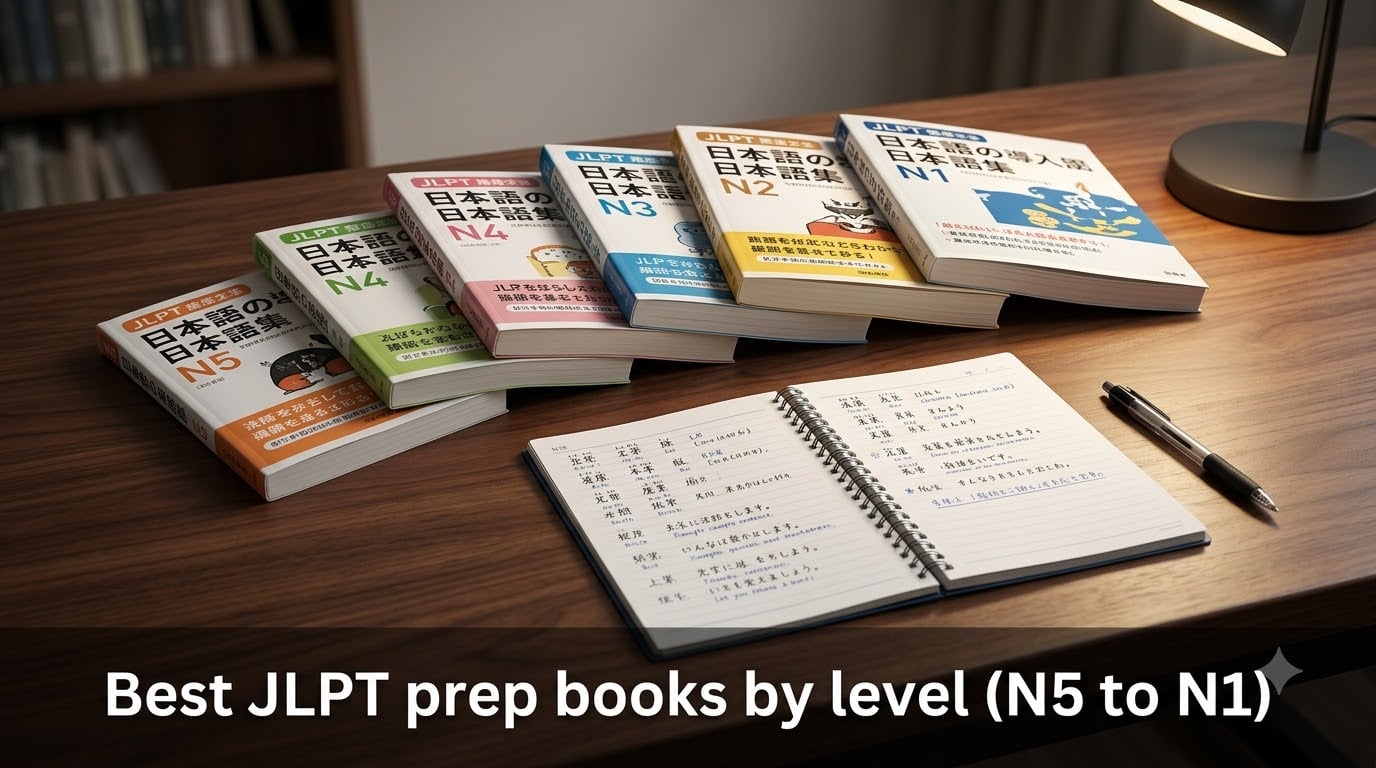
Finding the best JLPT prep books by level is one of the most important decisions you’ll make in your Japanese study journey. I’ve spent years studying Japanese, tried dozens of textbooks, and helped hundreds of learners pick the right materials for their target level. The wrong book can waste months of your time and leave you underprepared on test day.
Whether you’re a complete beginner eyeing the N5 or a seasoned learner tackling the N1, this guide breaks down the top JLPT prep books for every level. We’ll cover the major series—Shin-Kanzen Master, Nihongo Sou-Matome, Try! JLPT, and more—and help you decide which ones actually deserve your money.
By the end, you’ll know exactly which books to buy for your JLPT level, how to combine them effectively, and how to build a study plan that works. We’ve updated this guide for 2026 with the latest recommendations from the JLPT community.
Table of Contents
What Is the JLPT?
The JLPT (Japanese Language Proficiency Test) is a standardized exam administered by the Japan Foundation. It’s the most widely recognized certification of Japanese language ability worldwide. The test has five levels—N5 through N1—with N5 being the most basic and N1 the most advanced.
Each level tests three sections: Language Knowledge (vocabulary and grammar), Reading, and Listening. All questions are multiple-choice. The difficulty roughly doubles with each jump in level. N5 requires about 100 kanji and 800 vocabulary words, while N1 demands 2,000+ kanji and 10,000+ vocabulary words.
JLPT is taken twice a year—in July and December—at testing centers worldwide. Registration fills up fast in some countries, so plan ahead. For 2026 test dates and registration windows, check the official site at jlpt.jp.
| Level | Kanji | Vocabulary | Grammar | Approx. Study Hours |
|---|---|---|---|---|
| N5 | ~100 | ~800 | Basic patterns | 350-450 |
| N4 | ~300 | ~1,500 | Intermediate basics | 600-750 |
| N3 | ~650 | ~3,700 | Intermediate | 950-1,100 |
| N2 | ~1,000 | ~6,000 | Upper-intermediate | 1,600-1,800 |
| N1 | ~2,000+ | ~10,000+ | Advanced | 3,000+ |
The jump from N3 to N2 is widely considered the hardest leap. Many learners stall at N3 before eventually breaking through to N2 with more focused study.
How to Choose the Right JLPT Prep Book
Not all JLPT books serve the same purpose. Understanding the three types of study materials will save you money and confusion. Here’s the framework I recommend.
Reference books teach you new material. They explain grammar points, introduce vocabulary, and walk you through concepts. Think of these as your main textbooks—Shin-Kanzen Master and Nihongo Sou-Matome fall into this category.
Drill books let you practice what you’ve learned. They’re filled with exercises that reinforce grammar, vocabulary, and kanji through repetition. The Preparatory Course for the JLPT is a popular drill series.
Practice test books simulate the actual exam. They give you full-length mock tests so you can build test-taking stamina and identify weak areas. The official JLPT practice workbooks from the Japan Foundation are the gold standard here.
For most learners, I recommend buying one reference book and one practice test book per level. If budget allows, add a drill book for your weakest section. Forum discussions consistently show that learners who combine reference and practice materials outperform those who use only one type.
If you can only buy one book per level: Go with Shin-Kanzen Master for N3 and above. For N5/N4, start with Genki or Minna no Nihongo and add the official practice workbook. This gives you the best return on investment.
Best JLPT N5 Prep Books
N5 is the entry-level JLPT, testing basic Japanese survival skills. You need roughly 100 kanji, 800 vocabulary words, and fundamental grammar patterns. The good news: N5 is very achievable in 3-6 months with consistent study.
Genki 1: An Integrated Course in Elementary Japanese
Genki 1 is the single most recommended textbook for absolute beginners aiming at N5. It covers grammar, vocabulary, kanji, reading, and listening in a structured format. The textbook includes audio, a workbook, and clear English explanations.
Reddit users widely report that completing Genki 1 puts you in strong N5 territory. It’s the standard in university Japanese courses across North America and Europe. The grammar explanations are clear, and the practice exercises build naturally.
The main drawback is that it doesn’t directly target JLPT test format. You’ll want to pair it with an official practice workbook to get comfortable with the question types.
Minna no Nihongo I (みんなの日本語)
Minna no Nihongo is the other foundational textbook option. It’s more immersive—the main textbook is entirely in Japanese, with a separate translation and grammar explanation book. Many classroom programs worldwide use this series.
If you prefer learning through context and immersion from day one, Minna no Nihongo is the better choice. Self-studiers may find Genki more approachable due to the English explanations.
Nihongo Sou-Matome N5 (日本語総まとめ)
Sou-Matome N5 is a structured 6-week review book covering vocabulary, grammar, kanji, and reading in weekly chunks. It’s designed for learners who already have some basics and want focused JLPT preparation.
This series works best as a review tool alongside a main textbook. Its weekly format keeps you accountable. However, forum feedback consistently notes that Sou-Matome becomes less detailed at higher levels—something to keep in mind as you progress.
JLPT N5 Official Practice Workbook
This is the only practice test published by the test administrators themselves. It contains sample questions that reflect the actual exam format. Every N5 candidate should work through this book before test day.
The official workbook doesn’t teach content—it tests what you know. Use it in the final 4-6 weeks before your exam to identify gaps.
Best JLPT N4 Prep Books
N4 builds on N5 fundamentals with more complex grammar, about 300 kanji, and roughly 1,500 vocabulary words. If N5 is survival Japanese, N4 is conversational ability. Most learners need 6-12 months of study after N5 to reach this level.
Genki 2: An Integrated Course in Elementary Japanese
Genki 2 completes the elementary series and covers most N4 material. Completing both Genki 1 and 2 puts you at a solid N4 level. The series maintains the same clear explanations and structured approach.
Forum experiences consistently confirm that Genki 1 and 2 together cover N5 and N4 comprehensively. After finishing Genki 2, many learners move directly to intermediate materials or JLPT-specific prep books for N3.
Minna no Nihongo II
The second volume of Minna no Nihongo continues the immersive approach. It’s ideal for learners who started with volume I and prefer the all-Japanese format. The progression is smooth, and it aligns well with N4 requirements.
Shin-Kanzen Master N4 (新完全マスター)
Shin-Kanzen Master N4 is a strong choice for targeted JLPT preparation. It covers grammar, reading, vocabulary, kanji, and listening in separate volumes. The explanations are thorough, with practice exercises after each lesson.
This is where Shin-Kanzen Master starts showing its strength. The series is widely regarded as the most comprehensive JLPT-specific prep material available. Forum users consistently praise its depth and accuracy.
JLPT N4 Official Practice Workbook
Like the N5 version, this is essential for familiarizing yourself with the test format. Work through it in the weeks before your exam to build confidence and identify weak spots.
Best JLPT N3 Prep Books
N3 is the intermediate milestone. It requires roughly 650 kanji and 3,700 vocabulary words. The grammar becomes noticeably more nuanced, and reading comprehension demands real fluency. This level typically takes 12-18 months after N4.
N3 is where many self-studiers hit their first real wall. The material gets significantly harder, and you need to start thinking in Japanese rather than translating from English. The right books make this transition much smoother.
Shin-Kanzen Master N3 (新完全マスター)
Shin-Kanzen Master N3 is the most recommended JLPT prep series for intermediate learners. It covers grammar, reading, vocabulary, kanji, and listening in separate volumes. The grammar explanations are clear and thorough, with practice exercises that mirror the actual test.
This series is consistently praised in forums for its depth. Learners report that completing the full Shin-Kanzen Master N3 set gives you strong N3 preparation. The reading and listening volumes are particularly well-designed.
Nihongo Sou-Matome N3 (日本語総まとめ)
Sou-Matome N3 maintains its 6-week format with daily lessons covering vocabulary, grammar, kanji, reading, and listening. It’s more approachable than Shin-Kanzen Master but slightly less detailed.
If you’re studying on a tight schedule, Sou-Matome’s structured daily lessons keep you on track. It’s a good companion to Shin-Kanzen Master or a standalone option for learners who prefer lighter materials.
Try! JLPT N3
Try! JLPT is another solid series that combines grammar explanations with practice tests. It includes a full mock exam at the end of each book. The grammar explanations use example sentences extensively, which helps with context.
This series is particularly good for learners who learn best through examples. It’s less systematic than Shin-Kanzen Master but more engaging for some study styles.
Tobira: Gateway to Advanced Japanese
Tobira isn’t a JLPT-specific book—it’s an intermediate Japanese textbook that bridges the gap between beginner and advanced levels. Many learners use it between Genki 2 and Shin-Kanzen Master N3.
Completing Tobira gives you a strong foundation for N3-level grammar and reading. It’s widely used in Japanese language schools and recommended as a stepping stone to JLPT N3 materials.
Best JLPT N2 Prep Books
N2 is where things get serious. You need approximately 1,000 kanji, 6,000 vocabulary words, and upper-intermediate grammar. The reading passages are long and complex, and the listening section tests real-world comprehension. Most learners need 2-3 years of study to reach N2.
The jump from N3 to N2 is notoriously difficult. Forum discussions repeatedly highlight this as the biggest challenge in JLPT preparation. The right materials are critical at this stage.
Shin-Kanzen Master N2 (新完全マスター)
Shin-Kanzen Master N2 is the gold standard for N2 preparation. The series covers grammar, reading, vocabulary, kanji, and listening in separate volumes. At N2, the depth of Shin-Kanzen Master becomes essential—it doesn’t cut corners.
Learners consistently recommend this series as the primary N2 resource. The grammar explanations cover every point thoroughly, and the reading practice builds the stamina needed for the actual test. If you can only buy one N2 prep series, make it this one.
Nihongo Sou-Matome N2 (日本語総まとめ)
Sou-Matome N2 continues the daily-lesson format. However, forum feedback indicates that Sou-Matome starts losing depth at N2 compared to Shin-Kanzen Master. It’s useful as a review tool but may not be sufficient as your only N2 resource.
Use Sou-Matome N2 alongside Shin-Kanzen Master for a comprehensive approach. Its weekly structure complements the more detailed Shin-Kanzen Master volumes.
Try! JLPT N2
Try! N2 includes grammar explanations and a full practice exam. It’s a good supplementary resource, particularly for learners who want additional practice tests alongside their main study materials.
JLPT N2 Kanji Companion: Target 900
At N2, dedicated kanji study becomes important. The Target series (Nihongo Noryoku Shiken Target) is a popular kanji companion that teaches kanji in JLPT-level groups. It includes readings, vocabulary, and example sentences for each kanji.
Forum users strongly recommend adding a kanji companion at N2 and above. Kanji is one area where flashcard drilling alone isn’t enough—you need contextual examples.
Best JLPT N1 Prep Books
N1 is the highest JLPT level and one of the most respected Japanese language certifications in the world. You need 2,000+ kanji, 10,000+ vocabulary words, and advanced grammar. The reading passages are taken from actual Japanese publications. This level typically requires 3+ years of serious study.
Passing N1 opens doors to Japanese university admission, professional employment in Japan, and translation work. It’s a serious commitment, and the right materials are non-negotiable.
Shin-Kanzen Master N1 (新完全マスター)
Shin-Kanzen Master N1 is the most recommended prep series for the highest JLPT level. The grammar volume alone covers over 200 advanced grammar points with detailed explanations and practice exercises. The reading volume features passages comparable to the actual test.
Learners who have passed N1 almost universally credit Shin-Kanzen Master as their primary resource. The series is comprehensive, accurate, and closely aligned with the actual exam.
Nihongo Sou-Matome N1 (日本語総まとめ)
Sou-Matome N1 maintains its daily-lesson format, but the series is noticeably thinner than Shin-Kanzen Master at this level. Forum feedback is consistent: Sou-Matome N1 alone is not enough for most learners.
Use it as a supplementary review tool alongside Shin-Kanzen Master. Its bite-sized daily lessons are good for reviewing material you’ve already studied in depth.
Try! JLPT N1
Try! N1 includes a full practice exam and grammar explanations. It’s a valuable supplementary resource, especially for the practice test component. Many learners use it to build test-taking confidence after studying with Shin-Kanzen Master.
The Preparatory Course for the JLPT N1
This drill-focused series is excellent for N1 grammar and vocabulary practice. It features hundreds of practice questions organized by topic. Learners use it to reinforce what they’ve learned in their main reference books.
The Preparatory Course is particularly strong for grammar drills. If grammar is your weak point at N1, this book fills that gap effectively.
JLPT N1 Kanji Companion: Target 1000+
At N1, a dedicated kanji companion is nearly essential. The Target 1000+ covers advanced kanji with contextual vocabulary and example sentences. Pair it with Anki flashcards for effective kanji retention.
Online mock tests from sites like getmina.co are also highly recommended as supplements to your book study. They help build speed and familiarity with the N1 format.
How to Plan Your JLPT Study Schedule
Having the right books is only half the equation. How you use them determines your success. Here’s a practical framework based on what works for successful JLPT learners.
Step 1: Assess your current level. If you’ve completed Genki 1, you’re roughly at N5. After Genki 2, you’re around N4. Use this as your starting point. Don’t skip levels—each builds on the last.
Step 2: Set a realistic timeline. Most learners need 3-6 months per level from N5 to N3. N2 and N1 typically require 6-12 months each. Count backward from your target test date and plan accordingly.
Step 3: Allocate daily study time. Aim for at least 1-2 hours of focused study daily. Break your time across grammar, vocabulary, kanji, reading, and listening. Don’t neglect any section—JLPT tests all of them.
Step 4: Review lower levels. Before starting a new level, spend 2-4 weeks reviewing material from the level below. This solidifies your foundation and prevents knowledge gaps from becoming problems.
Step 5: Take practice tests regularly. Start taking practice tests 6-8 weeks before your exam date. Time yourself and simulate test conditions. Use your results to identify weak areas and adjust your study plan.
Anki flashcards are the most-used vocabulary retention tool among successful JLPT learners. Many pre-made JLPT decks are available for free. Pairing Anki with your textbook study significantly improves retention.
Frequently Asked Questions
Can I pass N5 in 3 months?
Yes, passing JLPT N5 in 3 months is realistic with consistent daily study. You’ll need roughly 1-2 hours per day using a structured textbook like Genki 1. Completing the textbook and working through the official practice workbook should give you enough preparation.
What are the best textbooks to learn Japanese for the JLPT N5 exam?
The two most recommended textbooks for JLPT N5 are Genki 1 and Minna no Nihongo I. Genki 1 is more popular among self-studiers due to its English explanations, while Minna no Nihongo is favored in classroom settings. Pair either with the JLPT N5 Official Practice Workbook for test-specific preparation.
Is Genki 1 enough for JLPT N5?
Completing Genki 1 covers most N5 grammar and vocabulary. However, you should supplement it with the official JLPT N5 practice workbook to familiarize yourself with the test format. Genki 1 alone gives you strong foundations but doesn’t teach test-taking strategies.
Which JLPT level is the most difficult?
N1 is the most difficult JLPT level, requiring 2,000+ kanji and 10,000+ vocabulary words. However, many learners find the jump from N3 to N2 to be the most challenging relative leap. N2 demands a significant increase in reading speed and vocabulary depth that catches many intermediate learners off guard.
How long should I study for the JLPT?
Study time varies by level: N5 requires 350-450 hours, N4 needs 600-750 hours, N3 takes 950-1,100 hours, N2 demands 1,600-1,800 hours, and N1 requires 3,000+ hours of total study. Break these into daily sessions of 1-2 hours for consistent progress.
Is Shin-Kanzen Master enough to pass JLPT?
Shin-Kanzen Master is widely regarded as the most comprehensive JLPT prep series. For N3 and above, completing the full Shin-Kanzen Master set (grammar, reading, vocabulary, kanji, listening) gives you strong preparation. Most successful learners recommend pairing it with official practice tests for best results.
Which is better: Shin-Kanzen Master or Nihongo Sou-Matome?
Shin-Kanzen Master is more thorough and detailed, making it the preferred choice for serious self-studiers at N3 and above. Nihongo Sou-Matome is more approachable with its daily-lesson format, making it good for review or for learners who prefer lighter material. Many learners use both: Sou-Matome for daily review alongside Shin-Kanzen Master for in-depth study.
Final Thoughts
Choosing the best JLPT prep books by level doesn’t have to be overwhelming. For N5 and N4, start with Genki or Minna no Nihongo as your foundation and add official practice workbooks. At N3 and above, Shin-Kanzen Master becomes your primary resource, supplemented by Sou-Matome for review and the official practice tests for exam simulation.
Remember: no single book is enough. The most successful JLPT learners combine reference materials with practice tests and use tools like Anki for vocabulary retention. Pick your books based on your level, budget, and study style—and then actually use them consistently.
Ready to get started? Identify your current level, order the right books, and commit to daily study. The JLPT is a marathon, not a sprint—but with the right materials and consistent effort, you’ll get there. Good luck on your exam in 2026.