
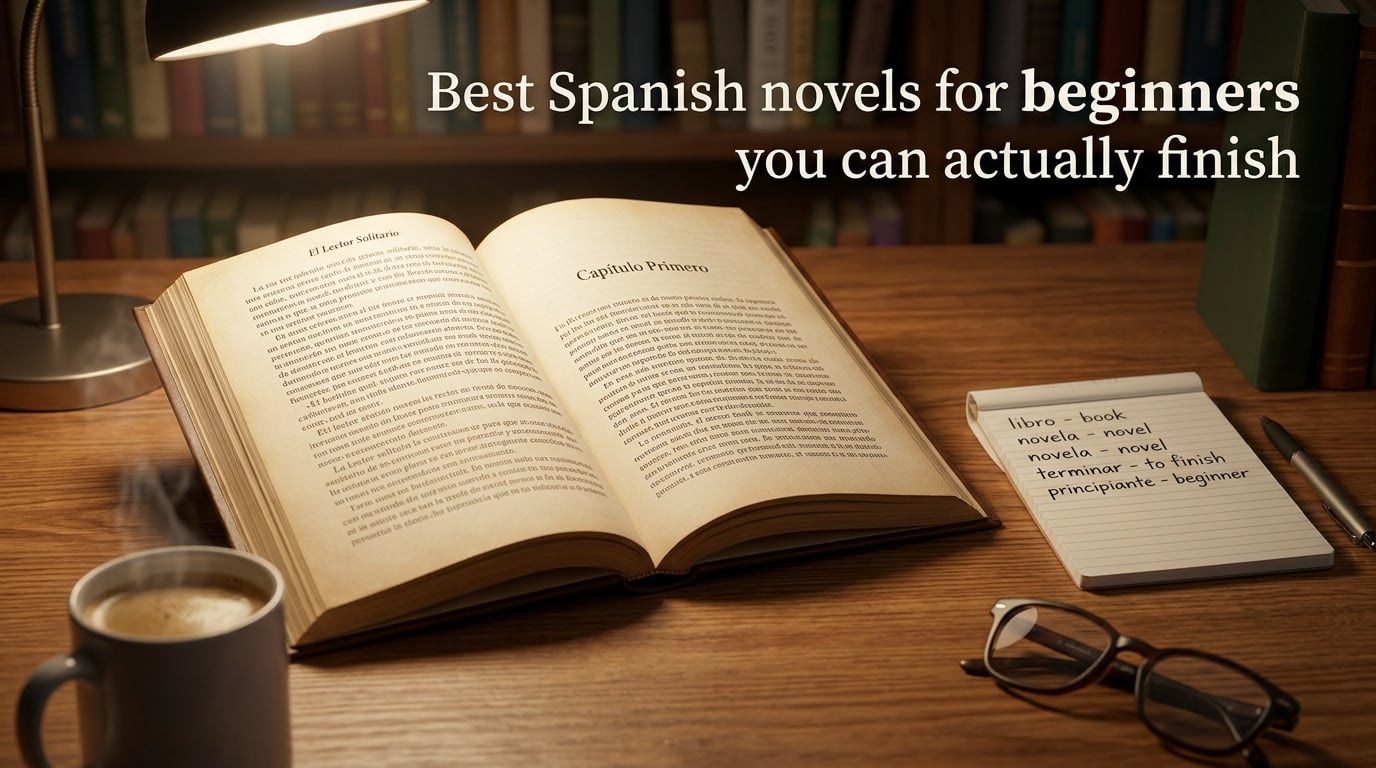
Finding the best Spanish novels for beginners feels harder than it should be. Most lists throw around the same titles, then leave you wondering whether you will actually be able to finish a single chapter without your dictionary catching fire.
I have spent the last few years reading Spanish books at every level, from picture books my niece outgrew to short story collections by Olly Richards, all the way up to my first attempt at Cien años de soledad. Some of those books made me want to quit Spanish entirely. Others pulled me through to the last page without me noticing.
This guide focuses on books you can actually finish. Each recommendation includes a CEFR level, a clear description of what to expect, and a reason it belongs on your shelf. You will also get a comparison table, free resources, reading strategies, and answers to the questions beginners ask me most often in 2026.
Table of Contents
Quick Picks: Best Spanish Novels for Beginners at a Glance
Short on time? Here are my top five recommendations across difficulty levels and genres.
- El Principito by Antoine de Saint-Exupéry (A2) — Short chapters, familiar story, gentle vocabulary. The best first book for most beginners.
- Short Stories in Spanish for Beginners by Olly Richards (A1-A2) — Eight stories written specifically for learners, with summaries and comprehension questions.
- Papelucho by Marcela Paz (A2) — A clever, funny children’s classic from Chile that does not feel childish at all.
- Manolito Gafotas by Elena Favíola (A2-B1) — Madrid slang, school life, and humor that actually works for adults learning Spanish.
- La casa de Bernarda Alba by Federico García Lorca (B1) — A short play with clear language, intense emotion, and one of the cleanest plots in Spanish literature.
Now let me explain why these work, what other books belong on your list, and how to choose the right one for your level.
Why Reading in Spanish Works for Beginners
Reading Spanish novels helps beginners learn because it exposes you to the same words and structures over and over again, in context, at a pace you control. Unlike a podcast or a conversation, you can stop, re-read a sentence, and look up a word without losing your place.
The research backs this up. Gabriel Wyner, author of Fluent Forever, recommends aiming for 85 to 95 percent comprehension when you read. Hit that range and you learn new words from context without getting lost. Drop below 80 percent and frustration takes over. That is the threshold that separates a book you will finish from a book you will abandon by chapter three.
Novels do something textbooks cannot. They give you repeated exposure to natural sentence rhythm, idioms, and the kind of connective tissue (the small words, transitions, and contractions) that make spoken Spanish feel smooth instead of choppy. A learner who reads 20 pages of a simple novel absorbs more usable language than someone memorizing a vocabulary list of equivalent length.
I noticed this myself with Manolito Gafotas. The first chapter took me an entire weekend. By the fourth chapter, I was catching jokes before the punchline landed. That is the moment reading stops being a chore and starts being a reward.
Understanding CEFR Levels for Spanish Reading
Before you pick a book, you need to know your CEFR level. CEFR (Common European Framework of Reference for Languages) puts readers into six bands, and most beginner-friendly Spanish books sit in A1, B1, or somewhere in between.
- A1 (Beginner): You know basic greetings, numbers, present-tense verbs, and around 500 words. Books at this level use short sentences and high-frequency vocabulary only.
- A2 (Elementary): You can handle past tense, common reflexive verbs, and roughly 1,000 words. This is the sweet spot for most beginner book recommendations.
- B1 (Intermediate): You are comfortable with subjunctive basics, complex sentences, and roughly 2,000 words. Original Spanish literature starts to open up here.
- B2 (Upper Intermediate): You can read most contemporary novels with occasional dictionary use. Native-level writing is within reach.
If you are unsure where you fall, take a free placement test on the Cervantes Institute website or any of the major language apps. Do not skip this step. Picking a B1 book when you are actually at A1 is the fastest way to give up.
Best Spanish Novels for Beginners (A1 to A2 Level)
These are the books that took me from “I can order a coffee” to “I just finished a chapter without touching my dictionary.” Every title here works for someone in their first year of Spanish.
El Principito by Antoine de Saint-Exupéry (A2)
El Principito is the book I recommend most often, and it works because you already know the story. If you read it as a child in English, you will understand the plot without translating every word. The Spanish translation is gentle, the chapters are short (most are under five pages), and the philosophical tone gives you memorable phrases worth keeping.
Buy the bilingual edition if you can. Seeing the English and Spanish side by side lets you check your guesses without breaking your reading flow. Pair it with the audiobook for pronunciation, and you have a complete study unit in a single book.
Short Stories in Spanish for Beginners by Olly Richards (A1-A2)
Olly Richards has built a small empire of language-learner short story collections, and his Spanish volume is one of the strongest. Eight original stories are written specifically for learners, each one using high-frequency vocabulary and natural sentence patterns. Every chapter ends with a summary and comprehension questions, which lets you check whether you actually understood or just thought you did.
The plots lean toward mystery and intrigue, which makes them feel like real reading instead of homework. This is the book I hand to anyone who says, “I want a book that does not feel like it was written for a textbook.”
Papelucho by Marcela Paz (A2)
Papelucho is a children’s classic in Chile, and it works brilliantly for adults learning Spanish. The narrator is an eight-year-old boy who writes diary entries about his family, his dog, and the strange adults around him. The humor is sharp, the vocabulary is everyday Spanish, and the chapters are short enough to read in one sitting.
One warning: the original uses Chilean slang and vocabulary that differs from Castilian Spanish. If you are learning the Spain version, this is still useful, but expect to look up a few regional words.
Manolito Gafotas by Elena Favíola (A2-B1)
Manolito Gafotas is my secret weapon for adult beginners. The narrator is a kid from a working-class Madrid neighborhood, and the book reads like a Spanish version of A Christmas Story. You get Madrid slang, family drama, schoolyard politics, and a voice that is funny without being silly.
This book pushes you slightly past A2, so save it for when you feel comfortable with basic past tenses. The payoff is real Madrid Spanish, the kind you will actually hear in cafés and on the street.
Cuentos de la Selva by Horacio Quiroga (A2-B1)
Horacio Quiroga wrote short stories about the jungle, animals, and the thin line between nature and human cruelty. Cuentos de la Selva is his most accessible collection, and the language is direct enough for beginners to follow.
The stories come from Uruguay, so the Spanish is Latin American. Expect some vocabulary you will not find in Spain-focused textbooks, but the simple sentence structure makes it manageable.
El Capibara con Botas by Nadia Fink (A1-A2)
This illustrated children’s book from Argentina tells the story of a capybara who finds a pair of boots. It sounds absurd, and it is absurd, but that is exactly why beginners love it. The vocabulary is heavily repeated (perfect for early learners), the illustrations provide context clues, and the whole thing takes about 20 minutes to read.
If you are at the very start of your Spanish journey and feel intimidated by El Principito, start here. You will finish it tonight and feel like you actually read something in Spanish.
Intermediate Spanish Novels (B1 to B2 Level)
Once you have finished two or three beginner books, it is time to step up to intermediate Spanish literature. These novels use richer vocabulary, longer sentences, and more cultural references, but they remain readable without a dictionary every other line.
La Casa de Bernarda Alba by Federico García Lorca (B1)
García Lorca’s final play is one of the cleanest reads in Spanish literature. Five women locked in a house after a funeral, a battle for control, and the heat of Andalusia pressing down on every scene. The language is poetic but direct, the cast is small, and the entire play runs about 90 pages.
Read it twice. Once for plot, once for the way Lorca builds tension through repetition. It is one of the best language-learning texts ever written because every line does work.
Como Agua para Chocolate by Laura Esquivel (B1)
This Mexican novel blends magical realism with recipes and family history. The chapters are short, the language is vivid, and the plot moves quickly. It works well for B1 readers because Esquivel repeats key phrases (especially around cooking and emotion), which gives your brain time to absorb new vocabulary in context.
El Alquimista by Paulo Coelho (B1-B2)
Yes, The Alchemist is on every list, but it earns its place. The Spanish original is short, the sentences are simple, and the themes (dreams, journeys, signs) repeat throughout. If you have read it in English, you will fly through it in Spanish. If you have not, it is a perfectly fine first novel.
Pedro Páramo by Juan Rulfo (B2)
Save this for when you feel confident. Rulfo’s masterpiece is short, fragmented, and set in a ghost town in Mexico. The language is dense and poetic, which is why B2 readers find it rewarding and B1 readers find it overwhelming. Treat it as a goalpost. When you can read Pedro Páramo comfortably, you are ready for full Spanish literature.
Genre-Specific Recommendations
One gap in most beginner book lists is genre coverage. Most recommendations lean literary, which is great for cultural exposure but ignores what gets adults to actually finish a book. Here are picks by genre.
Mystery and Thriller
El Misterio de la Casa Verde by various authors — A bilingual mystery anthology designed for learners, with simple plots and clear vocabulary.
Don Quijote (abridged editions) by Miguel de Cervantes — Abridged adaptations strip the baroque 17th-century Spanish down to something a B1 reader can enjoy. The humor still works.
Romance
Beginner Spanish readers by Fiona Robertson — Short, contemporary love stories written for learners, with predictable plots that help comprehension.
Como Agua para Chocolate doubles as a romance novel if the magical realism gets heavy. The central love story carries the book.
Fantasy and Science Fiction
Native Spanish sci-fi for beginners is thin on the ground, but Olly Richards’ Stories in Spanish collection includes fantasy-adjacent plots that scratch this itch.
For B1 readers, Crónicas Marcianas (Ray Bradbury in Spanish translation) uses simple language despite the complex themes. The translation is clean and the chapters are short.
Free Spanish Books and Reading Resources
You do not need to spend anything to start reading in Spanish. Here are the best free resources I have found.
Project Gutenberg Spanish Library
Project Gutenberg hosts thousands of public-domain Spanish books, including most of the classics. You can read Don Quijote, La Celestina, and dozens of 19th-century novels in your browser without paying a cent. The catch is that older Spanish uses archaic vocabulary, so start with 20th-century titles.
Biblioteca Digital Hispánica
Run by the Spanish National Library, this digital library offers free access to historical Spanish texts, including manuscripts, early printed books, and modern editions. The interface is in Spanish, which adds a small layer of difficulty, but the catalog is unmatched.
Wikisource in Spanish
Wikisource hosts a surprising number of short stories, poems, and essays in the public domain. Search for authors you know and you will often find free editions of their shorter works. Cuentos by Emilia Pardo Bazán is a great starting point.
News Sites for Daily Reading
Once you can handle A2 books, start reading Spanish news. BBC Mundo, El País, and La Nación all publish daily articles at varying difficulty levels. Treat one article a day as a five-minute reading exercise.
How to Choose the Right Spanish Book for Your Level
Choosing the right book is the difference between finishing it in a week and abandoning it by page 20. Use this checklist before you buy or download anything.
Step 1: Test Your Level Honestly
Take a placement test or read the first page of an A2 book. If you understand 85 percent of the words, you are at A2. If you understand 60 percent, drop down to A1 material. Do not lie to yourself here.
Step 2: Pick a Genre You Already Love in English
You are going to struggle through this book. Make sure the story is one you actually want to read. If you read fantasy in English, look for Spanish fantasy. If you cannot put down a thriller, find a Spanish mystery. Familiar plot patterns reduce cognitive load.
Step 3: Use Kindle Samples
Amazon lets you download the first 10 percent of any Kindle book for free. Read the sample and count how many words you have to look up. If it is more than one per page, the book is too hard. If it is zero, the book is too easy. Aim for one or two per page.
Step 4: Pair the Book with Its Audiobook
Listening while you read trains your ear and helps with pronunciation. Audible, Spotify, and YouTube all host Spanish audiobook versions of most major titles. Look for the audiobook first and then buy the matching print or Kindle edition.
Step 5: Pick a Series If You Can
Series are gold for language learners. Once you learn the vocabulary and style of one book, the next three are easier. Olly Richards’ short stories come in series, as do the Manolito Gafotas novels and many graded reader lines.
Reading Strategies for Spanish Beginners
Picking the book is half the battle. The other half is reading it in a way that actually builds your Spanish instead of just wearing you down.
Strategy 1: Read the Same Page Twice
First pass for meaning. Second pass for new vocabulary. Highlighting new words on the second pass gives you a focused list to study instead of a wall of unknown vocabulary from the entire book.
Strategy 2: Keep a Sentence Notebook
Instead of writing down individual words, write down full sentences you found interesting, funny, or useful. Sentences stick in memory better than word lists, and you can review 10 sentences faster than 50 isolated words.
Strategy 3: Set a Daily Page Count, Not a Time Limit
Time-based goals fail on busy days. Page-based goals succeed because they are concrete. Commit to five pages a day. That is roughly 20 minutes for an A2 book, and you will finish most beginner novels in two to three weeks.
Strategy 4: Skip the Dictionary on the First Pass
Resist the urge to look up every word. Guess from context, then check your guesses after you finish the chapter. Looking up every unknown word kills momentum and turns reading into a vocabulary exercise.
Strategy 5: Read Out Loud Occasionally
Reading a passage out loud activates your speaking muscles and forces you to slow down enough to notice pronunciation and rhythm. Even five minutes of out-loud reading per chapter will improve your accent.
Frequently Asked Questions
What are the best novels to read in Spanish for beginners?
The best Spanish novels for beginners are El Principito by Antoine de Saint-Exupéry (A2), Short Stories in Spanish for Beginners by Olly Richards (A1-A2), Papelucho by Marcela Paz (A2), Manolito Gafotas by Elena Favíola (A2-B1), and Cuentos de la Selva by Horacio Quiroga (A2-B1). All five use simple vocabulary, short chapters, and engaging stories that adult learners can finish in a few weeks.
What is the best Spanish learning book for beginners?
Short Stories in Spanish for Beginners by Olly Richards is widely considered the best Spanish learning book for beginners because it combines original fiction with summaries, comprehension questions, and a controlled vocabulary list. For learners who prefer a real novel, El Principito offers a familiar story in gentle Spanish.
Can I learn Spanish by reading novels?
Yes, you can learn Spanish by reading novels. Reading exposes you to natural sentence patterns, idioms, and high-frequency vocabulary in context. Aim for 85 to 95 percent comprehension, read consistently, and pair novels with audiobooks for the fastest results.
What is the 80/20 rule for Spanish?
The 80/20 rule for Spanish means that roughly 80 percent of everyday Spanish comes from the most common 20 percent of words. By focusing on the 1,000 most frequent Spanish words first, beginners can understand a surprising amount of real-world text, including simple novels, before expanding into less common vocabulary.
How do I choose a Spanish book for my level?
Choose a Spanish book by matching it to your CEFR level (A1, A2, B1, or B2), testing it with a free Kindle sample, and aiming for 85 to 95 percent comprehension. Pick a genre you already enjoy in English, and pair the book with its audiobook for pronunciation practice.
What Spanish books should I read first?
Start with El Principito (A2), then move to Short Stories in Spanish for Beginners by Olly Richards (A1-A2), followed by Papelucho (A2) or Manolito Gafotas (A2-B1). After two or three beginner books, step up to La Casa de Bernarda Alba by García Lorca (B1) or Como Agua para Chocolate by Laura Esquivel (B1).
Final Thoughts on Building Your Spanish Reading Habit
The best Spanish novels for beginners are the ones you actually finish. El Principito, Short Stories in Spanish for Beginners, and Papelucho are my top three because they balance simplicity with story, and they give you the confidence to keep going.
Pick one book from this list today. Download the Kindle sample, check the difficulty, and commit to five pages a day. Two weeks from now, you will have finished your first Spanish novel, and that single accomplishment will do more for your fluency than another month of flashcards.
Reading in Spanish is not a study technique. It is the technique. Start one book, finish it, and your Spanish will move forward more in those two weeks than in any previous month of app-based practice. Bienvenido al siguiente capítulo.