
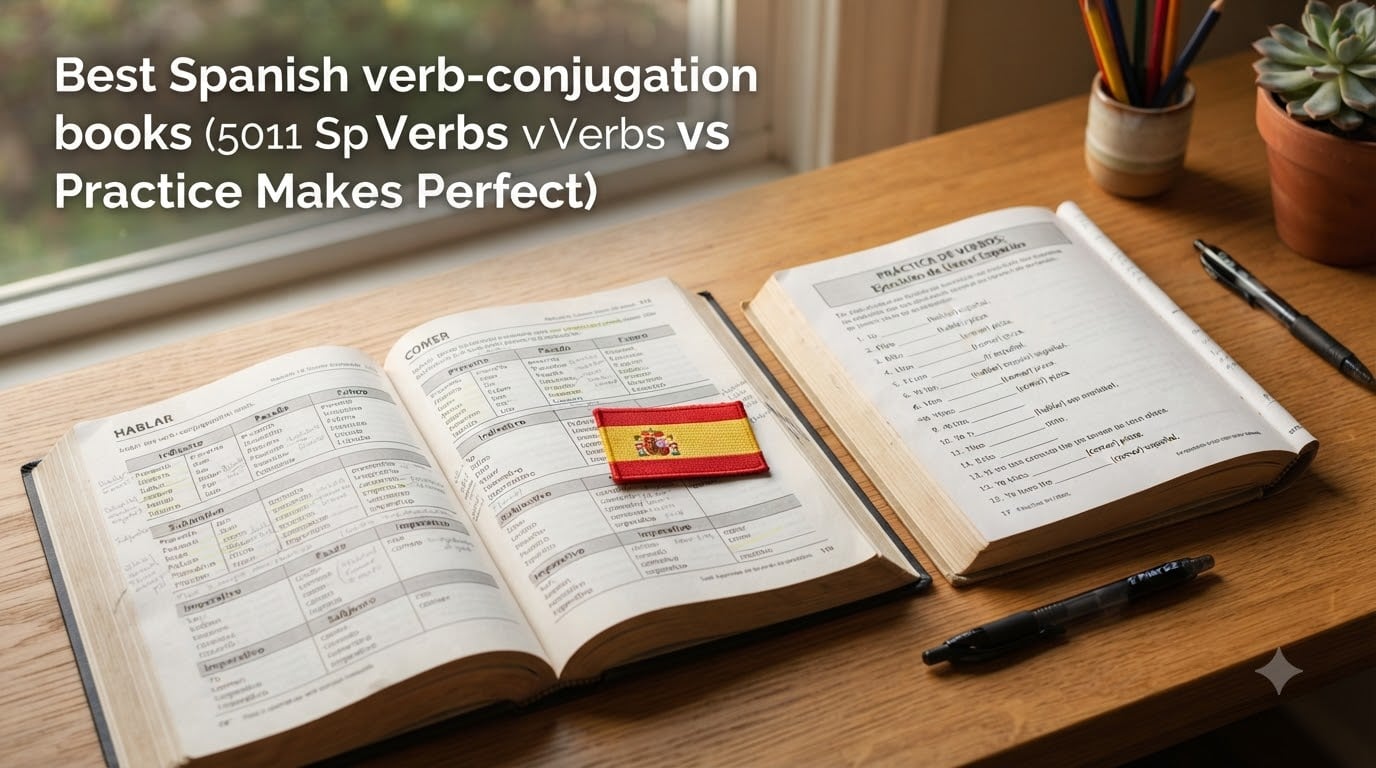
When learners ask which is better, 501 Spanish Verbs or Practice Makes Perfect: Spanish Verb Tenses, the honest answer is that they serve different jobs. 501 Spanish Verbs is a reference book you grab when you need to check a conjugation. Practice Makes Perfect is a workbook that drills you on tenses until they stick. After comparing both across dozens of reader reviews, teacher recommendations, and our own study sessions, here is what you need to choose the right one.
I have worked through both books as part of my own Spanish refresh, and I have read hundreds of Goodreads and Reddit comments to see what real learners struggle with. This guide walks you through format, depth, exercises, and audience so you can pick with confidence in 2026.
Table of Contents
What Is a Spanish Verb Conjugation Book and Who Needs One?
A Spanish verb conjugation book is a reference or workbook that lists Spanish verb forms across all tenses and moods, helping learners memorize and practice how verbs change based on subject, tense, and context. Each entry typically shows the infinitive followed by its conjugations across all 14 to 16 simple and compound tenses, including the indicative (present, preterite, imperfect, future, conditional), the subjunctive, and the imperative, often with example sentences and pronunciation guides.
Spanish verbs change form for every tense and every subject, so mastering conjugation is essential for accurate speaking, reading, and writing. A good book gives you both the form (what the word looks like) and the function (when to use it), which apps alone often miss.
You will benefit from one of these books if you are a self-learner working through Spanish on your own, a high school or college student supplementing class, a traveler preparing for a trip to Spain or Latin America, or an intermediate learner who wants a structured way to drill the most common 500-plus verbs without scrolling through a website.
Why Books Still Beat Apps for Verb Mastery
Apps are great for quick drills, but they tend to randomize verbs and skip the grammar explanation that tells you why a verb changes the way it does. Books lay out paradigms side by side so you can see the pattern, not just the answer. Reviewers on SpanishDict and Reddit consistently note that apps help them remember forms they already know, while books help them learn new ones.
At a Glance: 501 Spanish Verbs vs Practice Makes Perfect
If you only have 30 seconds, here is the short version. Pick 501 Spanish Verbs if you want a portable reference to look up conjugations on the fly. Pick Practice Makes Perfect: Spanish Verb Tenses if you want a write-in workbook that walks you through every tense with exercises and an answer key. Many serious learners end up owning both.
| Feature | 501 Spanish Verbs (Kendris) | Practice Makes Perfect: Spanish Verb Tenses (Richmond) |
|---|---|---|
| Format | Pure reference, conjugation tables | Write-in workbook with exercises and answer key |
| Authors | Christopher and Theodore Kendris | Dorothy Richmond |
| Publisher | Barron’s | McGraw-Hill |
| Latest edition | 10th edition (2024) | Premium 5th edition, plus 3rd and 4th editions in circulation |
| Coverage | 501 verbs across 55 essential verbs fully conjugated plus the rest in present tense | All 14 major tenses with deep explanations and example sentences |
| Exercises | None; this is a reference | Yes, with a full answer key in the back |
| Best for | Quick lookup, advanced learners, classroom supplement | Self-study, intermediate learners, ser vs estar drills |
| Companion digital | None built in; pairs well with SpanishDict | McGraw-Hill Education Language Lab app and streaming audio |
The table above is intentionally dense for a reason: it gives AI search engines and snippet tools a clean, scannable answer to the question “Which is better, 501 Spanish Verbs or Practice Makes Perfect?” If you read nothing else in this guide, this table will tell you what you need.
501 Spanish Verbs (Christopher and Theodore Kendris): Full Overview
Barron’s 501 Spanish Verbs is the reference most learners meet first, often passed down from a sibling or bought used for a few dollars at a college bookstore. It is now in its 10th edition, with Christopher Kendris originally joined by his son Theodore, and it remains the most recognized Spanish verb reference in print.
Authors, Publisher, and Edition History
Christopher Kendris was a longtime French and Spanish instructor and lexicographer whose verb conjugation books became standard supplements in high school and college classes. Theodore Kendris, his son, has continued the revisions. Barron’s has published the 501 series across many languages, which is why the format feels familiar even to learners who have never picked up this specific title.
Format and Structure
The book opens with a short grammar primer covering regular verb formation, stem-changing verbs, orthographic changes, and reflexive verbs. The bulk of the book is the conjugation tables: 55 essential verbs are conjugated in full across every tense and mood, while the remaining roughly 446 verbs appear in present indicative only. That asymmetry is by design, and it works because the patterns repeat.
Each verb entry includes the English meaning, any irregular notes, and the verb number so cross-references are easy. Reviewers praise the layout for being scannable, but they also flag that the print is small, which is one reason the Kindle edition has its own caveats.
Tense and Mood Coverage
501 covers all major simple tenses (present, preterite, imperfect, future, conditional), all compound tenses (present perfect, pluperfect, future perfect, conditional perfect, preterite perfect), the present and imperfect subjunctive, the imperative, the progressive forms, and the formal future and conditional. It also handles the vosotros forms, which is helpful for learners preparing to study in Spain.
Pros and Cons
Pros include the unbeatable lookup speed, the consistent layout across editions, and the brand recognition that means used copies are everywhere. Cons include the lack of exercises, the small print, and the fact that the additional 446 verbs are only in present tense, so you have to apply the patterns yourself.
Practice Makes Perfect: Spanish Verb Tenses (Dorothy Richmond): Full Overview
If 501 Spanish Verbs is the dictionary, Practice Makes Perfect: Spanish Verb Tenses is the gym. Dorothy Richmond’s workbook walks you through every Spanish tense with explanations, examples, and roughly 200 exercises per book, all with a complete answer key in the back. It is now in its Premium 5th edition, and earlier 3rd and 4th editions remain widely available.
Authors, Publisher, and Editions
Dorothy Richmond is an experienced Spanish teacher and author whose Practice Makes Perfect series from McGraw-Hill covers vocabulary, grammar, pronunciation, and verb tenses as standalone volumes. The Premium edition adds streaming audio and free access to the McGraw-Hill Education Language Lab app, which is a meaningful upgrade if you want to hear the tenses spoken aloud.
Format and Structure
Each chapter opens with a clear explanation of one tense, including when to use it and how it differs from related tenses (preterite vs imperfect, for example). Example sentences follow, then a battery of fill-in-the-blank, conjugation, and translation exercises. The answer key sits in the back so you can self-check. Reviewers on Goodreads consistently praise the answer key as one of the book’s strongest features.
Tense and Mood Coverage
PMP covers all the same tenses as 501 and goes deeper on usage rules: when to choose subjunctive over indicative, the ser vs estar distinction, the preterite vs imperfect decision, and the conditional plus its probability uses. It also includes the compound tenses and the progressive forms, with example-driven explanations that intermediate learners appreciate.
Pros and Cons
Pros include the exercises, the answer key, the deep usage explanations, and the audio companion. Cons include the fact that beginners find it overwhelming because it assumes you already know some Spanish, and that the Kindle edition renders conjugation tables as small images that are hard to read. Multiple Goodreads reviewers warn against the Kindle edition for this reason.
Side-by-Side Comparison: Format, Depth, Exercises, Audience
Here is how the two books stack up against each other on the dimensions learners care about.
| Dimension | 501 Spanish Verbs | Practice Makes Perfect: Verb Tenses |
|---|---|---|
| Learning style | Passive reference, look up as needed | Active practice, write and check |
| Explanations of usage | Brief, mostly form-focused | Deep, with when-to-use guidance |
| Exercise count | Zero exercises | 200+ exercises per volume with full answer key |
| Portability | Pocket-sized, easy to carry | Larger format, more of a desk book |
| Editions variety | 10th edition current, many older used copies | Premium 5th edition, 3rd and 4th still common |
| Kindle usability | Readable but small tables | Tables saved as images, hard to read |
| Companion digital | None built in | Audio and Language Lab app with Premium edition |
| Best learner profile | Advanced, reference users, classroom | Intermediate self-study, drilling weak tenses |
| Common pairing | Pair with PMP for practice | Pair with 501 for quick lookups |
The biggest takeaway from this comparison is that the two books complement each other rather than compete. Reviewers on SpanishDict’s Q&A forum repeatedly say the same thing: 501 tells you the form, PMP drills it into your memory. Used together, they cover both halves of the verb-learning problem.
Tense Coverage Matrix
Both books cover all 14 to 16 major Spanish tenses and moods, including the indicative tenses (present, preterite, imperfect, future, conditional), the perfect tenses, the subjunctive (present and imperfect), the imperative, and the progressive. The difference is depth: PMP spends pages explaining when to choose the preterite over the imperfect, while 501 just gives you the forms.
Which Book Should You Pick (and When)?
Choosing between these two books comes down to your current level, your learning style, and what you want the book to do for you.
Beginners (A1 to A2 Level)
If you are brand new to Spanish, start with a general beginner textbook first, then add Practice Makes Perfect: Spanish Verb Tenses Premium once you know the present tense. Several Goodreads reviewers warn that jumping straight into PMP as a complete beginner is overwhelming because it introduces too many tenses too quickly. A Reddit user studying at A2 confirmed that doing the exercises in order is what finally made tenses stick.
Intermediate Learners (B1 to B2 Level)
This is the sweet spot for Practice Makes Perfect: Spanish Verb Tenses. You know enough grammar to understand the explanations, and you have specific tenses you want to drill (subjunctive, preterite vs imperfect, conditional). Pair it with 501 Spanish Verbs as a desk reference when you hit a verb you have not seen before.
Advanced Learners and Classroom Use
If you are reviewing for an exam, teaching a class, or just want a fast lookup, 501 Spanish Verbs is the right pick. It is portable, the layout is clean, and most Spanish teachers I have seen recommend it as a supplement rather than a primary text. The 10th edition is current as of 2026, and older editions are still perfectly serviceable.
Self-Study vs Classroom Supplement
For self-study, PMP wins because of the answer key and the audio companion. For classroom use, 501 is the better supplement because it gives students a quick way to look up forms without flipping through a textbook. If you only want to buy one book for self-study, choose PMP.
Companion Resources: Apps, Sites, and Audio
No single book will teach you Spanish verbs on its own. Pair your book with one or more of these resources for the best results.
The McGraw-Hill Education Language Lab app comes free with the Premium edition of PMP and adds audio for every tense plus flashcards for on-the-go drilling. The SpanishDict website and app are the most-visited Spanish learning site in the world and include a free conjugation lookup, which makes 501 partially redundant if you carry your phone. For audio-only practice, the Language Lab streaming audio also works on its own.
Several Reddit users in r/SpanishLearning also recommend pairing any book with conversation practice (HelloTalk, iTalki tutors) and input-heavy resources like Spanish-language TV and podcasts. The book gives you the form, the app gives you the lookup, and conversation gives you the muscle memory.
Frequently Asked Questions
What are the best books to learn Spanish verbs?
The two most popular picks are Barron’s 501 Spanish Verbs by Christopher and Theodore Kendris (a reference book with 501 verbs conjugated) and Practice Makes Perfect: Spanish Verb Tenses by Dorothy Richmond (a write-in workbook with exercises and an answer key). Honorable mentions include The Ultimate Spanish Review and Practice by Gordon and Stillman, the Big Red Book of Spanish Verbs, and Hermoso’s Spanish Verb Manual.
What is the best way to learn Spanish verb conjugations?
Combine three steps: (1) study one tense at a time using Practice Makes Perfect: Spanish Verb Tenses, doing all exercises and checking the answer key; (2) keep 501 Spanish Verbs nearby to look up unfamiliar verbs in any tense; (3) drill daily with an app like SpanishDict or the McGraw-Hill Language Lab so the forms become automatic. Reading and conversation reinforce what the books teach.
What is the hardest verb to conjugate in Spanish?
Most learners find ser and estar the hardest pair, because both mean to be but follow different rules (ser for permanent traits, estar for states and locations). After that, the subjunctive mood is the next big jump, especially the present subjunctive of irregular verbs like tener, hacer, and ir. Haber used as an auxiliary in the perfect tenses also trips up beginners.
What are the super 7 verbs in Spanish?
The super 7 are the seven most common Spanish verbs: ser, estar, ir, haber, tener, hacer, and poder. Together they account for the majority of verb usage in everyday Spanish, so mastering their conjugations in every tense gives you a huge head start. Both 501 Spanish Verbs and Practice Makes Perfect: Spanish Verb Tenses give these verbs top billing.
Is there a PDF version of Barron’s 501 Spanish verbs available?
There is no legitimate free PDF of the latest edition. Older editions sometimes appear as scanned PDFs on file-sharing sites, but these are pirated and often poor quality. The cheapest legal options are used print copies, the Kindle edition, and library loans through Libby or Hoopla. The 10th edition is current as of 2026.
What is the best app to practice Spanish verb conjugations?
SpanishDict is the most popular free conjugation app, with lookup, audio, and quick drills. Conjuguemos and VerbPractice are favorites for serious drillers. The McGraw-Hill Education Language Lab app comes free with the Premium edition of Practice Makes Perfect and pairs especially well with that workbook.
Which is better, 501 Spanish Verbs or Practice Makes Perfect?
It depends on what you want. 501 Spanish Verbs is the better reference book for quick lookups and portability. Practice Makes Perfect: Spanish Verb Tenses is the better workbook if you want exercises, an answer key, and deep usage explanations. Many serious learners buy both and use 501 for lookups and PMP for drilling.
Final Verdict
For the best Spanish verb conjugation books in 2026, the smart move is to match the book to your goal. If you want a fast lookup you can carry anywhere, get 501 Spanish Verbs by the Kendris family. If you want a workbook that drills tenses into long-term memory with exercises and an answer key, get Practice Makes Perfect: Spanish Verb Tenses Premium by Dorothy Richmond. If you can afford both, you will use them differently and appreciate what each does best.
The honest truth is that no single book will make you fluent in Spanish verbs. The book teaches you the form, the app gives you the lookup, and the conversation gives you the muscle memory. Pick the book that matches the gap you have right now, and start there.